



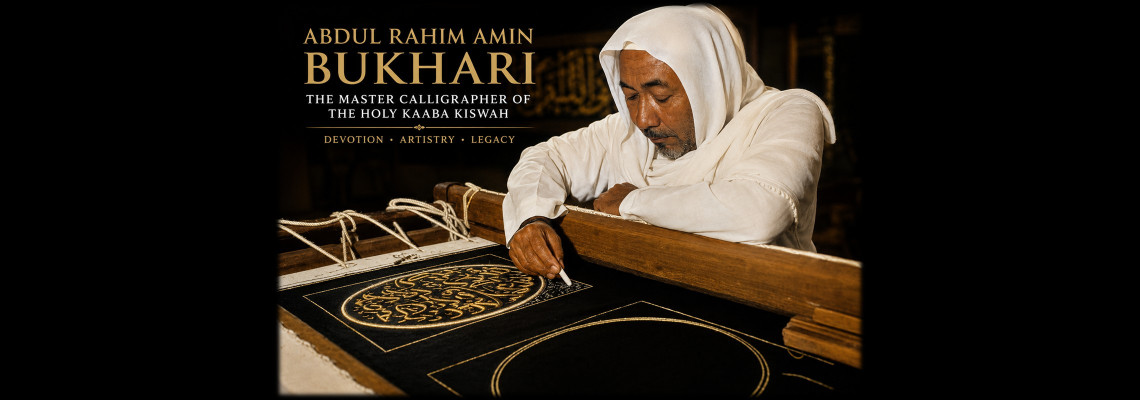
Abdul Rahim Amin Bukhari: The Master Calligrapher Behind the Holy Kaaba's Kiswah
Introduction: The Man Whose Art Embraced the House of Allah
Every year, millions of Muslims stand before the Holy Kaaba in awe.
Their eyes are drawn toward the magnificent black Kiswah adorned with golden Quranic verses. Pilgrims raise their hands in supplication while gazing upon the sacred embroidered inscriptions that circle the House of Allah like a crown of divine beauty.
Many Muslims know the Kiswah.
Many know the Kaaba.
Many know the Black Stone (Hajar al-Aswad).
Yet very few know the name of the man whose calligraphy became permanently connected to the sacred covering of the Kaaba and whose artistic vision helped shape one of the most recognizable Islamic symbols in the world.
That man was Abdul Rahim Amin Abdullah Bukhari (رحمه الله).
For more than three decades, Abdul Rahim Amin Bukhari devoted his life to serving the Holy Kaaba through art, craftsmanship, and devotion. He was not a king. He was not a politician. He did not command armies nor seek fame. Instead, he dedicated his talents to beautifying the House of Allah.
His hands drew the Quranic verses that millions would later gaze upon.
His designs adorned the sacred Kiswah.
His artistic mastery helped produce twenty-one Kiswahs for the Holy Kaaba.
His calligraphy appeared upon the Kaaba's famous door curtain (Sitara) and contributed to some of the most important decorative elements ever placed upon the House of Allah.
Even today, many of the artistic foundations used in Kiswah production continue to reflect his influence.
His story is a remarkable example of sincerity (Ikhlas), excellence (Ihsan), and service to Islam.
This is the story of the legendary calligrapher of the Kaaba.
The Sacred Importance of the Kaaba's Kiswah
Before understanding Abdul Rahim Amin Bukhari, we must first understand the significance of the Kiswah itself.
The Kiswah is not merely a cloth.
It is the sacred covering of the House of Allah.
For centuries, Muslim rulers and governments have considered the production of the Kiswah one of the greatest honors in the Islamic world.
The Kiswah serves several purposes:
Honoring the House of Allah
Protecting the Kaaba's exterior walls
Displaying Quranic verses
Representing the unity of the Muslim Ummah
Preserving one of the greatest traditions in Islamic history
The black silk covering contains:
Quranic verses embroidered in gold and silver thread
Decorative Islamic patterns
Calligraphic panels
The famous Hizam (golden belt)
The Sitara (door curtain)
Every letter embroidered upon the Kiswah requires extraordinary precision because these verses will surround the most sacred structure on Earth.
An error is unacceptable.
A mistake becomes visible to millions.
For this reason, only the finest artists, calligraphers, embroiderers, and craftsmen have historically been entrusted with the task.
Among those masters, few achieved the status of Abdul Rahim Amin Bukhari.
Birth and Early Life in Makkah
Abdul Rahim Amin Abdullah Bukhari was born in the blessed city of Makkah al-Mukarramah in 1917 CE (1335 AH).
Few places in the world shape a person's heart like Makkah.
Every day he would witness pilgrims arriving from every corner of the Muslim world.
He grew up under the shadow of the Haram.
The Adhan of Masjid al-Haram echoed through his childhood.
The Kaaba stood at the center of his daily life.
Many historians believe that living so close to the Haram deeply influenced his spiritual character and artistic aspirations.
Unlike many modern artists who seek worldly recognition, the artistic culture of Makkah during his youth was rooted in service to Islam.
Calligraphy was not merely decoration.
It was considered an act of devotion.
Writing Quranic verses beautifully was regarded as a sacred trust.
The young Abdul Rahim displayed exceptional talent in:
Arabic handwriting
Artistic ornamentation
Geometric design
Islamic decorative patterns
Traditional calligraphy
Teachers and senior craftsmen quickly recognized his potential.
At a time when most artistic training occurred through apprenticeship rather than formal academies, he began learning from experienced masters who specialized in Islamic arts.
These early lessons would eventually prepare him for one of the greatest responsibilities any Muslim artist could ever receive.
The Historical Environment of Makkah During His Youth
To appreciate Abdul Rahim Amin Bukhari's achievements, we must understand the era in which he lived.
The early twentieth century was a period of major transformation in the Arabian Peninsula.
Transportation was changing.
Pilgrimage numbers were increasing.
Modern administrative systems were emerging.
At the same time, efforts were being made to preserve traditional Islamic craftsmanship.
The production of the Kiswah remained one of the most respected crafts in Makkah.
The craftsmen who worked on the Kiswah were not viewed as ordinary workers.
They were considered custodians of a sacred trust.
Every stitch carried responsibility.
Every embroidered verse represented the Word of Allah.
Every decorative panel would eventually become part of the visual identity of Islam's holiest sanctuary.
For a young artist like Abdul Rahim Amin Bukhari, entering this world meant entering a tradition stretching back many centuries.
It was a tradition connected to:
Ottoman artisans
Mamluk craftsmen
Abbasid calligraphers
Early Islamic decorative arts
His future work would become part of this historical chain.
The Art of Islamic Calligraphy: More Than Beautiful Writing
Many people mistakenly assume calligraphy is simply beautiful handwriting.
Islamic calligraphy is far more profound.
Throughout Islamic civilization, calligraphy became one of the highest forms of artistic expression because Muslims sought to honor the words of Allah.
Unlike many civilizations that focused heavily on sculpture or figurative representation, Islamic artists developed extraordinary sophistication in:
Arabic script
Geometry
Ornamentation
Architectural decoration
Among all styles of Arabic writing, one script stood above the others for monumental religious works:
Thuluth Script
Thuluth is often called the king of Arabic calligraphy.
Its characteristics include:
Elegant curves
Powerful vertical strokes
Balanced proportions
Majestic appearance
Exceptional readability
The inscriptions seen on mosques, domes, minbars, and the Kiswah frequently use Thuluth script because it conveys both beauty and grandeur.
Mastering Thuluth requires decades of practice.
A single inscription may be drafted repeatedly before achieving perfection.
Abdul Rahim Amin Bukhari became one of the great masters of this tradition.
His command of Thuluth would later become one of the defining features of the Holy Kaaba's visual identity.
Joining the Sacred Service of the Kiswah
As his skills matured, Abdul Rahim Amin Bukhari entered the field that would define his life's legacy—the production of the Kiswah of the Holy Kaaba.
For many artists, designing a monument is a lifetime achievement.
For Abdul Rahim Amin Bukhari, the monument was the Kaaba itself.
Working within the Kiswah institution required mastery of multiple disciplines.
A craftsman could not simply be a calligrapher.
He needed knowledge of:
Textile design
Gold-thread embroidery
Quranic layout planning
Decorative balance
Geometric ornamentation
Religious accuracy
Abdul Rahim Amin Bukhari excelled in all of these fields.
His talents quickly distinguished him from other craftsmen.
Over time he became involved in nearly every artistic aspect of Kiswah production.
His colleagues recognized not only his skill but also his dedication and meticulous attention to detail.
This combination of technical excellence and sincere devotion would eventually elevate him to leadership positions within the Kiswah factory.
Little did the young craftsman know that his work would one day become visible to millions of Muslims around the globe and remain associated with the House of Allah long after his death.
The Master of the Kiswah: Abdul Rahim Amin Bukhari's Greatest Achievements
A Lifetime Dedicated to the House of Allah
There are people whose names become famous throughout the world.
There are kings remembered for their power.
There are scholars remembered for their books.
There are generals remembered for their victories.
Then there are rare individuals whose legacy becomes attached to the House of Allah itself.
Abdul Rahim Amin Bukhari was among those rare souls.
While millions of pilgrims circumambulated the Holy Kaaba, few realized that behind the magnificent embroidered Quranic verses stood decades of dedication, precision, and artistic excellence from a humble servant of Allah.
His life was not measured in worldly achievements.
It was measured in service to the Sacred House.
For more than thirty years, he devoted himself to preserving, designing, improving, and beautifying the Kiswah of the Kaaba.
Few craftsmen in Islamic history have enjoyed such a privilege.
Entering the World of the Kiswah
The production of the Kiswah has always been one of the most prestigious responsibilities in the Muslim world.
The Kiswah is not simply sewn together.
Its creation involves numerous specialized stages:
1. Selection of Silk
The highest-quality silk is selected and prepared for weaving.
2. Dyeing
The silk is dyed to achieve the deep black appearance that Muslims around the world recognize instantly.
3. Design Layout
Every Quranic verse, decorative border, geometric element, and panel must be carefully planned.
4. Calligraphy Preparation
Master calligraphers create precise inscriptions that later serve as templates for embroidery.
5. Embroidery
Gold and silver threads are meticulously stitched by skilled craftsmen.
6. Assembly
Individual panels are assembled into the final Kiswah that will cover the Kaaba.
Each stage requires expertise.
An error at any stage could affect the appearance of the entire Kiswah.
Abdul Rahim Amin Bukhari gradually mastered every artistic aspect of this process.
This broad expertise distinguished him from many of his contemporaries.
Rather than specializing in only one area, he became knowledgeable in multiple disciplines connected to Kiswah production.
Rising Through the Ranks
His dedication did not go unnoticed.
As years passed, Abdul Rahim Amin Bukhari earned increasing responsibility within the Kiswah institution.
Historical records indicate that he served in several important roles, including:
Technical Supervisor
Responsible for ensuring artistic and technical accuracy.
Head of Artistic Craftsmen
Overseeing workers involved in decorative and calligraphic production.
Deputy Director of the Kiswah Factory
One of the highest positions within the institution.
Senior Consultant
Even after retirement, his expertise remained so valuable that he continued advising future generations.
This progression demonstrates the immense trust placed in him.
The Kiswah Factory could not afford incompetence.
Only individuals with exceptional skill and reliability were entrusted with leadership.
The fact that Abdul Rahim Amin Bukhari rose through these ranks speaks volumes about his character and mastery.
Producing Twenty-One Kiswahs
One of the most astonishing facts about Abdul Rahim Amin Bukhari's career is that he participated in the production of twenty-one Kiswahs.
To appreciate the magnitude of this achievement, consider the following:
Every Kiswah is unique.
Every year requires:
New calligraphic preparation
New embroidery
New inspection
New assembly
Each Kiswah represents thousands of hours of labor.
Every panel must meet extraordinary standards because it will cover the most sacred building on Earth.
Producing a single Kiswah is an honor.
Participating in twenty-one Kiswahs is a historic achievement.
This means that for decades, Muslims performing Hajj and Umrah were gazing upon artistic works that bore his influence.
Countless photographs of the Kaaba taken during those years preserve the visual legacy of his craftsmanship.
Millions of prayers were made in front of the Kiswahs he helped create.
Millions of tears were shed before inscriptions he designed.
Millions of hearts were moved by verses he helped present in their most beautiful form.
Few artists in history can claim such an impact.
The Famous Hizam of the Kaaba
One of the most recognizable features of the Kiswah is the golden belt that encircles the Kaaba.
This belt is known as the Hizam.
Positioned approximately two-thirds of the way up the Kaaba's walls, the Hizam contains Quranic verses embroidered in gold and silver thread.
The belt serves both artistic and spiritual purposes.
Its inscriptions include verses emphasizing:
The greatness of Allah
The sanctity of the Kaaba
The importance of Tawheed
Remembrance of Allah
Designing the Hizam is exceptionally difficult.
The calligraphy must:
Remain legible from a distance
Fit precise architectural dimensions
Maintain perfect visual balance
Harmonize with decorative patterns
Abdul Rahim Amin Bukhari became one of the principal masters responsible for these artistic layouts.
His expertise in Thuluth calligraphy made him particularly suited for this task.
Even today, many artistic principles used in modern Hizam production reflect patterns established during his era.
The Sitara: The Curtain of the Kaaba Door
Perhaps the most visually captivating section of the Kiswah is the curtain covering the Kaaba's door.
This curtain is known as the Sitara.
The Sitara is often considered the masterpiece of the entire Kiswah.
It contains:
Elaborate Quranic inscriptions
Intricate decorative motifs
Gold-thread embroidery
Geometric ornamentation
When pilgrims stand before the Kaaba, their eyes are naturally drawn toward the Sitara.
Throughout Islamic history, rulers spared no expense in making this section especially magnificent.
Abdul Rahim Amin Bukhari played a major role in designing and preparing these sacred inscriptions.
His artistic vision contributed significantly to the visual identity of the Sitara during his era.
Because the Sitara occupies such a prominent location, his work became visible to millions of visitors from every continent.
Designing the Kaaba Door
Among all his accomplishments, few rival his contribution to the Kaaba's door itself.
The door of the Holy Kaaba is one of the most revered architectural elements in Islam.
It is not merely an entrance.
It symbolizes honor, sanctity, and divine hospitality.
Throughout history, Muslim rulers commissioned special doors for the Kaaba crafted from precious materials and decorated with Quranic inscriptions.
Abdul Rahim Amin Bukhari participated in the design and calligraphic preparation of inscriptions associated with major Kaaba doors.
His involvement extended beyond simple writing.
He carefully integrated:
Quranic verses
Decorative balance
Architectural proportions
Traditional Islamic aesthetics
This required exceptional precision because the inscriptions would become a permanent part of one of Islam's most sacred structures.
Unlike a manuscript hidden in a library, these inscriptions would be viewed by millions.
Every letter needed perfection.
Every curve required elegance.
Every proportion demanded accuracy.
His success in this responsibility cemented his reputation as one of the greatest calligraphers associated with the Kaaba in modern history.
His Relationship with Saudi Kings
One remarkable aspect of Abdul Rahim Amin Bukhari's life is that his service spanned multiple eras of Saudi leadership.
His career extended from the period of King Abdul Aziz through subsequent reigns.
This continuity demonstrates the trust successive administrations placed in his expertise.
Political leadership changed.
Technology evolved.
Pilgrimage numbers increased dramatically.
Yet Abdul Rahim Amin Bukhari remained a respected figure within the Kiswah institution.
Such longevity is rare.
His experience became invaluable because he carried institutional knowledge that younger generations could not easily acquire.
He served as a bridge between older traditions and modern production methods.
The Art of Writing for the House of Allah
Many calligraphers write for books.
Some write for mosques.
Others write for museums.
Abdul Rahim Amin Bukhari wrote for the Kaaba.
This distinction carries enormous spiritual significance.
Imagine the responsibility.
A calligrapher sits before a blank sheet.
He begins writing Quranic verses.
Those verses will later be embroidered in gold.
They will surround the House of Allah.
Millions of Muslims will see them.
Millions will photograph them.
Millions will pray before them.
The awareness of this responsibility requires immense humility.
The calligrapher is not creating art for personal fame.
He is serving a sacred purpose.
In many ways, this spirit of humility explains why Abdul Rahim Amin Bukhari remained relatively unknown outside specialist circles despite his extraordinary achievements.
His work spoke louder than his name.
Were There Any Miracles or Karamat Associated with Him?
This question frequently arises whenever discussing individuals who spent their lives serving the Haram and the Kaaba.
After examining available historical sources, no authenticated karamat (miracles) are specifically attributed to Abdul Rahim Amin Bukhari in the way such accounts are sometimes reported regarding famous Awliya Allah.
No reliable historical record describes:
Supernatural events
Extraordinary visions
Publicly documented miracles
Verified miraculous occurrences
As responsible researchers, we must distinguish between historical facts and unverified stories.
However, there is another perspective worth considering.
The greatest honor bestowed upon him may not have been a supernatural miracle.
Rather, it may have been the blessing of spending a lifetime serving the House of Allah.
For over thirty years:
His hands prepared inscriptions for the Kaaba.
His designs beautified the Sacred House.
His work assisted millions of pilgrims.
His artistic legacy became permanently associated with Islam's holiest sanctuary.
Many Muslims would consider this itself a tremendous barakah from Allah.
Not everyone is granted wealth.
Not everyone is granted fame.
But Allah grants certain servants the honor of serving His religion in unique ways.
Abdul Rahim Amin Bukhari appears to have been one of those blessed individuals.
The Legacy That Continues Today
Most artists leave behind paintings.
Some leave behind books.
Others leave behind monuments.
Abdul Rahim Amin Bukhari left behind something far greater.
He left behind a visual legacy connected to the Holy Kaaba.
Long after his passing, pilgrims continue to admire the style of calligraphy that he helped establish.
Students of Islamic art continue to study the elegance of his work.
Researchers continue to document his contributions.
His influence remains visible wherever the Kiswah is discussed.
The black silk of the Kaaba changes annually.
Yet the artistic foundations established by masters like Abdul Rahim Amin Bukhari continue to inspire each new generation.
His life reminds us that true greatness does not always require public recognition.
Sometimes the most honored servants of Allah are those whose names are unknown to the crowds but whose work becomes beloved in the sight of Allah.
And among the craftsmen of the Kaaba, Abdul Rahim Amin Bukhari remains one of the most distinguished examples of that noble tradition.
The Complete History of the Kaaba Kiswah and the Enduring Legacy of Abdul Rahim Amin Bukhari
The Kiswah: More Than a Covering
When Muslims look at the Holy Kaaba, they often see the magnificent black cloth embroidered with gold and silver Quranic verses.
Yet the Kiswah is much more than a decorative covering.
It is a symbol of Islamic civilization, a manifestation of love for the House of Allah, and one of the longest continuously maintained traditions in Islamic history.
For over fourteen centuries, Muslim rulers, scholars, craftsmen, and calligraphers have regarded the production of the Kiswah as one of the greatest honors in the Muslim world.
Every thread tells a story.
Every embroidered verse carries a message.
Every decorative motif reflects centuries of artistic refinement.
When Abdul Rahim Amin Bukhari dedicated his life to the Kiswah, he was joining a tradition that stretched back to the earliest generations of Islam.
To understand the significance of his contribution, we must first understand the extraordinary history of the Kiswah itself.
Did the Kaaba Always Have a Kiswah?
Many Muslims assume the Kaaba has always looked as it does today.
In reality, the appearance of the Kaaba has changed many times throughout history.
The tradition of covering the Kaaba predates Islam.
Historical reports indicate that Arab tribes honored the Kaaba by placing coverings upon it even before the coming of the Prophet Muhammad ﷺ.
After the advent of Islam, this practice continued and developed further.
The Prophet Muhammad ﷺ respected the sanctity of the Kaaba and maintained its honored status.
Over the centuries, Muslim rulers expanded the tradition, commissioning increasingly elaborate coverings made from superior materials.
Thus, the Kiswah evolved from a simple protective cloth into a masterpiece of Islamic craftsmanship.
The Kiswah During the Era of the Rightly Guided Caliphs
Following the passing of the Prophet ﷺ, the Khulafa al-Rashidun continued honoring the Kaaba.
Historical sources mention that various materials were used to cover the Kaaba, including:
Yemeni fabrics
Egyptian textiles
Fine woven cloth
Specially dyed materials
During this period, simplicity and reverence characterized the Kiswah.
The emphasis remained on honoring the Sacred House rather than displaying political power.
As the Islamic Empire expanded, however, resources became more abundant, allowing greater attention to craftsmanship and artistic excellence.
The Umayyad and Abbasid Contributions
During the Umayyad and Abbasid eras, the production of the Kiswah became increasingly sophisticated.
The Muslim world stretched from Spain to Central Asia.
Trade routes connected diverse cultures.
Textile production reached unprecedented levels.
This prosperity influenced Kiswah production.
Improvements included:
Better quality fabrics
More refined weaving techniques
Decorative embellishments
Enhanced calligraphic elements
The Abbasid period in particular witnessed remarkable advances in Islamic arts.
Calligraphy emerged as one of the most respected artistic disciplines.
Master calligraphers developed proportional systems that transformed Arabic writing into one of the world's greatest artistic traditions.
The foundations laid during these centuries would eventually influence all later Kiswah designs, including those created by Abdul Rahim Amin Bukhari many centuries later.
The Mamluk and Ottoman Golden Ages of the Kiswah
Many historians consider the Mamluk and Ottoman periods among the most influential eras in Kiswah development.
The Ottoman Empire especially invested heavily in:
Calligraphy
Architecture
Textile arts
Quranic ornamentation
Ottoman calligraphers elevated Thuluth script to extraordinary heights.
Their inscriptions adorned:
Mosques
Madrasas
Palaces
Tombs
Sacred sites
The visual language established by Ottoman masters eventually became the standard for monumental Islamic calligraphy.
When modern Kiswah artisans such as Abdul Rahim Amin Bukhari worked on the Kaaba's covering, they inherited this rich artistic legacy.
Many stylistic features visible on the Kiswah today can trace their roots back to Ottoman calligraphic traditions.
Why the Kiswah Became Black
One of the most frequently asked questions concerns the color of the Kiswah.
Why is it black?
Historical records show that the Kaaba was covered with various colors during different periods.
These included:
White
Green
Red
Striped fabrics
Over time, black emerged as the preferred color.
Several practical reasons contributed to this choice:
Durability
Dark colors showed wear less easily.
Visual Majesty
Black created a powerful and dignified appearance.
Contrast
Gold and silver embroidery stood out dramatically against a black background.
Today, the black Kiswah has become one of the most recognizable symbols in the world.
A single glimpse instantly reminds Muslims of Makkah, Hajj, Umrah, and the House of Allah.
Understanding the Components of the Modern Kiswah
Many people view the Kiswah as a single cloth.
In reality, it is a highly sophisticated artistic and engineering achievement composed of numerous elements.
The Main Black Silk Panels
These cover the walls of the Kaaba.
Each panel is carefully woven, dyed, and assembled.
The Hizam (Golden Belt)
This famous belt encircles the Kaaba.
It contains Quranic verses embroidered in gold and silver threads.
Decorative Medallions
Circular and geometric motifs provide visual balance.
Quranic Panels
Selected verses are displayed in designated locations.
The Sitara
The magnificent curtain covering the Kaaba's door.
This section often receives the greatest artistic attention.
Each of these components requires specialized expertise.
Abdul Rahim Amin Bukhari became one of the masters capable of integrating all these elements into a harmonious design.
The Quranic Verses on the Kiswah
One of the most fascinating aspects of the Kiswah is its use of Quranic inscriptions.
The verses are not chosen randomly.
Each selection emphasizes themes connected to:
Tawheed (Oneness of Allah)
Reverence for Allah
The sanctity of the Sacred House
Pilgrimage
Divine Majesty
Supplication
The inscriptions serve as a continuous reminder that the Kaaba is not worshipped.
Rather, it is a symbol directing worship toward Allah alone.
This distinction is fundamental to Islam.
The calligrapher therefore carries tremendous responsibility.
Every word must be accurate.
Every letter must be proportioned correctly.
Every composition must convey dignity and beauty.
For Abdul Rahim Amin Bukhari, this responsibility defined much of his professional life.
Why Thuluth Script Was Chosen
Among dozens of Arabic calligraphic styles, Thuluth became the preferred script for the Kiswah.
The reasons are both artistic and practical.
Monumental Beauty
Thuluth appears majestic from a distance.
Flexibility
It adapts well to curved and rectangular compositions.
Readability
Pilgrims can recognize verses even from significant distances.
Tradition
Centuries of Islamic architectural decoration established Thuluth as the premier monumental script.
Abdul Rahim Amin Bukhari excelled in Thuluth.
His mastery allowed him to create inscriptions that balanced:
Elegance
Clarity
Proportion
Spiritual impact
This skill became one of the defining features of his legacy.
The Spiritual Dimension of Sacred Calligraphy
In Islamic civilization, calligraphy has always possessed a spiritual dimension.
A Muslim calligrapher is not merely drawing shapes.
He is writing words that may include:
Verses of the Quran
Names of Allah
Names of Prophets
Sacred supplications
Historically, many calligraphers would perform wudu before beginning important work.
Some engaged in dhikr while writing.
Others regarded their profession as a form of worship.
Although specific details about Abdul Rahim Amin Bukhari's personal devotional practices are not extensively documented, his lifelong dedication to beautifying the House of Allah reflects this broader Islamic tradition.
The finest Islamic artists often viewed themselves not as creators seeking fame, but as servants striving for excellence in the path of Allah.
Why Millions Feel Emotion When Seeing the Kiswah
Many pilgrims report overwhelming emotions when they first see the Kaaba.
Tears flow.
Hearts tremble.
Supplications pour forth spontaneously.
While these experiences arise primarily from the sanctity of the Sacred House, the visual beauty of the Kiswah contributes significantly to the experience.
The elegant Quranic verses.
The shimmering gold embroidery.
The majestic black silk.
The harmony of the design.
All these elements work together to create an atmosphere of reverence and awe.
This is the power of sacred art.
It helps direct the heart toward remembrance of Allah.
Abdul Rahim Amin Bukhari spent his life helping create this experience for millions of believers.
The Influence of Abdul Rahim Amin Bukhari on Modern Kiswah Production
One reason his name remains respected among specialists is that his influence did not end with his death.
Many of the artistic principles he refined continue to guide modern Kiswah production.
His contributions include:
Calligraphic Templates
His lettering styles became reference points for later craftsmen.
Design Balance
His compositions demonstrated how inscriptions and ornamentation could harmonize.
Artistic Standards
He helped establish quality expectations within the Kiswah Factory.
Training Future Generations
His knowledge influenced younger artists who continued the tradition after him.
Thus, even though the Kiswah is renewed annually, aspects of his artistic vision continue to live on.
Lessons from the Life of Abdul Rahim Amin Bukhari
Modern society often measures success through wealth, fame, and social status.
Abdul Rahim Amin Bukhari offers a different definition of success.
His life teaches several important lessons.
Excellence (Ihsan)
He pursued perfection in his craft because he viewed his work as service to Allah.
Patience
Mastering calligraphy requires years of disciplined practice.
Humility
Despite extraordinary achievements, he remained relatively unknown to the wider public.
Dedication
He devoted decades to a single sacred mission.
Legacy
He reminds us that sincere work performed for Allah can outlive its creator.
Today, countless Muslims admire the beauty of the Kiswah without realizing that one of its greatest modern architects was a humble craftsman from Makkah.
A Name Forever Connected to the House of Allah
Most people leave this world and are gradually forgotten.
Yet some individuals become connected to causes greater than themselves.
Abdul Rahim Amin Bukhari became connected to the Kaaba.
His calligraphy adorned the Sacred House.
His designs beautified the Kiswah.
His artistic vision helped shape one of Islam's most recognizable symbols.
Even after his passing in 1999, his legacy continues.
Every year when a new Kiswah is installed.
Every time pilgrims gaze upon the golden inscriptions.
Every time students study the history of the Kaaba.
The memory of the master calligrapher of the Kiswah lives on.
His story is a reminder that sincere service to Allah can transform ordinary craftsmanship into a legacy that touches the hearts of millions across generations.
May Allah have mercy upon Abdul Rahim Amin Bukhari, reward him for his service to the Sacred House, and allow his dedication to inspire future generations of Muslims to pursue excellence, sincerity, and beauty in the service of Islam.
آمين.
Rare Facts, Historical Timeline, FAQs, Spiritual Lessons, and Complete SEO Package
Rare Facts About Abdul Rahim Amin Bukhari That Most Muslims Do Not Know
The story of Abdul Rahim Amin Bukhari contains many fascinating details that remain unknown even among those who deeply love the Kaaba and its history.
Rare Fact #1: He Was Born Within Sight of the Sacred World of Makkah
Unlike many famous calligraphers who traveled to Makkah later in life, Abdul Rahim Amin Bukhari was born in the blessed city itself.
His childhood unfolded in an environment filled with pilgrims, scholars, Qur'an reciters, and servants of the Haram.
This sacred atmosphere helped shape his spiritual and artistic character.
Rare Fact #2: He Witnessed the Transformation of Modern Makkah
During his lifetime, Makkah underwent enormous changes.
He witnessed:
Expansion of the Haram
Growth in Hajj numbers
Modernization of Kiswah production
Development of transportation networks
Arrival of pilgrims from every corner of the globe
Yet despite these changes, he remained committed to preserving the traditional beauty of Islamic calligraphy.
Rare Fact #3: His Work Was Seen by More Muslims Than Most Artists in Human History
Most artists exhibit their work in galleries.
Some display it in museums.
Abdul Rahim Amin Bukhari's work was displayed on the Holy Kaaba.
Every Hajj season.
Every Umrah season.
Every day of the year.
Millions upon millions of Muslims viewed his calligraphy.
Very few artists in human history have ever reached such an audience.
Rare Fact #4: He Served Multiple Generations of Pilgrims
A Muslim who performed Hajj in the 1950s may have seen his work.
Another who performed Hajj in the 1960s likely saw his work.
Pilgrims of the 1970s certainly encountered his artistic influence.
Entire generations experienced the Kaaba through designs that carried his signature style.
Rare Fact #5: His Legacy Continues Even Though the Kiswah Changes Every Year
The physical Kiswah is replaced annually.
Yet many design principles, calligraphic proportions, and artistic standards established during his era continue to influence modern production.
This means that his influence survives long after the materials themselves have been replaced.
Historical Timeline of Abdul Rahim Amin Bukhari
| Year | Event |
|---|---|
| 1917 CE (1335 AH) | Born in Makkah al-Mukarramah |
| 1920s–1930s | Studies traditional Arabic calligraphy and decorative arts |
| Early Career | Joins Kiswah production service |
| 1940s | Becomes increasingly involved in major Kiswah projects |
| 1950s | Recognized among leading artistic craftsmen of the Kiswah |
| 1962 | Serves in senior leadership positions including Deputy Director |
| 1960s–1970s | Participates in production of numerous Kiswahs |
| 1979 | Continues as senior consultant after retirement |
| Career Total | Contributes to approximately 21 Kiswahs |
| 1999 CE (1420 AH) | Passes away, leaving a lasting legacy connected to the Kaaba |
The Islamic Philosophy of Beauty and Sacred Art
Many Muslims ask an important question:
Why invest so much effort into beautifying the Kiswah?
The answer lies within a fundamental Islamic principle.
The Messenger of Allah ﷺ said:
"Allah is Beautiful and loves beauty."
Throughout Islamic civilization, beauty has never been viewed as something separate from faith.
Rather, beauty serves faith when it directs hearts toward Allah.
This principle can be observed throughout Islamic history:
Beautiful Qur'an recitation
Beautiful mosque architecture
Beautiful calligraphy
Beautiful manners
Beautiful character
The Kiswah embodies this principle.
Its purpose is not luxury.
Its purpose is honoring the House of Allah.
Its beauty elevates hearts and inspires reverence.
Abdul Rahim Amin Bukhari dedicated his life to this ideal.
Ihsan: The Secret Behind His Success
One word summarizes his life more than any other:
Ihsan
Ihsan means excellence.
It means performing every task as though one is standing before Allah.
The Prophet ﷺ described Ihsan as:
"To worship Allah as though you see Him, and if you do not see Him, know that He sees you."
A calligrapher practicing Ihsan does not settle for mediocrity.
A craftsman practicing Ihsan does not rush his work.
A servant practicing Ihsan treats every responsibility as an amanah (trust).
The extraordinary quality of Abdul Rahim Amin Bukhari's work reflects this Islamic ideal.
His life demonstrates that excellence itself can become an act of worship.
What Can Modern Muslims Learn From Him?
In today's world, many people seek instant success.
Social media encourages quick recognition.
Modern culture rewards visibility.
Abdul Rahim Amin Bukhari followed a different path.
His life teaches us:
Serve Before Seeking Recognition
He spent decades serving Islam without chasing fame.
Master a Skill
He dedicated himself to excellence rather than shortcuts.
Leave a Beneficial Legacy
His work continues benefiting Muslims long after his death.
Value Sincerity
The greatest achievements often emerge from sincere intentions.
Honor Your Craft
Whether one is a teacher, merchant, scholar, artisan, or entrepreneur, excellence pleases Allah.
The Successors of Abdul Rahim Amin Bukhari: Preserving a Sacred Legacy
Although detailed historical records do not identify a formal list of direct students trained personally by Abdul Rahim Amin Bukhari, his artistic influence continues to live through the generations of craftsmen, calligraphers, designers, embroiderers, and technical specialists who work in the King Abdulaziz Complex for the Holy Kaaba Kiswah in Makkah.
Like the great masters of Islamic calligraphy before him, Abdul Rahim Amin Bukhari's true students are not limited to individuals whose names appear in books. Rather, his legacy survives through the artistic methods, calligraphic standards, design principles, and production techniques that continue to guide Kiswah manufacturing today.
The modern Kiswah is produced by a highly specialized team consisting of:
Master Arabic calligraphers
Textile engineers
Silk weaving specialists
Gold and silver embroidery craftsmen
Computer-aided design technicians
Quranic proofreaders
Quality control experts
Assembly and installation teams
These craftsmen come primarily from Saudi Arabia, particularly Makkah and other regions of the Kingdom, although the artistic traditions they preserve reflect centuries of Islamic contributions from across the Muslim world, including the Hijaz, Egypt, Turkey, Syria, Iraq, Persia, Central Asia, and the Indian subcontinent.
Today, the production of the Kiswah is overseen through the King Abdulaziz Complex for the Holy Kaaba Kiswah in Makkah al-Mukarramah. This world-renowned institution combines traditional craftsmanship with modern technology while maintaining the sacred artistic heritage established by generations of masters, including Abdul Rahim Amin Bukhari.
The work continues throughout the entire year. Many Muslims are surprised to learn that the Kiswah is not produced in a few weeks. Instead, the process requires thousands of hours of continuous labor involving:
Preparation and testing of natural silk
Dyeing and treatment of fabrics
Designing and reviewing calligraphic inscriptions
Weaving large textile panels
Gold-plated and silver-plated thread embroidery
Manual stitching and assembly
Religious verification of Quranic verses
Detailed quality inspections
Final preparation before installation on the Holy Kaaba
More than a century after Abdul Rahim Amin Bukhari began serving the House of Allah, the sacred responsibility continues through a new generation of craftsmen who inherit the same mission: to honor the Kaaba with the highest standards of beauty, precision, and excellence.
In many ways, every new Kiswah produced today carries traces of the artistic legacy that masters such as Abdul Rahim Amin Bukhari helped establish. While the silk covering is renewed each year, the tradition of devotion, craftsmanship, and reverence for the House of Allah remains unchanged.
This continuity represents one of the most beautiful aspects of Islamic civilization—a chain of knowledge, skill, and service passed from one generation to the next, all in honor of the Sacred House of Allah.
The Connection Between Kiswah Art and Naqshbandi Spirituality
Within the Naqshbandi tradition, beauty and excellence are deeply connected to remembrance of Allah.
The great Naqshbandi masters taught:
Purify the heart.
Perfect one's character.
Beautify one's actions.
Serve creation for the sake of the Creator.
Just as the exterior of the Kaaba is beautified through the Kiswah, the heart of the believer must be beautified through:
Dhikr
Sincerity
Humility
Love of Allah
Love of the Prophet ﷺ
The Kiswah therefore becomes more than cloth.
It becomes a symbol.
The outer covering reminds us to purify our inner covering—the heart.
Frequently Asked Questions (FAQ)
Who was Abdul Rahim Amin Bukhari?
Abdul Rahim Amin Abdullah Bukhari was a renowned Makkah-born calligrapher and Kiswah designer who dedicated more than thirty years to serving the Holy Kaaba.
How many Kiswahs did he help produce?
Historical sources indicate that he contributed to approximately twenty-one Kiswahs.
Was he born in Makkah?
Yes. He was born in Makkah al-Mukarramah in 1917 CE.
What type of calligraphy did he specialize in?
He was particularly known for mastery of Thuluth script, one of the most prestigious forms of Arabic calligraphy.
Did he design the Kaaba door?
He contributed to calligraphic and artistic elements associated with major Kaaba door projects.
Did he work directly on the Sitara?
Yes. His artistic contributions extended to inscriptions and decorative elements used in the Sitara, the curtain covering the Kaaba's door.
Did he hold leadership positions?
Yes. He served in several senior positions, including Deputy Director within the Kiswah Factory.
Are his designs still visible today?
Many artistic principles and calligraphic traditions established during his era continue to influence modern Kiswah production.
Was he a scholar?
He is primarily remembered as a master craftsman, calligrapher, and designer rather than as a religious scholar.
Were miracles attributed to him?
No authenticated historical reports document specific miracles associated with him. His greatest legacy is his lifelong service to the House of Allah.
Why is he important in Islamic history?
Because his work helped shape the visual appearance of the Holy Kaaba for decades and influenced modern Kiswah production.
When did he pass away?
He passed away in 1999 CE (1420 AH).
Why is the Kiswah black?
Black provides visual majesty and creates striking contrast for gold and silver embroidery.
What is the Hizam?
The Hizam is the famous embroidered belt that encircles the Kaaba.
What is the Sitara?
The Sitara is the decorative curtain that covers the door of the Holy Kaaba.
What script appears on the Kiswah?
Primarily Thuluth calligraphy.
How often is the Kiswah replaced?
Traditionally, the Kiswah is replaced annually.
Why is calligraphy important in Islam?
Calligraphy became a major Islamic art form because it honors and preserves the words of Allah.
What lesson does his life teach?
That sincere service, excellence, and devotion to Allah create a legacy that outlives worldly fame.
Conclusion: The Man Behind the Golden Words of the Kaaba
History often remembers kings, conquerors, and political leaders.
Yet some of the most influential individuals are those who quietly dedicate themselves to serving sacred causes.
Abdul Rahim Amin Bukhari was one such individual.
Born in the blessed city of Makkah, he spent a lifetime honoring the House of Allah through calligraphy, design, and craftsmanship.
His hands helped shape twenty-one Kiswahs.
His artistic vision contributed to the Kaaba's sacred inscriptions.
His mastery of Thuluth calligraphy elevated the beauty of the Sacred House.
Although many pilgrims never knew his name, millions benefited from his work.
Every glance toward the golden verses of the Kiswah reflects a tradition that craftsmen like Abdul Rahim Amin Bukhari preserved with dedication and excellence.
His story reminds us that true greatness is not measured by fame.
True greatness lies in serving Allah sincerely and leaving behind a legacy that benefits generations.
May Allah reward Abdul Rahim Amin Bukhari abundantly for his service to the House of Allah, illuminate his grave, and grant him the highest stations among His righteous servants.
آمين يا رب العالمين.
Research Notes and Related Topics
Researchers studying Abdul Rahim Amin Bukhari frequently explore related subjects including the history of the Holy Kaaba, Kiswah production in Makkah, the evolution of the Kaaba's embroidered coverings, Thuluth calligraphy, Islamic textile arts, the Kiswah Factory of Makkah, the Sitara of the Kaaba, the Hizam of the Kaaba, Quranic inscriptions on the Kiswah, gold-thread embroidery, silver-thread embroidery, Islamic ornamentation, and the artistic heritage of the Haramayn al-Sharifayn.
The history of the Kiswah connects with broader topics such as Islamic civilization, sacred Islamic art, Arabic calligraphy, Makkah al-Mukarramah, Masjid al-Haram, Hajj history, Umrah history, the House of Allah (Baytullah), Kaaba architecture, Islamic craftsmanship, and the preservation of traditional Islamic artistic methods. Students of Islamic history often compare Ottoman, Abbasid, Mamluk, and modern Saudi contributions to the development of the Kiswah and the visual identity of the Holy Kaaba.
Readers interested in authentic Kiswah pieces, framed Kiswah artifacts, Kaaba memorabilia, Makkah heritage items, Madinah collectibles, Islamic calligraphy artwork, and historical Islamic artifacts may also benefit from studying the contributions of Abdul Rahim Amin Bukhari and other craftsmen who dedicated their lives to serving the Sacred House of Allah through excellence, sincerity, and artistic mastery.