












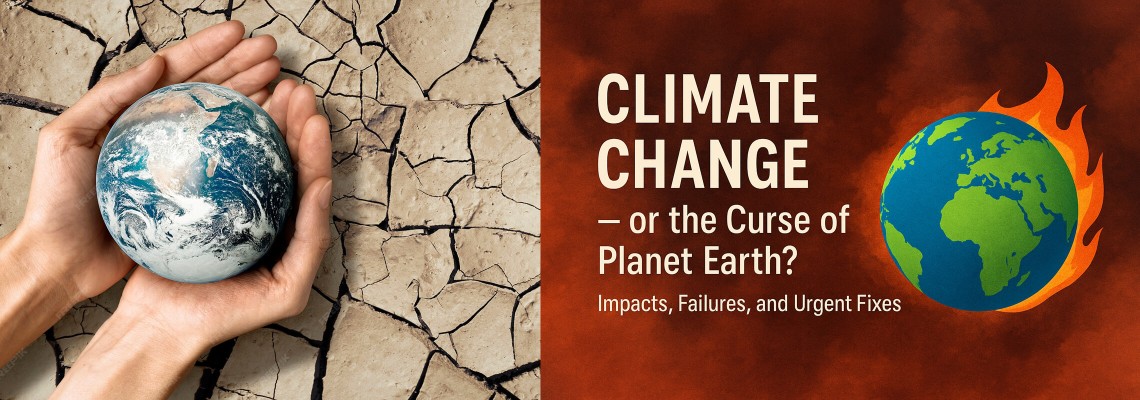
Climate Change — or the Curse of Planet Earth?
In simple words: Climate change is the long-term warming of our planet and shifts in rain, wind, and storms — mostly caused by human-made greenhouse gases (like CO₂ and methane) trapping heat in the atmosphere. It is not “nature’s mood”; it’s physics, pollution, and policies.
1) What people think it is — and what it actually is
Many people picture “hotter summers” or “angry nature.” Scientifically, climate change means a persistent change in climate patterns due to heat-trapping gases from burning coal, oil, and gas; deforestation; and industrial farming. The latest global assessment concludes warming is unequivocally caused by humans, with global temperature already ~1.1–1.3 °C above pre-industrial levels. Every fraction of a degree increases risks for people and nature.
Further reading: IPCC AR6 Synthesis Report – ipcc.ch/report/ar6/syr/
2) Environmental processes & triggered devastation — global + regional
Below are the key physical processes amplified by warming, and the events they trigger in different regions.
Core processes (everywhere)
- Hotter baseline → more extreme heatwaves, longer droughts, higher evaporation.
- Warmer oceans → stronger storms, heavier rainfall, marine heatwaves, coral bleaching.
- Thawing ice & glaciers → sea-level rise, glacial lake outburst floods (GLOFs), water cycle disruption.
- Shifted jet streams/monsoons → “stuck” weather: stalled storms, long heat spells, failed rains.
- Dry + windy → wildfires and smoke; soil degradation; crop losses.
Regional snapshots (latest notable impacts)
South Asia (Pakistan & India)
- Monsoon floods & landslides: In Aug 2025, severe flooding and landslides hit Khyber Pakhtunkhwa and Indian Kashmir with heavy casualties and infrastructure damage. Sources: Reuters, AP News
- Unprecedented heatwaves: Apr–Jul 2025 brought extreme heat across northern India and Pakistan, straining power, water, and health systems.
- Glacier melt & GLOFs: Increased risks in Gilgit–Baltistan & KP threaten valleys, roads, and livelihoods. e.g. Glacial Lake Outburst Flood (GLOF): A sudden and potentially catastrophic flood event caused by the failure of a natural dam holding back a glacial lake.
- Smog crises: Seasonal smog spikes (e.g., Lahore) with hazardous PM2.5 levels, overwhelming clinics. Smog is a type of intense air pollution that appears as a dense, dirty haze. It's a combination of smoke and fog, along with other harmful pollutants like nitrogen dioxide, sulfur dioxide, and particulate matter.
Middle East
- Record-hot nights: Aug 2025 saw the hottest nights on record in parts of Jordan and the region, raising life-threatening heat stress. Source: The Guardian
Europe & North Atlantic
- Nordic heatwave (2025): Hospitals strained, wildfires and algal blooms surged; attribution studies show the heat was far more likely due to climate change. Source: The Guardian
- Southern Europe wildfires: Spain, Portugal, Greece repeatedly battle large fires during prolonged heat. Source: AP News
Australia & Oceania
- Marine heatwaves & coral bleaching: Wide-scale bleaching with severe losses on iconic reefs. Sources: The Guardian, Global bleaching overview
Arctic & Global Cryosphere
- Rapid glacier/ice loss: Shrinking mountain glaciers and Arctic ice accelerate sea-level rise and disrupt water supply. Permafrost thaw refers to the warming and subsequent melting of permanently frozen ground, primarily found in high-latitude regions.
Quick table: who faces what?
| Region | Key Processes | Typical Disasters |
|---|---|---|
| South Asia | Monsoon intensification; glacier melt | Floods, landslides, heatwaves, GLOFs, smog |
| Middle East | Extreme heat & aridity | Deadly hot nights, water stress |
| Europe | Heat extremes; drought; stalled systems | Heatwaves, wildfires, algal blooms, shortages |
| Australia/Oceania | Marine heatwaves | Coral bleaching, coastal ecosystem loss |
| Arctic/High Mountains | Ice & permafrost thaw | Sea-level rise, GLOFs, infrastructure damage |
3) How people and economies are being hit
- Health: Heat stress, respiratory illness from smog and wildfire smoke; higher risks for babies and mothers. Source: Vox (health & heat)
- Food & prices: Droughts, floods, and storms slash yields; global food inflation spikes. Overview: Axios
- Infrastructure & jobs: Roads, power grids, farms, and fisheries damaged; tourism and insurance costs soar.
4) Countries & regions most exposed (illustrative)
South Asia (Pakistan, India, Bangladesh) faces compound risks from monsoons, heat, and glacier hazards. Middle East is on the front line of extreme heat. Small Island States face sea-level rise and saltwater intrusion. Southern Europe, Australia face fire/heat/bleaching. High mountain regions face rapid ice loss.
5) Why we’re late — policies and funding
- Policy gap: Current national pledges still point to ~2.4–3 °C warming by 2100 — far above the 1.5 °C goal.
- Finance gap: Vulnerable countries struggle to access adaptation funds; loss & damage finance is insufficient.
- Politics: Short-term interests slow clean energy and resilience investments.
Further reading: UNFCCC Climate Update – unfccc.int
6) Urgent steps to reverse the crisis & restore Earth
Principle: Everyone acts according to capacity — and neighbors cooperate beyond politics. The planet doesn’t respect borders, so our solutions must cross them.
A) High-income nations
- Fund adaptation & loss-and-damage at meaningful scale; accelerate coal/oil/gas phase-out.
- Share clean tech (grids, storage, EV buses, irrigation) at low/no cost; open licensing for climate-critical tech.
- Shift a slice of military budgets into Earth-restoration (reforestation, wetland/mangrove recovery, coastal defenses).
- Use carbon border adjustments to push industries toward zero emissions; recycle revenues to vulnerable countries.
B) Middle-income nations
- Form regional “green corridors” (shared solar/wind, cross-border grids, joint water management).
- Protect natural shields (forests, mangroves, floodplains) and climate-proof cities (cool roofs, shade, drainage).
- Electrify public transport; incentivize rooftop solar; modernize irrigation (drip, sprinklers) to save water.
- Establish cross-border disaster response teams and stockpiles.
C) Low-income nations
- Prioritize resilience: rainwater harvesting, elevated shelters, drought-resistant seeds, community early warnings.
- Zero-cost protection: stop deforestation and overfishing; enforce basic zoning in floodplains.
- Access global funds fast: simplified pipelines for adaptation and loss & damage; outcome-based grants.
D) All nations, together
- Set aside geopolitical disputes for water, energy, and disaster cooperation.
- Open data sharing (weather, crop, fire, flood) in real time; common alerting protocols.
- Build a connected clean-energy network (regional interconnectors to share surplus wind/solar).
- Align health policy with heat & air-quality action (cooling centers, clean cooking, heat-health plans).
Helpful overviews: Climate Central (extreme heat insights) – climatecentral.org | WRI on IPCC AR6 – wri.org
7) The mindsets we need
- Long-term leadership: Think beyond election cycles; treat climate action as national security.
- Fairness: Those who emitted most must help those who suffer most.
- Practical hope: Solutions exist — we must scale them, not debate their existence.
- Unity: Cooperation beats competition; a liveable planet is the only “superpower.”
Understanding Climate Change Up Close: What These Gases & Particles Actually Do
Climate change is driven by how different gases and tiny particles (aerosols) interact with sunlight, heat, clouds, and ice. Below are simple, point-by-point notes on the main culprits and how they trigger bigger events.
Carbon Dioxide (CO2) — Long-Lived Heat Trapper
- CO2 traps heat in the atmosphere for a very long time (centuries), steadily warming the planet.
- More CO2 = higher average temperatures → more heatwaves, drought risk, and heavier downpours.
- Oceans absorb some CO2, becoming more acidic → coral stress and fishery impacts.
- Warming melts glaciers/ice → sea-level rise and increased risk of glacial lake outburst floods (GLOFs).
Methane (CH4) — Powerful but Shorter-Lived
- Much stronger warming effect than CO2 (per molecule) but stays ~a decade in air.
- Boosts formation of ground-level ozone (a warming gas that also harms lungs and crops).
- Cutting methane gives fast climate benefits in years, not decades.
Nitrous Oxide (N2O) — Dual Threat
- Long-lived greenhouse gas → steady warming.
- Also depletes stratospheric ozone, affecting upper-atmosphere temperatures and circulation.
Nitrogen Dioxide (NO2) & NOx — Ozone Builders & Particle Makers
- NO2 itself warms little, but it helps form ground-level ozone (a greenhouse gas) and nitrate aerosols.
- Ozone near the surface warms climate and damages crops; nitrate aerosols reflect sunlight (slight cooling) but harm health.
- These chemical reactions also change cloud droplets → can alter rainfall timing and monsoon behavior.
Sulfur Dioxide (SO2) — Reflects Sunlight but Disrupts Rains
- Converts to sulfate aerosols that reflect sunlight → short-term cooling effect.
- More tiny droplets can suppress rainfall locally → dry spells in some regions; also drives acid rain.
- Not a solution: it’s toxic, short-lived, and masks rather than fixes warming.
Black Carbon (Soot) — Small, Dark, Extremely Warming
- Strongly absorbs sunlight → heats the air and accelerates ice/snow melt when deposited on glaciers (e.g., Himalaya).
- Worsens heatwaves and reduces visibility; major health hazard (PM2.5).
Ground-Level Ozone (O3) — Not from a Chimney, But Made in the Air
- Forms when NOx + VOCs react in sunlight → warming gas and crop-damaging pollutant.
- Aggravates heat stress during heatwaves; lowers yields of staples like wheat and rice.
Ammonia (NH3) — Hidden Player in Particle Pollution
- Combines with SO2/NOx to form ammonium sulfate/nitrate particles (PM2.5).
- These particles reflect sunlight (slight cooling) but change cloud properties and harm health.
Halocarbons (CFCs/HCFCs/HFCs) — Potent Greenhouse Gases
- Very strong warming per molecule; some older types also destroy stratospheric ozone.
- Phased down globally, but replacements still need tight control to limit warming.
Where Do These Emissions Come From? (Major Sources)
| Pollutant | Main Climate Mechanism (Simple) | Net Climate Effect* | Major Sources |
|---|---|---|---|
| CO2 (Carbon Dioxide) | Traps outgoing heat for centuries | Warming | Coal/oil/gas power; vehicles; industry; cement; deforestation; burning residues |
| CH4 (Methane) | Strong heat trap; makes ground-level ozone | Warming (fast) | Oil & gas leaks; coal mines; landfills; rice paddies; cattle/livestock; wetlands |
| N2O (Nitrous Oxide) | Long-lived heat trap; depletes ozone aloft | Warming | Nitrogen fertilizers; manure; industrial chemicals; biomass burning |
| NO2 / NOx (Nitrogen Oxides) | Builds ozone (warming) & nitrate particles (reflect sunlight) | Mixed (ozone warms; particles cool slightly) | Vehicles; diesel generators; power plants; industry; ships; open burning |
| SO2 (Sulfur Dioxide) | Forms sulfate particles that reflect sunlight; alter clouds | Cooling mask (short-term) | Coal/oil power; metal smelting; ships; volcanoes |
| Black Carbon (Soot) | Absorbs sunlight; darkens ice & speeds melt | Warming (strong, regional) | Diesel exhaust; brick kilns; biomass/crop residue burning; cookstoves; wildfires |
| O3 (Ground-Level Ozone) | Formed in air; warms & damages crops/health | Warming | Not directly emitted; made from NOx + VOCs in sunlight (traffic, solvents, industry) |
| NH3 (Ammonia) | Makes PM2.5 particles with SO2/NOx; changes clouds | Small cooling mask; big health impact | Fertilized fields; livestock; waste; some industry |
| Halocarbons (CFCs/HCFCs/HFCs) | Very strong heat trapping; some deplete ozone | Warming | Refrigeration/AC; foams; aerosols; (older CFCs now phased out; HFCs phased down) |
*Net climate effect = broad global tendency. Local effects can differ (e.g., aerosols may cool globally but disrupt rainfall regionally).
Why This Matters for Real-World Disasters
- More heat-trapping gases (CO2, CH4, N2O) → higher odds of heatwaves, drought, and intense rainfall.
- Aerosols (SO2, nitrate, NH3 mixes) → reflect sun but can delay or suppress rain, shifting monsoon patterns.
- Black carbon on snow/ice → faster melt in mountains (Himalaya, Andes) → higher GLOF risk and seasonal water stress.
- Ozone near the ground → warms climate and cuts crop yields, raising food prices.
Human Health Impacts
Climate change directly affects human health across all regions of the world. Rising temperatures and pollution increase the risk of diseases, food insecurity, and premature deaths.
- Respiratory Diseases: Air pollution (NO2, SO2, PM2.5) increases asthma, COPD, and lung cancer risks.
- Heat-related Illnesses: Extreme heatwaves lead to dehydration, heat strokes, and higher mortality.
- Vector-borne Diseases: Warmer climates expand mosquito and tick habitats, spreading malaria, dengue, and Lyme disease.
- Food and Water Security: Droughts reduce crops, while floods contaminate drinking water sources.
| Health Issue | Main Climate Trigger | Examples |
|---|---|---|
| Asthma & Respiratory Illness | High NO2, SO2, PM2.5 | Urban smog, traffic pollution |
| Heat Stroke | Extreme heatwaves | South Asia, Middle East summers |
| Infectious Diseases | Rising temperature & humidity | Malaria, Dengue spread |
Biodiversity Loss & Extinction
Climate change disrupts natural ecosystems, causing species to migrate, decline, or go extinct. This impacts food chains and human survival.
- Habitat Loss: Melting ice in the Arctic threatens polar bears, seals, and migratory birds.
- Coral Reef Bleaching: Rising sea temperatures bleach corals, endangering marine biodiversity.
- Pollinator Decline: Bees and butterflies are threatened, risking global food production.
- Deforestation: Loss of rainforests accelerates extinction and CO2 emissions.
| Ecosystem | Climate Threat | Impact |
|---|---|---|
| Polar Regions | Ice melting | Loss of polar bear & penguin habitats |
| Coral Reefs | Ocean warming | Marine life collapse |
| Forests | Deforestation + warming | Extinction of birds, mammals, insects |
Climate Justice & Inequality
Climate change does not affect everyone equally. Vulnerable populations face the harshest consequences, despite contributing the least to emissions.
- Global Inequality: Developing nations contribute less than 10% of emissions but suffer most from floods, heatwaves, and droughts.
- Climate Refugees: Millions displaced due to sea-level rise, drought, and disasters.
- Ethical Responsibility: Wealthy nations must provide resources and technology to poorer countries.
- Intergenerational Justice: Current actions will determine the survival of future generations.
Technological & Innovative Solutions
Science and technology offer solutions to mitigate and adapt to climate change. Innovation is essential to reduce emissions and build resilience.
- Renewable Energy: Expansion of solar, wind, and hydro power reduces fossil fuel dependency.
- Carbon Capture: Technologies to absorb CO2 from the atmosphere.
- Sustainable Agriculture: Smart irrigation, drought-resistant crops, and regenerative farming.
- AI & Monitoring: Satellites and AI track deforestation, air quality, and illegal emissions.
- Green Transport: Electric vehicles and mass transit reduce traffic emissions.
Faith, Morality, and Climate Responsibility
Beyond politics, climate care is a moral and spiritual responsibility. Almost all religions call for stewardship of the Earth, compassion, and justice.
- Unity of Creation: The Earth belongs to all, no borders can divide air, water, or sky.
- Ethical Living: Simplicity, gratitude, and reduced consumption align with spiritual teachings.
- Faith-based Action: Communities of faith can inspire large-scale environmental movements.
- Spiritual Motivation: Protecting nature is an act of worship and a service to humanity.
Peace as the Foundation of Climate Action
Climate change cannot be solved while nations remain trapped in wars, domination, and conflicts. Every war destroys ecosystems, pollutes the atmosphere, and diverts valuable funds away from urgent climate action. For true planetary progress, peace is the first and essential requirement.
- End domination politics and resource exploitation.
- Prioritize humanity over territorial disputes.
- Shift military budgets toward renewable energy, reforestation, and water security.
Principles of Unity for Restoring Earth’s Ecosystem
The planet’s survival depends on unity, fairness, and collective responsibility. These guiding principles can serve as the backbone of a global climate restoration movement:
- Equality: Every nation, rich or poor, has equal responsibility.
- Mutual Aid: Wealthy economies must support vulnerable nations.
- Sustainability: All projects must protect future generations.
- Transparency: Open monitoring of policies and actions is required.
- Compassion: Nature must be treated as a living system, not just a resource.
A New Climate Agreement – Ten Ethical Commandments
Current climate agreements, such as the Paris Accord, are steps forward but often lack enforcement. Here is a proposed Universal Climate & Justice Covenant, consisting of ten ethical commandments every nation must follow:
- Respect Earth as a shared home, not a resource for exploitation.
- Do not wage wars that destroy the environment.
- Ensure fair distribution of food, water, and energy.
- Cut carbon emissions with measurable accountability.
- Protect forests, oceans, and rivers as sacred trusts.
- Safeguard biodiversity—prevent human-driven extinctions.
- Ban corruption in climate projects and funds.
- Educate every child on sustainability principles.
- Share clean technology openly among nations.
- Put humanity above politics, and peace above profit.
Beyond Politics – Capable Leaders for the Future
Existing political systems often prioritize elections or personal gain rather than global survival. We need specialized leaders chosen for vision, integrity, and proven ability.
Qualities of Future Climate Leaders:
- Knowledge of ecology and environmental science.
- Compassion for both people and nature.
- Commitment to transparency and truth.
- Global perspective, not limited nationalism.
- Proven record in problem-solving, not promises.
Funds Allocation & Monitoring with Rewards
Climate policies often fail due to corruption and delay. A centralized monitoring system is required to ensure accountability, transparency, and speed. Funds must reach projects directly, and communities must be engaged.
- Use blockchain-based tracking for climate funds.
- Create reward-based loyalty systems for successful projects.
- Engage local communities in monitoring and reporting.
- Maintain open dashboards accessible to all people.
Conclusion — Your role, our future – The Call of One Beating Heart
Climate change is not destiny. It is the sum of choices. Governments must invest, industries must transform, and people must lead with daily action and bold voices. If we cooperate across borders and act at the scale of the problem, we can cool the air, protect the vulnerable, and bring life back to oceans and forests. The longer we wait, the harder it becomes — but hope grows every time we choose solutions over silence.
The future of Earth lies not in politics alone but in the hands of every person and community. If humanity continues with domination and delay, disasters will intensify. But if we unite with compassion and wisdom, we can heal the Earth, restore balance, and ensure a livable future.
The message is clear: One planet, one promise, one beating heart. The Earth is calling us. The time to answer is now.
Earth Song – One Beating Heart
Beneath the same sky, we were born to share,
The oceans, the forests, the clean gentle air.
But we burned and we wasted, we poisoned the ground,
Now storms and the fires are all around.
But the Earth is still breathing, its calling our name,
We can heal it together, we can end the flame.
One planet, one promise, one beating heart,
We can't let it fall, we must play our part.
From mountains to deserts, from river to sea,
The future is ours, if we set it free.
The ice melts in silence, the coral turns white,
The crops dry in fields under endless sunlight.
From Karachi to Cairo, from Delhi to Rome,
Every land on this Earth is somebody's home.
The clock is still ticking, but it's not too late,
If we choose love and hope, not anger and hate.
One planet, one promise, one beating heart,
We can't let it fall, we must play our part.
From mountains to deserts, from river to sea,
The future is ours, if we set it free.
No borders, no walls can divide the sky,
The rain falls for all, the sun warms every eye.
Let's plant every seed, let's clean every stream,
Turn today's broken world into tomorrow's dream.
One planet, one promise, one beating heart,
Together we'll heal it, together we'll start.
From mountains to deserts, from river to sea,
The future is bright – if we set it free!
One planet, one promise, one home.