













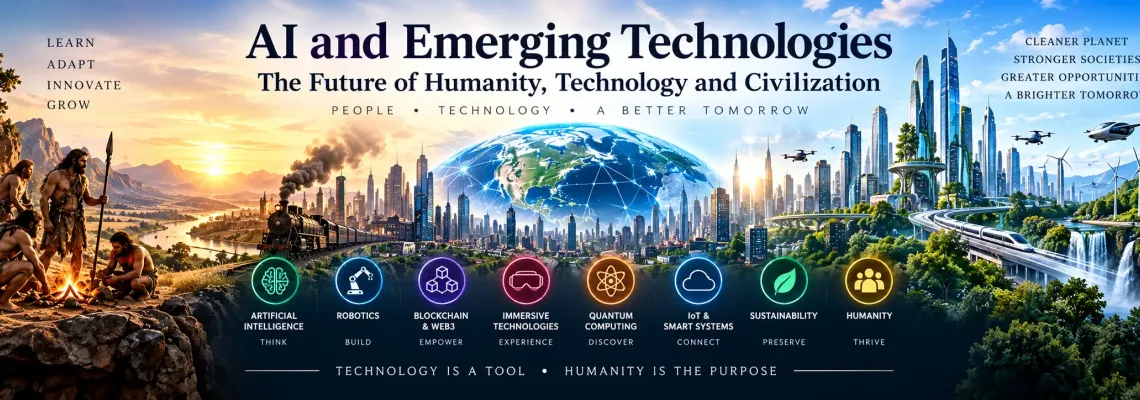
AI and Emerging Technologies: The Future of Humanity, Society, Ethics, Spirituality and Our Planet
From the first human tool to artificial intelligence: a human journey through technological evolution, innovation, promises and realities, benefits and dangers, ethics, spirituality, climate change, war, economics, society and the future of civilization.
Introduction: From the First Tool to Artificial Intelligence
Imagine a human being thousands of years ago picking up a stone and realizing that it could become a tool.
It may have been one of the simplest moments in human history, but it represented something extraordinary: the human ability to look at the world as it exists and imagine how it could be changed.
From that beginning came increasingly sophisticated tools and systems:
Stone → Tool → Wheel → Agriculture → Writing → Printing → Electricity → Machines → Computer → Internet → Smartphone → Artificial Intelligence
Technology has never been only about machines. It has always been about human needs, curiosity, survival, creativity, communication, knowledge and power.
Today, however, humanity has reached a remarkable turning point.
We are no longer building technologies that merely extend the strength of our hands. We are developing systems that can increasingly extend aspects of our memory, language, creativity, analysis, decision-making and problem-solving.
Artificial intelligence can generate text and images, write software, analyze information and interact through natural language. Robotics is moving intelligence into the physical world. Blockchain is changing how digital ownership and decentralized systems can operate. Virtual and augmented reality are changing how digital information can be experienced. Quantum computing may eventually change some areas of computation and cryptography.
At the same time, humanity faces challenges that technology alone cannot automatically solve:
- War and geopolitical conflict
- Climate change and environmental degradation
- Economic inequality
- Cybersecurity threats
- Digital addiction and attention problems
- Loss of privacy
- Misinformation and manipulation
- Rapid changes in employment
- Concentration of technological and economic power
- Questions about human purpose, morality and spirituality
Therefore, the most important question about emerging technologies may not simply be:
“What will technology be capable of doing?”
It may be:
“As our technology becomes more powerful, are our ethics, wisdom, social institutions and sense of responsibility developing at the same speed?”
This article explores that question.
It does not attempt to describe technology as either humanity's salvation or humanity's destruction. Instead, it examines both possibilities: what emerging technologies promise, what they have actually delivered, what problems they create, who benefits, who may be harmed, how they affect society and nature, and what ethical responsibilities accompany increasing technological power.
Most importantly, this is a human discussion about technology.
Because the future will not be shaped by machines alone.
It will be shaped by the choices humans make about how those machines are designed, controlled and used.
1. What Are Emerging Technologies?
Emerging technologies are technologies that are developing rapidly, gaining new applications, or have the potential to significantly change society, industries, economies or everyday life.
Some are already widely used. Others are still developing. Some remain experimental or speculative.
Examples include:
- Artificial Intelligence (AI)
- Generative AI
- AI agents
- Artificial General Intelligence (AGI)
- Internet of Things (IoT)
- Robotics and autonomous systems
- Blockchain and Web3
- Augmented, Virtual and Mixed Reality
- Digital Twins
- Quantum Computing
- 5G and future connectivity
- Biotechnology and synthetic biology
- Brain-computer interfaces
- Industrial Revolution 5.0
These technologies should not be viewed separately. One of the most important characteristics of the modern technological era is convergence.
AI can work with robotics.
Robotics can work with IoT.
IoT can work with 5G and edge computing.
Blockchain can support digital identity and ownership.
Virtual environments can use AI, digital twins and connected sensors.
Quantum computing may eventually influence AI, scientific research and cybersecurity.
This means that the future is unlikely to be created by one technology alone.
The most significant changes may come from combinations of technologies.
2. From Invention to Technological Evolution
Technology normally does not appear suddenly as a finished product.
A human need may lead to an idea. The idea becomes an invention. Experiments improve it. Businesses commercialize it. Society adopts it. New problems appear. The technology evolves again.
A simplified technology evolution cycle can therefore be described as:
Human Need → Idea → Invention → Experiment → Innovation → Adoption → Commercialization → Mass Usage → Social Impact → Ethical Questions → Evolution
This cycle is important because the original purpose of an invention can change dramatically after it enters society.
A technology may be invented for convenience but become an economic platform.
A communication tool may become an advertising system.
A social network may become a source of political influence.
An AI assistant may eventually become an autonomous business agent.
A technology intended to increase freedom may, under different circumstances, also increase surveillance or control.
Therefore, evaluating a technology only by its original invention is not enough.
We must examine what happens after millions or billions of people begin using it.
3. The Great Technological Revolutions
Human civilization has experienced several major technological transformations.
Agricultural Revolution
Agriculture allowed humans to produce food more systematically, establish permanent settlements and build increasingly complex societies.
Writing and Knowledge
Writing allowed knowledge to survive beyond the lifetime of an individual and enabled information to travel across generations.
Printing Revolution
The printing press dramatically increased the ability to reproduce and distribute knowledge.
Industrial Revolution
Machines, factories and new energy systems transformed manufacturing, transportation, cities and employment.
Electricity and Telecommunications
Electricity and communication technologies changed the speed at which people could work, communicate and organize.
Computer Revolution
Computers transformed calculation, data processing, engineering, business and scientific research.
Internet Revolution
The internet connected people, organizations, markets and information systems on a global scale.
Mobile and Smartphone Revolution
Computing and communication moved into people's pockets and became continuously available.
Artificial Intelligence Revolution
AI represents another major transition because computers are increasingly capable of performing tasks that traditionally required aspects of human intelligence.
The historical lesson is important:
Every major technology changes not only what humans can do, but also how humans live.
4. Artificial Intelligence — Teaching Machines to Learn
Artificial Intelligence is a broad field of computing concerned with creating systems capable of performing tasks that normally require forms of human intelligence.
Depending on the system, these tasks can include recognizing patterns, understanding language, analyzing images, making predictions, generating content or assisting with decisions.
Modern AI relies on technologies including machine learning, neural networks and deep learning.
The important point for an ordinary reader is simple:
Traditional software generally follows rules written by programmers. Machine-learning systems can learn patterns from data and use those patterns to produce predictions or outputs.
This difference has opened the door to enormous applications.
Where AI Is Already Used
- Search engines
- Translation
- Fraud detection
- Medical image analysis
- Recommendation systems
- Navigation
- Customer service
- Cybersecurity
- Manufacturing
- Education
- Financial analysis
- Content creation
AI therefore should not be understood as a single product such as a chatbot.
AI is becoming a general-purpose technology layer that can be incorporated into many different systems.
5. Generative AI — When Machines Begin Creating
Generative AI refers to systems capable of producing new content such as text, images, audio, video, software code and other forms of digital material.
ChatGPT and similar AI assistants have made generative AI accessible to ordinary users.
A person can now describe a problem in natural language and ask an AI system to help explain it, summarize information, brainstorm ideas, write code or create other forms of content.
This creates major opportunities in education, business, research, accessibility and creativity.
But it also introduces serious questions.
- How can people distinguish genuine information from AI-generated misinformation?
- Who owns AI-generated work?
- How should copyrighted material be treated?
- What happens when AI-generated content becomes more persuasive than human-created misinformation?
- How much should people trust an AI answer?
Generative AI therefore demonstrates a recurring theme of this article:
The same capability that creates enormous benefits can also create enormous risks when used irresponsibly.
6. AI Agents — From Answering to Acting
The next evolution of AI is moving beyond systems that simply answer questions.
AI agents are designed to perform sequences of tasks, use tools, analyze information and potentially act toward a specified goal.
The broad progression can be imagined as:
Search → AI Assistant → Copilot → AI Agent → Autonomous System
This could transform business, research, software development, customer service and many other areas.
However, greater autonomy also means greater responsibility.
If an AI system can take actions rather than merely provide suggestions, questions of authorization, accountability, security and human oversight become much more important.
The key question becomes:
How much authority should a human give to an autonomous machine?
7. Artificial General Intelligence — AGI
Artificial General Intelligence, commonly called AGI, generally refers to a hypothetical form of AI capable of performing a broad range of intellectual tasks with a level of generality approaching or exceeding human capabilities.
Unlike a system designed for one narrow purpose, AGI is generally discussed as an intelligence capable of learning and applying knowledge across many different domains.
AGI remains one of the most debated subjects in technology.
Potential benefits could include accelerated scientific research, medical discovery, education, engineering and problem-solving.
Potential risks could include economic disruption, concentration of power, misuse, security problems, loss of human control and profound questions about the relationship between humans and increasingly capable artificial systems.
It is important, however, to distinguish between:
- What exists today
- What current research suggests may become possible
- What experts forecast
- What remains speculative
Responsible discussion of the future should never present speculation as established fact.
8. Internet of Things — IoT
The Internet of Things describes physical objects equipped with sensors, connectivity and computing capabilities that can collect and exchange information.
Examples include smart appliances, industrial sensors, vehicles, agricultural equipment, medical devices and environmental monitoring systems.
When IoT is combined with AI, the result is often described as AIoT — Artificial Intelligence of Things.
The significance is enormous because computers can increasingly sense and respond to the physical world.
9. Robotics and Autonomous Systems
Robotics brings computation and intelligence into physical machines.
Modern robotics includes industrial robots, warehouse systems, medical robots, drones, autonomous vehicles and increasingly sophisticated humanoid robots.
The potential benefits include dangerous-task automation, improved manufacturing, assistance for elderly and disabled people, precision operations and increased productivity.
But robotics also raises questions about employment, safety, military use, accountability and human-machine relationships.
10. Augmented, Virtual and Mixed Reality
Augmented Reality — AR
AR adds digital information to the physical world.
Virtual Reality — VR
VR creates an immersive computer-generated environment.
Mixed Reality — MR
MR combines physical and digital environments in ways that allow digital objects to interact more naturally with the physical world.
Extended Reality — XR
XR is a broader term that encompasses AR, VR and MR experiences.
These technologies could transform education, training, healthcare, design, entertainment and remote collaboration.
But they also create questions about privacy, psychological effects, social interaction and the possibility of spending increasing amounts of life inside digitally constructed environments.
11. Digital Twins
A digital twin is a virtual representation of a real-world object, system, building, machine or process.
With sensors and real-time data, a digital twin can help organizations monitor performance, identify potential problems and simulate changes before making them in the physical world.
Applications may include factories, aircraft, buildings, cities, energy systems and healthcare.
12. Blockchain and Web3
Blockchain is a distributed ledger technology designed to record transactions or other data across a network in a way that can provide transparency, verification and resistance to unauthorized alteration.
Blockchain became widely known through cryptocurrencies, but its potential applications extend into digital ownership, financial systems, identity, supply chains and decentralized applications.
Smart Contracts
Smart contracts are programs deployed on blockchain networks that can automatically execute defined actions when programmed conditions are met.
Decentralized Applications — DApps
DApps are applications that use decentralized networks or blockchain infrastructure.
Decentralized Finance — DeFi
DeFi aims to provide financial functions through blockchain-based protocols rather than relying entirely on traditional financial intermediaries.
DAOs
Decentralized Autonomous Organizations use blockchain-based mechanisms, often including smart contracts and community voting, to coordinate organizational activities.
DEXs
Decentralized exchanges allow users to trade digital assets through decentralized protocols rather than relying exclusively on a conventional centralized exchange.
NFTs
Non-Fungible Tokens can represent unique digital records associated with ownership, authenticity, collectibles or other assets.
Blockchain technologies offer important possibilities, but they also demonstrate why emerging technologies require critical thinking. Decentralization can create new opportunities while also introducing security, financial, governance and usability risks.
13. Metaverse and Spatial Computing
The metaverse is commonly used to describe interconnected persistent digital environments, while spatial computing refers more broadly to computing systems that understand and interact with physical space.
When AI, XR, IoT, digital twins and high-speed connectivity converge, digital information may become increasingly integrated with physical environments.
This could transform education, engineering, entertainment, medicine and remote collaboration.
But it also raises a profound question:
If technology can create increasingly convincing digital worlds, how much of our lives should we choose to spend inside them?
14. Quantum Computing
Quantum computing uses principles of quantum mechanics to process information in fundamentally different ways from conventional computers.
It is not simply a faster replacement for every ordinary computer. Its importance lies in the possibility of solving particular classes of problems that are extremely difficult for conventional systems.
Potential areas include scientific simulation, optimization, chemistry, materials research and cryptography.
Quantum computing also creates an important cybersecurity challenge because sufficiently powerful quantum computers could threaten some existing cryptographic methods. This is one reason post-quantum cryptography is becoming an important field of research.
15. Industrial Revolution 5.0
Industry 5.0 builds on automation and digital transformation while placing greater emphasis on human-machine collaboration, sustainability, resilience and human-centered production.
The important idea is not simply:
Human versus Machine
but:
Human + AI + Robot
The challenge will be ensuring that increased productivity improves human life rather than reducing people to simple economic measurements.
16. Technology and the Future of Work
Every major technological revolution has changed employment.
Some occupations disappear, others transform, and entirely new occupations emerge.
AI and automation may therefore change the value of many skills.
Technical knowledge will remain important, but human abilities such as judgment, empathy, leadership, creativity, communication, critical thinking and ethical reasoning may become increasingly important.
The deeper question is not simply:
“Will AI take our jobs?”
It is:
“If machines perform more economically valuable tasks, how will humans define meaningful work, dignity and purpose?”
17. Technology and the Attention Economy
One of the most important social transformations of the digital age is the competition for human attention.
Short videos, reels, recommendations, notifications and infinite scrolling are designed around keeping users engaged for longer periods.
The technology is impressive. The social question is much more complicated.
When an individual's attention becomes an economic resource, the business objective of a platform may not always be identical to the individual's long-term wellbeing.
Children and teenagers may be particularly vulnerable because habits, attention patterns and self-regulation are still developing. Older adults and people with limited digital literacy may face different forms of vulnerability, including misinformation, scams and manipulative content.
This does not mean that every person who watches short videos is addicted. It means that society should take seriously the possibility that technologies optimized for engagement can influence attention, habits and behavior.
A useful question for every digital user is:
Am I using this technology intentionally, or has the technology learned how to keep me using it?
18. Technology, Society and Human Relationships
Technology can bring families and communities closer across geographical distances.
It can also reduce the need for physical interaction.
A person may communicate with hundreds of people online while having little meaningful conversation with the people sitting nearby.
This creates a paradox of the modern age:
We may be more connected digitally while becoming less connected socially.
The solution is not to reject technology. It is to ensure that digital communication strengthens rather than replaces meaningful human relationships.
19. Technology, Climate Change and the Natural World
Technology has an important double role in the environmental crisis.
It can help humanity understand and address climate change through satellite monitoring, climate modelling, renewable energy, smart grids, precision agriculture, water management and early-warning systems.
But digital technology also requires physical resources.
Data centers require energy. Electronics require materials. Batteries require minerals. Devices eventually become waste. Manufacturing and transportation consume resources.
Therefore, the statement “digital technology is clean” is too simplistic.
A digital economy still has a physical footprint.
Human civilization ultimately depends on natural systems:
Air → Water → Soil → Food → Forests → Oceans → Biodiversity → Human Life
No artificial intelligence system can make humanity independent of the natural world.
20. Technology, War and Geopolitical Power
The future of technology cannot be separated from the future of international relations.
Artificial intelligence, drones, satellites, cyber capabilities, autonomous systems and information technologies can be used for peaceful purposes, but they can also increase military capabilities.
This creates a dangerous imbalance between technological capability and ethical restraint.
The question therefore becomes:
What happens when humanity develops increasingly powerful technologies while nations remain divided by fear, competition and conflict?
Technology cannot guarantee peace.
A technologically advanced civilization can still experience war.
In fact, advanced technology can make the consequences of conflict more severe.
21. Technology, Capital and Economic Power
Innovation often follows a powerful economic chain:
Research → Invention → Innovation → Product → Marketing → Sales → Profit
This process has produced extraordinary improvements in medicine, communication, transportation, computing and manufacturing.
Profit can provide the investment required to turn research into products that reach millions of people.
But economic incentives can also create tensions.
When financial returns become the dominant measure of success, questions about long-term social wellbeing, environmental consequences, privacy and human dignity can become secondary.
The real challenge is therefore not simply capitalism versus technology or technology versus society.
It is the broader question of how economic systems can reward innovation while protecting people, communities and the planet.
22. Technology and Spirituality
Technology can give humanity extraordinary capabilities.
It can provide information, speed, entertainment, convenience, communication and productivity.
But there are things technology cannot automatically provide:
Wisdom · Purpose · Compassion · Moral Responsibility · Inner Peace · Meaning
This distinction is important.
A machine may provide information about thousands of spiritual traditions, but information is not necessarily wisdom.
An AI system may explain philosophical concepts, but explanation is not necessarily personal spiritual experience.
A virtual environment may simulate a beautiful landscape, but simulation is not the same as nature.
Technology may help people communicate with others, but communication alone does not guarantee love, compassion or meaningful relationships.
This leads to an important question:
Can technological progress occur without spiritual and ethical progress?
Different religions and philosophical traditions may answer this question differently. Yet many traditions share a concern for human dignity, responsibility, self-control, compassion, justice and the proper use of power.
For people of faith, technology can therefore be viewed as a means rather than the ultimate purpose of life.
Technology may serve human life, but it should not become the purpose of human life.
23. The Ethical Test for Every Emerging Technology
Before accepting a new technology simply because it is possible, society should ask several questions.
| Ethical Question | What Should We Ask? |
|---|---|
| Human Benefit | Does this technology genuinely improve human wellbeing? |
| Safety | What could happen if it fails or is misused? |
| Human Dignity | Does it respect people as human beings rather than merely data or consumers? |
| Freedom | Does it increase human autonomy or manipulate behavior? |
| Privacy | Who collects, controls and benefits from the data? |
| Justice | Who benefits and who may be excluded? |
| Environment | What is the technology's physical and environmental cost? |
| Accountability | Who is responsible when something goes wrong? |
| Human Values | Does it strengthen or weaken meaningful human life? |
| Future Generations | Are we leaving a better world for those who come after us? |
24. Promise vs Reality — What Did Technology Actually Deliver?
Every major technology arrives with promises.
The internet promised global access to information.
Social media promised greater human connection.
Smartphones promised unprecedented convenience.
Blockchain promised decentralization and digital ownership.
AI promises extraordinary productivity and new forms of intelligence.
Some promises have been fulfilled. Others have been partially fulfilled. Some have created unexpected problems.
Therefore, throughout this study we will examine each technology using five questions:
- What was promised?
- What has actually been achieved?
- What remains unfinished?
- What unexpected problems appeared?
- What is realistically possible next?
25. Technology Ethical Impact Scorecard
To make the comparison easier, each major technology can be evaluated through a balanced scorecard.
| Impact Area | Rating |
|---|---|
| Human Benefit | ★★★★★ |
| Productivity | ★★★★★ |
| Education | ★★★★★ |
| Healthcare Potential | ★★★★★ |
| Economic Opportunity | ★★★★★ |
| Social Risk | ★★★☆☆ |
| Privacy Risk | ★★★☆☆ |
| Cybersecurity Risk | ★★★☆☆ |
| Environmental Impact | ★★★☆☆ |
| Ethical Maturity | ★★★☆☆ |
| Human/Spiritual Impact | ★★★☆☆ |
Note: Individual technology ratings should be assigned only after reviewing evidence and should clearly distinguish factual evidence from editorial judgment.
26. Past, Present and Future — Measuring Technological Promises
For every major technology discussed in this article, we can compare three stages:
| Stage | Key Question |
|---|---|
| Past | What did people believe this technology would achieve? |
| Present | What has actually happened? |
| Future | What is realistically possible and what remains uncertain? |
This approach helps prevent both exaggerated optimism and exaggerated fear.
27. The Great Question: Will Technology Make Humanity Better?
Technology can make humanity more capable.
It can make communication faster, medicine more precise, education more accessible and industries more productive.
But greater capability does not automatically produce greater wisdom.
A powerful machine in the hands of a responsible person can create enormous benefit.
The same machine in the hands of someone seeking exploitation, domination or destruction can create enormous harm.
This is why the future of technology is ultimately also a question about the future of human character and institutions.
28. Frequently Asked Questions
What are emerging technologies?
Emerging technologies are rapidly developing or newly developing technologies that have the potential to significantly influence society, industries, economies or everyday life. Examples include AI, robotics, blockchain, IoT, XR and quantum computing.
What is the most important emerging technology today?
Artificial intelligence is one of the most influential because it can be integrated into many other technologies, including robotics, healthcare, cybersecurity, education, manufacturing and scientific research. However, no single technology will determine the future by itself.
Will artificial intelligence replace humans?
AI is more likely to replace or transform particular tasks than simply replace humanity as a whole. The long-term impact will depend on technological capability, economics, regulation, education and how organizations choose to deploy AI.
What is AGI?
Artificial General Intelligence refers to a hypothetical form of AI capable of performing a broad range of intellectual tasks with a high degree of generality. The exact definition and timeline for AGI remain subjects of substantial debate.
Can emerging technologies be dangerous?
Yes. Almost any powerful technology can create risks through malfunction, misuse, unintended consequences or concentration of power. AI, cyber technology, biotechnology, autonomous systems and other technologies therefore require responsible governance and ethical consideration.
Can technology solve climate change?
Technology can contribute significantly through renewable energy, energy efficiency, climate monitoring, smart infrastructure and other solutions. However, technology alone cannot solve climate change without changes in policy, economics, consumption patterns and international cooperation.
How does technology affect society?
Technology can improve communication, healthcare, education, productivity and access to information. It can also contribute to privacy concerns, misinformation, social isolation, inequality, digital addiction and changes in employment.
Can technology affect spirituality?
Technology can influence how people learn, communicate, worship, reflect and interact with religious communities. It may provide useful access to knowledge, but it should not automatically be treated as a substitute for human relationships, wisdom, spiritual practice or moral responsibility.
Is technological progress always the same as human progress?
No. Technological progress means that technological capabilities have increased. Human progress is broader and includes wellbeing, justice, peace, dignity, wisdom, environmental sustainability and meaningful human relationships.
What is the biggest risk of emerging technology?
There may not be one single biggest risk. A particularly serious concern is the interaction between powerful technologies and existing human problems such as war, inequality, misinformation, environmental degradation, poor governance and concentration of power.
What should humans do about emerging technologies?
Humanity should continue scientific and technological development while strengthening education, cybersecurity, ethical standards, responsible governance, environmental responsibility, human oversight and public understanding.
Conclusion: Technology Is a Tool — Civilization Is the User
Humanity has never possessed technological power on the scale available today.
Artificial intelligence, robotics, biotechnology, blockchain, quantum computing, immersive technologies and intelligent machines may transform almost every part of our lives.
They may help us discover medicines, expand knowledge, improve education, protect the environment and solve problems that once appeared impossible.
But the future cannot be measured only by computing power, economic growth or technological achievement.
A civilization also needs wisdom, ethics, responsibility, compassion, peace and respect for the natural world.
Technology can extend the power of the human hand and increasingly the power of the human mind. But it cannot by itself decide how that power should be used.
That responsibility remains with humanity.
At Naqshbandi Islami Store, we believe that knowledge and technology should ultimately remain servants of human wellbeing—not replacements for human dignity, meaningful relationships, moral responsibility and spiritual life.
The future is not simply a destination created by machines.
It is a future shaped by the choices of people.
May technological progress be accompanied by wisdom; innovation by responsibility; prosperity by justice; scientific advancement by respect for life; and technological power by humility before the natural and moral responsibilities entrusted to humanity.
Technology can make humanity more powerful.
Only wisdom can help humanity decide what to do with that power.
1. What Are Emerging Technologies?
When we hear the phrase “emerging technologies”, many people immediately think of artificial intelligence, robots, cryptocurrencies or futuristic cities. But the idea is much broader.
An emerging technology is a technology that is developing rapidly, gaining new applications, or has the potential to significantly change the way people live, work, communicate, learn, conduct business or interact with the world.
Some emerging technologies are already part of everyday life. Others are still being developed in laboratories and universities. Some exist mainly as research projects, while others are ideas whose practical future remains uncertain.
This distinction is important because the word “future” is often used too casually. A technology can be technically possible without being economically practical. It can be economically practical without being socially desirable. And something that is desirable may still require years of research before it becomes widely available.
For this reason, throughout this article we will distinguish between what already exists, what is developing, what is highly probable, what is possible and what remains speculative.
Examples of Emerging Technologies
- Artificial Intelligence (AI)
- Generative AI
- AI Agents and Autonomous AI
- Artificial General Intelligence (AGI)
- Internet of Things (IoT)
- Edge Computing and Edge AI
- Robotics and autonomous systems
- Augmented Reality (AR)
- Virtual Reality (VR)
- Mixed Reality (MR) and Extended Reality (XR)
- Spatial Computing
- Digital Twins
- Blockchain
- Web3 and decentralized applications
- Quantum Computing
- 5G and future connectivity technologies
- Biotechnology and synthetic biology
- Brain-computer interfaces
- Industrial Revolution 5.0
These technologies are not isolated islands. Their greatest impact may come from their convergence.
Artificial intelligence can provide intelligence to robots. Internet of Things devices can provide information from the physical world. Edge computing can process that information closer to where it is generated. High-speed networks can connect billions of devices. Digital twins can represent physical systems in digital environments.
Similarly, blockchain can provide new approaches to digital ownership and decentralized coordination, while AI can provide intelligent services on top of digital networks.
This means that the future may not belong to one revolutionary technology.
The most important technological changes may happen when several technologies begin working together.
2. From Invention to Technological Evolution
Every important technology has a story.
Usually, it does not begin as a finished product sitting on a laboratory table. It begins with a problem, a human need, curiosity or an idea about doing something differently.
A person observes a problem.
Someone imagines a solution.
An inventor creates something.
Researchers improve it.
Engineers make it practical.
Businesses manufacture and distribute it.
People begin using it.
Society adapts to it.
And eventually, new problems appear that require the technology to evolve again.
A simplified model of technological evolution can therefore be represented as:
Human Need → Idea → Invention → Experiment → Innovation → Adoption → Commercialization → Mass Usage → Social Impact → Ethical Questions → Evolution
Invention Is Not the Same as Innovation
An invention is the creation of something new or a new method of doing something.
Innovation is broader. It involves improving, applying, distributing or successfully using an idea in a way that creates practical value.
For example, the basic idea behind a technology may exist for years before engineers discover how to make it affordable and useful to millions of people.
This is why the history of technology is not simply a history of inventors.
It is also a history of researchers, engineers, entrepreneurs, manufacturers, investors, educators, governments and ordinary users.
When a Technology Enters Society
Something interesting happens when an invention leaves the laboratory and enters everyday life.
Its original purpose can change.
A communication technology can become an advertising platform.
A convenience technology can become an addiction.
A tool for sharing information can become a tool for misinformation.
A system designed to improve efficiency can change employment.
A technology designed to increase freedom can potentially be used for surveillance.
Therefore, judging a technology only by the intention of its inventor is not enough.
We must also examine what happens when that technology becomes powerful, profitable and widely adopted.
The real story of a technology begins not only when it is invented, but when humanity begins living with it.
3. The Great Technological Revolutions of Human Civilization
Human history can be viewed partly as a history of tools and technologies.
Long before computers existed, humans were already using technology to overcome physical limitations, preserve knowledge, produce food, travel, communicate and organize societies.
The First Tools
The earliest tools allowed humans to extend the capabilities of their hands and bodies.
A stone could become a cutting tool. A sharpened piece of wood could become a hunting instrument. Fire could provide warmth, protection and a way to transform food.
These early technologies may appear primitive compared with modern AI, but they established a fundamental principle that remains true today:
Technology allows humans to do something that would otherwise be difficult, impossible or extremely inefficient.
The Agricultural Revolution
Agriculture transformed human societies by allowing communities to produce food more systematically and establish permanent settlements.
With settled communities came larger populations, specialized occupations, trade, administration and increasingly complex civilizations.
A technological change in food production therefore became a social transformation.
Writing and the Preservation of Knowledge
Writing changed the relationship between human beings and knowledge.
Before written records, much knowledge depended heavily on memory and oral transmission. Writing allowed information to survive beyond the lifetime of the individual who possessed it.
Knowledge could travel through generations and across geographical distances.
In a sense, writing became an early external memory system for civilization.
The Printing Revolution
The development of printing technologies dramatically increased the ability to reproduce and distribute written information.
Books could reach more people, ideas could travel further, and education and scholarship could expand.
The lesson is important for today's digital age: when the cost of distributing knowledge falls, society itself can change.
The Industrial Revolution
Machines, factories and new energy systems transformed production and transportation.
Human physical labor could be amplified by machines, allowing goods to be produced on a scale previously impossible.
But industrialization also produced social challenges, including difficult working conditions, pollution, urbanization and major changes in employment.
Once again, technological progress produced both extraordinary benefits and serious costs.
Electricity and Telecommunications
Electricity changed almost every aspect of modern life.
It enabled new machines, lighting, industrial systems and communication technologies.
The telegraph and later telephone reduced the practical distance between people.
Human communication was no longer limited by the speed of physical travel.
The Computer Revolution
Computers transformed calculation and information processing.
Tasks that once required enormous amounts of manual calculation could increasingly be performed electronically.
Computing eventually became part of science, engineering, finance, education, manufacturing, government and everyday life.
The Internet Revolution
The internet connected computers and people across the world.
Information could move almost instantly between distant locations.
Commerce, education, communication, entertainment, journalism and business were transformed.
But the internet also introduced new challenges, including cybercrime, misinformation, privacy concerns and new forms of social manipulation.
The Smartphone Revolution
The smartphone placed a powerful computer, camera, communication system, navigation device and information gateway into an ordinary person's pocket.
For the first time, many people could remain continuously connected to digital networks throughout the day.
This created enormous convenience.
It also created a new problem: when technology becomes continuously available, it can become continuously demanding.
The Artificial Intelligence Revolution
Artificial intelligence represents another major technological transition.
Computers are increasingly capable of performing tasks involving language, pattern recognition, prediction, image analysis, content generation and decision support.
This makes AI different from many previous technologies.
Earlier machines primarily extended human physical capabilities.
Computers extended our ability to calculate and process information.
AI increasingly attempts to extend aspects of human cognitive capability.
That is why the AI revolution deserves careful consideration—not only as a technological development, but also as a social, economic, ethical and philosophical transformation.
4. A Simple Way to Understand Technological Progress
The history above reveals an important pattern.
Technology often begins by extending one human capability.
| Technology | Human Capability Extended |
|---|---|
| Early tools | Physical strength and manual ability |
| Agriculture | Food production and environmental management |
| Writing | Memory and knowledge preservation |
| Printing | Knowledge distribution |
| Machines | Physical production |
| Telephone | Communication across distance |
| Computers | Calculation and information processing |
| Internet | Global communication and information access |
| Smartphones | Portable computing and continuous connectivity |
| Artificial Intelligence | Increasingly sophisticated cognitive assistance and automation |
This progression raises an extraordinary question.
If technology continues extending more and more human capabilities, what happens when technology begins extending capabilities that we traditionally considered uniquely human?
That question takes us directly into the modern era of generative AI, autonomous systems and the possibility of artificial general intelligence.
5. Technology Is Neither Automatically Good nor Automatically Bad
It is tempting to classify a new technology as either a solution to humanity's problems or a threat to humanity.
Reality is usually more complicated.
The same technology can produce very different outcomes depending on who controls it, how it is designed, how it is used, what incentives surround it and what rules govern it.
A smartphone can help a student learn a new language or allow a family to communicate across continents.
The same device can also become a source of distraction and endless short-form entertainment.
Artificial intelligence can help a doctor analyze information, help a student understand a difficult subject or help a scientist process enormous quantities of data.
The same technology can potentially be used for fraud, manipulation, misinformation, surveillance or cyberattacks.
Therefore, throughout this article we will use a simple principle:
Technology creates capability. Human beings determine how that capability is used.
This is why technological progress must be discussed alongside ethics, education, law, economics, human behavior, spirituality, environmental responsibility and governance.
6. Questions to Think About Before We Enter the AI Era
Before exploring individual technologies, consider these questions:
- Does technological progress always mean human progress?
- Who should control powerful technologies?
- Who should benefit financially from technological innovation?
- What happens when commercial incentives conflict with social wellbeing?
- How much privacy should people sacrifice for convenience?
- How much autonomy should humans give to intelligent machines?
- Can technology improve the environment while simultaneously increasing resource consumption?
- Can greater digital connectivity strengthen communities while weakening physical relationships?
- Can technological knowledge provide information without providing wisdom?
- What responsibilities do today's innovators have toward future generations?
These questions will remain with us throughout the journey.
Because this is not simply a story about machines.
It is a story about human beings and the civilization we are choosing to build.
7. Artificial Intelligence — When Machines Begin to Learn
For thousands of years, human beings have built tools to extend their physical abilities. A hammer made the hand more powerful. A wheel made transportation easier. Machines multiplied human strength. Computers multiplied our ability to calculate and process information.
Artificial Intelligence introduces something different.
Instead of simply making a machine stronger or faster, humans are attempting to make machines capable of performing tasks that require forms of intelligence.
AI can recognize patterns, process language, analyze images, make predictions, recommend actions and generate new content.
In simple terms:
Artificial Intelligence is the attempt to create computer systems that can perform tasks associated with human intelligence.
That does not mean that today's AI thinks exactly like a human being. In fact, modern AI systems can be remarkably capable in some areas while still making surprisingly simple mistakes in others.
Understanding this difference is essential.
How Did Artificial Intelligence Begin?
The dream of creating intelligent machines is much older than today's chatbots.
Scientists and mathematicians began seriously exploring machine intelligence during the twentieth century. Early AI systems were often based on explicitly programmed rules. Later, researchers increasingly developed methods in which computers could learn patterns from data.
This produced a major transition:
Programmed Rules → Machine Learning → Deep Learning → Generative AI → AI Agents
Each stage expanded what machines could accomplish.
What Is Machine Learning?
Traditional computer programs generally depend on instructions written by programmers.
Machine learning works differently. Instead of specifying every possible rule, developers can train systems using data so that the system learns statistical patterns and uses those patterns to make predictions or generate outputs.
For example, instead of manually writing every rule required to identify thousands of different photographs of cats, a machine-learning system can be trained using large collections of labeled examples.
The machine does not need to understand a cat in the same way a child does. It learns patterns that help it distinguish one category from another.
What Is Deep Learning?
Deep learning is a branch of machine learning based on artificial neural networks containing multiple computational layers.
Deep-learning systems have become particularly important for image recognition, speech processing, natural language and other complex tasks.
The rapid development of computing power, specialized hardware, large datasets and improved algorithms has contributed significantly to the recent progress of AI.
Where Is AI Already Being Used?
AI is no longer confined to research laboratories.
- Search engines use AI to understand queries and rank information.
- Navigation systems use algorithms and data to estimate routes and travel conditions.
- Financial institutions use AI for fraud detection and risk analysis.
- Hospitals and researchers use AI-assisted systems for certain medical and scientific tasks.
- Manufacturers use AI for quality control and predictive maintenance.
- Cybersecurity systems use machine learning to identify suspicious patterns.
- Translation systems use AI to convert information between languages.
- Online stores use recommendation systems to personalize product suggestions.
- Digital assistants can understand and respond to natural-language requests.
In other words, AI is becoming less like a single product and more like a technological capability that can be incorporated into many different products and services.
8. Generative AI — When Machines Begin Creating
A particularly important development in recent years has been Generative Artificial Intelligence.
Earlier AI systems were often designed primarily to classify, predict or recommend.
Generative AI can produce new content.
It can generate:
- Text
- Images
- Computer code
- Audio
- Music
- Video
- Summaries
- Translations
- Ideas and drafts
This has changed the relationship between ordinary people and advanced computing.
A person does not necessarily need to know a programming language to communicate with a powerful AI system. Natural language itself can become an interface to computing.
A student can ask for an explanation.
A programmer can ask for assistance with code.
A business owner can develop a marketing draft.
A researcher can use AI to organize information.
A designer can generate visual concepts.
A person with a disability may use AI as an accessibility tool.
This democratization of sophisticated digital capabilities could become one of the most important benefits of generative AI.
But Can We Trust AI-Generated Information?
This is where the picture becomes more complicated.
Generative AI can produce convincing information that is incomplete, inaccurate or entirely fabricated.
An AI system may generate an answer that sounds confident even when the underlying information is wrong.
Therefore, AI should not be treated as an unquestionable authority.
Important principle: The more important the decision, the more important independent verification becomes.
This is particularly important for medical, legal, financial, security and religious information.
Generative AI and Creativity
Generative AI also challenges our traditional understanding of creativity.
If a person describes an idea and a machine creates an image, who is the creator?
If AI helps write a book, who is the author?
If an AI system produces music inspired by patterns learned from enormous quantities of existing material, what should society consider original?
These questions do not have simple universal answers.
They involve technology, copyright, economics, culture and philosophy.
9. Multimodal AI — One Intelligence, Many Forms of Information
Human beings naturally combine different forms of information.
We can look at an object, hear a sound, read words, observe movement and use previous knowledge to understand what is happening.
Modern AI systems are increasingly capable of working across multiple types of information, commonly called multimodal AI.
A multimodal system may be able to process combinations of:
- Text
- Images
- Audio
- Video
- Documents
- Structured data
This creates a much more natural human-computer interaction.
Instead of typing a detailed technical description of a problem, a person may eventually show a machine what is happening, speak about it and receive an explanation or recommendation.
The boundary between human communication and computer interaction is therefore becoming increasingly fluid.
10. AI Assistants — From Software to Digital Companions
The traditional computer waited for a command.
Modern AI assistants can understand natural language and help users perform a wide variety of tasks.
They can explain concepts, summarize documents, help write, analyze information, translate languages, assist with programming and support research.
This can dramatically reduce the amount of technical knowledge required to perform certain digital tasks.
But there is also a potential downside.
If people increasingly depend on AI for remembering, writing, calculating, researching and making decisions, some human skills may weaken through lack of practice.
This creates an important educational principle:
AI should ideally increase human capability rather than eliminate human understanding.
A student who uses AI to understand mathematics may become stronger.
A student who uses AI simply to avoid learning mathematics may become weaker.
The difference is not necessarily the technology.
The difference is how the technology is used.
11. AI Agents — From Answering Questions to Taking Action
The next stage of AI development is increasingly focused on systems that can do more than answer a question.
An AI agent may be designed to interpret a goal, plan a sequence of actions, use software tools, examine information and carry out tasks.
This represents an important transition:
Search → Assistant → Copilot → AI Agent → Autonomous System
A traditional search engine gives us information.
An AI assistant may explain the information.
A copilot may help us perform a task.
An AI agent may potentially perform multiple steps toward a defined objective.
Greater autonomy could make AI enormously useful in research, business, software development, administration and other areas.
The New Question: Who Is Responsible?
Suppose an AI system is allowed to make decisions or take actions automatically.
If something goes wrong, who is responsible?
The developer?
The company deploying the system?
The user?
The organization that supplied the data?
Or all of them in different ways?
As AI becomes more autonomous, accountability becomes increasingly important.
The more authority we give an AI system, the more carefully we must define its boundaries, oversight and accountability.
12. Artificial General Intelligence — The Question of AGI
Artificial General Intelligence, commonly known as AGI, is generally used to describe a hypothetical form of artificial intelligence with broad intellectual capabilities across many different tasks and domains.
Today's AI systems can be extraordinarily capable, but they still have important limitations.
AGI is generally discussed as a more general form of intelligence that could learn, reason and adapt across a much wider range of activities.
Because AGI does not have one universally accepted definition or a universally agreed timeline, discussions about it often mix established science with prediction.
That is why responsible discussion should separate:
- What exists today
- What researchers are actively developing
- What experts consider plausible
- What remains uncertain
- What is purely speculative
Why AGI Could Matter
If highly general machine intelligence becomes possible, its effects could extend far beyond the technology industry.
It could potentially influence:
- Scientific research
- Medicine
- Education
- Engineering
- Business
- Programming
- Manufacturing
- Economic productivity
- Cybersecurity
At the same time, increasingly capable AI could create serious risks involving employment, misinformation, concentration of power, cybersecurity, autonomous decision-making and human control.
The question is therefore not simply whether AGI is possible.
The deeper question is whether humanity can develop powerful intelligence while maintaining sufficient wisdom, safeguards and accountability to control how that intelligence is used.
13. The Promise of Artificial Intelligence
Every technological revolution begins with promises.
AI is no different.
Its potential benefits include:
| Area | Potential Benefit |
|---|---|
| Healthcare | Decision support, medical research, drug discovery and analysis of complex information |
| Education | Personalized explanations, tutoring and learning assistance |
| Science | Faster analysis of large datasets and assistance with scientific discovery |
| Business | Automation, analysis and productivity improvements |
| Accessibility | Assistance with communication, vision, hearing and other accessibility needs |
| Agriculture | Prediction, monitoring and precision farming |
| Cybersecurity | Detection of suspicious behavior and faster analysis of security events |
| Environment | Climate modelling, monitoring and optimization of energy and resources |
| Creativity | New tools for writing, design, music, video and other creative work |
These benefits are important, but potential is not the same as achievement.
That distinction will become central to our Promise vs Reality analysis later in this article.
14. The Risks of Artificial Intelligence
The same capabilities that make AI useful can also create risks.
Misinformation
AI can make it easier and cheaper to produce large quantities of convincing false content.
Deepfakes and Identity Manipulation
AI-generated images, voices and videos can make it increasingly difficult to determine whether digital material is authentic.
Privacy
AI systems can process enormous quantities of information, creating questions about how personal data is collected, stored, analyzed and used.
Employment Disruption
AI may automate some tasks, transform others and create new occupations. The transition could nevertheless be difficult for workers whose existing skills become less valuable.
Bias and Unfair Decisions
AI systems can reproduce or amplify problematic patterns contained in data or introduced through system design.
Overdependence
If people allow AI to perform too many cognitive tasks for them, they may gradually lose practice in skills such as research, writing, critical thinking and independent problem-solving.
Cybersecurity
AI can strengthen cyber defense, but the same technology can also assist malicious actors in creating more convincing scams, automating attacks and exploiting weaknesses.
Concentration of Power
Advanced AI requires substantial computing resources, data, engineering expertise and infrastructure. If these resources become concentrated among a small number of organizations, technological power may also become concentrated.
15. Artificial Intelligence and Human Intelligence
One of the biggest misunderstandings about AI is assuming that machine intelligence and human intelligence are simply different versions of the same thing.
Human intelligence is connected to biological life, physical experience, emotions, relationships, culture, consciousness, morality and personal history.
AI systems operate through computational processes and learned patterns.
A machine can produce an impressive answer without necessarily experiencing the world in the way a human being does.
This distinction matters when discussing consciousness, emotions, spirituality and moral responsibility.
A system may generate compassionate language.
That does not automatically prove that it experiences compassion.
A system may discuss spirituality.
That does not automatically mean that it possesses spiritual experience.
A system may produce philosophical arguments.
That does not automatically answer the deeper philosophical question of what consciousness actually is.
These questions remain open areas of scientific and philosophical inquiry.
16. AI and Education — A New Relationship With Knowledge
Education may be one of the areas most profoundly affected by AI.
A student can potentially receive explanations at different levels of difficulty, practice questions, feedback and personalized assistance.
A teacher can use AI to help prepare educational material and organize information.
However, education is not simply the delivery of answers.
Learning also requires curiosity, practice, failure, discussion, memory, critical thinking and independent reasoning.
Therefore, an important principle for the AI era is:
Use AI to accelerate learning, not to eliminate learning.
The student who asks an AI to solve every problem may finish an assignment but learn very little.
The student who asks AI to explain why an answer is correct, challenges the explanation and then solves similar problems independently may use the same technology as a powerful learning partner.
17. AI and the Future of Human Creativity
AI is changing the economics of creativity.
Tasks that once required specialized software skills may increasingly be performed through natural-language instructions.
This could allow more people to experiment with design, writing, music, video and programming.
But human creativity may remain important for reasons beyond simply producing an output.
Human beings create because they have experiences, emotions, relationships, memories, cultures, beliefs and personal intentions.
AI may become an extraordinary creative instrument without necessarily becoming a replacement for the human reasons behind creativity.
The future may therefore be less about human versus AI creativity and more about human creativity working with AI tools.
18. The Ethical Turning Point
At this stage of our journey, an important pattern is becoming visible.
AI is not merely another software upgrade.
It is becoming a technology that can influence decisions, generate information, create media, perform tasks and interact with people.
That makes ethics unavoidable.
The questions become:
- Who should control advanced AI?
- How much autonomy should AI receive?
- Who is responsible when AI causes harm?
- How should personal data be protected?
- How should children interact with AI?
- How should AI be used in education?
- Should AI be permitted to make high-stakes decisions without human review?
- How should society deal with AI-generated misinformation?
- How can technological progress remain compatible with human dignity?
These questions will become even more important when AI leaves the digital screen and begins controlling or assisting physical machines.
That is the next stage of our journey.
AI gives machines increasing intellectual capability. The next question is what happens when that intelligence is connected to the physical world.
19. Quick Questions and Answers About Artificial Intelligence
What is Artificial Intelligence in simple words?
Artificial Intelligence is technology that enables computers to perform tasks associated with forms of human intelligence, such as recognizing patterns, understanding language, making predictions and generating content.
Is AI the same as ChatGPT?
No. ChatGPT is an example of an AI system. Artificial intelligence is the much broader field that includes many different types of systems and applications.
Can AI think like a human?
AI can perform many tasks that appear intelligent, but this does not mean that current AI necessarily thinks, experiences emotions or understands the world in exactly the same way humans do.
Can AI make mistakes?
Yes. AI systems can produce inaccurate, incomplete or misleading outputs. Important information should therefore be independently verified.
Will AI replace all jobs?
There is no reliable basis for saying that AI will replace all jobs. Different occupations contain different tasks, and AI may automate some tasks while changing others and creating new types of work.
Is AI dangerous?
AI can create significant benefits and significant risks. Its impact depends heavily on how systems are designed, deployed, governed and used.
Can AI replace human teachers?
AI can provide valuable educational assistance, but education involves mentoring, social interaction, judgment, motivation and human relationships that cannot simply be reduced to generating answers.
What is AGI?
AGI generally refers to a hypothetical form of AI with broad capabilities across many intellectual tasks. Its definition and development timeline remain subjects of debate.
What is the biggest ethical concern about AI?
There is no single universally accepted answer. Major concerns include misuse, privacy, misinformation, bias, employment disruption, concentration of power, accountability and loss of human control over important decisions.
20. AI: Promise, Reality and the Road Ahead
| Dimension | Promise | Reality Today | Future Question |
|---|---|---|---|
| Productivity | Automate and accelerate knowledge work | Already assisting many digital tasks | How much work should machines perform? |
| Education | Personalized learning for everyone | Powerful assistance is increasingly available | Will AI strengthen or weaken independent learning? |
| Healthcare | Faster diagnosis and scientific discovery | AI is already used in selected applications | How much decision-making should remain human? |
| Creativity | Democratize creative production | Generative tools can create many forms of content | How will authorship and originality evolve? |
| Information | Make knowledge easier to access | AI can explain and summarize information rapidly | How will society protect truth and trust? |
| Automation | Reduce repetitive work | Automation is expanding into knowledge work | How will workers transition? |
| Autonomy | AI systems could perform complex workflows | Agentic systems are developing rapidly | Who controls autonomous decisions? |
The story of AI is therefore only beginning.
We have moved from machines that calculate to machines that can increasingly understand, generate and assist.
The next transformation will occur when intelligent systems are connected to billions of physical devices and machines.
That is where AI meets the Internet of Things, edge computing, robotics and autonomous systems.
21. When AI Leaves the Screen and Enters the Physical World
Until recently, much of our experience with artificial intelligence happened on a screen.
We typed a question and received an answer. We uploaded a photograph and received an analysis. We asked a computer to translate a sentence, summarize a document or generate an image.
But the next stage of technological evolution is much larger.
Artificial intelligence is increasingly being connected to physical objects, sensors, machines, vehicles, factories, buildings and entire environments.
This creates a fundamental transition:
AI that understands → AI that decides → AI that acts
When an AI system only produces text, an error may be inconvenient.
When an AI system controls a machine, vehicle, industrial process or medical device, an error can potentially have physical consequences.
That is why the physical expansion of AI requires not only better technology, but also stronger safety engineering, cybersecurity, regulation and human oversight.
22. Internet of Things — Connecting the Physical World
The Internet of Things (IoT) refers to physical objects that contain sensors, software, processing capabilities or network connectivity that allow them to collect, transmit or exchange information.
The idea is simple.
Instead of a computer knowing only what a person manually enters, sensors can allow digital systems to observe aspects of the physical world.
A temperature sensor can measure temperature.
A vehicle can report its location.
A smartwatch can collect activity information.
An industrial machine can report its operating condition.
A smart agricultural system can measure soil conditions.
A building can monitor energy consumption.
This creates a bridge between the physical and digital worlds.
Examples of IoT
- Smart home devices
- Connected vehicles
- Industrial sensors
- Smart electricity meters
- Agricultural monitoring systems
- Environmental sensors
- Wearable devices
- Healthcare monitoring equipment
- Smart city infrastructure
- Warehouse and logistics systems
The number of connected devices can become enormous because almost any physical object can potentially contain sensors and connectivity.
Why IoT Matters
IoT changes the question from:
“What information does the computer have?”
to:
“What is happening in the physical world right now?”
This is an important step toward intelligent environments.
23. AIoT — When Connected Things Become Intelligent
IoT collects information.
Artificial intelligence can analyze that information and identify patterns.
When these technologies are combined, the concept is often called AIoT — Artificial Intelligence of Things.
The basic model is:
Sensors → Data → AI Analysis → Decision → Action
Imagine a factory where sensors continuously monitor machines.
Instead of waiting for a machine to break, an AI system may identify patterns that suggest a developing problem and alert engineers before a major failure occurs.
In agriculture, sensors can provide information about soil and environmental conditions while AI can help identify patterns that support more precise decisions.
In buildings, connected systems can analyze energy usage and automatically adjust certain systems to improve efficiency.
In transportation, connected vehicles can exchange information with infrastructure and other systems.
These applications could make physical systems more efficient and responsive.
The Hidden Cost: More Sensors Mean More Data
There is, however, another side to intelligent environments.
The more objects that observe the world, the more information can potentially be collected about people.
A smart home may know when someone enters a room.
A connected vehicle may know where it travels.
A wearable device may record patterns of activity.
A smart city may collect information about movement and infrastructure usage.
This creates a fundamental privacy question:
How much of our physical life should become data?
The answer cannot be determined by technology alone. It requires social choices, laws, transparency and informed consent.
24. Edge Computing — Bringing Intelligence Closer to Us
Much of modern computing takes place in centralized cloud data centers.
Edge computing moves some processing closer to where data is generated.
Instead of sending every piece of information to a distant server, certain processing tasks can happen on or near the device itself.
For example, a camera may analyze video locally rather than continuously sending every frame to a remote server.
A vehicle may process information locally to respond quickly.
An industrial machine may analyze sensor data at the factory rather than waiting for a distant cloud service.
Why Edge Computing Matters
- Lower latency
- Faster response
- Potentially reduced network traffic
- Greater resilience when connectivity is interrupted
- Potential privacy advantages when sensitive information can be processed locally
However, edge devices also become important cybersecurity targets.
If intelligence is distributed across thousands or millions of devices, every device can potentially become part of the security environment.
This produces another technological paradox:
Distributed intelligence can make systems more resilient, but it can also create many more points that must be protected.
25. Robotics — Giving Intelligence a Physical Body
Artificial intelligence exists primarily as software. Robotics adds a physical body capable of interacting with the world.
A robot can sense its environment, process information and perform physical actions.
Modern robots are used in manufacturing, logistics, healthcare research, agriculture, exploration and many other fields.
Industrial Robots
Factories have used robots for decades, particularly for repetitive, precise or physically demanding operations.
As AI becomes more capable, robots can potentially become more flexible and better able to operate in environments that were previously difficult to automate.
Service Robots
Robots may assist with logistics, cleaning, delivery, inspection and other services.
Medical and Assistive Robotics
Robotic technologies can assist healthcare professionals and may provide important support in rehabilitation and accessibility.
Exploration Robots
Robots can operate in environments that are dangerous or inaccessible to humans, including disaster areas, deep oceans and space.
The human benefit can therefore be enormous.
Instead of sending a person into a dangerous environment, society may increasingly be able to send a machine.
26. Humanoid Robots — Machines Designed Around the Human Environment
Humanoid robots are designed with physical structures that resemble aspects of the human body, often including two legs, two arms and a human-like upper body.
Why build a robot that looks somewhat like a human?
One reason is that much of the world around us has already been designed for human bodies.
Doors, stairs, tools, shelves, vehicles and workplaces are generally designed around human proportions and movements.
A sufficiently capable humanoid robot could therefore potentially operate in environments without requiring every location to be redesigned.
Potential applications include:
- Manufacturing
- Warehousing
- Dangerous environments
- Household assistance
- Healthcare support
- Disaster response
- Future eldercare assistance
But humanoid robots also raise unusual social questions.
How should humans treat machines that look and behave increasingly like people?
Could people become emotionally attached to machines?
Could companies use human-like robots to manipulate customers?
Should autonomous robots have clearly defined behavioral boundaries?
These questions will become more important as robots become more capable and socially interactive.
27. Autonomous Vehicles — When Machines Drive
Autonomous vehicles use combinations of sensors, software, maps, machine learning and control systems to perceive their environment and perform driving tasks with varying levels of automation.
The potential benefits are significant.
- Reduced human driving workload
- Greater mobility for some people
- Potential improvements in transportation efficiency
- Automation of logistics
- Assistance in environments where human driving is difficult
But driving is a safety-critical activity.
A human driver can make a mistake. An automated system can also make a mistake.
The difference is that when millions of automated vehicles use similar software, a software or system-design problem could potentially affect very large numbers of vehicles.
This introduces an important principle for autonomous systems:
When technology controls physical movement, safety must be treated as a fundamental requirement rather than an optional feature.
The Ethical Question of the Autonomous Vehicle
Autonomous transportation also raises difficult questions about responsibility.
If a machine is involved in an unavoidable accident, how should responsibility be assigned?
How should safety priorities be designed?
How much control should passengers have?
How should systems behave when their sensors disagree?
These are not purely engineering questions.
They involve law, ethics, public policy and social expectations.
28. Drones and Autonomous Flying Systems
Drones have developed from relatively simple remotely controlled aircraft into increasingly sophisticated systems capable of navigation, sensing, imaging and automated operations.
Peaceful applications include:
- Aerial photography
- Agricultural monitoring
- Infrastructure inspection
- Search and rescue
- Environmental observation
- Mapping
- Delivery research
But drones also demonstrate the dual-use nature of emerging technologies.
The same underlying technologies can have civilian, commercial, scientific and military applications.
This is why responsible technology policy must consider not only what a technology was designed to do, but also what it could potentially be used to do.
29. Digital Twins — Creating a Digital Reflection of Reality
A digital twin is a digital representation of a physical object, system or process that can be connected to information about its real-world counterpart.
Imagine a large factory.
Thousands of sensors monitor machines, temperature, energy consumption and production processes.
A digital model can represent those systems and help engineers understand how the real factory is behaving.
They may then simulate certain changes digitally before implementing them physically.
Potential Applications
- Factories
- Buildings
- Aircraft
- Vehicles
- Energy systems
- Infrastructure
- Urban planning
- Healthcare research
Digital twins could help reduce waste, identify problems earlier and improve the design and maintenance of complex systems.
But again, the quality of a digital twin depends heavily on the quality of the data behind it.
If the sensors are inaccurate, the data is incomplete or the model is poorly designed, a highly sophisticated digital simulation can still produce misleading conclusions.
A digital representation of reality is not reality itself.
30. Smart Cities — When the Whole Environment Becomes Connected
The technologies discussed in this section can eventually converge at the city level.
A smart city may use combinations of:
- IoT sensors
- Artificial intelligence
- Edge computing
- 5G connectivity
- Digital twins
- Autonomous transportation
- Smart energy systems
- Environmental monitoring
Potential benefits include better traffic management, energy efficiency, public infrastructure monitoring, emergency response and environmental management.
But a city filled with sensors also becomes a city capable of generating enormous quantities of information about its inhabitants.
That creates a difficult balance:
How can a city become smarter without becoming a society of constant surveillance?
This question will become increasingly important as governments and businesses deploy intelligent infrastructure.
31. When Machines Can Sense, Decide and Act
We can now see a major transition taking place.
The traditional computer mainly processed information.
The internet connected information.
IoT connects physical objects.
AI analyzes information and makes predictions.
Robotics allows machines to act physically.
Autonomous systems combine these capabilities.
The emerging architecture can therefore be summarized as:
Sense → Understand → Decide → Act → Learn
This can produce extraordinary benefits.
It can also produce extraordinary risks.
If a system senses something incorrectly, its understanding may be wrong.
If its understanding is wrong, its decision may be wrong.
If the decision is wrong and the system is autonomous, the action may also be wrong.
Therefore:
The more autonomous a system becomes, the more important human oversight, testing, transparency, cybersecurity and fail-safe mechanisms become.
32. The Human Control Principle
One of the most important principles for the future of autonomous technology should be the idea of meaningful human control.
Humans should understand:
- What the system is designed to do
- What information it uses
- What decisions it can make
- What actions it can perform
- What limitations it has
- When a human must intervene
- Who is responsible if something goes wrong
This becomes especially important in healthcare, transportation, industrial systems, critical infrastructure, finance, law enforcement and military applications.
A machine can be extremely fast without being morally responsible.
A machine can be highly accurate without understanding human values.
A machine can optimize a target without understanding whether that target is actually good for society.
Therefore, increasing machine capability must be accompanied by increasing human responsibility.
33. Promise vs Reality — AI in the Physical World
| Technology | Promise | Reality / Challenge |
|---|---|---|
| IoT | Connect the physical world and improve efficiency | Connectivity is expanding, but privacy and security remain important challenges |
| AIoT | Make connected devices intelligent | Requires reliable data, secure devices and trustworthy AI |
| Edge AI | Faster and more private local intelligence | Limited hardware and distributed cybersecurity remain challenges |
| Robotics | Automate dangerous and repetitive physical work | Cost, reliability, safety and complex environments remain challenges |
| Autonomous Vehicles | Safer and more efficient transportation | Complex real-world conditions and safety validation remain major challenges |
| Drones | Efficient aerial monitoring and automation | Privacy, safety, regulation and dual-use concerns remain |
| Digital Twins | Understand and optimize physical systems digitally | Accuracy depends on data quality and model quality |
| Smart Cities | More efficient and responsive urban environments | Privacy, surveillance, cybersecurity and governance must be addressed |
34. Ethical Impact Snapshot
At this stage, we can already identify the main ethical dimensions of physical AI.
| Impact | Potential Benefit | Potential Risk |
|---|---|---|
| Safety | Machines can perform dangerous tasks | Machine failure can cause physical harm |
| Privacy | Better monitoring can improve services | Continuous sensing can enable surveillance |
| Employment | Automation can remove dangerous or repetitive work | Some workers may face significant disruption |
| Healthcare | Intelligent assistance and monitoring | Incorrect decisions can have serious consequences |
| Environment | Better monitoring and resource efficiency | Devices, data centers and manufacturing consume resources |
| Security | Automated threat detection | Connected devices create new attack surfaces |
| Human autonomy | Technology can assist people | Excessive automation can reduce human control |
35. Questions and Answers: AI in the Physical World
What is the Internet of Things?
IoT refers to physical objects equipped with sensors, software or connectivity that allow them to collect and exchange information.
What is AIoT?
AIoT generally refers to the combination of artificial intelligence and Internet of Things technologies, allowing connected devices to analyze information and support intelligent decisions or actions.
What is Edge AI?
Edge AI refers to AI processing performed on or near the device where data is generated rather than relying entirely on a distant cloud system.
Are robots going to replace humans?
Robots are likely to automate some tasks and transform many others. The overall effect on employment will depend on technology, economics, business decisions, education and the creation of new work.
Are autonomous vehicles completely independent?
Autonomous driving technologies exist at different levels of automation. The capabilities, limitations and human responsibilities depend on the specific system and deployment.
Are smart cities dangerous?
Smart-city technologies can improve infrastructure and services, but large-scale data collection creates legitimate concerns about privacy, surveillance, cybersecurity, transparency and governance.
Why is cybersecurity important for IoT?
Connected devices can become targets for attackers. Weak security in a large network of devices can potentially create risks beyond a single device, particularly when connected to important infrastructure.
What happens when AI controls a physical machine?
The consequences of an error can become physical. This is why autonomous physical systems require rigorous testing, safety mechanisms, cybersecurity, monitoring and appropriate human oversight.
36. The Next Step: A World Where Digital and Physical Reality Converge
We have now moved a long way from the original computer.
AI provides intelligence.
IoT provides sensing.
Connectivity provides communication.
Edge computing provides local processing.
Robotics provides physical action.
Digital twins provide digital representations of physical systems.
Autonomous systems bring many of these capabilities together.
The next stage is to make these technologies increasingly immersive and interconnected.
Digital information will not necessarily remain inside a rectangular screen.
It may increasingly appear around us, interact with physical environments and become part of the way we learn, work, communicate and experience the world.
This leads us naturally to the next chapter of technological evolution: Augmented Reality, Virtual Reality, Mixed Reality, Extended Reality, Spatial Computing and the Metaverse.
37. Augmented Reality — When Digital Information Appears in the Real World
Until now, much of our digital life has existed inside screens. We look at a phone, computer or television and enter a digital environment. Augmented Reality (AR) begins to change that relationship.
AR adds computer-generated information to the physical world while allowing us to continue seeing the real environment around us. Instead of replacing reality, it attempts to add a digital layer to reality.
A simple example is navigation. Imagine walking through an unfamiliar city while arrows appear over the street in front of you, showing exactly where to turn. Another example is furniture shopping: instead of imagining how a sofa might look in your room, an AR application can place a digital representation of the sofa into the room through your phone or compatible glasses.
How AR Works
AR systems can combine cameras, sensors, GPS, computer vision, artificial intelligence and spatial mapping. The system attempts to understand where the user and surrounding objects are and then positions digital information appropriately.
The basic process can be understood as:
See → Understand → Locate → Overlay → Respond
Modern AR can therefore become much more than colourful filters. It can potentially become an intelligent interface between humans and their physical surroundings.
Where AR Can Help
- Navigation and directions
- Education and interactive learning
- Medical and healthcare visualization
- Engineering and maintenance
- Architecture and construction
- Retail and product visualization
- Tourism and historical information
- Industrial training
- Remote assistance
- Accessibility for people with certain disabilities
The Educational Possibility
Imagine a student studying the human heart. Instead of looking only at a diagram in a textbook, the student could see a three-dimensional model and explore its chambers, valves and blood flow.
A history student could potentially stand at an archaeological site and see an educational reconstruction of how the location may have appeared centuries ago.
In this sense, AR could transform learning from reading about something into interacting with a representation of it.
The Problems
AR also introduces difficult questions. If digital information is continuously placed over reality, how much additional information can the human mind comfortably process?
There are also privacy concerns. AR devices may contain cameras and sensors that continuously observe surroundings. People nearby may be recorded without actively agreeing to it.
There is another subtle danger: reality itself could become commercially filtered. Imagine walking through a city where different businesses, advertisements, recommendations and digital offers constantly appear in your field of view.
The question would no longer be simply, “What am I looking at?” It could become:
Who decides what I am allowed to see?
Promise vs Reality
| Promise | Reality Today | Future Potential |
|---|---|---|
| Digital information everywhere | Possible in controlled applications | High potential |
| AR glasses replacing phones | Not yet mainstream | Possible |
| Revolutionary education | Useful demonstrations already exist | High potential |
| Invisible digital interface | Still developing | Possible |
38. Virtual Reality — When the Computer Creates Another Environment
Virtual Reality (VR) takes a different approach from AR.
AR adds digital information to the physical world. VR attempts to place the user inside a digitally generated environment.
With a VR headset, the user can look around a computer-generated environment and interact with objects using controllers, hand tracking, eye tracking or other sensors.
The important psychological difference is that VR is designed to create a stronger feeling of presence.
You are not simply watching a virtual world. Your brain can begin responding as though you are physically present inside it.
Applications of VR
- Professional training
- Flight and driving simulation
- Medical education
- Architecture and design
- Engineering visualization
- Military and emergency training
- Tourism experiences
- Gaming and entertainment
- Virtual meetings and collaboration
- Therapeutic and rehabilitation applications
Why Simulation Matters
One of the greatest advantages of VR is that dangerous or expensive situations can potentially be simulated safely.
A pilot can practise emergency procedures without putting an aircraft and passengers at risk. A medical student can practise procedures in a simulated environment. Engineers can examine a virtual model before building the physical structure.
Here VR becomes more than entertainment. It becomes a simulation technology.
The Psychological Question
But the same feature that makes VR powerful can also make it psychologically significant.
If a virtual environment becomes sufficiently convincing, people may spend increasing amounts of time there. This creates questions about excessive use, isolation, sleep, physical activity, social relationships and the boundary between entertainment and reality.
This does not mean VR is automatically harmful. The impact depends heavily on how, how often and why it is used.
A surgeon training for an emergency procedure and a child spending many uncontrolled hours inside a virtual entertainment environment are two completely different use cases.
Children and VR
Children deserve particular attention because their cognitive, social and emotional development is still occurring.
Parents, educators and developers therefore need to consider age appropriateness, duration of use, physical safety, content quality and whether virtual experiences are replacing important real-world activities.
The objective should not be to make children afraid of technology. It should be to ensure that technology remains a tool within childhood rather than becoming childhood itself.
39. Mixed Reality and Extended Reality — When the Boundaries Begin to Blur
Between the physical and completely virtual worlds lies a large spectrum of technologies.
Mixed Reality (MR) can combine physical and digital environments so that digital objects appear to exist within the user's physical space and interact with it.
Extended Reality (XR) is often used as an umbrella term covering AR, VR, MR and related immersive technologies.
Rather than thinking of AR, VR and MR as completely separate boxes, it is useful to imagine a spectrum:
Physical Reality → AR → MR → XR → VR → Fully Virtual Environment
A Practical Example
Consider an engineer repairing a complex machine.
With traditional technology, the engineer might open a manual on a computer or printed document.
With AR, instructions could appear beside the physical machine.
With MR, a digital 3D representation could appear anchored to the actual machine, allowing the engineer to inspect components interactively.
With VR, the engineer could practise the entire repair process in a simulated environment before touching the real equipment.
The same knowledge can therefore move across different levels of reality.
The Major Promise
Immersive computing could eventually make computers less dependent on traditional screens.
Instead of opening an application, searching through menus and clicking buttons, humans could potentially interact through space, voice, vision, gestures and natural language.
This could create a fundamentally different relationship between humans and computers.
40. Spatial Computing — Computing Understands Space
Spatial computing represents an important evolution of the idea.
Traditional computing understands files, windows, pixels and interfaces. Spatial computing attempts to understand places, objects, movement and three-dimensional relationships.
Imagine placing a virtual screen on the wall of your room. You move around it, resize it and interact with it. The system understands that the wall is physically there and attempts to maintain the digital object's position relative to the environment.
This requires technologies such as:
- Computer vision
- Depth sensing
- Artificial intelligence
- Motion tracking
- Spatial mapping
- Voice recognition
- Hand and gesture tracking
- Eye tracking
- Three-dimensional computing
Why Spatial Computing Matters
Spatial computing could change the meaning of a “computer interface.”
The interface may no longer be limited to a monitor.
The room itself can become the interface.
A designer could place a virtual building inside a physical room and walk around it. A teacher could place a virtual solar system in a classroom. A technician could see digital instructions attached directly to machinery.
The Human Factor
This technology also reminds us of an important principle: human beings evolved to interact with physical environments, not endless streams of flat screens.
Spatial interfaces could therefore make computing more natural in some situations.
But they could also make digital technology more difficult to escape.
If information follows us everywhere, when does the working day actually end?
If advertisements appear in our physical environment through digital glasses, where does private space begin?
If an AI assistant continuously observes our environment, who owns the resulting information?
These are not merely engineering questions. They are questions of privacy, human freedom, economics and ethics.
41. The Metaverse — A Digital World or a New Layer of the Internet?
The word Metaverse became one of the most discussed technology concepts of the early 2020s. It was often presented as a future in which people would work, communicate, play, shop and socialize through persistent digital environments.
However, the metaverse should not be understood as one single product or one particular website.
It is better understood as a broad vision of persistent, interactive, networked digital environments in which people can have digital identities, digital objects and digital experiences.
What Could a Metaverse Contain?
- Virtual workplaces
- Digital classrooms
- Virtual events
- Gaming environments
- Digital commerce
- Virtual tourism
- Social communities
- Digital assets
- AI-powered characters and assistants
- AR/MR connections to the physical world
The Metaverse and Web3
The metaverse and Web3 are often discussed together, but they are not the same thing.
The metaverse primarily concerns immersive digital experiences.
Web3 generally focuses on ideas such as decentralization, blockchain-based ownership, digital identity and user-controlled digital assets.
They can intersect, but neither requires the other.
A virtual world can exist without blockchain. A blockchain application can exist without virtual reality.
The Economic Possibility
Virtual environments could create new forms of commerce.
People may buy digital goods, virtual services, educational experiences, entertainment, professional services and access to communities.
Businesses could operate virtual showrooms. Universities could build immersive learning environments. Museums could provide virtual exhibitions.
But economic opportunity can also create economic exploitation.
If every aspect of a virtual environment becomes monetized, the user may gradually become both the customer and the product.
The Attention Economy Enters 3D
The modern internet already competes aggressively for human attention.
Short videos, endless scrolling, notifications, recommendations and personalized feeds can encourage prolonged engagement.
Immersive technology could make that competition even more powerful.
A two-dimensional advertisement on a screen is one thing. An intelligent commercial environment surrounding a person is something very different.
The future challenge may therefore not simply be:
Can technology create more immersive experiences?
It may be:
Can humanity remain psychologically free inside increasingly persuasive digital environments?
Immersive Technology — Promise vs Reality
| Technology | Original Promise | Reality Today | Future Potential |
|---|---|---|---|
| AR | Digital information over the physical world | Already useful in selected applications | High |
| VR | Complete digital immersion | Strong in gaming, simulation and training | High |
| MR | Digital objects interacting with physical environments | Developing technology | High |
| Spatial Computing | Computers understanding three-dimensional space | Early but rapidly developing | High |
| Metaverse | Persistent digital society | Much less mature than early hype suggested | Medium / uncertain |
Ethical Impact Snapshot
| Area | Potential Benefit | Potential Risk |
|---|---|---|
| Education | Immersive learning and visualization | Distraction and excessive screen/virtual exposure |
| Healthcare | Training, visualization and rehabilitation | Privacy and inappropriate dependence on simulation |
| Business | New forms of collaboration and commerce | Surveillance and aggressive monetization |
| Children | Interactive educational experiences | Overuse, unsuitable content and reduced real-world activity |
| Privacy | Context-aware assistance | Cameras, sensors and behavioural data collection |
| Society | New ways to communicate | Isolation, manipulation and misinformation |
| Spiritual / Human Life | Access to knowledge and global communities | Risk of replacing meaningful physical, social and spiritual experiences with digital substitutes |
| Environment | Remote collaboration and reduced physical travel in some cases | Energy use, electronic waste and manufacturing footprint |
Questions and Answers About AR, VR, MR, XR and the Metaverse
Is AR the same as VR?
No. AR adds digital information to the physical world, while VR attempts to place the user inside a digitally generated environment.
What is MR?
Mixed Reality combines physical and digital environments in ways that can allow digital objects to appear anchored to and interact with the physical environment.
What does XR mean?
XR, or Extended Reality, is commonly used as a broad term covering immersive technologies such as AR, VR and MR.
Will VR replace the real world?
There is no strong basis for assuming that it will. VR is more realistically viewed as a powerful medium for particular activities. Whether it becomes dominant depends on technology, cost, social behaviour, regulation and user preference.
Will the metaverse become the future internet?
It is possible, but far from guaranteed in the form originally imagined. Some elements of immersive digital environments are likely to continue developing even if the specific “metaverse” vision changes.
Can immersive technology be dangerous?
Yes, depending on its use. Risks can include privacy loss, excessive use, psychological effects, distraction, physical safety issues, manipulation and commercial exploitation.
Can immersive technology help older people?
Potentially. It could support education, communication, virtual tourism, accessibility and certain forms of rehabilitation. However, interfaces must be designed around accessibility and simplicity rather than assuming every user is technologically experienced.
What is the biggest ethical question?
One of the biggest questions is whether immersive technology will expand human freedom and capability—or become another mechanism for surveillance, manipulation and commercial control.
From Immersive Reality to Digital Ownership
We have now moved through an important technological journey.
Artificial Intelligence gave machines the ability to process information, recognize patterns and generate content.
IoT connected physical objects.
AIoT made those connected objects increasingly intelligent.
Robotics gave machines physical action.
AR and MR began placing digital information into physical space.
VR created entirely digital environments.
Spatial computing began treating physical space as part of the computer interface.
And the metaverse imagined persistent digital environments in which people, businesses and digital identities could interact.
But one important question remains:
If people can create digital worlds, digital identities and digital objects, who owns them—and who controls the rules?
This question takes us naturally to the next major technological revolution:
Blockchain, Smart Contracts, Decentralization and Web3.
These technologies attempt to change not simply what we do online, but who controls digital ownership, transactions, identity and trust.
The next chapter therefore moves from immersive digital reality to decentralized digital infrastructure.
42. Blockchain — Creating a Shared Digital Record of Trust
We have reached another major idea in the evolution of technology: Blockchain.
Artificial Intelligence asks:
“Can machines understand and generate information?”
Blockchain asks a different question:
“How can people and computers maintain trust in a digital environment without depending entirely on one central authority?”
At its simplest, a blockchain is a type of distributed digital ledger. Information is recorded in a sequence of blocks, and copies of the ledger can be maintained across a network of computers.
The important innovation is not simply storing information. It is creating a system in which participants can agree on the history of records according to predefined rules.
Why Was Blockchain Invented?
Digital information is extremely easy to copy.
If I send you a photograph, I can still keep the original. If I send you a document, both of us can possess a copy.
But financial value creates a different problem.
If I digitally send you one unit of money, the system must ensure that I cannot simply spend the same unit again.
This is known as the double-spending problem.
Traditional financial systems solve this largely through trusted institutions such as banks and payment processors.
Blockchain introduced another approach: a distributed network can collectively maintain a record according to cryptographic and consensus rules.
How Blockchain Works — A Simplified View
A simplified blockchain process looks like this:
Transaction → Verification → Consensus → Block → Chain → Shared Record
Cryptography helps protect the integrity of records, while consensus mechanisms determine how the network agrees on which transactions should be accepted.
Different blockchains use different designs. There is therefore no single “blockchain technology” that behaves exactly the same way everywhere.
What Makes Blockchain Different?
- Distributed record keeping
- Cryptographic verification
- Consensus mechanisms
- Resistance to unauthorized alteration under the system's security assumptions
- Transparent transaction history on many public blockchains
- Programmable digital assets and transactions
Blockchain Is Not the Same as Bitcoin
This distinction is extremely important.
Bitcoin is a cryptocurrency network.
Blockchain is the underlying type of distributed ledger technology used by Bitcoin and many other systems.
Blockchain can therefore be studied independently of any particular cryptocurrency.
Where Blockchain Could Be Useful
- Digital payments
- Asset records
- Supply-chain tracking
- Digital identity systems
- Certificates and credentials
- Cross-border transactions
- Digital ownership
- Programmable financial systems
- Record verification
The Promise
The original excitement around blockchain was partly based on the possibility of reducing dependence on centralized intermediaries.
Instead of asking one institution to maintain the definitive record, a network could potentially maintain a shared record according to transparent rules.
That is a powerful concept.
The Reality
Blockchain does not automatically create trust.
It moves trust from one place to another.
Users may still have to trust software, cryptographic systems, exchanges, wallet providers, developers, governance mechanisms and the assumptions underlying the network.
There can also be problems involving scalability, transaction costs, energy consumption for some consensus mechanisms, regulation, usability, scams and irreversible mistakes.
Therefore:
Blockchain can reduce certain forms of dependence on intermediaries, but it does not eliminate the need for trust, law, governance or human responsibility.
43. Smart Contracts — When Code Executes an Agreement
A smart contract is a program deployed on a blockchain that can automatically execute actions when predefined conditions are satisfied.
The word “contract” can be misleading. A smart contract is fundamentally software code. Whether it also constitutes a legally enforceable contract depends on the legal system and circumstances involved.
A Simple Example
Imagine a digital agreement that says:
“If payment is received, release the digital asset.”
The program can enforce that condition automatically according to its code.
This can reduce the need for someone to manually process every step.
Smart Contracts Can Enable
- Automated payments
- Digital asset transfers
- Escrow-like mechanisms
- Decentralized applications
- Financial protocols
- Token systems
- Automated royalties or distributions
The Greatest Strength and Greatest Weakness
Smart contracts can be powerful because they execute automatically.
But automation creates a major problem:
Code does exactly what it is programmed to do—even when humans intended something else.
A bug in ordinary software may cause an application to malfunction.
A bug in a financial smart contract can potentially result in significant financial losses.
This makes secure software development, auditing, testing and governance extremely important.
44. Decentralized Applications — DApps
Decentralized Applications, or DApps, are applications that use blockchain-based infrastructure for some part of their operation.
A traditional application might look like:
User → Company Server → Database → Service
A decentralized application may instead involve:
User → Interface → Blockchain / Smart Contracts → Distributed Network
In practice, many real-world DApps are hybrid systems. Their user interfaces, storage or other components may still rely on conventional centralized infrastructure.
Why DApps Matter
DApps can allow users to interact directly with programmable blockchain systems without every operation being controlled by a single company.
This creates possibilities for financial services, digital communities, games, marketplaces and other applications.
But Decentralization Is a Spectrum
A common mistake is to describe a system as simply “decentralized” or “centralized.” Real systems can contain different levels of decentralization.
A blockchain might be decentralized at the ledger level while a company controls the website through which most users access it.
A protocol might be governed by token holders while a small number of participants hold significant voting power.
Therefore, when evaluating a Web3 project, the important question is not:
“Does it say decentralized?”
but:
“Which parts are actually decentralized, who controls them, and what happens if that control changes?”
45. Decentralized Finance — DeFi
Decentralized Finance, or DeFi, refers broadly to blockchain-based financial applications and protocols that attempt to provide financial functions through smart contracts rather than traditional centralized intermediaries.
Potential functions include:
- Trading
- Lending
- Borrowing
- Asset exchange
- Liquidity provision
- Automated financial transactions
Why DeFi Became Important
Traditional finance can involve banks, brokers, clearing systems, payment processors and other intermediaries.
DeFi experiments with replacing or reducing some of these intermediaries through software protocols.
The vision is attractive:
Financial services that are programmable, globally accessible and available through open protocols.
But Accessibility Does Not Mean Safety
DeFi can expose users to risks that traditional financial institutions normally manage or regulate differently.
- Smart-contract vulnerabilities
- Market volatility
- Liquidity risks
- Oracle failures
- Private-key loss
- Fraud and scams
- Governance attacks
- Regulatory uncertainty
One of the biggest misunderstandings is assuming that removing an intermediary removes risk.
Usually, the risk has simply changed form.
DeFi and Financial Inclusion
There is a legitimate humanitarian possibility here.
People who have limited access to traditional financial infrastructure may potentially gain access to certain digital financial services through internet-connected devices.
But genuine financial inclusion requires more than technical access. It also requires education, consumer protection, security, reliable infrastructure and appropriate legal frameworks.
46. Decentralized Autonomous Organizations — DAOs
A Decentralized Autonomous Organization (DAO) is a blockchain-based organizational model in which rules, voting and treasury management can be implemented partly through smart contracts and decentralized governance mechanisms.
The concept asks an interesting question:
Can an organization coordinate people and resources through transparent digital rules rather than relying entirely on traditional corporate hierarchy?
Potential DAO Uses
- Community projects
- Open-source development
- Digital investment communities
- Protocol governance
- Shared digital resources
- Creator communities
The Governance Problem
Decentralized does not necessarily mean democratic.
If voting power depends on token ownership, people with large holdings may have disproportionate influence.
Low voter participation can also allow a small group to make decisions on behalf of a much larger community.
Thus, DAO governance raises an ancient political question in a new technological form:
Who gets to decide?
47. Decentralized Exchanges — DEXs
A Decentralized Exchange (DEX) allows users to trade certain blockchain-based assets through smart contracts and blockchain infrastructure rather than relying entirely on a traditional centralized exchange.
One major difference is that users can often interact directly with smart-contract-based liquidity systems from their own wallets.
Potential Advantages
- Reduced dependence on a centralized exchange for certain functions
- Greater transparency of many on-chain transactions
- Direct wallet interaction
- Global accessibility subject to technical and legal constraints
- Programmable trading infrastructure
Potential Problems
- Complex user interfaces
- Smart-contract risks
- Fraudulent tokens
- Price manipulation
- Liquidity problems
- Transaction fees
- Loss of funds through user error
- Regulatory challenges
The important lesson is that decentralization can provide new freedoms, but it can also transfer more responsibility to the individual user.
48. NFTs and Digital Ownership
NFT stands for Non-Fungible Token.
“Non-fungible” simply means that the item represented by the token is intended to be distinguishable rather than interchangeable on a one-for-one basis like identical units of currency.
NFT technology became famous through digital art and collectibles, but the underlying concept is broader.
An NFT can potentially represent or provide evidence of association with:
- Digital artwork
- Collectibles
- Memberships
- Tickets
- Game assets
- Certificates
- Digital identities or credentials
- Other digital or physical-linked assets
NFT Does Not Automatically Mean Copyright
This is one of the most important concepts for newcomers.
Owning an NFT does not automatically mean owning the copyright to the associated artwork or content.
Ownership rights depend on the specific terms governing the asset.
Therefore:
Digital ownership, copyright ownership and physical ownership are not necessarily the same thing.
Promise vs Reality
NFTs were sometimes presented as a revolutionary universal ownership system. In reality, the technology has found some useful applications, while speculative markets and hype have also dominated much of public discussion.
The more durable idea may ultimately be verifiable digital ownership and credentials, rather than expensive digital collectibles alone.
49. Web3 — A Different Vision of the Internet
Web3 is a broad term used for a vision of the internet involving decentralization, blockchain-based infrastructure, digital ownership, programmable assets and potentially greater user control over identity and online resources.
It should not be confused with a single technology.
Web3 is better understood as a technology and design philosophy built from multiple components.
From Web1 to Web2 to Web3
| Era | Simple Description | Main Relationship |
|---|---|---|
| Web1 | Mostly read | Websites publish information |
| Web2 | Read + Write + Participate | Users create content and interact through platforms |
| Web3 | Read + Write + Own | Experiments with user-controlled digital assets, identity and decentralized infrastructure |
This is a simplified model, not a strict historical boundary. Technologies overlap across eras.
The Big Web3 Question
Web2 created enormous convenience.
Search engines, social networks, cloud services, online marketplaces and mobile applications transformed everyday life.
But much of the digital economy became concentrated in powerful platforms.
Web3 emerged partly from the desire to challenge this concentration.
The philosophical question is:
Can the internet become an environment where users have more control over their identity, assets and digital relationships?
Web3's Biggest Challenge
The technology may be decentralized while the ecosystem around it becomes centralized.
Users may still depend on large exchanges, wallet providers, cloud infrastructure, interfaces and other services.
Complexity is another barrier. The average person should not need to understand cryptographic keys, gas fees, blockchain confirmations and smart-contract permissions simply to perform an ordinary digital transaction.
For Web3 to become genuinely mainstream, security and usability must become dramatically better.
Blockchain, Web3 and the Human Question
Blockchain technology introduces a fascinating possibility: reducing dependence on certain centralized authorities through mathematics, cryptography, software and distributed networks.
But there is an important philosophical warning.
Human civilization has never depended on technology alone.
We depend on laws, institutions, social norms, accountability, education and trust between people.
A blockchain can record a transaction.
A smart contract can execute code.
A DAO can conduct a vote.
A DEX can facilitate an exchange.
But none of these technologies can independently answer the deepest human questions:
- What is fair?
- What is just?
- What should society permit?
- Who should be protected?
- What should never be commercialized?
- What responsibilities do powerful people and institutions have?
- How should wealth and opportunity be distributed?
Technology can automate rules.
It cannot automatically make those rules morally good.
Technology, Trust and Human Responsibility
The development of blockchain raises a much larger question than how transactions are recorded.
It asks us to reconsider what we mean by trust.
For centuries, societies have built systems of trust around people and institutions. Banks manage financial records. Governments maintain official records. Courts resolve disputes. Universities issue qualifications. Businesses maintain customer accounts.
Blockchain offers another possibility: some forms of trust can be supported by cryptography, mathematics, distributed networks and transparent software rules.
But technical trust and human trust are not identical.
A computer system can tell us that a transaction occurred according to its rules. It cannot independently tell us whether the underlying transaction was fair, compassionate, lawful or beneficial to society.
This distinction becomes increasingly important as more economic and social activity moves into digital environments.
We should not confuse "the system followed its rules" with "the outcome was morally right."
The Problem of Code Without Context
Human life is complicated.
A written agreement may contain exceptions. A financial arrangement may involve hardship. A business transaction may involve circumstances that were impossible to predict when the agreement was created.
Software, however, generally requires precise rules.
This creates a fundamental challenge for smart contracts and automated systems:
Human life contains ambiguity; computer code requires instructions.
The future of decentralized technology will therefore depend not only on better software, but also on better governance mechanisms for situations where the real world does not fit neatly into code.
Blockchain and the Question of Power
Blockchain was partly inspired by the idea of reducing excessive dependence on centralized authorities.
But decentralization itself does not guarantee equal power.
Power can move from banks and traditional institutions toward developers, miners or validators, large token holders, exchanges, infrastructure providers, investors or other influential participants.
This means that every decentralized system should be examined carefully.
Ask:
- Who controls the software?
- Who can change the rules?
- Who validates transactions?
- Who controls important infrastructure?
- Who owns the largest share of the assets?
- Who can influence governance?
- What happens when something goes wrong?
- Who is accountable for the consequences?
These questions reveal an important principle:
Decentralization should be measured by actual control, not by marketing language.
Blockchain and the Future of Business
Blockchain could change some business models by making ownership, payments and transactions increasingly programmable.
A future business might use blockchain systems to manage digital memberships, loyalty programs, certificates, supply chains, payments or automated agreements.
However, businesses must also consider practical issues such as regulation, customer protection, cybersecurity, taxation, accounting, privacy and ease of use.
A technology can be technically impressive and still fail commercially if ordinary customers find it too complicated.
This is an important lesson from the history of technology:
Technical possibility does not automatically create useful adoption.
Successful technologies usually combine technical capability with affordability, reliability, convenience, trust and human usability.
Blockchain and the Future of Digital Identity
Identity is another area where blockchain technology has generated significant interest.
Today, people often maintain separate accounts and credentials across many organizations.
A person may have a government identity, passport, university certificate, professional qualification, bank account, social-media account and hundreds of online logins.
Future decentralized identity systems could potentially allow people to have greater control over certain digital credentials and selectively prove information about themselves.
Selective Disclosure
Imagine that you need to prove that you are above a particular age.
A traditional system may require you to show an identity document containing your full name, date of birth and other information.
A privacy-preserving digital identity system could potentially allow you to prove only the required fact without revealing unnecessary information.
This concept is important because the future of digital identity should not simply be about making identity more convenient.
It should also be about asking:
How much personal information should a person have to reveal in order to prove something?
Blockchain and Privacy - A Paradox
Blockchain is often associated with transparency, but transparency and privacy are not the same thing.
Many public blockchain systems make transaction information visible to anyone who can inspect the network.
This can provide valuable transparency, but it can also create privacy concerns.
If a person's blockchain activity can be linked to their real-world identity, a detailed picture of their financial behaviour could potentially be constructed.
This creates an interesting paradox:
More transparency can increase accountability, but too much transparency can reduce privacy.
The challenge is therefore finding the right balance between:
Transparency + Privacy + Accountability
A healthy digital society needs all three.
Blockchain and the Environment
Environmental impact is another area where blockchain technology must be evaluated carefully.
Not all blockchain networks consume energy in the same way.
Some consensus mechanisms, particularly proof-of-work systems, can require substantial computing resources and electricity.
Other consensus mechanisms, such as proof-of-stake designs, operate very differently and generally require much less computational energy for network consensus.
Therefore, it is inaccurate to describe "blockchain" as either automatically environmentally harmful or automatically environmentally friendly.
The environmental impact depends on the specific network, its consensus mechanism, hardware, electricity sources, transaction activity and infrastructure.
The Bigger Environmental Question
The right question is not only:
How much energy does this technology consume?
We should also ask:
What useful human or economic value does that energy consumption create?
This principle should eventually be applied to every major technology, including AI, cloud computing, data centres, robotics and advanced computing.
Technological progress should be measured not only by what we can build, but also by whether the resources used to build it create meaningful value for people and the planet.
Blockchain, Web3 and Inequality
One of the strongest arguments for decentralized technologies is that they could create more open access to digital economic systems.
But access to technology does not automatically create equality.
A technically open system can still produce unequal outcomes if wealth, education, infrastructure and technical knowledge are concentrated among a relatively small group.
Someone with advanced technical knowledge and substantial capital may be able to use decentralized systems very differently from someone with limited digital literacy and limited financial resources.
This creates an important distinction:
Open access is not the same as equal opportunity.
True technological inclusion requires affordable connectivity, education, cybersecurity awareness, accessible interfaces and protection against exploitation.
Blockchain and the Future of Money
Money has always evolved alongside technology.
Societies moved from physical commodities to coins, from coins to paper money, from paper to electronic banking and now toward increasingly digital forms of payment.
Blockchain adds another experimental layer to this evolution.
Digital assets can potentially move across networks according to programmable rules.
This raises questions about the future relationship between traditional financial institutions, central banks, private companies, cryptocurrencies, stablecoins and decentralized financial protocols.
It is too early to assume that one model will completely replace the others.
A more realistic possibility is that multiple systems will coexist and influence one another.
The Future Financial Landscape
The financial system of the future may contain:
- Traditional banking
- Digital payments
- Central bank digital infrastructure
- Private digital assets
- Stablecoins
- Tokenized assets
- Blockchain-based financial services
- Traditional financial markets connected to digital infrastructure
The important question will be how these systems are regulated and how effectively they protect ordinary people.
Blockchain and Cybersecurity
Blockchain uses cryptographic techniques, but this does not mean that every blockchain application is automatically secure.
Security can fail at many different layers.
- A smart contract can contain a programming vulnerability.
- A user's private key can be stolen.
- A wallet application can be compromised.
- An exchange can suffer a security breach.
- A phishing attack can trick a user into approving a malicious transaction.
- A governance mechanism can be manipulated.
- A centralized service connected to a blockchain can become a point of failure.
This demonstrates another important principle:
The security of a decentralized ecosystem depends on more than the blockchain itself.
Human behaviour remains one of the most important parts of cybersecurity.
The Human Cost of Irreversible Systems
One of blockchain's strengths can also become one of its weaknesses.
Some blockchain transactions are designed to be difficult or impossible to reverse once confirmed.
This can reduce certain forms of fraud and arbitrary alteration.
But what happens when an honest person makes a mistake?
A user might send an asset to the wrong address, lose access to a private key or approve a malicious transaction.
Traditional financial systems sometimes provide mechanisms for dispute resolution, account recovery or transaction reversal.
Decentralized systems may provide fewer such mechanisms.
This creates a fundamental trade-off:
More individual control can also mean more individual responsibility.
Promise vs Reality - The Bigger Picture
| Original Vision | Reality | Lesson |
|---|---|---|
| Remove centralized intermediaries | Some intermediaries can be reduced, but new intermediaries often emerge | Power can move rather than disappear |
| Create trust through code | Code can enforce technical rules | Technical trust is not the same as moral trust |
| Give users ownership | Digital assets can provide new forms of ownership or control | Legal ownership still depends on rights and laws |
| Create global financial access | Global digital networks exist | Education, regulation and infrastructure remain important |
| Make organizations democratic | Blockchain voting systems exist | Token concentration can create unequal influence |
| Make the internet decentralized | Decentralized infrastructure exists | Interfaces and infrastructure may remain centralized |
| Remove the need for trust | Trust remains necessary | Technology changes the structure of trust rather than eliminating it |
A Simple Blockchain Ethics Test
Before adopting a blockchain solution, an organization should ask several basic questions.
- Does blockchain actually solve a real problem?
- Would a conventional database solve the problem more efficiently?
- Who benefits from the system?
- Who carries the risk?
- Who controls the system?
- Can ordinary users understand how it works?
- What happens when a user makes a mistake?
- How is personal information protected?
- How much energy and infrastructure does the system require?
- What legal protections exist?
- Who is accountable when something goes wrong?
If these questions cannot be answered clearly, the technology should not be adopted simply because it is described as innovative or decentralized.
Final Perspective on Blockchain and Web3
Blockchain is one of the most interesting technological experiments of the digital age.
It demonstrated that distributed networks could maintain shared records and support programmable transactions without relying on a single central database for every function.
Smart contracts introduced programmable rules.
DApps created new application models.
DeFi experimented with alternative financial infrastructure.
DAOs explored new forms of digital governance.
DEXs demonstrated decentralized trading mechanisms.
NFTs introduced new approaches to digital assets and ownership.
Web3 brought these ideas together into a broader vision of a more decentralized internet.
But the story is not finished.
The technology has achieved real things, but many of its largest promises remain uncertain.
The most important question is therefore not whether blockchain will "win" against traditional technology.
The more useful question is:
Which problems does decentralization genuinely solve better, and where does centralized organization remain more practical, accountable or beneficial?
The future may not be completely centralized or completely decentralized.
It may be a hybrid world in which centralized institutions, decentralized protocols, artificial intelligence and human governance operate together.
And this leads us to the next technological frontier.
Blockchain changes how we can establish digital records and programmable trust.
But quantum computing could change the fundamental capabilities of computation itself.
It could affect scientific research, optimization, materials science, artificial intelligence and cybersecurity.
More importantly, it could challenge some of the cryptographic foundations on which today's digital world depends.
The next question is no longer only who controls the data.
The next question is what happens when computers themselves begin operating according to a fundamentally different computational model.
Next Chapter: Quantum Computing
Our journey now moves from digital trust and decentralized systems to next-generation computation.
We will explore how quantum computers work, what makes qubits different from classical bits, where quantum advantage may actually appear, why quantum computing is difficult to build, how it could affect artificial intelligence, and why cybersecurity professionals are already preparing for a possible post-quantum future.
Blockchain changed the question of digital trust.
Quantum computing may change the question of computational power.
PART VII - NEXT-GENERATION COMPUTING & CONNECTIVITY
50. Cloud Computing - When the Computer Moves Beyond the Desk
Cloud computing has already changed the way individuals, businesses and governments use computers.
Instead of purchasing and maintaining every server locally, organizations can access computing power, storage, databases and software through remote data centres.
The cloud therefore represents an important change in the history of computing:
Personal Computer -> Network -> Data Centre -> Cloud -> Intelligent Cloud
Modern artificial intelligence would be much more difficult to deliver at global scale without enormous computing infrastructure in data centres.
What Is the Cloud?
The word "cloud" can make digital infrastructure sound invisible, but the cloud is actually extremely physical.
Behind online storage, streaming services, websites, e-commerce platforms and AI systems are buildings containing servers, networking equipment, cooling systems, electricity infrastructure and backup systems.
The digital world may look invisible, but behind every digital service is a physical infrastructure.
Why Cloud Computing Matters
- Businesses can rent computing resources instead of purchasing all hardware themselves.
- Applications can scale according to demand.
- Users can access information from multiple devices.
- Companies can operate digital services across countries.
- AI systems can access large amounts of computing power.
- Backup and disaster-recovery systems can become easier to implement.
The Problem of Centralization
Cloud computing also creates a new form of dependency.
If an organization becomes completely dependent on one provider, an outage, account problem, cyberattack, pricing change or service-policy change can have significant consequences.
This creates a central question for businesses:
Who controls the infrastructure on which your digital business depends?
Cloud Computing and the Environment
Cloud services require electricity, cooling, buildings and hardware.
At the same time, centralized and highly efficient infrastructure can sometimes use resources more efficiently than thousands of poorly utilized individual systems.
Therefore, the environmental impact cannot be judged simply by saying that cloud computing is either "green" or "bad."
The real impact depends on energy sources, efficiency, workload, hardware lifecycle and infrastructure design.
51. 5G and 6G - Connecting an Increasingly Intelligent World
Computing is no longer restricted to computers.
Smartphones, vehicles, cameras, sensors, industrial machines, medical devices, robots and wearable devices increasingly communicate with one another.
This makes communication networks a fundamental part of modern computing.
What Is 5G?
5G is a generation of cellular communication technology designed to improve important capabilities such as data rates, latency and support for large numbers of connected devices.
Its significance is therefore much greater than simply downloading a video faster.
5G can support applications involving:
- Connected vehicles
- Smart factories
- Industrial sensors
- Remote monitoring
- Augmented reality
- Connected healthcare equipment
- Smart-city infrastructure
- Large-scale Internet of Things deployments
5G and the Internet of Things
Imagine a factory containing thousands of sensors.
Each sensor can generate information about temperature, pressure, movement, vibration or machine performance.
A modern network can move this information toward computing systems where artificial intelligence can analyse it.
The result becomes:
Sensors -> Network -> Data -> AI -> Decision -> Action
This is one of the foundations of the intelligent physical world.
5G Is Not the Same as Wi-Fi
5G is a cellular networking technology, while Wi-Fi is designed primarily for local wireless networking.
They can complement one another.
What Is 6G?
6G refers to the next generation of wireless communication research and development.
It is expected to explore capabilities beyond today's networks, potentially involving advanced sensing, artificial intelligence, extremely high performance and new forms of machine-to-machine communication.
However, many detailed claims about 6G remain predictions rather than established capabilities.
For this reason, responsible technology analysis must distinguish between current reality and future expectations.
52. Quantum Computing - A Different Kind of Computer
Quantum computing is one of the most fascinating areas of modern computer science and physics.
But it is also one of the most misunderstood.
A quantum computer is not simply a normal computer with a faster processor.
It uses principles of quantum physics to process information in a fundamentally different way.
Classical Bits
Traditional computers represent information using bits.
A classical bit can represent a value of 0 or 1.
Billions of these bits can be processed to perform calculations, run applications and operate the digital systems of modern civilization.
Quantum Bits
Quantum computers use qubits.
Qubits are physical quantum systems whose states can be manipulated using quantum operations.
Quantum computing can exploit phenomena such as:
- Superposition
- Entanglement
- Quantum interference
It is important not to oversimplify this by saying that a qubit is merely "0 and 1 at the same time." Quantum computation involves probability amplitudes, interference and measurement in ways that are fundamentally different from classical computation.
Why Quantum Computing Could Matter
Quantum computers may eventually provide important advantages for particular classes of problems.
Potential areas include:
- Scientific simulation
- Chemistry
- Materials science
- Drug discovery research
- Optimization
- Physics
- Cryptographic analysis
- Selected machine-learning problems
The phrase "particular classes of problems" is extremely important.
Quantum computers are not expected to make every computer task faster.
Quantum Computing Is Not Magic
Quantum computing faces enormous engineering challenges.
Quantum states are fragile and can be disturbed by environmental noise.
Researchers therefore have to deal with problems involving:
- Noise
- Quantum errors
- Error correction
- Hardware scaling
- Cooling or environmental control, depending on the technology
- Reliable quantum operations
- Large-scale system engineering
Consequently, the scientific principle is real, but the path toward large-scale fault-tolerant quantum computing remains challenging.
53. Quantum AI - When Quantum Computing Meets Artificial Intelligence
Quantum AI is a broad term describing research into the relationship between quantum computing and artificial intelligence or machine learning.
The concept is attractive because AI increasingly requires enormous computational resources, while quantum computing offers a completely different computational model.
But we must separate scientific research from marketing claims.
Quantum computing does not automatically make an AI system intelligent.
Likewise, adding the word "quantum" to an AI product does not automatically mean that it provides a quantum advantage.
Possible Quantum AI Applications
Researchers are investigating whether quantum methods might eventually contribute to selected areas such as:
- Optimization
- Machine-learning algorithms
- Scientific simulation
- Pattern-related computational problems
- Complex mathematical problems
However, practical quantum advantage for useful AI workloads remains an active research question.
AI Can Also Help Quantum Computing
The relationship works in both directions.
Artificial intelligence may help researchers analyse experimental data, improve control systems, optimize processes and discover patterns in quantum experiments.
This creates an interesting technological loop:
AI helps develop Quantum Computing -> Quantum Computing may eventually help selected AI workloads.
How powerful this relationship becomes remains uncertain.
54. Post-Quantum Cybersecurity - Preparing Before the Threat Arrives
Quantum computing is not only a scientific opportunity.
It is also a cybersecurity issue.
Modern digital infrastructure depends heavily on cryptographic systems for secure communication, authentication, digital signatures and other security functions.
A sufficiently capable fault-tolerant quantum computer could threaten some widely used public-key cryptographic algorithms.
This does not mean that quantum computers will break every form of encryption.
Different cryptographic systems have different security properties, and the impact of quantum computing varies between algorithms.
Why Start Preparing Now?
Replacing cryptographic infrastructure is not a quick process.
Large organizations may have thousands of applications, devices, certificates and systems that depend on cryptographic technologies.
There is also a strategic concern often described as:
Harvest now, decrypt later.
An attacker could potentially collect encrypted information today and attempt to decrypt it in the future if technological capabilities change.
This is particularly important for information that needs to remain confidential for many years.
Post-Quantum Cryptography
Post-Quantum Cryptography, or PQC, is the field of developing cryptographic methods intended to remain secure against attackers using quantum computers.
The transition toward post-quantum security is therefore not something that should wait until a powerful quantum computer suddenly appears.
Cybersecurity planning must consider long-term threats before they become immediate threats.
55. Quantum Computing and Cybersecurity - A New Arms Race
Throughout history, technological progress has created competition between attack and defence.
When weapons became more powerful, defensive systems evolved.
When computers became connected, cybersecurity developed.
When attackers developed new techniques, defenders developed new protections.
Quantum computing may create another stage in this technological competition.
Countries, companies and research organizations that develop powerful quantum capabilities could gain advantages in science, industry and cybersecurity.
This makes quantum computing not merely a commercial technology.
It may also become a matter of:
- National security
- Economic competition
- Scientific leadership
- Cybersecurity
- Geopolitical influence
The Geopolitical Question
Advanced computing capabilities are increasingly connected to national power.
The countries that lead in semiconductors, AI, cloud infrastructure, quantum computing, telecommunications and cybersecurity may gain significant economic and strategic advantages.
This creates a new technological reality:
Computing power is increasingly becoming a component of economic and geopolitical power.
56. The Convergence of Cloud, AI, Connectivity and Quantum Computing
The greatest technological transformation may not come from any single technology.
It may come from their combination.
| Technology | Primary Function | Contribution to the Future |
|---|---|---|
| Cloud Computing | Computing and storage | Provides large-scale digital infrastructure |
| 5G and Future Networks | Connectivity | Connects people, machines, vehicles and sensors |
| Artificial Intelligence | Analysis and decision support | Turns data into predictions, content and decisions |
| Robotics | Physical action | Allows machines to act in the physical world |
| Quantum Computing | Specialized computation | May eventually solve selected problems beyond practical classical approaches |
| Post-Quantum Security | Protection | Prepares digital infrastructure for future cryptographic threats |
Put these technologies together and we begin to see a larger system:
Sense -> Connect -> Compute -> Understand -> Decide -> Act -> Learn
This cycle represents a major direction in technological development.
57. When Technology Becomes an Integrated System
Consider a future manufacturing facility.
Sensors continuously monitor machines.
5G or other advanced networks connect the equipment.
Cloud systems store and process large quantities of information.
AI identifies unusual patterns.
A digital twin simulates what may happen next.
A robotic system performs an approved physical action.
Cybersecurity systems monitor the entire environment.
Human engineers supervise the process.
The result is no longer a collection of separate technologies.
It becomes an integrated intelligent system.
This is where technological progress becomes especially powerful—and where governance becomes especially important.
58. The Human Control Principle
As systems become more autonomous, a fundamental principle should remain:
The more powerful the automated system, the more important meaningful human oversight becomes.
Not every decision needs a human to approve every individual action.
For example, an automated system can adjust a building's temperature without asking a person every few seconds.
But decisions involving human rights, safety, financial survival, medical treatment, employment or significant public consequences require stronger safeguards.
Human Oversight Should Include
- Clear responsibility
- Ability to intervene
- System monitoring
- Security controls
- Auditability
- Emergency shutdown procedures where appropriate
- Clear accountability
Automation should therefore not mean abandonment of responsibility.
59. Promise vs Reality - Next-Generation Computing
| Technology | Original Promise | Reality Today | Future Confidence |
|---|---|---|---|
| Cloud Computing | Computing available as an on-demand service | Already fundamental to modern digital infrastructure | [HIGH] |
| 5G | High-performance mobile connectivity | Commercially deployed in many markets | [HIGH] |
| 6G | Advanced intelligent wireless networks | Primarily research and development | [MEDIUM] |
| Quantum Computing | Major advantages for selected difficult problems | Real technology but still facing major engineering challenges | [MEDIUM] |
| Quantum AI | New computational approaches to AI | Active research with uncertain practical advantage | [LOW] |
| Post-Quantum Cryptography | Protection against future quantum threats | Active standardization and migration work | [HIGH] |
60. Ethical Impact Snapshot
| Area | Potential Benefit | Potential Risk |
|---|---|---|
| Cloud Computing | Affordable access to powerful infrastructure | Centralization and dependence on providers |
| Connectivity | Global communication and machine coordination | Surveillance, cyberattacks and digital inequality |
| Artificial Intelligence | Automation and scientific discovery | Misuse, misinformation and concentration of power |
| Quantum Computing | Scientific and computational breakthroughs | Cryptographic disruption and geopolitical competition |
| Cybersecurity | Protection of critical infrastructure | Continuous competition between attackers and defenders |
| Environment | Optimization and scientific tools for energy and climate research | Growing computing, cooling and hardware requirements |
| Employment | New technical professions and increased productivity | Automation and transformation of existing jobs |
61. Questions and Answers About Next-Generation Computing
Will quantum computers replace normal computers?
Probably not. Quantum computers are based on a different computational model and are more likely to work alongside classical computers for specialized problems.
Will quantum computers make every calculation faster?
No. Quantum computers are expected to provide advantages only for particular classes of problems and algorithms.
Will quantum computers break all encryption?
No. Quantum computing poses serious concerns for certain cryptographic algorithms, particularly some widely used public-key systems, but it does not mean that every form of encryption becomes useless.
Why is post-quantum cybersecurity important today?
Large cryptographic migrations can take many years. Sensitive information may also need to remain secure for a long time. Preparing early reduces future transition risks.
Will 6G replace 5G immediately?
There is no reason to expect an immediate replacement. Different generations of communication technology can coexist for considerable periods, depending on infrastructure, economics and technical requirements.
Will quantum AI definitely become more powerful than today's AI?
That is not known. Quantum AI is an active research area, but practical advantages over classical AI remain uncertain.
Is cloud computing environmentally harmful?
Cloud computing has an environmental footprint because data centres require electricity, cooling and hardware. However, efficiency can vary greatly between systems, workloads and energy sources.
What is the most important principle for future computing?
Powerful technology should be developed together with security, accountability, human oversight, environmental responsibility and ethical governance.
62. From Computing Power to Economic Power
For much of human history, economic power depended heavily on land, natural resources, physical labour, transportation and industrial machinery.
In the information age, another resource became increasingly important:
Computational capability.
Today, access to advanced chips, cloud infrastructure, AI models, data, telecommunications and cybersecurity capabilities can provide significant economic advantages.
In the future, quantum computing and other advanced technologies could add another layer to this competition.
This raises a larger question that cannot be answered by engineers alone:
If technological power becomes increasingly concentrated, how can its benefits reach the wider population?
This question leads us directly toward the next major part of our journey.
Technology does not exist outside the economy.
It changes how factories operate, how companies compete, how employees work and how wealth is created.
The Industrial Revolution changed physical labour.
The Information Revolution changed information work.
The AI Revolution is beginning to change cognitive work.
The next question is what happens when humans and intelligent machines work together across factories, offices, hospitals, farms, transportation systems and entire industries.
Next: Industrial Revolution 5.0 and the Future of Jobs.
PART VIII - INDUSTRY, WORK & THE HUMAN FUTURE
63. Industrial Revolution 5.0 - When Technology Meets Human Purpose
Human civilization has experienced several major industrial transformations.
The first Industrial Revolution introduced mechanized production and changed the relationship between humans and machines.
The second brought electricity, mass production and large-scale industrial manufacturing.
The third introduced electronics, computers and automation.
The fourth Industrial Revolution brought together artificial intelligence, robotics, cloud computing, Internet of Things, big data, advanced connectivity and increasingly intelligent automation.
Now another idea is emerging:
Industrial Revolution 5.0.
But Industrial Revolution 5.0 should not simply mean "more advanced machines."
Its central idea is that technology should increasingly work with humans rather than simply replacing humans.
A useful way to understand the transition is:
Industry 1.0 - Mechanization
Industry 2.0 - Electricity and Mass Production
Industry 3.0 - Computers and Automation
Industry 4.0 - Connected and Intelligent Industry
Industry 5.0 - Human-Centred, Sustainable and Resilient Industry
What Makes Industry 5.0 Different?
Industry 4.0 is strongly associated with connectivity, automation, data and intelligent systems.
Industry 5.0 adds a stronger emphasis on:
- Human-centred technology
- Sustainability
- Resilience
- Human-machine collaboration
- Worker wellbeing
- Responsible innovation
This represents an important philosophical change.
The question is no longer simply:
How much can we automate?
It becomes:
How can we use advanced technology to create a more productive, sustainable, resilient and human-centred society?
64. Humans and Robots - From Replacement to Collaboration
For centuries, machines have replaced particular forms of physical labour.
A machine can lift more weight than a human.
An industrial robot can repeat the same movement thousands of times.
A computer can perform calculations far faster than a person.
Artificial intelligence can process enormous quantities of information.
But replacement is not the only possible relationship between humans and machines.
Another model is collaboration.
A Human-Machine Team
Imagine a manufacturing worker operating alongside a robotic system.
The robot performs repetitive or physically demanding movements.
The human monitors the process, handles unusual situations, communicates with colleagues and makes decisions requiring judgement.
The result is not necessarily:
Human OR Machine
It can become:
Human + Machine
This distinction will become increasingly important as AI and robotics become more capable.
65. Cobots - Robots Designed to Work With Humans
Collaborative robots, often called cobots, are designed to operate in environments where humans and robots can work in closer proximity under appropriate safety conditions.
Traditional industrial robots often operate inside restricted areas because their speed, strength and movement can create safety hazards.
Cobots are designed with different safety considerations and can support tasks such as:
- Assembly
- Packaging
- Inspection
- Material handling
- Machine tending
- Repetitive workplace tasks
The broader idea is important because the future factory may contain fewer isolated robot cells and more human-machine collaboration.
The Human Advantage
Humans remain particularly valuable in situations involving:
- Context
- Judgement
- Communication
- Creativity
- Ethical reasoning
- Adaptability
- Unexpected situations
Machines can be extremely good at repeatable processes.
Humans can be extremely good at dealing with situations that were never fully specified in advance.
66. AI and the Future of Office Work
The industrial revolution is no longer limited to factories.
Artificial intelligence is increasingly entering offices and knowledge-based professions.
AI can already assist with tasks such as:
- Writing drafts
- Summarizing documents
- Translating languages
- Analysing data
- Generating software code
- Creating presentations
- Customer support
- Research assistance
- Information retrieval
- Routine administrative work
This changes the nature of automation.
Previous automation primarily affected many physical and routine tasks.
AI increasingly reaches into cognitive and information-based tasks.
The Important Distinction
A job is rarely just one task.
A doctor does not simply diagnose patients.
A teacher does not simply deliver information.
A lawyer does not simply produce documents.
An engineer does not simply perform calculations.
A business manager does not simply create reports.
Most professions contain many different activities.
AI may therefore automate some tasks within a profession without eliminating the entire profession.
This distinction is essential when discussing the future of employment.
67. Jobs vs Tasks - A Better Way to Think About Automation
One of the biggest mistakes in discussions about AI and employment is asking only:
Which jobs will disappear?
A better question is:
Which tasks within those jobs can be automated, augmented or transformed?
| Type of Task | Potential AI Impact |
|---|---|
| Highly repetitive digital task | High potential for automation |
| Routine data processing | High potential for automation |
| Basic content generation | High potential for AI assistance |
| Pattern recognition | High potential for AI assistance |
| Complex judgement | AI assistance possible, human responsibility remains important |
| Interpersonal care | Technology can assist, but human interaction remains important |
| Leadership | AI can provide information, but human accountability remains important |
| Ethical decisions | AI may provide analysis, but responsibility should remain human |
| Physical work in unpredictable environments | Automation possible but technically difficult in many situations |
68. Which Jobs May Grow?
Technological disruption does not only destroy jobs.
It also creates new forms of work.
Previous industrial revolutions created professions that could not have been imagined before the underlying technologies existed.
The digital economy has already created roles involving software development, cloud infrastructure, cybersecurity, data science, digital marketing, user experience and AI engineering.
Future demand may increase in areas such as:
- Artificial intelligence
- Cybersecurity
- AI governance
- Robotics
- Quantum computing
- Data engineering
- Cloud infrastructure
- Digital identity
- Human-machine interaction
- AI safety
- Technology ethics
- Digital forensics
- Automation engineering
Some existing professions may also become more valuable because technology increases their productivity.
69. The New Skill: Working With AI
One of the most important future skills may not be simply "knowing AI."
It may be knowing how to work with AI effectively and responsibly.
This includes understanding:
- What AI can do
- What AI cannot reliably do
- How to verify AI-generated information
- How to communicate effectively with AI systems
- How to protect confidential information
- How to recognize hallucinations and errors
- How to evaluate AI outputs
- How to use AI without surrendering human judgement
The strongest future worker may therefore not be the person who knows nothing about AI, nor the person who blindly depends on AI.
It may be the person who understands both human expertise and machine capability.
70. Human Skills That Become More Important
If machines become increasingly capable of generating information, some traditionally valuable skills may become less differentiating.
Knowing how to produce a basic summary may become less valuable when an AI can generate one instantly.
Knowing how to create a basic image may become less rare when generative systems can produce images in seconds.
Knowing basic information retrieval may become less distinctive when AI systems can search and synthesize information.
This does not make human skills irrelevant.
It changes which human skills become valuable.
Potentially Important Human Capabilities
- Critical thinking
- Problem framing
- Judgement
- Creativity
- Leadership
- Communication
- Empathy
- Ethical reasoning
- Curiosity
- Adaptability
- Domain expertise
- Responsibility
The future may therefore reward people who can ask better questions, evaluate answers and make responsible decisions.
71. Education Must Change With Technology
If AI can provide an answer to almost any ordinary question, education cannot remain focused only on memorizing answers.
Students will increasingly need to learn how to:
- Ask meaningful questions
- Understand fundamental concepts
- Evaluate evidence
- Detect misinformation
- Use AI responsibly
- Think independently
- Communicate clearly
- Solve unfamiliar problems
- Collaborate with others
This does not mean memorization becomes useless.
People need foundational knowledge in order to recognize errors, understand context and reason effectively.
AI can provide information.
Education must teach people how to understand what that information means.
72. The Digital Divide Becomes an AI Divide
Previous generations experienced a digital divide between people who had access to computers and the internet and those who did not.
The next divide could involve access to advanced AI.
Consider two workers.
The first has high-quality AI tools, fast internet, modern hardware, technical education and organizational support.
The second has limited connectivity, outdated hardware, little AI training and no institutional support.
Even if both people are equally talented, technology may increase the productivity gap between them.
This means that AI access is increasingly becoming an issue of:
- Education
- Economic opportunity
- Workplace competitiveness
- Social equality
- National development
Equal access to knowledge and technological opportunity may become one of the defining social questions of the AI era.
73. The Future of Small Businesses
Advanced technology is not only for giant corporations.
AI, cloud services, e-commerce platforms and digital marketing tools can potentially give small businesses access to capabilities that previously required large teams.
A small business may use AI for:
- Customer support
- Product descriptions
- Market research
- Translation
- Graphic concepts
- Data analysis
- Inventory planning
- Email communication
- Content development
- Business forecasting
This could reduce some barriers to entrepreneurship.
However, the opposite can also happen.
If the most powerful AI systems are controlled by a small number of companies, smaller businesses may become increasingly dependent on those providers.
Therefore, technology can simultaneously democratize capability and concentrate power.
This tension will appear repeatedly throughout our exploration of the future.
74. Technology, Productivity and Human Wellbeing
Productivity is one of the strongest arguments for technological progress.
If a machine can perform a task in one hour that previously required ten hours of human labour, society potentially gains enormous productive capacity.
But productivity alone does not answer the question of who benefits.
Suppose technology doubles productivity.
What happens to the additional value?
Does it become:
- Higher wages?
- Lower prices?
- Higher corporate profits?
- Shorter working hours?
- More investment?
- More unemployment?
- More public revenue?
- More inequality?
The technological achievement itself does not determine the answer.
Economic institutions and human decisions determine how productivity is distributed.
75. The Four Possible Futures of Work
It is useful to imagine several possible directions rather than assuming one inevitable future.
Future A - Human + AI Collaboration
AI performs routine tasks while humans focus on judgement, creativity, relationships and complex decisions.
This could increase productivity while preserving meaningful human roles.
Future B - High Automation
Machines perform a large proportion of routine cognitive and physical work.
This could create enormous wealth but would require major changes to education, employment and economic distribution.
Future C - Unequal Automation
Some people and companies gain extraordinary productivity while others lose economic opportunities.
This could increase inequality and social tension.
Future D - Human-Centred Technology
Society deliberately designs automation around human wellbeing, sustainability, dignity and meaningful work.
This is not guaranteed.
It is a choice.
76. Industrial Revolution 5.0 and Human Dignity
There is a deeper question behind all discussions about future employment.
What is the purpose of work?
Work provides income, but for many people it also provides identity, social connection, achievement, responsibility and a sense of contribution.
If machines eventually perform more of the economically necessary work, society may have to rethink the relationship between employment and human worth.
A person's value should never depend entirely on whether a machine considers their labour economically efficient.
Human dignity must remain greater than economic productivity.
This principle becomes increasingly important as automation becomes more capable.
77. Environmental Responsibility in Industry 5.0
Industrial progress has historically created enormous improvements in living standards, but it has also consumed natural resources and contributed to pollution and environmental damage.
Industry 5.0 therefore places greater emphasis on sustainability and resilience.
Advanced technology could help reduce waste through:
- Predictive maintenance
- Precision manufacturing
- Energy optimization
- Smart logistics
- Better resource management
- Digital twins
- Intelligent agriculture
- Improved recycling systems
But technology itself consumes resources.
Robots require materials.
Data centres require electricity.
AI requires computing infrastructure.
Electronic devices eventually become waste.
Therefore:
A technology cannot be called sustainable merely because it is digital.
78. Future Skills - What Should Humans Learn?
The safest response to technological change is not to predict one perfect list of future jobs.
Instead, people should develop capabilities that remain useful across changing technologies.
| Skill | Why It Matters |
|---|---|
| Critical Thinking | AI can generate answers, but humans must evaluate them. |
| Communication | Human collaboration remains essential. |
| Problem Solving | New problems cannot always be solved by predefined procedures. |
| AI Literacy | People need to understand AI capabilities and limitations. |
| Cybersecurity Awareness | More connected systems create more security responsibilities. |
| Creativity | New ideas remain valuable even when production becomes easier. |
| Ethical Reasoning | Powerful technology requires responsible decisions. |
| Adaptability | Technology will continue changing. |
| Domain Expertise | AI becomes more useful when combined with deep knowledge. |
| Human Relationships | Trust, empathy and social connection cannot be reduced entirely to automation. |
79. Promise vs Reality - Industrial Revolution 5.0
| Promise | Current Reality | Future Confidence |
|---|---|---|
| Humans and robots working together | Already demonstrated in industrial environments | [HIGH] |
| AI increasing worker productivity | Already occurring in many knowledge-work applications | [HIGH] |
| Large-scale job transformation | Increasingly visible, but exact impact varies by occupation and economy | [HIGH] |
| Most jobs disappearing | Not established; jobs contain many different tasks | [LOW] |
| Human-machine collaboration becoming normal | Growing in multiple industries | [HIGH] |
| Technology creating more wealth | Historically demonstrated productivity gains, but distribution varies | [HIGH] |
| Technology automatically creating equal prosperity | Not demonstrated | [SPECULATIVE] |
80. Questions and Answers About the Future of Work
Will AI take everyone's jobs?
There is no reliable basis for saying that AI will eliminate every job. A more realistic expectation is that AI will automate some tasks, transform many jobs and create new forms of work.
Which workers are most exposed to AI?
Exposure depends on the tasks involved. Jobs containing large amounts of routine, predictable digital work may have greater potential for automation or AI assistance.
Will new jobs be created?
Technological revolutions historically create new occupations as well as eliminate or transform existing ones. The exact future mix cannot be predicted with certainty.
Will human creativity disappear?
No. AI can generate creative outputs, but human creativity involves intention, experience, culture, meaning, judgement and personal expression.
Will robots replace human workers?
Robots can replace or automate particular tasks, especially repetitive physical work. In many environments, however, the more practical model may be collaboration between humans and machines.
What should students learn for the future?
Students should develop strong fundamentals in mathematics, science, language, technology, critical thinking, communication, problem solving and ethical reasoning, while learning how to use AI responsibly.
Will technology make everyone richer?
Technology can increase productive capacity and create wealth, but it does not automatically determine how that wealth is distributed.
What is the biggest danger of automation?
One major danger is not automation itself, but unmanaged economic and social disruption if technological benefits become concentrated while large groups of people struggle to adapt.
The Deeper Question - What Happens When Work Changes?
Industrial Revolution 5.0 is ultimately not only a story about factories and robots.
It is a story about human identity.
For generations, people have organized their lives around work.
We ask children what profession they want when they grow up.
Adults often introduce themselves through their occupation.
Families depend on employment for financial security.
Communities are built around workplaces.
If intelligent machines increasingly perform economically valuable tasks, society may eventually need to reconsider what gives human beings purpose, dignity and social value.
Perhaps the future of work will not be about humans competing against machines.
Perhaps it will be about humans learning how to use machines without allowing machines to define what it means to be human.
The goal of technological progress should not be to make humans economically unnecessary. It should be to make human life more meaningful, secure, creative and dignified.
Next Chapter - The Attention Economy and Digital Addiction
There is another transformation happening alongside AI and automation.
While machines are becoming increasingly capable of capturing human productivity, digital platforms are becoming increasingly capable of capturing something else:
Human Attention.
Short videos, reels, notifications, recommendation algorithms, endless scrolling, online games and personalized content are competing for the most limited resource every human possesses:
Time.
This creates one of the most important paradoxes of the digital age.
Technology was supposed to save time.
But the same technology can also consume the time it saves.
The next part of our journey therefore examines the Attention Economy, Digital Addiction, Screen Culture, Human Psychology and the Paradox of Connectivity.
PART IX — HUMAN BEHAVIOUR IN THE DIGITAL AGE
57. The Attention Economy — When Human Attention Becomes the Product
For most of human history, attention was largely controlled by the individual. A person could decide when to work, when to rest, when to read, when to talk and when to remain alone.
The digital world changed this relationship.
Today, thousands of applications, websites, advertisements, notifications, videos and recommendations compete for the same limited resource:
Human attention.
Attention has become an economic resource.
If a platform can keep a person watching for another minute, another video, another advertisement or another product recommendation, that additional attention can potentially create additional economic value.
This does not mean that every technology company deliberately wants to harm its users. The deeper issue is that many digital business models are designed around engagement, retention, advertising, subscriptions, transactions or data.
Therefore, a fundamental question emerges:
When companies compete for our attention, who protects our right to control our own attention?
57.1 The Smartphone Changed the Relationship
The smartphone did something historically unusual: it placed a powerful communication, entertainment, information and commercial device inside the user's pocket almost continuously.
It is no longer necessary to sit in front of a computer to enter the digital world.
The digital world travels with us.
We carry it to the bedroom, dining table, workplace, classroom, mosque, market, hospital waiting room, family gathering and even into moments when we are supposed to be resting.
By April 2026, approximately 6.12 billion people were using the internet worldwide, representing about 73.8% of the global population. Around 5.79 billion social-media user identities were also reported. Data from DataReportal indicates that the average internet user spends more than 33 hours per week consuming online media, although simultaneous media use means this figure should not be interpreted as 33 completely separate hours of attention. :contentReference[oaicite:0]{index=0}
The numbers are enormous, but the more important question is not simply:
How much time are we online?
The more important question is:
What are we doing with that time?
57.2 The New Competition: Your Next Five Seconds
Traditional media competed for minutes or hours.
Modern recommendation systems can compete for seconds.
A person watches one short video.
Then another appears.
Then another.
Then another.
The user does not necessarily make a conscious decision to continue.
The system simply provides another piece of content that might be interesting.
This creates a completely different form of media consumption.
Instead of asking:
"What do I want to watch?"
the user increasingly encounters:
"What will the system show me next?"
This distinction is extremely important.
57.3 The Infinite Feed
Traditional newspapers eventually ended.
Books eventually ended.
Television programmes had schedules.
A physical magazine had a final page.
Many modern digital feeds have no natural ending.
There is always another post.
Another video.
Another recommendation.
Another notification.
Another comment.
Another advertisement.
This creates what can be described as an infinite attention loop.
The user does not need to decide to begin a new activity because the current activity never clearly ends.
57.4 Short-Form Video and the Habit of Rapid Switching
Short-form video is one of the clearest examples of modern attention design.
The problem is not that short videos are inherently bad.
A 30-second educational explanation can be extremely useful.
A short Islamic reminder can be meaningful.
A short scientific demonstration can teach something valuable.
A short business lesson can save time.
The concern begins when the brain becomes accustomed to continuously changing stimulation.
Instead of choosing long-form concentration, the person may increasingly prefer rapid novelty.
This can affect how some people approach reading, studying, conversation and other activities that require patience.
It would be scientifically incorrect to claim that short videos automatically "destroy the brain." Human behaviour is more complicated than that.
But it is reasonable to recognize that repeated exposure to highly stimulating, rapidly changing digital content can influence habits of attention and media consumption.
57.5 The Habit Loop
A simplified digital habit loop can look like this:
Trigger -> Open App -> New Content -> Reward -> Repeat
The trigger may be:
- A notification
- Boredom
- Loneliness
- Stress
- Habit
- Curiosity
- Fear of missing something
The reward may be:
- Entertainment
- Information
- Social approval
- Novelty
- Humour
- Shopping opportunities
- Emotional stimulation
Eventually, opening the application may become almost automatic.
The person may not even remember why the phone was picked up.
The most powerful digital habit may be the habit we perform without consciously deciding to perform it.
58. Digital Addiction, Screen Culture and the Human Mind
The word "addiction" should be used carefully.
Not every person who uses social media frequently is clinically addicted.
Not every child who watches YouTube has a disorder.
Not every adult who checks WhatsApp repeatedly has lost control of their behaviour.
However, problematic or compulsive patterns of digital use are real areas of concern, and modern technology makes continuous engagement unusually easy.
58.1 The Phone Check
Consider a simple everyday behaviour:
You hear a notification.
You look at your phone.
There is no important message.
You open another application.
You see a video.
You watch it.
Five minutes later you are somewhere completely different from where you started.
This small event may appear insignificant.
But repeated hundreds or thousands of times, small interruptions can become a major part of daily life.
58.2 From Communication Tool to Life Interface
The smartphone has gradually become an interface to many parts of modern life:
- Communication
- Banking
- Shopping
- Maps
- Education
- Entertainment
- Photography
- News
- Work
- Healthcare information
- Travel
- Government services
- Artificial intelligence
This creates a paradox.
The smartphone can save enormous amounts of time.
At the same time, the smartphone can consume enormous amounts of time.
The same device can increase productivity and decrease productivity.
The difference is often not the device itself.
The difference is how the person uses it and how the surrounding digital system is designed.
58.3 Children and the Digital Childhood
One of the most important questions of the digital age is:
What happens when a child's childhood takes place partly inside algorithmically managed environments?
Children are not simply small adults.
Their brains, habits, social skills, emotional regulation and understanding of the world are still developing.
Therefore, the question should not simply be whether children can use technology.
They obviously can.
The deeper question is:
What kind of technology use helps a child develop into a capable human being?
Technology can help children:
- Learn languages
- Explore science
- Develop programming skills
- Access educational material
- Communicate with family
- Create art and music
- Explore history and geography
- Develop research skills
But excessive or poorly supervised digital use may also compete with:
- Sleep
- Physical activity
- Reading
- Family interaction
- Face-to-face friendships
- Outdoor play
- Quiet reflection
- Deep concentration
The answer is therefore not simply "technology is bad for children."
The better question is:
What technology, how much, at what age, for what purpose, and under what guidance?
58.4 Teenagers and the Always-Connected Generation
Recent research illustrates how deeply connected younger generations have become.
Pew Research Center reported in 2025 that 97% of U.S. teenagers use the internet daily, with about four-in-ten saying they are online almost constantly. About 36% reported using at least one of five major social platforms almost constantly. :contentReference[oaicite:1]{index=1}
The same research found that about 64% of U.S. teenagers use AI chatbots, including roughly three-in-ten who use them daily. :contentReference[oaicite:2]{index=2}
This represents a major transition.
The younger generation is not merely becoming a social-media generation.
It is becoming an AI-assisted generation.
Students may ask AI before asking a teacher.
People may ask AI before searching Google.
Someone may discuss an emotional problem with an AI system before speaking with another person.
This creates extraordinary opportunities, but also new questions about dependency, critical thinking, privacy, emotional development and human relationships.
58.5 AI as a New Habit
Artificial intelligence introduces a different kind of convenience.
Previously, if we did not know something, we searched for it.
Then we read several pages.
Now we can simply ask:
"Explain this to me."
That is powerful.
But convenience can create dependency.
If a person uses AI to explain every difficult concept, write every paragraph, solve every problem and make every decision, the person may gradually reduce opportunities to practice independent thinking.
Therefore:
AI should ideally amplify human thinking rather than replace the habit of thinking.
58.6 The Elderly and Retired Population
Digital transformation is not only a children's issue.
Older adults are also increasingly participating in digital life.
They use smartphones for family communication, banking, religious content, news, shopping, video calls, health information and entertainment.
This can reduce isolation and provide access to services that were previously difficult to obtain.
But digital literacy becomes especially important because older users may sometimes face:
- Online fraud
- Fake investment offers
- Phishing messages
- Health misinformation
- Impersonation scams
- Manipulative advertising
- AI-generated misinformation
The digital divide therefore has two dimensions.
The first is whether a person has access to technology.
The second is whether that person has the knowledge to use technology safely.
58.7 Digital Loneliness
One of the great paradoxes of modern civilization is that communication has become easier while meaningful connection may still be difficult.
A person can have hundreds of contacts and still feel alone.
A person can receive dozens of messages and still feel unheard.
A person can spend hours watching other people's lives and still feel disconnected from their own.
The American Psychological Association's 2025 Stress in America survey found that 54% of U.S. adults reported feeling isolated from others often or some of the time, while 50% reported feeling left out and 50% reported lacking companionship often or some of the time. :contentReference[oaicite:3]{index=3}
These figures do not prove that social media causes loneliness.
They demonstrate something more fundamental:
Digital connectivity does not automatically produce human connection.
59. The Paradox of Connectivity
Humanity has never possessed such powerful communication tools.
Yet communication itself has become more complicated.
We can speak to someone on the other side of the planet in seconds.
But we may struggle to sit quietly with someone sitting beside us.
We can know what millions of strangers are doing.
But sometimes we know less about what is happening inside our own family.
We can instantly discover breaking news from another continent.
But we may not remember what we read yesterday.
We can communicate constantly.
But constant communication is not necessarily meaningful communication.
59.1 The Notification Society
Notifications have transformed communication from something we initiate into something that can interrupt us.
The phone may tell us:
- Someone posted something.
- Someone liked something.
- Someone sent a message.
- A product price changed.
- A news story appeared.
- A video is recommended.
- A sale has started.
- An application wants our attention.
Individually, each notification appears harmless.
Collectively, they create an environment in which attention is repeatedly fragmented.
This raises an important design question:
Should every piece of information that can reach us be allowed to interrupt us?
59.2 Multitasking: The Myth of Doing Everything at Once
Modern technology encourages simultaneous activities.
A person may:
- Watch a video
- Reply to WhatsApp
- Listen to music
- Check email
- Read news
- Work on a document
all within the same period.
But human attention remains limited.
In many situations, what we call multitasking is actually rapid switching between tasks.
Each switch can carry a cognitive cost.
The result can be a strange modern experience:
We are busy almost all the time, yet sometimes feel that we accomplished very little.
59.3 The Death of Boredom?
For much of human history, boredom was unavoidable.
A person waiting for a bus might simply wait.
A person sitting outside might watch the sky.
A person walking might think.
A person travelling might look through a window.
Today, almost every empty moment can be filled.
Waiting becomes scrolling.
Walking becomes listening.
Eating becomes watching.
Standing becomes checking notifications.
Even going to sleep can become another opportunity for digital consumption.
This may appear harmless, but boredom has historically provided space for reflection, imagination and spontaneous thought.
Therefore, one of the most underrated skills of the future may be:
The ability to be alone with one's thoughts.
59.4 The Algorithm Knows What Keeps Us Watching
Recommendation algorithms do not necessarily understand what is morally best for a person.
They are generally optimized around particular objectives such as relevance, engagement, retention, advertising performance or other measurable outcomes.
This creates a critical distinction:
What keeps us engaged is not necessarily what makes us wiser, healthier or happier.
A shocking story may receive more attention than a careful explanation.
Anger may spread faster than nuance.
Controversy may outperform moderation.
Fear may outperform reassurance.
Novelty may outperform depth.
Therefore, the information environment can gradually become shaped by what attracts attention rather than what deserves attention.
59.5 The Rise of Algorithmic Reality
Two people can now live in the same city, use the same internet and experience completely different information environments.
One person sees business opportunities.
Another sees political conflict.
Another sees religious content.
Another sees entertainment.
Another sees conspiracy theories.
Another sees luxury lifestyles.
Another sees war.
Another sees climate disasters.
Another sees AI-generated content.
The internet is no longer one common information environment.
It is increasingly personalized.
This creates a new social problem:
When every person receives a different version of reality, how do societies maintain a shared understanding of facts?
59.6 Misinformation Meets Artificial Intelligence
Generative AI makes this problem more complicated.
Images can be generated.
Voices can be synthesized.
Videos can be manipulated.
Text can be produced at enormous scale.
False information can therefore become cheaper and faster to create.
The American Psychological Association reported in 2025 that 69% of surveyed U.S. adults considered the spread of inaccurate or misleading information a significant source of stress, while 57% said the rise of AI was a significant source of stress. :contentReference[oaicite:4]{index=4}
This does not mean that AI itself is misinformation.
It means that society increasingly has to distinguish between:
Information that looks convincing
and
Information that is actually true.
60. The Commercialization of Human Behaviour
Technology does not merely observe human behaviour.
Increasingly, it can measure it.
Platforms can learn which videos people watch, which products they click, how long they remain on a page, what they search for and which advertisements they respond to.
This creates enormous economic opportunities.
Businesses can provide more relevant products.
Customers can discover useful services.
Advertising can become more efficient.
But another question appears:
How much should a person's behaviour be converted into an economic signal?
The more measurable human behaviour becomes, the greater the temptation to optimize it.
And when behaviour becomes measurable, it can potentially become predictable.
When behaviour becomes predictable, it can potentially become influenceable.
This is where technology, economics and ethics meet.
61. The New Digital Habits We Must Learn
The answer is not to reject technology.
Human civilization cannot simply return to a pre-digital world.
The more realistic goal is digital maturity.
Digital maturity means learning to use powerful technologies without allowing those technologies to automatically control our behaviour.
61.1 The Five Questions Before Opening an App
Before opening an application, ask:
- Why am I opening this?
- What do I actually want to accomplish?
- How much time do I want to spend?
- Will this improve my life or merely occupy my attention?
- What will I be doing if I do not open it?
These questions are simple, but they return something important to the user:
conscious choice.
61.2 Digital Fasting
A useful future habit may be the deliberate creation of periods without unnecessary digital stimulation.
This does not necessarily mean abandoning technology.
It may simply mean creating protected periods for:
- Family
- Prayer
- Reading
- Exercise
- Nature
- Deep work
- Sleep
- Conversation
- Reflection
The goal is not to hate technology.
The goal is to prevent technology from occupying every empty space in life.
62. Technology, Spirituality and the Lost Ability to Be Present
There is also a deeper dimension to this discussion.
Human beings need information, but they also need meaning.
They need communication, but they also need companionship.
They need entertainment, but they also need silence.
They need productivity, but they also need rest.
They need knowledge, but they also need wisdom.
A civilization that becomes extremely efficient at capturing attention may still become poor at experiencing the present moment.
Across many religious and philosophical traditions, silence, reflection, contemplation, prayer, remembrance and self-discipline have been treated as important parts of human development.
Modern technology does not automatically eliminate these practices.
But a civilization that fills every silent moment with stimulation may make them more difficult.
The future challenge may not be learning how to connect to the digital world. We already know how to do that. The challenge may be learning when to disconnect from it.
63. Promise vs Reality — Digital Connectivity
| Promise | Reality |
|---|---|
| Connect everyone | Connectivity has expanded dramatically, but digital inequality and meaningful human connection remain challenges. |
| Give people unlimited information | Information is abundant, but misinformation and information overload are also abundant. |
| Save time | Many digital tools save time, while entertainment and notification systems can consume it. |
| Make communication easier | Communication is easier, but constant communication does not guarantee deeper relationships. |
| Personalize information | Personalization improves relevance but can also create filter bubbles and fragmented realities. |
| Make people more productive | Automation can increase productivity, while interruption and multitasking can reduce concentration. |
| Improve education | Digital learning has enormous potential, but access, quality, attention and critical thinking remain important. |
| Make AI a personal assistant | AI can provide powerful assistance, but overdependence may weaken independent judgment if used carelessly. |
64. Human Behaviour Scorecard
| Area | Past | Present | Future Outlook |
|---|---|---|---|
| Communication | 4/10 | 9/10 | [HIGH] 10/10 |
| Access to information | 3/10 | 10/10 | [HIGH] 10/10 |
| Entertainment access | 3/10 | 10/10 | [HIGH] 10/10 |
| Attention protection | 8/10 | 5/10 | [MEDIUM] 5-8/10 |
| Privacy | 9/10 | 5/10 | [MEDIUM] 4-7/10 |
| Personalization | 2/10 | 9/10 | [HIGH] 10/10 |
| Risk of misinformation | 4/10 | 8/10 | [HIGH] 8-10/10 |
| Human control over attention | 9/10 | 6/10 | [MEDIUM] 5-8/10 |
| Digital convenience | 2/10 | 10/10 | [HIGH] 10/10 |
| Need for digital wisdom | 4/10 | 9/10 | [HIGH] 10/10 |
Important: These scores are an editorial synthesis for educational comparison, not scientific measurements.
65. The Most Important Habit of the AI Age
Humanity has spent decades learning how to make machines faster.
We have built faster processors.
Faster networks.
Faster search.
Faster communication.
Faster payments.
Faster transportation.
And now faster artificial intelligence.
But perhaps the next great human skill is not speed.
It is intentionality.
Knowing when to accelerate.
Knowing when to slow down.
Knowing what deserves attention.
Knowing what does not.
Knowing when information is useful.
Knowing when information becomes noise.
Knowing when AI should help.
Knowing when a human being should think independently.
Knowing when to connect.
Knowing when to disconnect.
And ultimately:
Knowing the difference between using technology and being used by technology.
66. Questions and Answers — Human Behaviour in the Digital Age
Q1. Is social media automatically harmful?
No. Social media can provide communication, education, business opportunities, community and entertainment. The important questions are how it is used, how much time it consumes, what content is encountered and whether it supports or damages real-life responsibilities and relationships.
Q2. Are short videos bad?
Not automatically. Short videos can communicate useful information efficiently. The concern is excessive or compulsive consumption, especially when constant novelty begins competing with sleep, study, work, relationships or deeper forms of learning.
Q3. Is smartphone use destroying human intelligence?
That is an exaggerated claim. Smartphones can increase access to knowledge and powerful tools. However, excessive dependence on external digital systems can reduce opportunities to practice memory, concentration, problem-solving and independent judgment.
Q4. Should children be banned from technology?
In most cases, the better approach is not simply prohibition. Children need age-appropriate technology, supervision, education, boundaries and opportunities for physical activity, social interaction, reading and real-world exploration.
Q5. Can AI become addictive?
AI systems can become deeply integrated into daily behaviour, especially when they provide immediate answers, entertainment, companionship or emotional interaction. The long-term social and psychological consequences are still developing and should be studied carefully.
Q6. Can technology make people lonely?
Technology can contribute to isolation in some circumstances, but loneliness has many causes. Digital communication can also reduce loneliness by helping people maintain relationships and communities. The key issue is whether digital interaction complements or replaces meaningful human relationships.
Q7. What is the greatest danger of the attention economy?
The greatest danger may be the gradual loss of conscious control over attention. If people continuously consume whatever algorithms place in front of them, they may spend less time intentionally choosing what deserves their attention.
Q8. What is the healthiest relationship with technology?
A healthy relationship is one in which technology serves clearly defined human goals rather than automatically controlling the person's time, attention and behaviour.
67. The Deeper Question
At this point, our discussion of emerging technologies becomes much more personal.
Blockchain changes trust.
AI changes intelligence and creation.
Robotics changes physical work.
Quantum computing may change computation.
Virtual reality changes our experience of digital environments.
But the attention economy changes something even more fundamental:
It changes the way we spend our lives.
And time is different from money.
Money can sometimes be earned again.
Technology can sometimes be replaced.
Data can sometimes be recovered.
But yesterday cannot be recovered.
A childhood moment cannot be downloaded again.
A conversation with a parent cannot always be repeated.
A year spent distracted cannot simply be restored.
This is why the human-behaviour section may ultimately be more important than any individual technology.
Because the future of civilization will not be determined only by what machines can do.
It will also be determined by what human beings choose to do with their limited time and attention.
68. Transition — From Human Habits to Human Society
Individual habits eventually become collective behaviour.
Millions of people using the same platforms create new cultures.
New cultures influence markets.
Markets influence businesses.
Businesses influence governments.
Governments influence laws.
And laws influence the future direction of technology.
Therefore, the next question is no longer only:
"How is technology changing me?"
It becomes:
"How is technology changing society itself?"
That takes us to the next major part of this journey:
PART X — TECHNOLOGY AND SOCIETY
Here we will examine technology and family life, education, culture, inequality, employment, social trust, privacy, communities, human relationships and the changing structure of society.
Because once technology changes millions of individual habits, it stops being merely a personal tool.
It becomes a force that reshapes civilization.
PART X — TECHNOLOGY AND SOCIETY
69. Technology Is No Longer Outside Society
For a long time, people thought about technology as something separate from society.
A machine was a machine.
A telephone was a telephone.
A computer was a computer.
The internet was a tool.
But that separation is becoming increasingly difficult to maintain.
Technology now influences how people communicate, learn, work, travel, shop, receive news, form relationships, express opinions, manage money and understand the world around them.
Technology is therefore no longer simply something society uses.
It has become something that increasingly shapes society.
When technology becomes embedded in everyday life, changing technology also means changing society.
70. The Digital Family
The family is one of the oldest and most important institutions of human civilization.
Technology has changed family life in both positive and negative ways.
70.1 The Family That Became More Connected
Modern communication allows families separated by thousands of kilometres to remain connected.
A father working abroad can speak to his children every day.
Grandparents can see grandchildren through video calls.
Family photographs can be shared instantly.
Important family events can be experienced remotely.
In emergencies, information can reach family members within seconds.
This is a remarkable achievement.
Technology has reduced the physical distance between people.
70.2 The Family That Became More Distracted
But another reality exists.
A family can sit together in the same room while every person is looking at a different screen.
The dining table may contain four people but six conversations.
Parents may be answering messages.
Children may be watching videos.
Someone may be scrolling social media.
Another person may be shopping online.
Everyone is physically present.
But psychologically, they may be somewhere else.
Physical presence and emotional presence are not the same thing.
70.3 The Digital Parenting Problem
Parents now face a challenge previous generations never experienced at the same scale.
They must teach children how to live in both:
- The physical world
- The digital world
A parent may understand how to teach a child to cross a road safely.
But what about crossing the digital world safely?
What about:
- Online strangers?
- Cyberbullying?
- Scams?
- Deepfakes?
- Inappropriate content?
- Manipulative advertising?
- Privacy?
- AI-generated information?
- Online peer pressure?
- Excessive screen use?
The future parent therefore needs a new skill:
Digital parenting.
71. Education — From Teacher-Centred to Intelligence-Assisted Learning
Education is one of the areas most likely to be transformed by artificial intelligence.
For centuries, the teacher was one of the primary gateways to knowledge.
The teacher explained.
The student listened.
The student memorized.
The student answered questions.
Books provided additional knowledge.
Now a student can ask an AI system to explain the same subject in different ways.
For example:
- "Explain quantum physics like I am 10 years old."
- "Explain it at university level."
- "Give me an example."
- "Test me."
- "Find my mistakes."
- "Give me another exercise."
This is a fundamental change.
The computer is no longer merely storing information.
It can participate in the learning process.
71.1 The Teacher Will Not Simply Disappear
It would be a mistake to assume that AI automatically makes teachers unnecessary.
A teacher does much more than deliver information.
A good teacher can recognize confusion.
Understand a student's emotional state.
Motivate a struggling student.
Teach discipline.
Build confidence.
Manage a classroom.
Develop social skills.
Provide human encouragement.
AI can support many educational activities, but human relationships remain important.
The future classroom may not be teacher versus AI. It may be teacher plus AI.
71.2 The Danger of AI Homework
AI can create a strange educational paradox.
A student may receive a perfect answer without understanding the subject.
The assignment may be completed.
The learning may not have happened.
This creates a new educational principle:
Completion is not the same as learning.
The future of education therefore needs better methods of testing understanding, reasoning and creativity rather than simply testing whether students can produce a correct written answer.
71.3 The New Literacy
In the past, literacy primarily meant being able to read and write.
Modern society requires additional forms of literacy:
- Digital literacy
- Media literacy
- Data literacy
- Cybersecurity awareness
- AI literacy
- Financial literacy
- Information verification
A person who can read but cannot distinguish between genuine information and AI-generated misinformation may still be vulnerable.
Therefore, education must evolve.
72. Work — When Machines Begin to Compete With Human Labour
Every major technological revolution has changed employment.
Machines replaced some physical tasks.
Computers automated calculations.
Software automated administrative processes.
The internet changed commerce.
Artificial intelligence is now beginning to automate portions of cognitive work.
This is different from previous automation because machines can increasingly work with:
- Language
- Images
- Audio
- Code
- Data
- Documents
- Patterns
- Predictions
72.1 Will AI Take All Jobs?
Probably not.
But that does not mean employment will remain unchanged.
A more realistic possibility is that AI will transform many occupations by automating some tasks while increasing the value of other tasks.
A job may therefore change without completely disappearing.
For example, a marketing professional may spend less time writing first drafts and more time developing strategy.
A programmer may spend less time writing routine code and more time reviewing architecture and security.
An accountant may automate repetitive calculations and spend more time interpreting financial information.
A teacher may use AI for lesson preparation while spending more time mentoring students.
72.2 The Real Competition
The future may not simply be:
Humans versus AI.
It may increasingly be:
Humans using AI versus humans refusing to adapt.
This is not guaranteed in every occupation, but it represents an important possibility.
[HIGH] AI-assisted work will continue expanding across many knowledge-intensive occupations.
[MEDIUM] Some occupations will experience substantial restructuring.
[MEDIUM] New occupations and specialties will emerge around AI, cybersecurity, robotics, data and human-AI collaboration.
[SPECULATIVE] Some occupations that appear highly secure today could eventually become heavily automated.
73. Technology and Inequality
One of the greatest questions of the technological age is not:
"Can technology create wealth?"
History has already demonstrated that it can.
The harder question is:
"Who receives the benefits?"
73.1 Technology Can Reduce Inequality
A smartphone can provide access to information that previously required a university library.
Online education can reach people living far away from major institutions.
Digital payments can help small businesses participate in wider markets.
AI can provide affordable assistance that previously required expensive professionals.
Cloud computing allows small companies to access infrastructure once available mainly to large organizations.
Technology can therefore democratize access.
73.2 Technology Can Also Increase Inequality
The same technology can create concentration of wealth.
A company with superior AI systems may serve millions of customers with relatively few employees.
Large companies may have more data, computing power and capital than smaller competitors.
People with advanced digital skills may benefit more rapidly than people without them.
Those without reliable internet access may fall further behind.
This produces a fundamental paradox:
The same technology can democratize opportunity and concentrate economic power at the same time.
74. The Digital Divide
The digital divide is not simply about whether someone owns a smartphone.
It includes several layers.
| Layer | Question |
|---|---|
| Access | Does the person have reliable internet and suitable devices? |
| Affordability | Can the person afford connectivity and digital services? |
| Skills | Does the person know how to use technology effectively? |
| Safety | Can the person recognize scams, misinformation and cyber threats? |
| Quality | Does the person have access to high-quality information and tools? |
| Opportunity | Can technology actually improve the person's education or income? |
A person may therefore be technically connected but still digitally disadvantaged.
75. Technology and Culture
Technology does not simply transmit culture.
It can transform culture.
Music distribution changed from physical records to digital streaming.
Photography moved from film to smartphones.
News moved from newspapers to websites and social platforms.
Shopping moved from physical stores toward e-commerce.
Entertainment moved from scheduled television toward on-demand platforms.
Communication moved from letters toward instant messaging.
And now creation itself is being transformed by generative AI.
75.1 The Speed of Cultural Change
Traditional culture often changed gradually.
Digital culture can change extremely quickly.
A new phrase can become globally popular within days.
A new video format can spread across countries within hours.
A new online trend can influence millions of people before parents, teachers, researchers or governments fully understand it.
This creates a challenge for institutions.
Technology can move faster than society's ability to understand its consequences.
76. Technology and Social Trust
Every society depends on trust.
We trust that money has value.
We trust that documents are genuine.
We trust that news can sometimes be verified.
We trust that a person's voice is generally their own.
We trust photographs to represent something that actually happened.
AI-generated content challenges some of these assumptions.
76.1 The Deepfake Problem
A convincing fake video can make a person appear to say something they never said.
A synthetic voice can imitate a real person's speech.
An AI-generated photograph can depict an event that never happened.
This creates two dangers.
The first is believing something false.
The second may be even more dangerous:
People may eventually stop believing something true simply because they can claim it is fake.
This is sometimes called the liar's dividend.
When society knows that realistic fakes are possible, genuine evidence can also be challenged.
77. Privacy — The Price of Convenience
Modern technology can provide remarkable convenience.
Maps know where we are.
Applications remember our preferences.
Shopping websites recommend products.
Streaming platforms recommend entertainment.
AI systems can personalize responses.
Smart devices can automate homes.
But personalization often requires information.
This produces another fundamental trade-off:
More data can create more convenience, but more data can also create more privacy risk.
77.1 The Question of Ownership
Who should control information about a person?
The company that collects it?
The government?
The person themselves?
Some combination?
And what happens when information collected for one purpose is later used for another?
These are not merely technical questions.
They are questions about human rights, law, economics and power.
78. Technology and Democracy
Digital technology can strengthen democratic participation.
Citizens can access information.
Governments can publish data.
People can organize communities.
Public officials can communicate directly with citizens.
But the same infrastructure can also be used to spread misinformation, manipulate public opinion, amplify polarization and target individuals with highly personalized political messages.
Therefore, technology does not automatically produce democracy.
It provides capabilities.
Human institutions determine how those capabilities are used.
A powerful communication system can strengthen democracy or weaken it, depending on who controls it and how it is governed.
79. Technology and Human Dignity
There is a deeper question beneath productivity, profit and efficiency.
What happens to human dignity when machines become capable of performing more and more human tasks?
If a machine writes better than a person, is the person's creativity worthless?
If a robot performs physical labour better than a worker, does the worker lose their dignity?
If AI can answer questions faster than a teacher, does the teacher become unnecessary?
No.
Human worth cannot be reduced to economic productivity.
A human being is more than a worker.
More than a consumer.
More than a data point.
More than an online profile.
More than an economic unit.
This principle will become increasingly important as automation advances.
80. Technology and Human Relationships
Technology can bring people together.
But it can also change the quality of relationships.
Messages can replace conversations.
Reactions can replace discussion.
Followers can replace community.
Algorithms can influence who we see.
AI companions may eventually provide conversation without requiring another human being.
This creates an important future question:
Can technology satisfy the need for human connection, or can it only simulate part of it?
[HIGH] Digital communication will remain a major part of human relationships.
[MEDIUM] AI-mediated communication and AI companions will become more common.
[LOW] AI could replace a significant portion of certain forms of human social interaction.
[SPECULATIVE] Some people may eventually prefer artificial relationships over difficult human relationships.
81. Technology and the Meaning of Community
Historically, communities were usually geographic.
You lived in a village.
You belonged to a neighbourhood.
You attended a local institution.
You knew nearby families.
The internet introduced another type:
Communities of interest.
A person can now belong simultaneously to communities spread across different countries.
A programmer in Pakistan can collaborate with someone in Japan.
A researcher in Europe can communicate with a scientist in America.
A small business owner can learn from customers around the world.
A spiritual community can connect people across continents.
This is one of technology's greatest achievements.
But online communities can also become highly polarized.
People may surround themselves with individuals who already agree with them.
Opposing viewpoints may be blocked, mocked or excluded.
Community can therefore become either:
a bridge
or
a digital fortress.
82. Society's New Responsibility
Previous generations mainly asked:
"Can we build this technology?"
Modern civilization must ask additional questions:
- Should we build it?
- Who should control it?
- Who benefits?
- Who carries the risks?
- What happens to vulnerable people?
- What happens to children?
- What happens to privacy?
- What happens to employment?
- What happens to the environment?
- What happens to human dignity?
- What happens if the technology fails?
- What happens if the technology is deliberately misused?
These questions represent the transition from technological capability to technological responsibility.
83. Technology and Society — Promise vs Reality
| Promise | Reality |
|---|---|
| Technology will connect humanity | It has connected billions, but polarization, loneliness and digital isolation remain possible. |
| Technology will democratize knowledge | Access to information has expanded enormously, but misinformation and unequal access remain. |
| AI will improve education | AI can personalize learning, but dependency and academic misuse create new challenges. |
| Automation will make work easier | Automation can increase productivity while also changing jobs and required skills. |
| The internet will create equal opportunity | It creates new opportunities but does not eliminate economic or digital inequality. |
| Digital communication will strengthen relationships | It makes communication easier but cannot automatically create meaningful relationships. |
| Technology will make information trustworthy | Digital tools provide information at enormous scale while AI also makes convincing misinformation easier to produce. |
| Personalization will improve our lives | It can improve convenience while increasing concerns about privacy and behavioural influence. |
84. Technology and Society — Ethical Impact Snapshot
| Area | Impact | Main Question |
|---|---|---|
| Family | High | Are devices bringing families together or separating attention? |
| Education | Very High | Will AI improve learning or replace learning? |
| Employment | Very High | Who benefits from automation? |
| Privacy | Very High Risk | Who controls personal data? |
| Inequality | High Risk | Will technology distribute opportunity or concentrate wealth? |
| Social trust | High Risk | How will society distinguish real from synthetic information? |
| Culture | Very High | Who shapes the culture of the algorithmic age? |
| Human dignity | Very High | Will people be valued beyond productivity and economic output? |
Note: These ratings are an educational editorial assessment, not scientific measurements.
85. Questions and Answers — Technology and Society
Q1. Is technology making society better?
In some ways, yes. Technology has improved communication, medicine, transportation, education, productivity and access to information. But technology also creates new risks. The better question is not whether technology is good or bad, but whether society is using it in ways that improve human wellbeing.
Q2. Will AI eliminate human jobs?
AI will automate some tasks and may eliminate or substantially change some jobs. At the same time, new tasks, occupations and forms of human-AI collaboration are likely to emerge. The scale and speed of employment change remain uncertain.
Q3. Is technology increasing inequality?
It can do both. Technology can give people inexpensive access to education, markets and information, while advanced technology can also concentrate wealth and power among organizations with superior capital, data and infrastructure.
Q4. Should children have smartphones?
There is no single answer for every child. Age, maturity, purpose, family circumstances, supervision and the type of access all matter. The goal should be responsible digital development rather than simply ownership or prohibition.
Q5. Can AI replace teachers?
AI can replace or automate some teaching tasks, but education involves much more than information delivery. Human teachers provide mentorship, motivation, social development and judgment that AI does not automatically reproduce.
Q6. Is online friendship real friendship?
Online relationships can be genuine and meaningful. However, digital interaction and physical human presence are not identical. Healthy social life may benefit from both.
Q7. What is the biggest social risk of AI?
There may not be one single biggest risk. A combination of misinformation, concentration of power, job disruption, surveillance, cyber threats, manipulation and overdependence could become more significant than any individual risk.
86. The Civilization Equation
We can now expand the central idea of this book.
Technology alone does not determine the future.
The future emerges from the interaction of multiple forces:
Technology x Power x Economics x Human Behaviour x Ethics x Environment = Future Civilization
Technology provides capability.
Economics determines incentives.
Power determines who can influence decisions.
Human behaviour determines how systems are actually used.
Ethics determines what society considers acceptable.
The environment determines the physical limits within which civilization must operate.
If one element becomes extremely powerful while the others remain weak, the result can become unstable.
87. The New Definition of Progress
For centuries, progress was often measured through:
- More production
- More wealth
- More speed
- More infrastructure
- More technology
These achievements matter.
But the twenty-first century requires a broader definition.
True progress = Technological advancement + Human wellbeing + Justice + Ethics + Peace + Environmental sustainability + Human dignity
A civilization that becomes technologically powerful while becoming socially unstable cannot simply be called successful.
A civilization that becomes extremely wealthy while millions remain excluded has a distribution problem.
A civilization that develops extraordinary AI while losing control of misinformation has a governance problem.
A civilization that becomes highly connected while people become increasingly isolated has a human problem.
A civilization that becomes technologically advanced while destroying the environment has a sustainability problem.
Technology must therefore be judged not only by what it can do.
It must also be judged by what it does to human beings.
88. Transition — From Society to Capital, Wealth and Power
Once technology becomes deeply embedded in society, another question becomes unavoidable:
Who owns the technology?
Who owns the data?
Who owns the computing infrastructure?
Who controls the algorithms?
Who receives the profits?
Who carries the risks?
Who decides what is allowed?
And what happens when technological capability becomes concentrated in the hands of a relatively small number of companies, governments or institutions?
These questions take us into one of the most sensitive parts of this book:
PART XI — TECHNOLOGY, CAPITAL, ECONOMICS AND POWER
Here we will examine the relationship between technological innovation, capitalism, investment, research, invention, marketing, sales, profit, wealth distribution and concentration of power.
We will not treat capitalism as automatically good or automatically bad.
Instead, we will examine the system honestly:
How can capital accelerate innovation?
How can profit encourage useful invention?
When can markets create opportunity?
When can economic incentives encourage harmful behaviour?
And can technological progress become concentrated in ways that reduce the freedom and opportunity of ordinary people?
The next question is therefore not simply:
What can technology do?
It is:
Who controls what technology can do?
PART XI — TECHNOLOGY, CAPITAL, ECONOMICS AND POWER
89. Technology Has Always Been Connected to Power
Technology is often presented as a neutral tool.
A hammer is a tool.
A computer is a tool.
Artificial intelligence is a tool.
But throughout history, technological capability has also been connected to economic and political power.
The civilization that develops better ships can travel farther.
The civilization that develops better weapons can fight differently.
The civilization that develops better agricultural technology can produce more food.
The civilization that develops better industrial machinery can produce goods at enormous scale.
The civilization that develops better computing infrastructure can process information faster.
And the civilization that develops advanced AI may gain capabilities that influence almost every sector of society.
Technological power rarely remains only technological power. It can become economic, political and strategic power.
90. Research -> Invention -> Innovation -> Marketing -> Sales -> Profit
Modern technology is rarely created through a single moment of genius.
Behind a successful technology there is usually a long chain of activity.
Research -> Invention -> Development -> Innovation -> Manufacturing -> Marketing -> Sales -> Profit -> Investment -> Further Research
Each stage serves a different purpose.
90.1 Research
Research attempts to understand something that is not yet fully understood.
Scientists may spend years investigating mathematics, physics, biology, computing or human behaviour without knowing exactly what commercial product will eventually emerge.
90.2 Invention
An invention introduces a new method, device, process or concept.
But invention alone does not guarantee social impact.
A brilliant invention can remain inside a laboratory.
90.3 Innovation
Innovation turns ideas into useful applications, systems, products or services that people can actually use.
This is where engineering, design, manufacturing, software development and business become important.
90.4 Marketing
A useful product still needs to reach people.
Marketing communicates why the product matters.
But marketing can also create artificial demand, exaggerate benefits or encourage unnecessary consumption if ethical boundaries are ignored.
90.5 Sales
Sales converts interest into transactions.
At this stage, technology becomes part of the economic system.
90.6 Profit
Profit can provide resources for future investment.
A profitable company can potentially hire researchers, build infrastructure, develop new products and expand access.
Profit therefore is not automatically an enemy of innovation.
In many circumstances, the possibility of financial return provides a powerful incentive to invest in difficult and expensive technologies.
90.7 The Ethical Question
The problem appears when the final objective becomes:
Profit at any cost.
Then questions about safety, privacy, human wellbeing and environmental impact can become secondary.
The central challenge is therefore not:
"Should companies make profit?"
Of course businesses need sustainable economics.
The deeper question is:
"What limits should exist around the pursuit of profit?"
91. Capital as an Engine of Innovation
Large technological projects often require enormous amounts of money.
Research laboratories require scientists.
Data centres require buildings and electricity.
Semiconductor factories require extremely sophisticated equipment.
Robotics companies require engineering teams.
Space programmes require massive infrastructure.
AI development requires advanced computing resources and highly skilled researchers.
Capital can therefore accelerate technological development.
An investor provides resources today in the expectation that the technology may create value tomorrow.
This risk-taking mechanism has helped finance many important innovations.
91.1 The Positive Cycle
A healthy economic innovation cycle can look like this:
Capital -> Research -> Innovation -> Useful Product -> Revenue -> Profit -> Reinvestment -> New Innovation
This can create a virtuous cycle.
But there is another possibility.
92. When the Innovation Cycle Becomes an Extraction Cycle
A system can gradually shift from creating value to extracting value.
Instead of asking:
"What problem can we solve?"
the organization may increasingly ask:
"How much can we extract from the user?"
The extraction can take different forms:
- Money
- Attention
- Personal data
- Behavioural information
- Subscriptions
- Advertising exposure
- Transaction fees
- Lock-in
This does not mean that every subscription, advertisement or data collection practice is exploitative.
The distinction is whether the economic relationship creates reasonable value and informed choice or whether it relies heavily on manipulation, dependency or lack of meaningful alternatives.
A technology can create enormous value while still creating an unhealthy business model around that value.
93. The Attention Economy Becomes an Economic System
Earlier we discussed human attention as a behavioural issue.
Now we can see its economic dimension.
If a platform earns money from advertising, then user attention has measurable economic value.
More engagement can mean more opportunities to display advertisements or generate other forms of revenue.
This creates an incentive to make digital experiences highly engaging.
But there is a fundamental difference between:
Helping a person accomplish something
and
keeping a person engaged for as long as possible.
These objectives can overlap.
But they are not identical.
94. The Consumer in the Digital Economy
Traditional commerce generally followed a simple model:
Product -> Customer -> Payment
Digital commerce can be much more complicated.
A modern digital service may involve:
User -> Data -> Algorithm -> Personalization -> Attention -> Advertisement -> Transaction -> More Data
The customer may therefore become both:
- A buyer
- A source of behavioural information
This is one reason data has become such an important economic resource.
95. Data — The New Economic Resource
It is common to hear the phrase:
"Data is the new oil."
The comparison is useful in one sense because data can be economically valuable.
But the analogy is incomplete.
Oil is a physical resource that is consumed.
Data can often be copied, combined, analysed and reused.
Its value can also increase when combined with other data and better analytical systems.
Artificial intelligence makes this even more important because AI systems can transform large quantities of information into predictions, recommendations and automated decisions.
The question therefore becomes:
If personal data can create economic value, who should receive the benefits created from that value?
96. The Concentration of Technological Capital
Advanced technology often benefits from scale.
A large company may have:
- More capital
- More engineers
- More computing infrastructure
- More data
- More customers
- More distribution channels
- More research capacity
These advantages can reinforce one another.
More customers can create more revenue.
More revenue can finance more research.
More research can create better products.
Better products can attract more customers.
This can produce a powerful feedback loop.
Scale -> Capital -> Technology -> Market Share -> More Scale
This is not automatically harmful.
Large organizations can provide products and infrastructure that would be impossible for small companies to build.
But excessive concentration can create another problem:
Dependency.
97. When Society Becomes Dependent on a Few Technology Providers
Imagine a world where a small number of organizations control significant portions of:
- Cloud computing
- AI infrastructure
- Operating systems
- Search
- Social communication
- Payment infrastructure
- Digital advertising
- Semiconductor technology
- Critical data
If one provider experiences a major outage, millions of people and businesses may be affected.
If a provider changes its rules, entire industries may need to adapt.
If access becomes expensive, smaller organizations may struggle.
If a platform controls distribution, businesses may become dependent upon its algorithms.
This is why technological concentration is not simply a business issue.
It can become a societal resilience issue.
98. Small Businesses in the Age of Giant Technology
Technology has simultaneously empowered and challenged small businesses.
A small company can now reach customers internationally through:
- E-commerce
- Social media
- Search engines
- Digital advertising
- Cloud computing
- Online payments
- AI tools
- Remote workers
A small business can therefore operate with capabilities that previously required a large organization.
But the same small business may depend on large technology platforms for traffic, advertising, payments, hosting, logistics or communication.
This creates an important economic paradox:
Technology can give small businesses global reach while simultaneously making them dependent on large digital platforms.
99. The Winner-Takes-More Economy
Digital markets can sometimes produce very large differences between the largest and smaller participants.
A successful digital product can potentially reach millions or billions of users without requiring a proportional increase in physical distribution.
This scalability is one of the greatest strengths of software and digital platforms.
But scalability can also create extreme economic concentration.
The question is therefore:
How much concentration is healthy?
There is no universal number that answers this question.
The answer depends on competition, barriers to entry, consumer choice, interoperability, regulation and whether dominant organizations can prevent meaningful competition.
100. Research and the Problem of Commercial Pressure
Scientific research ideally seeks knowledge.
Business seeks sustainable economic value.
These objectives can work together.
But they can also conflict.
Research may take years.
Markets may demand results this quarter.
Scientists may want to publish findings.
Companies may want to protect intellectual property.
Researchers may want transparency.
Businesses may want competitive advantage.
Governments may want strategic superiority.
These competing interests make technology governance extremely complicated.
100.1 The Question of Who Funds Research
Funding influences what can be researched at scale.
If a technology has a clear commercial opportunity, investment may arrive quickly.
If a problem affects poor communities but offers little financial return, investment may be harder to attract.
This creates a major ethical question:
Will humanity research what is most profitable, or what is most important?
101. Innovation and the Poor
Technological progress does not automatically reach everyone at the same speed.
A wealthy consumer may access the newest AI tools, devices and services immediately.
A poorer family may struggle to afford reliable internet.
A large hospital may purchase advanced AI systems.
A small rural clinic may lack basic digital infrastructure.
A large corporation may automate rapidly.
A small business may not have the capital or expertise to adopt new systems.
Therefore, technological progress can create a widening gap between:
those who can adopt technology
and
those who cannot.
102. Technology, Wealth and the Question of Distribution
Suppose AI dramatically increases productivity.
Who receives the additional wealth?
Possibilities include:
- Technology companies
- Investors
- Workers
- Consumers
- Governments through taxation
- Entrepreneurs
- Society through lower prices
The actual distribution may involve all of these groups in different proportions.
This is why the future of AI is not only a technical question.
It is also an economic question.
103. The Productivity Paradox
Technology can make an individual dramatically more productive.
One person with AI can potentially perform tasks that once required several people.
But greater individual productivity does not automatically guarantee greater social equality.
If the economic gains flow primarily toward owners of capital, inequality may increase.
If productivity gains are widely distributed through higher wages, lower prices, public services and broader ownership, society may benefit more broadly.
Therefore:
The question is not only how much wealth technology creates. It is how that wealth is distributed.
104. Capitalism and Technology — A Balanced View
Capitalism has played an important role in financing innovation, entrepreneurship, competition and commercial adoption.
Markets can reward useful products.
Competition can force companies to improve.
Investment can finance risky research.
Entrepreneurship can turn ideas into products.
Profit can provide resources for further innovation.
But markets do not automatically solve every ethical problem.
A profitable product can still create social harm.
A successful business model can still damage privacy.
A highly demanded product can still create environmental costs.
A monopoly can remain profitable while reducing competition.
A platform can maximize engagement while increasing unhealthy behaviour.
Therefore, the balanced position is neither:
"Capitalism is the enemy of progress."
nor:
"The market will automatically solve everything."
The more useful question is:
What economic system can encourage innovation while protecting human dignity, fair competition, social stability and the environment?
105. The Problem of Externalized Costs
Sometimes the person who receives the benefit from a technology is not the person who carries all of its costs.
A company may earn revenue from a product while society deals with pollution.
A platform may earn advertising revenue while users deal with misinformation.
A data-driven service may provide convenience while individuals carry privacy risks.
A highly automated business may increase profits while displaced workers carry the transition costs.
Economists often describe these broader costs as externalities.
The concept is extremely important for technological ethics.
When evaluating a technology, we should ask:
Who gets the benefit?
Who pays the cost?
Who carries the risk?
106. Technology and the Future of Ownership
Digital technology is also changing what ownership means.
In the physical world, ownership is relatively intuitive.
You own a book.
You own a vehicle.
You own a house.
In digital environments, the distinction between ownership, access and licensing can become complicated.
You may pay for a service without owning the underlying content.
You may purchase access that depends on a platform remaining operational.
Your digital identity may depend on systems controlled by another organization.
This raises an important future question:
Will people increasingly own digital assets, or merely rent access to digital systems?
107. The New Digital Feudalism?
Some commentators use terms such as "digital feudalism" to describe extreme concentration of digital infrastructure and economic power.
The analogy should not be treated as a literal historical equivalence.
But it raises an interesting question.
If a small number of organizations control essential digital infrastructure, and billions of people depend upon that infrastructure, could society develop new forms of economic dependency?
This is a legitimate subject for debate.
The answer is not predetermined.
Strong competition, open standards, decentralized technologies, public infrastructure, regulation and new business models could reduce concentration.
Alternatively, increasing complexity and capital requirements could strengthen large incumbents.
[MEDIUM] Concentration of technological infrastructure will remain an important economic and political issue.
[HIGH] Access to computing, data and advanced AI capabilities will influence competitive advantage.
[SPECULATIVE] A future economy could become heavily dependent on a small number of organizations controlling critical AI infrastructure.
108. Technology and the Future of Money
Technology is also changing money.
We have moved from:
Cash -> Cards -> Online Banking -> Mobile Payments -> Digital Wallets -> Programmable and Tokenized Financial Systems
Blockchain introduced another possibility: financial systems that can operate through distributed networks and programmable contracts.
AI introduces another layer by potentially automating financial analysis, fraud detection, customer service and decision-making.
Central banks are exploring digital forms of money.
Private companies are developing new payment systems.
Cryptocurrency networks operate outside traditional banking structures.
The future of money may therefore become increasingly digital.
But digital money also raises questions about privacy, surveillance, financial inclusion, cybersecurity and control.
109. When Money Becomes Programmable
Traditional physical money is relatively simple.
A digital financial system can potentially include software-defined rules.
Payments can become automated.
Contracts can become programmable.
Transactions can be monitored.
Financial services can become personalized.
This can create enormous efficiency.
But it also raises a philosophical question:
How much control should institutions have over how individuals use their money?
Financial technology therefore sits at the intersection of:
Money + Privacy + Freedom + Security + Government + Technology.
110. Technology and Power — The Ultimate Question
We began this part with a simple question:
Who controls technology?
Now we can see why the question is so important.
Technology influences:
- Information
- Money
- Employment
- Communication
- Education
- Infrastructure
- Security
- Culture
- Political influence
Whoever controls important technological infrastructure may therefore gain influence over many parts of society.
This does not necessarily mean that technology companies will become governments.
It means that technological infrastructure can become strategically important enough that governments, businesses and citizens cannot ignore who controls it.
111. Promise vs Reality — Technology, Capital and Power
| Promise | Reality |
|---|---|
| Technology creates prosperity | It can create enormous wealth, but distribution remains a major question. |
| Markets reward innovation | Competition can reward useful innovation, but markets can also produce concentration. |
| Digital technology democratizes opportunity | It lowers some barriers while creating new dependencies on platforms and infrastructure. |
| Data improves services | Data can improve personalization while creating privacy and power concerns. |
| Automation makes everyone more productive | Productivity can increase, but economic gains may not be distributed equally. |
| Profit drives innovation | Profit can finance innovation, but profit incentives can conflict with social and environmental goals. |
| Technology decentralizes power | Some technologies decentralize control while others create powerful network effects and concentration. |
112. Ethical Test — Technology, Capital and Power
Before accepting a new technology simply because it is profitable, ask:
- Who benefits?
- Who pays?
- Who owns it?
- Who controls it?
- Who carries the risk?
- Can people leave the system?
- Is there meaningful competition?
- Is the customer adequately informed?
- Are vulnerable people protected?
- Are environmental costs included?
- Does the technology increase human freedom or dependency?
- Does it strengthen society or merely increase consumption?
113. A More Complete Definition of Innovation
Perhaps humanity needs to redefine innovation.
Innovation should not simply mean:
Something newer, faster and more profitable.
A more mature definition might be:
Innovation is the creation of new capabilities that produce meaningful human value while responsibly managing their social, ethical and environmental consequences.
Under this definition, a technology that makes billions of dollars but creates enormous long-term harm would not automatically qualify as successful innovation.
114. The Civilization-Level Economic Question
The most important economic question of the AI age may not be:
"How much money will AI make?"
It may be:
"What kind of economic civilization will AI create?"
Will productivity gains create broader prosperity?
Will automation create meaningful leisure or mass unemployment?
Will AI democratize expertise or concentrate it?
Will small businesses become more powerful or more dependent?
Will data become a personal asset or primarily a corporate resource?
Will technology reduce inequality or increase it?
Will capital remain concentrated or become more broadly distributed?
These questions cannot be answered by engineers alone.
They require economists, lawmakers, entrepreneurs, workers, educators, ethicists and ordinary citizens.
115. Transition — From Economic Power to Geopolitical Power
There is one final step.
If technology creates economic power, and economic power creates political influence, then advanced technology can also become a source of geopolitical power.
Semiconductors.
AI.
Cybersecurity.
Quantum computing.
Satellites.
Drones.
Robotics.
Energy technology.
Digital infrastructure.
All of these technologies can influence national security and international competition.
And when technological competition becomes strategic competition, technology can enter the most dangerous human environment of all:
war.
PART XII — TECHNOLOGY, WAR AND GEOPOLITICAL POWER
In the next part, we will examine how emerging technologies are changing warfare, intelligence, cyber conflict, autonomous systems, economic sanctions, information warfare, military power and geopolitical competition.
We will also ask a difficult question:
What happens when the technologies designed to make civilization more powerful also make civilization more capable of destroying itself?
PART XII — TECHNOLOGY, WAR AND GEOPOLITICAL POWER
116. Technology and War — An Uncomfortable Relationship
Human beings have always used technology to protect themselves, compete with one another and fight wars.
The history of warfare is therefore also partly a history of technological development.
Stone weapons changed early human conflict.
Metal weapons changed warfare again.
Gunpowder transformed armies.
Industrialization introduced mass production and mechanized warfare.
Aircraft created a new dimension of conflict.
Radar changed detection.
Radio transformed communication.
Computers changed intelligence and command systems.
Satellites changed navigation and observation.
The internet created a new domain of conflict.
Artificial intelligence is now beginning to influence almost every one of these areas.
Technology does not create human conflict, but it can dramatically change the scale, speed and character of conflict.
117. The Five Domains of Modern Conflict
Modern strategic competition is no longer limited to land, sea and air.
Technology has expanded the environment in which countries compete.
| Domain | Examples |
|---|---|
| Land | Vehicles, sensors, robotics and communications |
| Sea | Ships, submarines, sensors and autonomous systems |
| Air | Aircraft, drones, radar and autonomous systems |
| Space | Satellites, navigation, communications and observation |
| Cyber | Networks, infrastructure, information systems and digital operations |
There is also another battlefield that does not fit neatly into a physical map:
Information.
118. Information Warfare — When Reality Becomes a Battlefield
Wars are not fought only with physical weapons.
They are also fought through information.
Propaganda is not new.
False information existed long before computers.
What technology changes is the speed, scale and precision with which information can be produced and distributed.
A message can now reach millions of people within minutes.
A photograph can spread globally before its authenticity is checked.
A video can influence public opinion before journalists can investigate it.
Artificial intelligence adds another layer.
Text, images, voices and videos can increasingly be generated or manipulated at very low cost.
This means future conflicts may involve competition over something extremely valuable:
What people believe to be true.
118.1 The Deepfake Battlefield
Imagine a fabricated video appearing during a military or political crisis.
The video appears to show a leader announcing an important decision.
Millions of people see it.
Some believe it.
Others claim it is fake.
Still others cannot determine which is true.
Even if the video is eventually proven false, damage may already have occurred.
This produces a dangerous principle:
In the AI era, the speed of misinformation can become faster than the speed of verification.
119. Cyberwarfare — War Without Traditional Front Lines
Traditional warfare usually has visible geographic boundaries.
Cyber conflict is different.
A digital attack can originate from one country, pass through infrastructure in several other countries and affect systems somewhere else.
The attacker may be difficult to identify.
The target may be thousands of kilometres away.
The affected infrastructure may belong to civilians rather than soldiers.
This creates difficult questions about responsibility and proportionality.
119.1 What Makes Cyber Conflict Different?
- Geography becomes less important.
- Attribution can be difficult.
- Attackers can potentially operate remotely.
- Civilian infrastructure may be affected.
- Digital effects can spread across interconnected systems.
- The boundary between crime, espionage and state activity can become difficult to determine.
Cybersecurity is therefore no longer simply an IT department's responsibility.
For modern societies, cybersecurity increasingly becomes part of national resilience.
120. Critical Infrastructure — The Hidden Backbone of Civilization
Modern civilization depends on digital systems that many people rarely think about.
Electricity networks.
Water systems.
Hospitals.
Telecommunications.
Transportation.
Banking.
Fuel distribution.
Food supply chains.
Government services.
These systems increasingly depend upon computers and networks.
This creates enormous efficiency.
But it also creates dependency.
If critical systems fail, the consequences can extend far beyond the digital world.
The more civilization depends on digital infrastructure, the more important digital resilience becomes.
121. Drones — The Changing Meaning of the Aircraft
Drones have transformed the relationship between aviation and human operators.
Aerial systems can now be remotely controlled and increasingly assisted by automation.
The technology has many peaceful applications:
- Agriculture
- Photography
- Mapping
- Disaster assessment
- Infrastructure inspection
- Search and rescue
- Environmental monitoring
- Delivery experiments
But the same basic technology can also have military applications.
This dual-use nature is a recurring theme throughout emerging technology.
A technology designed for civilian purposes may also be adapted for conflict.
122. Autonomous Systems — When Machines Begin Making Decisions
The most significant technological change may not be the machine itself.
It may be the degree of autonomy given to that machine.
A remotely controlled system requires a human operator to make important decisions.
An increasingly autonomous system can sense its environment, process information and make some decisions without continuous human input.
This creates a spectrum:
Human-controlled -> Human-assisted -> Automated -> Increasingly autonomous
The further a system moves along this spectrum, the more important human oversight becomes.
122.1 The Moral Question
When a machine can make decisions in a high-risk environment, who is responsible for the outcome?
The programmer?
The manufacturer?
The military commander?
The government?
The operator?
The machine?
A machine cannot carry moral responsibility in the same way a human being can.
Therefore, accountability must ultimately remain with human institutions.
The more autonomy we give machines, the more important human accountability becomes.
123. Artificial Intelligence and Military Decision-Making
AI can potentially assist military organizations with large amounts of information.
It can process data faster than humans in certain tasks.
It can help identify patterns.
It can support logistics.
It can assist planning and simulation.
It can analyse satellite imagery and other information sources.
These capabilities may increase efficiency.
But high-speed decision-making can also create danger.
If humans begin trusting automated recommendations without sufficient verification, errors can propagate quickly.
This is particularly concerning in situations where decisions can have irreversible consequences.
124. The Speed Problem
One of the most important effects of AI may be acceleration.
Humans need time to:
- Understand information
- Discuss alternatives
- Consider consequences
- Check assumptions
- Communicate
- Make judgments
Machines can process some forms of information extremely quickly.
If competing systems become increasingly automated, there may be pressure to respond faster.
This creates a dangerous feedback loop:
Faster systems -> Faster decisions -> Less time for human reflection -> Greater possibility of escalation
The challenge is therefore not merely building faster AI.
It may be building systems that know when not to act quickly.
125. Nuclear Weapons and Technology
The nuclear age introduced humanity to an uncomfortable reality.
Scientific knowledge can create capabilities so powerful that the survival of civilization itself becomes part of strategic calculation.
Nuclear weapons changed international relations because a major conflict between nuclear-armed states could have catastrophic consequences.
Technology therefore does not always produce security simply by increasing destructive capability.
Sometimes security depends on restraint, communication, verification and deterrence.
This provides an important lesson for the AI age:
Having more power does not automatically make civilization safer. Sometimes safety depends on how responsibly that power is controlled.
126. AI and Nuclear Command — A Boundary That Matters
The possibility of highly automated systems interacting with nuclear command and control raises exceptionally serious ethical and strategic questions.
AI systems can process information, but they do not possess human moral responsibility.
They can make predictions, but predictions can be wrong.
They can detect patterns, but ambiguous events can be misinterpreted.
For systems involving civilization-level consequences, human authority and accountability are therefore especially important.
[HIGH] Nuclear decision-making will remain one of the most sensitive areas of AI governance.
[MEDIUM] AI-assisted analysis may increasingly support strategic decision-making.
[LOW] The degree to which autonomous systems will be trusted with irreversible strategic decisions remains uncertain.
[SPECULATIVE] Fully autonomous civilization-level military decision-making would represent an extreme and highly consequential future scenario.
127. Technology and Geopolitical Competition
Technology has become a major component of international competition.
Countries compete over:
- Semiconductors
- Artificial intelligence
- Quantum computing
- Cybersecurity
- Space technology
- Telecommunications
- Energy technology
- Robotics
- Advanced manufacturing
- Scientific talent
This competition is not necessarily military.
Economic competition can be equally important.
A country with advanced semiconductor manufacturing may gain economic advantages.
A country with strong AI research may gain technological advantages.
A country with secure communications infrastructure may gain strategic resilience.
Technology has therefore become part of national competitiveness.
128. Semiconductors — The Tiny Technology Behind the Giant World
Modern civilization depends upon semiconductors.
They are found in:
- Smartphones
- Cars
- Computers
- Medical equipment
- Industrial machines
- Telecommunications
- AI data centres
- Satellites
- Consumer electronics
The semiconductor supply chain is therefore strategically important.
A disruption in advanced chip production can affect industries around the world.
This demonstrates a broader principle:
Globalization creates efficiency through specialization, but specialization can also create dependency.
129. Technology Sanctions and Economic Warfare
Modern geopolitical competition increasingly involves economic tools.
Countries can restrict access to:
- Technology
- Components
- Software
- Capital
- Equipment
- Specialized manufacturing tools
These measures can be used to influence the technological development of other countries.
Technology has therefore become part of economic statecraft.
130. The Global Technology Race
A technological race can produce positive outcomes.
Competition can accelerate research.
Governments may invest more in education.
Companies may innovate faster.
Infrastructure may improve.
Scientific collaboration may expand.
But competition can also produce pressure to deploy technology before its risks are fully understood.
This creates a dangerous incentive:
"If we do not build it first, someone else will."
That logic may accelerate innovation.
It can also weaken caution.
The race to build powerful technology can become dangerous when being first becomes more important than being responsible.
131. Brainpower Becomes Strategic Power
In previous centuries, national power depended heavily on territory, natural resources and industrial capacity.
These remain important.
But knowledge and talent are increasingly strategic resources.
A country with:
- Strong universities
- Excellent researchers
- Skilled engineers
- Advanced computing infrastructure
- Strong cybersecurity
- Reliable energy
- Investment capital
- Entrepreneurial ecosystems
may be able to develop technological capabilities faster than a country lacking these foundations.
This means education is not only an economic investment.
It can also become a national strategic asset.
132. The Talent Migration Problem
Highly skilled people can work increasingly across borders.
A talented programmer, scientist or engineer may live in one country while working for an organization headquartered somewhere else.
This creates opportunities for developing countries.
Remote work can connect talent with global markets.
But it can also create a challenge when highly educated people permanently leave countries that invested in their education.
This is often described as brain drain.
The future may therefore require a new model:
Global talent networks without permanent loss of local opportunity.
133. Space Technology and Geopolitical Power
Space is becoming increasingly important to modern civilization.
Satellites support:
- Navigation
- Weather forecasting
- Communication
- Earth observation
- Scientific research
- Disaster monitoring
- Timing systems
As society becomes more dependent on satellites, space infrastructure becomes increasingly strategic.
Space is therefore no longer simply a scientific frontier.
It is also an economic and geopolitical environment.
134. Technology and the Global South
Technological competition is often discussed from the perspective of the world's richest economies.
But billions of people live in developing and emerging economies.
Their technological future matters enormously.
AI could help developing countries leapfrog certain stages of development.
Digital payments can expand financial access.
Online education can expand access to knowledge.
Telemedicine can extend healthcare expertise.
AI translation can reduce language barriers.
Cloud services can reduce infrastructure costs.
But dependence on foreign infrastructure can also create strategic vulnerability.
Therefore, technological development should ideally include:
- Local skills
- Local infrastructure
- Open standards
- Cybersecurity
- Affordable access
- Responsible regulation
- Local innovation
135. The Geopolitical Digital Divide
There may eventually be a difference between countries that can develop advanced AI and countries that can only consume it.
There may be a difference between countries that manufacture advanced chips and countries that must import them.
There may be a difference between countries with strong cybersecurity and countries highly dependent on foreign digital infrastructure.
This could create a new form of geopolitical inequality.
Technological sovereignty may therefore become increasingly important.
136. Technology Does Not Guarantee Peace
Humanity has repeatedly developed technologies that were expected to improve life.
Some of those technologies were also incorporated into warfare.
This does not mean technology is inherently destructive.
It means that technology amplifies human capabilities.
A communication network can connect families.
The same network can spread propaganda.
AI can discover medicines.
The same AI capabilities can be misused.
Drones can inspect crops.
The same general technology can be adapted for military purposes.
Satellites can monitor weather.
The same infrastructure can support strategic intelligence.
This is the fundamental problem of dual-use technology.
137. The Dual-Use Technology Principle
Many emerging technologies do not belong neatly in the category of "good" or "bad."
They are capabilities.
Their consequences depend on:
- Who controls them
- Why they are used
- What safeguards exist
- Who is affected
- What incentives exist
- Whether accountability exists
Therefore:
The ethical character of a technology cannot always be determined by the technology alone. It must also be examined through its purpose, governance and consequences.
138. Promise vs Reality — Technology and War
| Promise or Expectation | Reality |
|---|---|
| Technology will make war more precise | Some technologies can improve precision, but uncertainty, errors and unintended consequences remain. |
| Automation will reduce human error | Automation can reduce some errors while creating new forms of system failure and overreliance. |
| Digital communication will improve understanding | It can improve communication while also enabling misinformation and manipulation. |
| Cyber technology will remain separate from physical conflict | Digital and physical infrastructure are increasingly interconnected. |
| AI will make strategic decisions faster | Speed can help analysis but can also reduce time for human verification and reflection. |
| Technological competition increases security | Competition can strengthen capabilities while also creating escalation and arms-race risks. |
139. Technology and War — Ethical Impact Snapshot
| Area | Risk Level | Central Ethical Question |
|---|---|---|
| Autonomous systems | Very High | How much decision-making should machines receive? |
| AI decision support | High | How should humans verify automated recommendations? |
| Cyber conflict | Very High | How can civilian infrastructure be protected? |
| Deepfakes | High | How can societies preserve trust in evidence? |
| Critical infrastructure | Very High | How resilient are essential systems? |
| Space systems | High | How can critical satellite infrastructure remain secure? |
| Semiconductor supply chains | High | How should strategic technological dependency be managed? |
| AI arms competition | Very High | Can innovation continue without uncontrolled escalation? |
Note: These ratings are an educational editorial assessment, not scientific measurements.
140. Questions and Answers — Technology, War and Geopolitics
Q1. Is technology the cause of modern wars?
No. Wars arise from complex political, economic, territorial, ideological and historical factors. Technology changes the capabilities available to societies and can alter how conflicts are conducted.
Q2. Is AI going to make war completely autonomous?
That outcome is not inevitable. AI-assisted and increasingly autonomous systems are developing, but the degree of autonomy that governments will permit in high-consequence decisions depends on policy, military doctrine, law, ethics and international agreements.
Q3. Why is cybersecurity a national security issue?
Because modern societies depend heavily on digital infrastructure. Disruption of communications, energy, healthcare, finance or transportation systems can have consequences beyond the computer network itself.
Q4. Can AI make misinformation worse?
Yes. Generative AI can lower the cost and time required to produce convincing text, images, audio and video. At the same time, AI can also help detect misinformation. The technology can therefore strengthen both sides of the information battle.
Q5. What is dual-use technology?
A dual-use technology is a technology that can have both civilian and military or harmful applications. Many advanced technologies fall into this category.
Q6. Why are semiconductors geopolitically important?
Because modern economies and strategic systems depend heavily on advanced chips. Control over manufacturing capacity, specialized equipment, supply chains and technical expertise can therefore create significant economic and strategic advantages.
Q7. Can technology create peace?
Technology alone cannot create peace. It can improve communication, monitoring, humanitarian response and economic development, but lasting peace ultimately depends on human institutions, diplomacy, justice, trust and political decisions.
141. The Most Dangerous Combination
The greatest danger may not come from one technology.
It may come from several powerful technologies interacting with one another.
Imagine the combination of:
AI + Autonomous Systems + Cyber Operations + Satellites + Drones + Synthetic Media + Economic Pressure + Geopolitical Rivalry.
Each technology may be manageable individually.
The interaction between them can become much more difficult to predict.
This returns us to one of the central principles of this book:
The greatest danger may not be any single technology. It may be the interaction between powerful technologies and flawed human institutions.
142. The Human Control Principle
As technology becomes more powerful, humanity needs a simple principle:
The greater the potential consequence of a decision, the stronger the requirement for meaningful human accountability.
This does not mean humans must manually control every machine.
Automation is useful.
AI assistance is useful.
Robotics is useful.
Autonomous systems can be useful.
But systems capable of causing irreversible or civilization-level consequences require exceptional safeguards.
143. A Civilization at a Technological Crossroads
Humanity is entering an unusual period.
We have technologies capable of:
- Creating information
- Analysing enormous datasets
- Automating decisions
- Operating machines
- Connecting billions of people
- Observing the planet
- Manipulating biological systems
- Changing financial systems
- Transforming industrial production
These capabilities could improve human life dramatically.
But they also increase the consequences of poor decisions.
Our technological power is increasing faster than our certainty about how every consequence will unfold.
That is why governance matters.
144. Transition — From War to the Planet
War is not the only area where technology can create civilization-level consequences.
There is another system that connects every human being:
the natural environment.
Every data centre requires energy.
Every factory requires resources.
Every smartphone requires minerals.
Every vehicle requires materials and energy.
Every server produces heat.
Every electronic device eventually becomes waste.
Technology can help humanity fight climate change.
But technology itself also has an environmental footprint.
Therefore, after examining war, power and geopolitical competition, we must ask a different question:
Can humanity become technologically more powerful without becoming environmentally more destructive?
PART XIII — TECHNOLOGY, CLIMATE CHANGE AND THE NATURAL WORLD
In the next part, we will examine energy consumption, AI data centres, electronic waste, minerals, water, renewable energy, climate modelling, environmental monitoring, sustainable technology and the difficult relationship between technological growth and the limits of nature.
The central question will be:
Can technology help humanity solve environmental problems without creating new environmental problems of its own?
PART XIII — TECHNOLOGY, CLIMATE CHANGE AND THE NATURAL WORLD
145. The Digital World Is Still a Physical World
Modern civilization often describes technology using words such as "digital", "virtual", "cloud" and "online".
These words can create an illusion.
The cloud is not actually a cloud.
The internet is not weightless.
Artificial intelligence does not exist without physical computers.
A blockchain does not operate without electricity and hardware.
A smartphone does not appear from nowhere.
Every digital service depends on physical infrastructure.
Behind every search, video, message, AI response and online transaction are:
- Data centres
- Servers
- Semiconductors
- Electricity
- Cooling systems
- Telecommunication networks
- Buildings
- Minerals
- Water
- Transportation
The digital world may feel virtual, but its environmental footprint is physical.
146. Climate Change — The Civilization-Level Challenge
Climate change is one of the defining environmental challenges of the modern era.
The Earth's climate has always changed naturally over geological time. However, modern climate science has established that human activities, particularly greenhouse-gas emissions from fossil-fuel use and other sources, are driving the current long-term warming trend.
The consequences can include:
- Rising temperatures
- More frequent or intense heat extremes
- Changing rainfall patterns
- Melting glaciers and ice sheets
- Sea-level rise
- Ocean warming
- Changes in ecosystems
- Pressure on food and water systems
Technology has an important role in this story.
It is both:
part of the problem
and potentially
part of the solution.
147. Technology as Part of the Climate Problem
Industrial civilization requires energy and materials.
Factories require electricity and fuel.
Transportation requires energy.
Buildings require energy.
Data centres require electricity.
Manufacturing electronics requires minerals and complex supply chains.
Therefore, technological expansion can increase environmental pressures if the energy and materials supporting it are not managed sustainably.
147.1 The AI Energy Question
Artificial intelligence requires computing.
Computing requires electricity.
Data centres also require cooling and other supporting infrastructure.
As AI adoption grows, the demand for computing infrastructure is increasing.
The International Energy Agency has estimated that global electricity consumption from data centres could more than double by 2030, reaching around 945 TWh, with AI identified as a major driver of this growth.
This does not mean that every AI question or response has an enormous environmental impact.
The environmental footprint depends on the model, hardware, efficiency, electricity source, utilization and many other factors.
The important point is broader:
AI has an infrastructure footprint.
148. The Data Centre — The Factory of the Digital Age
During the Industrial Revolution, factories became symbols of economic transformation.
In the digital era, data centres have become an equally important part of technological infrastructure.
A large data centre can contain thousands of computing systems.
These systems perform:
- Cloud computing
- Search
- Video processing
- Artificial intelligence
- Online commerce
- Financial transactions
- Scientific computation
- Storage
Data centres therefore support much of modern civilization.
But they also require:
- Electricity
- Cooling
- Buildings
- Networking equipment
- Backup systems
- Land
- Water in some cooling systems
The challenge is not to eliminate data centres.
Modern civilization depends upon them.
The challenge is to make them increasingly efficient and sustainable.
149. Renewable Energy and the Digital Future
One of the most important opportunities is to change the energy supporting technology.
Instead of relying primarily on fossil fuels, societies can increasingly use:
- Solar power
- Wind power
- Hydropower
- Nuclear energy
- Geothermal energy
- Energy storage
- More efficient electricity grids
This creates an important distinction.
Increasing electricity consumption does not necessarily mean increasing greenhouse-gas emissions at the same rate.
If electricity generation becomes cleaner, technologies that depend upon electricity can potentially become substantially cleaner as well.
This is one reason the future of AI and the future of energy are increasingly connected.
150. AI as a Climate Tool
AI can also help address environmental problems.
It can assist with:
- Weather forecasting
- Climate modelling
- Energy demand prediction
- Renewable energy forecasting
- Electricity-grid optimization
- Wildfire detection
- Deforestation monitoring
- Agricultural optimization
- Water management
- Industrial efficiency
- Scientific research
For example, better forecasting can help electricity operators manage variable renewable generation.
Satellite imagery combined with AI can help identify changes in forests, agriculture and ecosystems.
AI can also accelerate certain scientific simulations and analyses.
150.1 The Climate Technology Paradox
This creates another paradox:
AI may consume more resources while also helping humanity use resources more efficiently.
The correct evaluation therefore cannot simply be:
"AI uses electricity, therefore AI is bad for the environment."
Nor can it be:
"AI can solve climate problems, therefore its environmental impact does not matter."
Both statements are incomplete.
The real question is:
What is the total environmental benefit or cost of a technology across its entire lifecycle?151. The Lifecycle of Technology
Every technological product has a lifecycle.
Raw Materials -> Manufacturing -> Transportation -> Use -> Maintenance -> Disposal or Recycling
Environmental analysis should consider the entire chain.
151.1 Raw Materials
Electronic devices require many materials.
These can include metals and other minerals needed for batteries, electronics, wiring and specialized components.
Mining can affect land, water and ecosystems.
151.2 Manufacturing
Manufacturing requires energy, industrial infrastructure and water.
Complex semiconductor manufacturing is particularly resource-intensive.
151.3 Transportation
Products move through global supply chains.
Raw materials may be extracted in one region, processed in another, manufactured somewhere else and sold globally.
151.4 Use
Some products consume little energy during use.
Others, such as large computing systems, can consume substantial electricity over their operating life.
151.5 End of Life
Eventually, devices become obsolete, damaged or unwanted.
This creates electronic waste.
152. Electronic Waste — The Forgotten Side of Technology
The world produces enormous quantities of electronic waste.
The Global E-waste Monitor reported that approximately 62 million tonnes of e-waste were generated globally in 2022 and projected that this could reach around 82 million tonnes by 2030 if current trends continue.
This includes discarded:
- Phones
- Computers
- Televisions
- Appliances
- Networking equipment
- Electronic components
- Batteries and other electronic products
Electronic waste contains valuable materials.
It can also contain hazardous substances if poorly managed.
Therefore, recycling is not simply a waste-management issue.
It is also a resource-security issue.
153. The Circular Economy
The traditional industrial model can be described as:
Take -> Make -> Use -> Throw Away
A circular economy attempts to create a different model:
Design -> Use -> Repair -> Reuse -> Refurbish -> Recover -> Recycle
This approach attempts to keep products and materials useful for longer.
Technology itself can support this transition.
AI can help predict equipment failures.
Digital tracking can improve supply chains.
Automation can improve sorting.
Data can help businesses manage inventories more efficiently.
Better product design can also make repair and recycling easier.
154. Planned Obsolescence and the Upgrade Culture
Modern consumers are frequently encouraged to upgrade.
A newer phone appears.
A newer computer appears.
A newer watch appears.
A newer television appears.
A newer AI-enabled device appears.
Not every upgrade is unnecessary.
New technology can provide genuine improvements in security, efficiency and capability.
But a culture in which people replace functioning products simply because a newer model exists can increase resource consumption.
This raises an important question:
Should technological progress always require replacing what already works?
155. Technology and Water
Water is another important part of the technology story.
Water can be used in industrial manufacturing and in some data-centre cooling systems.
At the same time, agriculture, households and ecosystems also depend upon water.
This creates a local-resource question.
A technology may have relatively low water impact globally but create significant pressure if a large facility is located in a water-stressed region.
Therefore, environmental impact should not always be evaluated only at the global level.
Location matters.
156. Technology and Nature
Human civilization has increasingly transformed the natural environment.
We build cities.
Construct roads.
Clear land.
Extract minerals.
Build dams.
Produce energy.
Manufacture goods.
Technology has enabled these achievements.
But nature is not merely a warehouse of resources.
It is also a complex system.
Forests store carbon.
Wetlands filter water.
Oceans regulate climate.
Soil supports agriculture.
Insects pollinate plants.
Rivers support ecosystems and communities.
Human survival depends upon these systems.
157. The Natural World Does Not Run on Economic Deadlines
A company may have a quarterly target.
A government may have an election cycle.
An investor may expect annual returns.
A technology company may want rapid growth.
But ecological systems operate according to physical and biological processes.
Nature does not negotiate with quarterly financial reports.
A forest cannot instantly regenerate because a market demands more timber.
A river cannot instantly replenish because a city needs more water.
An ecosystem cannot necessarily recover simply because a company has changed its policy.
This creates a fundamental conflict between short-term economic incentives and long-term ecological processes.
158. Technology and Agriculture
Agriculture is one area where technology can potentially produce enormous environmental benefits.
Precision agriculture can use sensors, satellite imagery and AI to improve decisions about:
- Water
- Fertilizer
- Pesticides
- Crop health
- Harvest timing
- Soil conditions
Better information can potentially reduce waste while maintaining or increasing productivity.
Robotics may eventually automate some agricultural tasks.
Drones can assist with monitoring.
Satellite data can help farmers understand large areas of land.
These technologies demonstrate an important principle:
Technology does not have to mean consuming more. It can also mean using resources more intelligently.
159. Technology and Natural Disasters
Technology cannot stop every natural disaster.
But it can help societies prepare for them.
Satellites can observe storms.
Weather models can forecast hazards.
Early-warning systems can provide alerts.
Communication networks can distribute emergency information.
Drones can assist with assessment after disasters.
AI can analyse large amounts of environmental data.
Digital mapping can help identify vulnerable areas.
These capabilities can save lives when properly designed and maintained.
160. Climate Adaptation vs Climate Prevention
Technology has two broad environmental roles.
Mitigation attempts to reduce the causes of climate change.
Adaptation attempts to help societies cope with changes that are already occurring or expected.
Examples of mitigation include:
- Renewable energy
- Energy efficiency
- Low-carbon transportation
- Carbon-management technologies
- Industrial efficiency
Examples of adaptation include:
- Early-warning systems
- Climate-resilient infrastructure
- Water management
- Heat planning
- Drought-resistant agriculture
- Disaster preparedness
Humanity may need both.
161. The Risk of Technological Overconfidence
There is a dangerous idea hidden inside technological civilization:
"Technology will solve everything."
Technology can solve many problems.
But it cannot abolish physical reality.
It cannot create unlimited resources.
It cannot make every ecosystem infinitely resilient.
It cannot guarantee that every climate prediction will be perfect.
It cannot remove every consequence of poor human decisions.
Technology should therefore be combined with responsible consumption, good governance and environmental stewardship.
162. The Energy-Technology Feedback Loop
The relationship between technology and energy is becoming increasingly important.
More technology can increase electricity demand.
More electricity generation requires infrastructure.
More clean energy can reduce emissions.
Lower-cost clean energy can enable more electrification.
More electrification can increase demand for electricity.
This creates a feedback loop:
Technology -> Electricity Demand -> Energy Infrastructure -> Cleaner Energy -> More Electrification -> More Technology
The direction of this cycle will depend heavily on how quickly energy systems become cleaner, more efficient and more resilient.
163. The Future of Sustainable Technology
The most successful technologies of the future may not simply be the most powerful.
They may also be:
- Energy efficient
- Repairable
- Recyclable
- Durable
- Secure
- Affordable
- Resource efficient
- Compatible with environmental limits
This suggests a new design philosophy:
Build for performance, but also build for sustainability.
164. The Environmental Cost of Convenience
Modern consumers expect convenience.
One-click shopping.
Same-day delivery.
Instant streaming.
Unlimited storage.
Always-on AI.
Rapid device replacement.
These conveniences are valuable.
But convenience can hide resource consumption.
The environmental question is therefore not whether convenience is bad.
It is whether society can design convenience without unnecessary waste.
165. Promise vs Reality — Technology and the Environment
| Promise | Reality |
|---|---|
| Digital technology will reduce environmental impact | Digital services can reduce some physical activities while requiring substantial infrastructure, energy and materials. |
| AI will solve climate change | AI can support climate science, efficiency and forecasting but cannot replace political, economic and behavioural action. |
| Electric technology is automatically green | Environmental impact depends on electricity generation, manufacturing, materials, lifecycle and disposal. |
| Cloud computing is environmentally invisible | Cloud services depend on physical data centres, electricity, cooling and hardware. |
| Technology reduces waste | Digital optimization can reduce waste while rapid device replacement increases electronic waste. |
| More efficient technology solves resource problems | Efficiency helps, but increased consumption can offset some gains. |
166. Environmental Technology Scorecard
| Technology Area | Climate Potential | Environmental Risk | Future Outlook |
|---|---|---|---|
| Renewable energy | Very High | Medium | [HIGH] Major expansion |
| AI for climate science | High | Medium | [HIGH] Growing use |
| Smart electricity grids | Very High | Medium | [HIGH] Major importance |
| Electric vehicles | High | Medium | [HIGH] Continued expansion |
| Precision agriculture | High | Low to Medium | [HIGH] Increasing adoption |
| Data centres | Indirect | High | [HIGH] Rapid growth |
| Electronic devices | Indirect | High | [HIGH] Continued growth |
| Electronic recycling | Very High | Low | [HIGH] Increasing importance |
Note: These ratings are an educational editorial assessment, not scientific measurements.
167. Questions and Answers — Technology and the Natural World
Q1. Is AI bad for the climate?
AI has an environmental footprint because it requires computing infrastructure and electricity. However, AI can also help improve energy systems, scientific research, agriculture, forecasting and environmental monitoring. Its overall impact depends on how the technology is developed and used.
Q2. Are data centres environmentally harmful?
They can create significant energy and resource demands, but their environmental impact varies by location, efficiency, electricity source, cooling technology and utilization. Cleaner electricity and more efficient infrastructure can reduce their footprint.
Q3. Is renewable energy completely environmentally harmless?
No energy technology is completely impact-free. Renewable systems require land, materials, manufacturing and infrastructure. Their lifecycle impacts must be considered. Their major advantage is that they can generate electricity with much lower operational greenhouse-gas emissions than fossil-fuel generation.
Q4. Can technology stop climate change?
Technology is an essential part of the solution, but technology alone cannot guarantee a solution. Energy systems, policy, economics, infrastructure, consumption patterns and international cooperation also matter.
Q5. Why is electronic waste dangerous?
Electronic waste contains valuable recoverable materials as well as substances that can be hazardous when handled improperly. Rapid growth in discarded electronics therefore creates both an environmental challenge and an opportunity for better recycling and resource recovery.
Q6. Does buying a newer device always help the environment?
No. A newer device may be more energy efficient, secure or capable, but manufacturing a new device also requires materials and energy. Extending the useful life of functioning electronics can sometimes reduce environmental impact.
Q7. What is the biggest environmental lesson of the digital age?
Digital technology is not separate from nature. Every digital service depends upon physical infrastructure, energy and materials. Sustainable technology therefore requires thinking about the entire lifecycle.
168. Technology Must Learn From Nature
Nature operates through extraordinary efficiency.
Waste from one biological process can become a resource for another.
Energy flows through ecosystems.
Materials circulate.
Systems adapt.
Diversity creates resilience.
Modern industry is increasingly interested in these principles.
Biomimicry, circular design, renewable energy and regenerative approaches attempt, in different ways, to learn from natural systems.
The future may therefore involve a philosophical shift:
Instead of asking only:
"How can we make nature work harder for us?"
we may increasingly ask:
"How can we design human systems that work more like sustainable natural systems?"
169. The Technology-Nature Balance
Humanity should not have to choose between technological progress and environmental responsibility as if only one is possible.
The challenge is to redefine progress.
A successful technology should ideally:
- Create genuine human value
- Use resources efficiently
- Reduce unnecessary waste
- Protect human health
- Respect ecosystems
- Remain economically viable
- Remain accessible where possible
- Be resilient over the long term
This is harder than simply building the fastest or cheapest product.
But civilization is now large enough that the consequences of poor design can also become enormous.
170. The Deepest Environmental Question
Human civilization has become exceptionally powerful at transforming the physical world.
We can move mountains.
Build enormous cities.
Cross oceans.
Change rivers.
Launch satellites.
Manipulate atoms.
Build artificial intelligence.
But power creates responsibility.
The question of the future is not whether humanity can dominate nature.
The more important question is whether humanity can become powerful enough to coexist responsibly with nature.
A civilization is not truly advanced merely because it can transform the planet. It is advanced when it can transform the planet without destroying the systems that sustain life.
171. Transition — From Nature to Meaning
At this point, our journey has moved through technology, AI, human behaviour, society, economics, power, war and the environment.
But one question remains that technology alone cannot answer.
What is all this progress ultimately for?
Why do human beings seek knowledge?
Why do we create?
Why do we build civilizations?
Why do we accumulate wealth?
Why do we seek power?
Why do we explore the universe?
Why do we want longer lives?
And what gives those lives meaning?
These questions cannot be answered by faster processors.
They cannot be solved by blockchain.
They cannot be answered by AI alone.
They belong to philosophy, spirituality, religion and the deepest questions of human existence.
PART XIV — TECHNOLOGY, SPIRITUALITY, RELIGION AND MEANING
In the next part, we will explore whether technology can provide meaning, whether AI can imitate spiritual conversation, how religious belief systems may respond to emerging technologies, and whether a hyperconnected civilization can remain spiritually grounded.
The central question will be:
Technology can increasingly tell us what we can do. But can it tell us what we should live for?
PART XIV — TECHNOLOGY, SPIRITUALITY, RELIGION AND MEANING
172. The Question Technology Cannot Easily Answer
Human civilization has become extraordinarily good at answering questions that begin with:
How?
How can we travel faster?
How can we communicate instantly?
How can we calculate more efficiently?
How can we produce more food?
How can we build intelligent machines?
How can we explore space?
How can we extend technological capability?
Science and engineering have transformed our ability to answer these questions.
But human beings have always asked another category of questions:
Why?
Why are we here?
What is a good life?
What is right and wrong?
What is the meaning of suffering?
What happens after death?
What is consciousness?
Does human life have a purpose?
What responsibilities do we have toward one another?
These questions belong to philosophy, religion, spirituality and human reflection.
Technology can expand what humanity can do. It does not automatically tell humanity what it should do.
173. Intelligence Is Not the Same as Wisdom
This distinction becomes increasingly important in the age of artificial intelligence.
A machine may process enormous amounts of information.
It may identify patterns.
It may generate sophisticated language.
It may solve difficult mathematical problems.
It may help scientists discover new possibilities.
But information is not wisdom.
Prediction is not morality.
Calculation is not meaning.
Knowledge is not automatically judgment.
A system can potentially answer:
"What is likely to happen?"
without being able to answer in a human moral sense:
"What ought to happen?"
173.1 The Wisdom Gap
Humanity's technological capabilities are expanding rapidly.
But technological capability and moral wisdom do not necessarily grow at the same speed.
This creates what we might call a wisdom gap.
The greater the power of our tools, the more important wisdom becomes.
A primitive technology may cause limited damage when misused.
A civilization with extremely powerful technologies can create consequences on a global scale.
Therefore:
The more powerful the technology, the more important the ethical maturity of its users.
174. Can Artificial Intelligence Become Spiritual?
This is one of the most fascinating questions of the AI era.
An AI system can discuss religion.
It can explain sacred texts.
It can generate prayers or reflective writing.
It can imitate the language of spiritual teachers.
It can answer questions about philosophy.
It can provide comforting words.
But none of these capabilities, by themselves, establish that the machine possesses spiritual consciousness.
An AI can produce a sentence about faith without necessarily possessing faith.
It can describe compassion without necessarily experiencing compassion.
It can discuss prayer without necessarily praying.
It can explain grief without necessarily experiencing grief.
This distinction is critical.
An AI can simulate the language of spirituality without proving that it possesses spiritual experience.
175. The Difference Between Simulation and Experience
Imagine an AI system saying:
"I understand how painful your loss must be."
The statement may be emotionally useful.
But what does "understand" mean?
Does the machine experience sadness?
Does it have personal memories?
Does it fear death?
Does it experience love?
Does it possess subjective consciousness?
Science and philosophy continue to debate the nature of consciousness, and there is no established scientific basis for assuming that fluent language from an AI system proves subjective experience.
Therefore, we should distinguish between:
Expressing an idea
and
experiencing the reality represented by that idea.
176. Religion and Technology Are Not Necessarily Opposites
Technology and religion are sometimes presented as opposing forces.
But the historical relationship is more complicated.
Religious communities have used writing, architecture, printing, libraries, mathematics, medicine, astronomy, transportation and communication technologies throughout history.
Modern religious communities also use:
- Websites
- Mobile applications
- Online education
- Digital libraries
- Video lectures
- Livestreaming
- Translation tools
- AI-assisted research
- Global communication
The question is therefore not simply whether religion should accept technology.
The more meaningful question is:
How should technology be used without allowing technological convenience to replace the deeper purposes of religious and spiritual life?
177. Islam and the Question of Technology
Within Islamic thought, knowledge, reflection, responsibility and the ethical use of human capability are important themes.
Technology can therefore be viewed as a means through which human beings can perform beneficial work, seek knowledge, support communities and improve worldly affairs.
At the same time, technological capability does not remove moral responsibility.
A powerful tool remains subject to the intentions and actions of the person using it.
This creates a useful principle for the technological age:
Capability does not automatically justify use.
The fact that something can be built does not by itself answer whether it should be built or how it should be used.
178. Technology as a Tool, Not a Purpose
A smartphone can help a person communicate with family.
It can also consume hours of attention.
AI can help a student learn.
It can also become a shortcut that prevents learning.
Social media can spread beneficial knowledge.
It can also spread misinformation.
Digital commerce can help a business serve customers.
It can also encourage unnecessary consumption.
Technology therefore becomes healthiest when it remains connected to a meaningful human purpose.
Technology may serve human life, but it should not become the purpose of human life.
179. The Spiritual Cost of Constant Stimulation
Earlier we examined the attention economy.
Now we can examine its spiritual dimension.
A person who is constantly stimulated may have very little opportunity for silence.
Every quiet moment can be filled with:
- Videos
- Music
- Messages
- News
- Notifications
- Entertainment
- Shopping
- AI conversation
But many spiritual traditions place importance on reflection, silence, remembrance, contemplation and self-discipline.
The problem is therefore not technology itself.
The problem is the possibility that a person becomes uncomfortable with silence because the digital environment has trained them to expect constant stimulation.
180. The Lost Ability to Sit in Silence
Consider an ordinary moment.
A person sits alone.
There is no urgent task.
The phone is nearby.
Within seconds, the person reaches for it.
Why?
Perhaps boredom.
Perhaps habit.
Perhaps anxiety.
Perhaps curiosity.
Perhaps the desire for stimulation.
But what if the person simply remained quiet?
Thoughts might appear.
Memories might emerge.
Questions might arise.
Reflection might begin.
This is not necessarily a religious experience.
It is a human experience.
And it raises an important question:
Have we become so connected to the digital world that we are losing our ability to encounter our own thoughts?
181. AI as a Spiritual Assistant
AI could potentially support certain spiritual and religious activities.
For example, it may help people:
- Find information about religious history
- Compare translations
- Organize study material
- Learn languages
- Explore philosophical questions
- Locate references
- Create educational summaries
- Study historical contexts
But there is an important limitation.
AI-generated religious information can contain errors, omissions or inappropriate interpretations.
Therefore, AI should not automatically be treated as an authoritative religious scholar.
For questions of religious law, doctrine or sensitive interpretation, qualified human scholars and trusted primary sources remain important.
182. The Danger of AI Religious Authority
Imagine a future in which millions of people ask an AI:
"What does my religion say about this?"
If the AI provides an answer confidently, many users may assume that the answer is authoritative.
But an AI system can:
- Misquote a source
- Confuse different interpretations
- Miss historical context
- Produce a plausible but incorrect explanation
- Mix traditions together
- Reflect biases present in its training or system design
This creates a new responsibility:
AI can assist religious learning, but users should distinguish assistance from authority.
183. Religion, Belief Systems and Artificial Intelligence
Different religions and philosophical traditions will respond to AI in different ways.
Some may emphasize stewardship and responsible use.
Others may focus on human dignity.
Some may examine consciousness and the nature of personhood.
Others may concentrate on social justice, compassion and responsibility.
These differences should not automatically be treated as weaknesses.
They represent humanity's long history of thinking about how powerful capabilities should be used.
Technology can therefore create a new opportunity for dialogue between:
- Scientists
- Engineers
- Philosophers
- Religious scholars
- Ethicists
- Educators
- Communities
184. Can Technology Answer the Meaning of Life?
Technology can help answer many practical questions about living.
It can help us understand diseases.
It can help us communicate.
It can help us travel.
It can help us learn.
It can help us create.
But the question of ultimate meaning is different.
A machine can tell us how the human body works.
That does not automatically tell us why human life has value.
A machine can calculate the age of the universe according to a scientific model.
That does not automatically settle philosophical questions about existence.
A machine can describe religious beliefs.
That does not establish the truth or falsity of those beliefs.
These questions require different forms of reasoning and, for believers, faith.
185. The Mortality Question
Technology has always attempted, directly or indirectly, to reduce human vulnerability.
Medicine fights disease.
Engineering protects us from environmental danger.
Transportation reduces physical distance.
Communication reduces isolation.
Artificial intelligence may eventually assist medicine and scientific discovery in ways that further extend healthy life.
But technological progress does not eliminate mortality.
Human beings remain finite.
This reality gives urgency to another question:
If life becomes technologically longer, will people automatically understand how to live it better?
The answer is not necessarily.
186. Longevity and the Meaning of Life
Imagine two futures.
In the first, technology significantly extends human lifespan.
People live much longer but remain anxious, distracted and disconnected.
In the second, people live somewhat longer while developing stronger relationships, healthier communities, greater wisdom and deeper meaning.
Which future represents greater progress?
This illustrates why longevity alone cannot be the only measure of human advancement.
Adding years to life and adding meaning to life are not the same achievement.
187. Material Success and Spiritual Fulfilment
Modern economies often measure success through:
- Income
- Wealth
- Assets
- Productivity
- Consumption
- Business growth
These measurements are useful for understanding economic conditions.
But they cannot fully measure:
- Love
- Trust
- Character
- Compassion
- Faith
- Wisdom
- Inner peace
- Purpose
- Meaning
A society can become richer without necessarily becoming wiser.
It can become faster without becoming happier.
It can become more connected without becoming more compassionate.
It can become more intelligent without becoming more ethical.
Material progress and spiritual progress are not automatically the same thing.
188. Hyperconnectivity and the Human Soul
The phrase "human soul" has different meanings across religions and philosophical traditions.
Science does not provide a universally accepted scientific definition of the soul.
Religious traditions may understand it in profoundly different ways.
For this reason, the question should be approached with humility.
Technology can study human behaviour.
It can measure brain activity.
It can analyse language.
It can model decisions.
But whether these measurements completely capture the deepest nature of human existence remains a philosophical and religious question.
189. The Spiritual Risk of a Hyperconnected Civilization
A hyperconnected civilization could experience an unusual contradiction.
People may have access to more knowledge than any previous generation.
Yet they may have less time for reflection.
They may have more communication.
Yet less meaningful conversation.
More entertainment.
Yet less contentment.
More choices.
Yet less clarity.
More information.
Yet less wisdom.
More artificial companionship.
Yet potentially less human intimacy.
This does not mean the future must be negative.
It means civilization must consciously protect qualities that technology cannot automatically provide.
190. The Human Need for Transcendence
Human beings have repeatedly looked beyond immediate material survival.
They have created:
- Religions
- Philosophies
- Art
- Music
- Poetry
- Architecture
- Rituals
- Stories
- Traditions
These activities often express something deeper than economic utility.
They represent the human desire to understand existence and connect with something larger than immediate personal needs.
Technology can support these expressions.
But it does not automatically replace them.
191. Can an AI Have Faith?
This question should be approached carefully.
An AI can generate statements expressing belief.
It can explain religious concepts.
It can simulate a conversation about faith.
But whether an artificial system can genuinely possess faith, spiritual experience or religious commitment is not established by its ability to produce religious language.
For now, the safest distinction is:
AI can represent religious ideas without demonstrating that it personally believes them.
192. Can an AI Pray?
An AI can generate a prayer.
It can reproduce traditional forms of prayer.
It can help a person organize words for prayer.
But whether the machine itself possesses intention, spiritual consciousness or a relationship with the Divine is a completely different question.
Technology should therefore not blur the distinction between:
generating religious language
and
living a religious or spiritual experience.
193. The Role of Human Intention
One of the most important concepts in ethical and spiritual traditions is intention.
The same technology can be used for different purposes.
A camera can document history or invade privacy.
A computer can educate or deceive.
AI can assist a doctor or facilitate manipulation.
Social media can spread knowledge or hatred.
Money can support families or finance exploitation.
The technology itself may remain similar.
The intention and use can be radically different.
This reinforces a central principle:
Power without moral direction is incomplete progress.
194. Spirituality as a Counterbalance to Technological Acceleration
Technology tends to ask:
How can we do more?
Spiritual reflection can encourage different questions:
What is enough?
What is worth doing?
What should we refuse to do?
What responsibilities do we have toward others?
What kind of person should we become?
These questions can act as a counterbalance to unlimited technological acceleration.
195. The Ethics of Enough
Modern technology often encourages the idea that more is better.
More speed.
More storage.
More followers.
More money.
More productivity.
More entertainment.
More consumption.
More information.
More automation.
But perhaps mature civilization must also rediscover the concept of enough.
Enough information.
Enough consumption.
Enough screen time.
Enough work.
Enough stimulation.
Enough material accumulation.
Enough technological intrusion.
This does not mean rejecting ambition.
It means recognizing that unlimited consumption is not necessarily unlimited wellbeing.
196. Technology and Spiritual Freedom
Freedom is often understood as the ability to choose.
But genuine choice becomes difficult when behaviour is constantly manipulated by:
- Notifications
- Algorithms
- Advertising
- Social pressure
- Fear of missing out
- Digital dependency
- Compulsive consumption
Therefore, spiritual and personal freedom in the digital age may include the ability to say:
No.
No to another notification.
No to unnecessary consumption.
No to endless scrolling.
No to manipulation.
No to information overload.
No to technology when technology interferes with a more important human responsibility.
197. Promise vs Reality — Technology and Spirituality
| Promise or Expectation | Reality |
|---|---|
| Technology will make humans happier | Technology can improve many aspects of life, but happiness and meaning involve factors beyond technological convenience. |
| AI can become a source of wisdom | AI can provide information and perspectives, but wisdom involves judgment, values and lived human experience. |
| AI can become a religious authority | AI can assist research but can make mistakes and should not automatically be treated as authoritative. |
| Constant connectivity will create deeper relationships | Connectivity can strengthen relationships but does not automatically create meaningful connection. |
| More information creates more wisdom | Information can increase knowledge while also creating overload and confusion. |
| Technology will overcome human limitations | Technology can reduce many limitations but does not eliminate mortality, moral responsibility or the need for meaning. |
198. Spiritual and Human Impact Scorecard
| Area | Potential Benefit | Potential Risk |
|---|---|---|
| Religious education | Very High | Medium |
| Access to knowledge | Very High | Medium |
| Global community | High | Medium |
| Personal reflection | Medium | High |
| Attention and presence | Medium | Very High |
| Meaning and purpose | Indirect | High if technology becomes a substitute for deeper human life |
| Religious authority | Medium assistance | Very High if AI is treated as unquestionable authority |
| Human relationships | High | High |
Note: These ratings are an educational editorial assessment, not scientific measurements.
199. Questions and Answers — Technology, Religion and Spirituality
Q1. Can AI replace religion?
There is no technological basis for assuming that AI can replace religion. AI can provide information, simulate conversation and assist religious education, but questions of faith, worship, meaning and spiritual commitment belong to human religious and philosophical life.
Q2. Can AI become a religious scholar?
AI can assist with research and explanation, but it should not automatically be treated as a qualified religious authority. Religious questions may require context, scholarship, interpretation and human judgment.
Q3. Can AI have a soul?
Science currently does not establish that AI systems possess a soul, and religious traditions differ in how they understand the concept. An AI's ability to produce human-like language does not by itself demonstrate spiritual existence.
Q4. Can technology improve spirituality?
It can support access to religious texts, lectures, education, communities and reminders. But technology cannot guarantee spiritual development. The human intention and practice remain important.
Q5. Is technology against religion?
No. Technology is a tool. Religious and ethical traditions can influence how tools are used. The central question is whether technology serves human wellbeing and moral responsibility.
Q6. What is the biggest spiritual danger of technology?
One possible danger is allowing technological stimulation, consumption and convenience to occupy so much attention that there is little room for reflection, relationships, worship, responsibility and meaningful human experience.
200. The Spiritual Test of Technology
Before adopting a powerful technology, perhaps humanity should ask not only:
Is it profitable?
Is it efficient?
Is it possible?
but also:
Does it make us more humane?
Does it strengthen responsibility?
Does it protect dignity?
Does it strengthen meaningful relationships?
Does it leave space for reflection?
Does it encourage wisdom rather than merely consumption?
Does it help humanity serve something greater than itself?
201. The Greatest Question
Imagine humanity reaches a future where:
AI is extremely capable.
Robots perform much of the physical work.
Medicine is dramatically more advanced.
Computers are extraordinarily powerful.
Transportation is highly automated.
People are connected globally.
Virtual environments are almost indistinguishable from physical environments.
Material abundance is much greater than today.
Would humanity automatically be fulfilled?
Not necessarily.
Because technological progress can answer the question:
"What can we achieve?"
But human beings will continue to ask:
"What is worth achieving?"
202. Technology Can Increase Power, Not Automatically Wisdom
This may be one of the central lessons of the entire book.
Technology can make humans:
- Faster
- Stronger
- More connected
- More productive
- More informed
- More capable
But technology does not automatically make humanity:
- Wiser
- More compassionate
- More ethical
- More peaceful
- More spiritually mature
Those qualities require human development.
203. Transition — From Meaning to Ethics
We have now reached an important conclusion.
Technology can transform the world.
But transformation itself is not necessarily progress.
Progress depends upon direction.
Direction depends upon values.
Values require ethical reasoning.
And when technologies become powerful enough to affect billions of people, individual morality alone may not be sufficient.
Society also needs rules, institutions, accountability and governance.
Therefore, our journey now moves toward one of the most important sections of this entire book:
PART XV — TECHNOLOGY ETHICS, AI ETHICS AND GOVERNANCE
We will examine the ethical questions that emerge when technology becomes powerful enough to influence human rights, privacy, employment, healthcare, education, warfare, democracy, identity and the future of civilization.
The central question will be:
Just because humanity can build something, does that mean humanity should build it?
PART XVI - TECHNOLOGY SCORECARDS, PROMISE VS REALITY
After exploring technology, artificial intelligence, society, economics, war, climate, spirituality, ethics and governance, we now reach an important point in our journey.
We have discussed what technologies can do. We have also discussed what they might become. But there is another question that is often ignored:
How much of the promise has actually become reality?
Almost every major technology arrives with a story about the future. Sometimes that story becomes reality. Sometimes it takes much longer than expected. Sometimes the technology succeeds, but in a completely different way from what people originally imagined. And sometimes the promised future never arrives.
Therefore, technological progress should not be measured only by excitement, investment or media attention. It should also be measured by real-world human benefit, reliability, accessibility, safety, ethics and sustainability.
204. The Promise vs Reality Test
For every major emerging technology, we can ask five simple questions:
- What was promised?
- What has actually been achieved?
- What remains unfinished?
- What unexpected problems appeared?
- What is realistically possible next?
This approach protects us from two opposite mistakes.
The first mistake is technological pessimism: assuming that new technology will fail simply because earlier predictions were exaggerated.
The second mistake is technological hype: assuming that every impressive demonstration will automatically become a reliable product that transforms everyday life.
The truth is usually somewhere between these extremes.
205. Artificial Intelligence - Promise vs Reality
What Was Promised?
Artificial intelligence was presented as a way to automate difficult intellectual tasks, improve decision-making, discover scientific knowledge, personalize education and eventually perform work that previously required human intelligence.
What Has Been Achieved?
Modern AI can already recognize patterns, generate text and images, translate languages, analyze large amounts of information, assist programmers, summarize documents, support scientific research and interact through natural language.
Generative AI has also dramatically changed how ordinary people interact with software. Instead of learning every command, users can increasingly describe what they want in natural language.
What Remains Unfinished?
AI still struggles with reliability, reasoning in unfamiliar situations, understanding real-world context, maintaining factual accuracy and consistently knowing when it does not know something.
Human-level general intelligence remains an open research question.
Future assessment: [MEDIUM] AI capability will probably continue to expand significantly, but the exact speed and limits of that progress remain uncertain.
206. Blockchain and Web3 - Promise vs Reality
What Was Promised?
Blockchain and Web3 promised decentralized ownership, trust without traditional intermediaries, programmable money, decentralized applications and a more user-controlled internet.
What Has Been Achieved?
Blockchain has demonstrated that decentralized networks can maintain shared records without depending on a single central database. Smart contracts have enabled programmable transactions, while cryptocurrencies have created new forms of digital assets and financial experimentation.
What Remains Unfinished?
Mass adoption remains limited by complexity, regulation, security problems, user experience, scalability and the difficulty of making decentralized systems as convenient as traditional services.
The Web3 vision is therefore partly real, partly experimental and partly still aspirational.
Future assessment: [MEDIUM] Some blockchain applications are likely to become important infrastructure, but the broader promise of a completely decentralized internet remains uncertain.
207. Metaverse - Promise vs Reality
What Was Promised?
The metaverse was often presented as a persistent digital world where people could work, socialize, shop, learn and entertain themselves through immersive virtual environments.
What Has Been Achieved?
Virtual worlds, online games, virtual meetings, digital avatars and immersive experiences already exist.
However, the idea of billions of people spending most of their lives inside a fully immersive virtual world has not become everyday reality.
What Remains Unfinished?
Hardware comfort, cost, social acceptance, compelling applications, interoperability and long-term user demand remain major challenges.
Future assessment: [MEDIUM] Immersive computing is likely to grow, but the exact form of the future metaverse remains uncertain.
208. Augmented Reality and Mixed Reality - Promise vs Reality
Augmented and mixed reality promised to place digital information directly into the physical environment.
Some of this promise has already appeared through navigation, industrial assistance, training, visualization, gaming and specialized professional applications.
However, lightweight glasses that people comfortably wear all day and that seamlessly replace many smartphone functions remain a developing vision rather than a universal reality.
Future assessment: [MEDIUM] The technology has strong practical potential, especially where digital information can directly improve physical tasks.
209. Robotics - Promise vs Reality
Robotics has existed for decades and has already transformed manufacturing, logistics, medicine, agriculture and other industries.
Yet the popular image of a general-purpose household robot capable of cleaning, cooking, caring for children and performing almost any physical task remains largely unrealized.
The physical world is extremely complicated. Objects have different shapes, surfaces, weights and positions. Humans also behave unpredictably.
Robots therefore face a fundamentally different challenge from software AI.
Future assessment: [HIGH] Robotics will continue expanding in controlled environments.
Future assessment for general-purpose humanoid household robots: [LOW]
210. Autonomous Vehicles - Promise vs Reality
Autonomous vehicles promised transportation without human drivers and potentially safer roads with fewer accidents caused by human error.
Advanced driver-assistance systems are already widely deployed, while autonomous driving has progressed in selected environments.
But completely driverless transportation everywhere, in every weather condition and on every road remains a much harder problem.
Future assessment: [HIGH] Automation in transportation will continue.
Universal fully autonomous driving: [MEDIUM] The technical, legal and social barriers remain significant.
211. Digital Twins - Promise vs Reality
A digital twin is a digital representation of a physical object, machine, building, factory or system that can be connected to real-world data.
The technology is already useful in manufacturing, engineering, infrastructure, energy and maintenance.
The larger promise is to create increasingly accurate digital representations of entire cities, industrial systems and complex environments.
Future assessment: [HIGH] Digital twins have practical value today and are likely to become more sophisticated as sensors, AI and simulation improve.
212. Internet of Things and AIoT - Promise vs Reality
The Internet of Things promised a world where everyday objects could sense their environment, communicate and respond.
That world has already partially arrived.
Smart watches, cameras, vehicles, industrial sensors, home appliances and connected infrastructure are examples of this transformation.
The challenge is that billions of connected devices also create billions of potential security, privacy and maintenance problems.
Future assessment: [HIGH] Connected devices will continue expanding, but security and privacy must develop alongside connectivity.
213. Quantum Computing - Promise vs Reality
Quantum computing promises to solve certain classes of problems that are extremely difficult for conventional computers.
Research has demonstrated important advances, but large-scale, fault-tolerant quantum computing remains a major engineering challenge.
It would therefore be misleading to describe quantum computing as an ordinary replacement for today's computers.
Instead, it is better understood as a potentially powerful new computing paradigm for specific problems.
Future assessment: [MEDIUM]
214. Quantum AI - Promise vs Reality
Quantum AI combines ideas from quantum computing and artificial intelligence.
The long-term promise is that quantum systems could potentially accelerate or improve certain computational tasks relevant to optimization, simulation or machine learning.
However, many claimed advantages remain theoretical or experimental.
Future assessment: [LOW] for broad practical impact in the near term.
215. Synthetic Media - Promise vs Reality
Synthetic media includes AI-generated images, video, audio, voices and other forms of digital content.
Unlike many technologies in this chapter, synthetic media has progressed extremely quickly into ordinary consumer use.
It can reduce the cost of creative production, assist education and entertainment, and enable new forms of communication.
At the same time, it creates serious challenges involving misinformation, fraud, identity abuse and trust.
Future assessment: [HIGH] Synthetic media will become an increasingly normal part of digital communication.
216. AI Agents - Promise vs Reality
AI assistants traditionally answered questions or generated content. AI agents aim to go further by planning tasks, using tools and taking actions.
The promise is significant: instead of asking software to perform individual steps, a person could describe a goal and allow an AI system to coordinate many steps.
However, autonomous action creates a new category of risk.
An incorrect answer is one problem. An incorrect action can create financial, legal, operational or security consequences.
Future assessment: [HIGH] AI systems will increasingly perform multi-step tasks.
Fully autonomous agents operating without meaningful human oversight: [LOW] as a universal model for high-stakes activities.
217. Industrial Revolution 5.0 - Promise vs Reality
Industrial Revolution 5.0 places greater emphasis on collaboration between humans and advanced machines, resilience, sustainability and human-centered production.
This represents an important shift from asking only how much technology can produce to asking what kind of industrial system society actually wants.
The concept is more of a strategic framework than a single technology.
Future assessment: [MEDIUM]
218. Technology and Human Creativity - Promise vs Reality
Technology has repeatedly changed creative work.
The camera did not eliminate art. Digital photography did not eliminate photography. Computer graphics did not eliminate filmmaking. Word processors did not eliminate writing.
AI is now entering the same historical conversation.
It may automate portions of creative production while simultaneously creating new forms of creativity.
The unresolved question is not simply whether machines can create.
The deeper question is:
What happens to human creativity when the cost of producing content approaches zero?
This question may become one of the defining cultural issues of the AI era.
219. Technology and Education - Promise vs Reality
Technology promised universal access to knowledge.
The internet came remarkably close to achieving this in terms of information availability. Smartphones made access even easier. AI can now provide personalized explanations and tutoring-like interaction.
But access to information is not the same as education.
Education also requires discipline, curiosity, critical thinking, human relationships, values and the ability to distinguish truth from falsehood.
Promise fulfilled: High for access to information.
Promise fulfilled: Partial for genuine personalized education.
220. Technology and Healthcare - Promise vs Reality
Technology has already transformed diagnosis, imaging, medical records, surgery, pharmaceutical research and communication between patients and healthcare professionals.
AI may accelerate some areas of medical research and clinical support.
But healthcare is a high-stakes environment where errors can cause serious harm.
Therefore, healthcare AI should not be judged by how impressive a demonstration looks. It should be judged by evidence, clinical validation, safety, privacy and measurable patient outcomes.
Future assessment: [HIGH] for increasing use of AI-assisted healthcare tools.
Human replacement in high-stakes medical decisions: [LOW] without appropriate professional oversight.
221. Technology and Jobs - Promise vs Reality
Every major technological revolution creates both fear and opportunity.
Some jobs disappear. Other jobs change. Entirely new professions can emerge.
The difficult part is the transition.
A worker whose task is automated today may not automatically have the skills required for tomorrow's job.
This means the future of work is not only a technology question. It is also an education, economic policy and social protection question.
Future assessment: [HIGH] AI will change many occupations.
Prediction that AI will eliminate all human work: [SPECULATIVE]
222. Technology and Human Attention - Promise vs Reality
Digital technology promised greater connectivity and access to information.
It delivered both.
But the same systems also created an economy in which human attention became extremely valuable.
Notifications, recommendation systems, short videos and personalized feeds compete for limited human attention.
This is an important example of an unintended consequence:
A technology can solve one problem while creating another.
Connectivity increased, but constant stimulation can make concentration and digital balance more difficult.
223. Technology and Privacy - Promise vs Reality
Digital services promised convenience.
In exchange, users often provide information about their identities, locations, preferences, searches, purchases and behavior.
This created a fundamental modern tradeoff:
More personalization can require more data.
The question for the future is whether society can develop useful personalization without creating systems of excessive surveillance.
224. Technology and Democracy - Promise vs Reality
The internet was initially associated with greater access to information and communication.
It has certainly made it easier for ordinary people to publish ideas and communicate across borders.
But the same infrastructure can also accelerate misinformation, manipulation, political polarization and synthetic media.
Technology therefore does not automatically strengthen democracy.
Its effect depends heavily on institutions, media literacy, platform design, laws and human behavior.
225. Technology and Inequality - Promise vs Reality
Technology has enormous potential to reduce inequality by making education, information, financial services and economic opportunities more accessible.
But technology can also increase inequality when advanced tools are available mainly to wealthy individuals, companies or countries.
This produces a critical principle:
Innovation creates opportunity, but access determines who receives the opportunity.
The future therefore depends not only on what humanity invents, but also on how widely the benefits are distributed.
226. The Technology Scorecard
The following scorecard is an editorial synthesis based on the concepts discussed throughout this book. The stars are not scientific measurements. They are a simple way to compare the relative potential, maturity and risks of different technologies.
| Technology | Human Benefit | Productivity | Economic Opportunity | Social Risk | Privacy Risk | Cybersecurity Risk | Environmental Concern | Overall Potential |
|---|---|---|---|---|---|---|---|---|
| Artificial Intelligence | ★★★★★ | ★★★★★ | ★★★★★ | ★★★★ | ★★★★ | ★★★★ | ★★★ | ★★★★★ |
| Generative AI | ★★★★★ | ★★★★★ | ★★★★★ | ★★★★ | ★★★★ | ★★★★ | ★★★ | ★★★★★ |
| AI Agents | ★★★★★ | ★★★★★ | ★★★★★ | ★★★★★ | ★★★★ | ★★★★★ | ★★★ | ★★★★★ |
| Blockchain | ★★★ | ★★★ | ★★★★ | ★★★ | ★★★ | ★★★★ | ★★★ | ★★★★ |
| Web3 | ★★★ | ★★★ | ★★★★ | ★★★ | ★★★ | ★★★★ | ★★★ | ★★★★ |
| Robotics | ★★★★★ | ★★★★★ | ★★★★★ | ★★★★ | ★★ | ★★★ | ★★★ | ★★★★★ |
| Autonomous Vehicles | ★★★★ | ★★★★★ | ★★★★ | ★★★★ | ★★★ | ★★★★★ | ★★★ | ★★★★★ |
| Digital Twins | ★★★★ | ★★★★★ | ★★★★ | ★★ | ★★★ | ★★★ | ★★★ | ★★★★★ |
| Augmented Reality | ★★★★ | ★★★★ | ★★★★ | ★★★ | ★★★ | ★★★ | ★★ | ★★★★ |
| Virtual Reality | ★★★★ | ★★★ | ★★★★ | ★★★ | ★★★ | ★★★ | ★★ | ★★★★ |
| Quantum Computing | ★★★★ | ★★★ | ★★★★★ | ★★ | ★★★ | ★★★★★ | ★★★ | ★★★★★ |
| IoT and AIoT | ★★★★ | ★★★★★ | ★★★★★ | ★★★★ | ★★★★★ | ★★★★★ | ★★★ | ★★★★★ |
| Synthetic Media | ★★★★ | ★★★★★ | ★★★★★ | ★★★★★ | ★★★★ | ★★★★ | ★★ | ★★★★★ |
227. How to Read the Stars
The scorecard should not be interpreted as saying that five stars are always good.
For example, five stars under Social Risk means that the technology has a high level of potential social risk.
Similarly, a technology receiving three stars for environmental concern does not mean that its environmental impact is positive. It means that the environmental issue deserves significant attention.
The purpose of the scorecard is comparison, not mathematical precision.
228. Past, Present and Future - The Three-Stage Test
| Stage | Main Question |
|---|---|
| Past | What did people originally imagine? |
| Present | What can the technology actually do today? |
| Future | What could reasonably happen next? |
This framework helps separate history from marketing and evidence from speculation.
229. High-Confidence, Medium-Confidence and Speculative Futures
Not every prediction deserves the same level of confidence.
[HIGH] means the direction is strongly supported by current technological and economic trends.
[MEDIUM] means the development is plausible, but important technical, economic, social or regulatory uncertainties remain.
[LOW] means the possibility exists, but significant barriers remain.
[SPECULATIVE] means the idea is possible in principle but should not be treated as a reliable forecast.
This distinction is especially important when discussing AGI, superintelligence, fully autonomous societies, human-machine merging, radical life extension or other civilization-scale possibilities.
230. The Biggest Lesson From Technological History
Technology rarely follows a perfectly straight line.
Some inventions arrive early and transform society quickly.
Some take decades to mature.
Some become important in ways nobody expected.
Others disappear after enormous investment and excitement.
Therefore, the correct question is not:
"Will this technology change the world?"
A better question is:
"Under what conditions could this technology change the world, who would benefit, who could be harmed, and who would control it?"
231. The Civilization Scorecard
At the beginning of this journey, technology appeared to be the main subject.
But after examining AI, blockchain, robotics, immersive reality, quantum computing, economics, war, climate, spirituality and ethics, something deeper becomes visible.
The future is not created by technology alone.
It emerges from the interaction of:
Technology + Power + Economics + Human Behaviour + Ethics + Environment
These forces influence one another continuously.
A powerful technology inside an unjust institution can create new forms of inequality.
A powerful technology inside a peaceful and accountable institution can create enormous benefits.
A technology designed for convenience can become a tool of surveillance.
A technology designed for connection can contribute to isolation.
A technology designed for efficiency can create unemployment if society fails to manage the transition.
A technology designed to improve knowledge can also accelerate misinformation.
This is why technology cannot be evaluated separately from civilization.
232. What Does Real Progress Mean?
For centuries, humanity often measured progress through production, wealth, speed, power and technological capability.
These measurements are useful, but incomplete.
A civilization can become technologically advanced while becoming socially divided, environmentally damaged or spiritually empty.
Therefore, a broader definition of progress is necessary:
True progress = Technological advancement + Human wellbeing + Justice + Ethics + Peace + Environmental sustainability + Human dignity
If one component becomes extremely strong while the others collapse, civilization may become more powerful without becoming more successful.
233. The Final Question of Part XVI
Humanity now possesses technologies capable of influencing almost every major part of life.
AI can influence information.
Robotics can influence physical work.
Blockchain can influence ownership and financial systems.
Immersive technologies can influence perception.
Quantum computing may influence computation and cybersecurity.
Biotechnology can influence life itself.
Digital networks can influence society.
And increasingly, these technologies can interact with one another.
This creates an important possibility:
The greatest transformation may not come from one technology. It may come from the combination of many technologies.
And that leads us to the next and perhaps most important part of this book.
PART XVII - THE MAJOR DANGERS FACING HUMAN CIVILIZATION
Technology can create extraordinary opportunities. But civilization must also understand what could go wrong.
The next section will examine the major threats that emerge when powerful technologies interact with war, nuclear weapons, cyberwarfare, climate change, inequality, misinformation, surveillance, biological risks, digital addiction, concentrated economic power and human decision-making.
The purpose is not to create fear.
The purpose is to develop foresight.
Because preparing for danger is not pessimism.
It is responsibility.
PART XVII - THE MAJOR DANGERS FACING HUMAN CIVILIZATION
We have now reached one of the most important questions in this entire journey.
If emerging technologies can transform education, healthcare, communication, transportation, industry, science, finance and human productivity, then why should the future be dangerous?
The answer is simple:
Technology increases human capability, but it does not automatically create justice, peace, wisdom or equality.
A powerful technology can be used to improve millions of lives. The same technology can also be used for surveillance, manipulation, economic domination, cyberwarfare or military advantage.
Therefore, the future of technology cannot be separated from the future of civilization itself.
The question is no longer only what humanity can invent. The question is what kind of world will exist when those inventions become widely available.
234. The Great Technological Paradox
Emerging technologies have a remarkable characteristic.
They tend to spread.
An invention may begin in one laboratory, university, company or country. It may initially be available only to a small group of people. But once knowledge, software, manufacturing techniques, capital and human skills begin to circulate, the technology can gradually move across borders.
This process can feel almost magical.
A technology that once appeared distant can suddenly become familiar.
A smartphone that was once a luxury becomes ordinary.
Internet access that was once limited to universities becomes available to billions.
Artificial intelligence that initially existed mainly inside research laboratories becomes available through ordinary computers and mobile phones.
Digital payments, cloud computing, social networks, satellite navigation and online education have followed similar patterns of expansion.
We can call this phenomenon the Magical Expansion of Technology.
It is not magic in the literal sense. It is the result of human curiosity, competition, investment, falling costs, imitation, trade, education, communication and the natural attraction of people toward useful or fascinating new capabilities.
Technology has a power of attraction. Once people see what is possible, many naturally want access to it.
People may adopt a technology because it is useful. They may adopt it because their friends use it. They may adopt it because businesses require it. They may adopt it because governments introduce it. Or they may simply be fascinated by what it can do.
Whether societies want it or not, technological change therefore tends to cross borders.
235. Technology Does Not Respect Borders Forever
Geographical borders remain important for governments, law and sovereignty. But knowledge itself is much harder to contain.
A scientific idea can be published.
A software technique can be copied.
A business model can be reproduced.
A trained engineer can move to another country.
A student can learn from an international university through the internet.
A small company can use cloud infrastructure created by a multinational corporation.
A person in a developing region can use the same AI service as someone living in a technologically advanced city.
This creates both opportunity and danger.
If technology spreads into a world characterized by justice, peace and cooperation, its benefits can spread with it.
If technology spreads into a world characterized by inequality, conflict and concentrated power, technological advancement can also amplify those problems.
This is why the distribution of technological capability matters almost as much as technological capability itself.
236. The Five Foundations of a Prosperous Technological Civilization
If humanity wants to receive the enormous benefits of emerging technologies and the transformation of knowledge, technological innovation alone will not be enough.
We need a broader civilization-level foundation.
Five principles can provide a useful starting point.
- Justice and equality
- Peace and security
- Universal access to basic human needs and safe technology
- Economic dignity and family security
- Freedom and ease of movement, learning and opportunity
These are not merely economic goals.
They are conditions under which technology can become a genuine instrument of human development.
237. Foundation One - Justice and Equality
The first foundation is justice.
A world in which only a small number of countries, companies or institutions can generate knowledge, develop advanced technologies, invest enormous amounts of capital and control critical infrastructure may become technologically advanced without becoming globally prosperous.
This distinction is extremely important.
Global technological progress is not the same thing as global human progress.
If one region possesses advanced AI, robotics, quantum computing, biotechnology and space infrastructure while large parts of the world remain unable to access quality education, healthcare, secure internet and modern technology, the technological divide can become an economic and political divide.
The objective should therefore not be to prevent technologically advanced countries from succeeding.
The objective should be to expand opportunity so that more societies can participate in creating, using and benefiting from advanced technology.
This means investment in education, research institutions, infrastructure, entrepreneurship, digital connectivity and human skills across the world.
Justice does not mean making everyone identical. It means creating a fair opportunity for people and societies to develop their capabilities.
Future principle: [HIGH] A more inclusive distribution of technological opportunity is likely to produce greater global stability than extreme technological concentration.
238. Foundation Two - The World Must Be Peaceful
Technology cannot reach its full humanitarian potential in a permanently unstable world.
War destroys infrastructure.
Conflict interrupts education.
Displacement separates families.
Economic uncertainty discourages investment.
Cyberwarfare can damage essential services.
Modern weapons can cause destruction at extraordinary speed.
And emerging technologies can make conflict even more complicated.
Artificial intelligence, autonomous systems, drones, cyber capabilities, satellite systems and advanced surveillance can all become dual-use technologies.
The same innovation that helps humanity coordinate transportation or monitor disasters can potentially be adapted for military purposes.
Therefore, technological progress must be accompanied by serious efforts toward peace, diplomacy, international cooperation and responsible arms control.
The more powerful technology becomes, the more valuable peace becomes.
A technologically advanced civilization without peace may simply possess more powerful tools for destroying itself.
239. Foundation Three - Basic Human Needs and Safe Digital Access
Before discussing a futuristic civilization filled with humanoid robots, quantum computers and intelligent agents, we should remember the foundation of human life.
Every person should have a realistic opportunity to access:
- Food
- Safe shelter
- Clothing
- Personal and community security
- Education
- Healthcare
- Clean and safe living conditions
- Reliable communication
- Safe internet access
- Appropriate access to modern technology
In the digital age, safe internet access increasingly resembles basic infrastructure.
But access should not mean simply giving people an internet connection.
People also need protection from cybercrime, exploitation, fraud, harmful manipulation, unsafe platforms and abuse of personal data.
Digital safety should therefore become part of modern citizenship.
A person should ideally be able to participate in digital life without being forced to sacrifice privacy, dignity or security.
There is also a cultural dimension.
Technology should be accessible while respecting the cultural, social and moral diversity of different communities.
A truly global digital civilization should not require every society to abandon its identity in order to participate.
240. Ending Conflicts Between Societies
Access to technology alone cannot create harmony.
Human societies contain differences in language, culture, history, philosophy, religion, political beliefs and social structures.
Differences themselves are not necessarily a problem.
The danger begins when differences become reasons for hatred, persecution, violence or permanent exclusion.
A prosperous technological civilization should therefore learn a difficult lesson:
We do not need to become identical in order to live peacefully together.
Respectful coexistence can allow different communities to preserve their identities while participating in a shared global system of knowledge, trade, education and technology.
241. Foundation Four - Economic Dignity and Family Security
A technological civilization should not measure success only by the wealth of corporations, governments or financial markets.
It should also ask whether ordinary households can live with dignity.
A person should have a realistic opportunity to earn enough to support their family or household, maintain basic security and participate in society.
This becomes particularly important when automation changes employment.
If AI and robotics dramatically increase productivity but the gains are concentrated among a small number of owners, technological progress could increase social instability.
If productivity gains are accompanied by better education, new opportunities, fair wages, social protection and accessible entrepreneurship, the same technology could raise living standards.
This leads to an important principle:
Technological productivity should ultimately translate into human prosperity.
Social protection should therefore not be viewed only as a safety net for individuals.
It can also become a form of global economic protection.
A secure household is more capable of educating children, adopting new technologies, changing careers, starting businesses and participating productively in society.
242. From Social Protection to Global Protection
The future may require us to think about economic security at a broader level.
Automation can cross borders.
AI can cross borders.
Financial systems can cross borders.
Climate events can cross borders.
Cyber threats can cross borders.
Supply-chain disruptions can cross borders.
Therefore, some of the consequences of technological transformation cannot be solved by individual households or even individual countries alone.
This does not necessarily mean creating one global government.
It means developing better international cooperation around education, economic resilience, cybersecurity, disaster response, technology standards and human development.
243. Foundation Five - Easier Movement Around the World
Human civilization has always been shaped by movement.
People travel to learn.
They travel to work.
They travel to trade.
They travel to meet family.
They travel to study.
They travel to discover new cultures.
They move when opportunities appear.
Technology has dramatically reduced the distance between people intellectually, but physical movement remains constrained by visas, documentation, transportation costs, residency rules and political restrictions.
A future-oriented civilization should explore ways to make legitimate international movement simpler, safer and more reliable.
This could include:
- More efficient visa systems
- Reliable digital identity and travel documentation
- Transparent residency systems
- Faster legitimate immigration processing
- More affordable international transportation
- Better recognition of education and professional qualifications
- Improved international student mobility
- Safer systems for families and workers moving between countries
This does not mean eliminating national borders or ignoring security requirements.
It means using technology to make legitimate movement more efficient while maintaining appropriate security and legal safeguards.
244. Technology Is Becoming as Important as Trade
For centuries, international trade connected economies.
Today, technology is becoming equally important.
A country may import machines, energy, food and raw materials. But it also increasingly depends on software, cloud infrastructure, semiconductors, digital platforms, cybersecurity systems, AI models and technical knowledge.
Technology has therefore become part of the infrastructure of economic life.
This creates a new question:
Should access to essential technological capabilities become a major component of global development policy?
The answer deserves serious international discussion.
245. A World of Opportunities, Not a World of Fortresses
Imagine a world in which a child born in a small city does not automatically inherit a small future.
A child should be able to learn from the world's knowledge.
A talented student should be able to access education beyond geographical boundaries.
An entrepreneur should be able to reach international markets.
A researcher should be able to collaborate internationally.
A skilled worker should be able to explore legitimate opportunities abroad.
A family should be able to live with dignity and security.
A person should be able to discover other cultures without being treated as an enemy simply because they were born on the other side of a border.
This is the broader dream:
A world that becomes a land of opportunities rather than a collection of technological fortresses.
246. Not Only a Few Countries - Not Only a Few Cities
Even within technologically advanced countries, opportunity is often concentrated in particular cities and regions.
Research universities, technology companies, investment capital, highly skilled workers and infrastructure can cluster together.
This creates another layer of inequality.
A country may be technologically advanced while many of its own towns and rural communities remain economically disconnected from the opportunities created by that technology.
The future should therefore aim for wider geographic distribution of opportunity.
Technology can make this possible through remote education, telemedicine, digital entrepreneurship, remote work, distributed research, online commerce and high-speed communication.
The future city should not be the only place where the future exists.
247. The New Humble Order
Humanity may eventually need a new understanding of technological power.
Not an order based purely on who possesses the most capital.
Not an order based purely on who controls the most advanced technology.
Not an order based purely on military strength.
Not an order based purely on geographic advantage.
Instead, we may need a more humble order in which technological capability is accompanied by responsibility.
The strongest societies would not measure their greatness only by how much power they possess.
They would also measure it by how responsibly they use that power and how much opportunity they help create for others.
The highest form of technological power may eventually be the ability to create prosperity without creating domination.
248. The Balance We Should Seek
The goal should not be to stop technological progress.
Nor should the goal be unlimited technological acceleration without consideration of consequences.
We need balance.
Innovation with responsibility.
Freedom with security.
Competition with fairness.
Economic growth with human dignity.
Connectivity with privacy.
Automation with human opportunity.
Scientific advancement with ethics.
Technological power with peace.
Economic development with environmental responsibility.
Global cooperation with cultural diversity.
This balance may become one of the defining challenges of the twenty-first century.
249. The Five Dream Agenda
We can now summarize the vision in five simple principles.
| Foundation | Global Goal |
|---|---|
| 1. Justice and Equality | Expand access to knowledge, technology, opportunity and economic participation beyond a small group of powerful countries or institutions. |
| 2. Peace | Reduce conflict, prevent catastrophic warfare and create conditions in which technology can serve development rather than destruction. |
| 3. Basic Human Needs and Safe Technology | Ensure meaningful access to food, shelter, clothing, security, education, healthcare, safe internet and appropriate technology. |
| 4. Economic Dignity | Enable people and households to achieve sufficient economic security to support their families and participate in society. |
| 5. Freedom of Movement and Opportunity | Make legitimate international travel, education, residence, work and collaboration easier, safer and more reliable. |
250. Why These Five Principles Matter for Emerging Technology
These principles are not separate from artificial intelligence, robotics, blockchain, quantum computing or any other emerging technology.
They are the environment in which those technologies will operate.
Imagine the same AI system existing in two different worlds.
In the first world, education is accessible, institutions are accountable, peace is maintained, families have economic security and people have basic digital rights.
In the second world, wealth is extremely concentrated, societies are divided, misinformation is widespread, conflict is common and millions of people lack basic services.
The technology may be identical.
The outcomes could be completely different.
This demonstrates a central idea of this book:
Technology does not operate in a vacuum. Civilization determines how technology behaves in the real world.
251. The Knowledge Transformation Must Be Global
Humanity is entering a period in which access to knowledge is changing dramatically.
AI can translate.
AI can explain.
AI can tutor.
AI can summarize.
AI can help people write software.
AI can help researchers analyze information.
Online education can connect learners to institutions around the world.
Cloud computing can provide capabilities that once required expensive physical infrastructure.
This creates an extraordinary possibility:
The knowledge of civilization can become increasingly accessible to ordinary people.
But accessibility must become more than a slogan.
People need electricity, connectivity, devices, education, digital literacy, language support and economic stability to benefit from the knowledge transformation.
Otherwise, the knowledge revolution may increase the advantage of people who already possess resources.
The true opportunity is therefore to make knowledge transformation broadly inclusive.
252. The Magical Expansion Must Become a Human Expansion
Technology will continue to spread.
The question is what spreads with it.
If only technology spreads, societies may receive powerful tools without the institutions needed to use them safely.
If technology spreads together with education, justice, peace, digital rights, economic opportunity and ethical awareness, the result could be much more positive.
Therefore:
We should not only spread technology. We should spread the conditions that allow humanity to benefit from technology.
253. The Ultimate Global Opportunity
The dream is not that every person becomes wealthy in exactly the same way.
The dream is that every person has a meaningful chance to live, learn, work, create, travel, raise a family, explore knowledge and participate in the future.
Different societies may choose different cultures, economic systems and ways of life.
But beneath those differences there can still be universal principles of dignity, safety, opportunity and justice.
This is perhaps the most important idea to carry into the remaining chapters of this book.
The future should not belong only to the countries that invent technology. It should belong to humanity.
254. The New Definition of Prosperity
Perhaps the old definition of prosperity was:
More production + more wealth + more technology + more power.
The emerging definition should be broader:
Knowledge + Technology + Justice + Peace + Opportunity + Human Dignity + Sustainability.
This does not reject economic growth.
It gives economic growth a larger purpose.
It does not reject technological competition.
It asks competition to coexist with cooperation.
It does not reject national interests.
It asks national interests to coexist with global responsibilities.
255. A Civilization Worth Building
At this point, our journey has moved beyond technology.
We began by asking what emerging technologies are.
We examined AI, blockchain, robotics, immersive reality, quantum computing and many other innovations.
We explored their economic benefits and risks.
We examined their relationship with war, geopolitics and climate.
We asked what they might mean for human behavior, spirituality and religion.
And now we have reached a deeper question.
What kind of civilization do we want these technologies to create?
That question cannot be answered by engineers alone.
It cannot be answered by governments alone.
It cannot be answered by corporations alone.
It cannot be answered by economists alone.
It requires scientists, engineers, educators, entrepreneurs, policymakers, philosophers, religious scholars, communities and ordinary citizens to participate in the conversation.
Because the future is not merely something that happens to humanity.
The future is also something humanity chooses.
256. Transition - From Dangers to Possibilities
Understanding danger should never become an excuse for abandoning progress.
The purpose of examining risks is to make better decisions.
Humanity has enormous problems, but it also possesses extraordinary capabilities.
Technology could help us educate billions of people, improve healthcare, increase productivity, reduce certain forms of dangerous work, improve disaster response, accelerate scientific discovery and connect communities across geographical boundaries.
The challenge is to make these possibilities work for people rather than allowing technological power to become concentrated in ways that undermine human dignity.
Our next section therefore turns from the question:
"What could go wrong?"
to another equally important question:
"What could humanity achieve if technology is guided by wisdom, justice and cooperation?"
PART XVIII - WHAT TECHNOLOGY COULD GIVE HUMANITY
The next part will explore the positive possibilities of emerging technologies and the conditions required to turn technological capability into genuine human prosperity.
PART XVIII - WHAT TECHNOLOGY COULD GIVE HUMANITY
After examining the dangers of technology, it is equally important to look at the other side of the picture.
Technology is not only a source of risk. It is also one of humanity's greatest tools for solving problems.
The same intelligence, connectivity, automation and computing power that can create new risks can also help humanity overcome problems that have existed for centuries.
The difference may not be the technology itself.
The difference may be how we choose to use it.
Technology can increase our power. The challenge is to make sure that increased power produces increased human wellbeing.
257. The Positive Question
Instead of asking only what artificial intelligence, robotics, biotechnology, quantum computing and other technologies can do, we should ask a more human question:
What problems of humanity could these technologies help us solve?
Human civilization still faces enormous challenges:
- Poverty
- Hunger
- Disease
- Limited access to education
- Unemployment and economic insecurity
- Climate change
- Natural disasters
- War and conflict
- Cybercrime
- Misinformation
- Infrastructure inequality
- Loneliness and social isolation
- Limited access to specialized knowledge
No technology can solve all of these problems by itself.
But technology can give humanity better tools with which to address them.
258. Technology Could Democratize Knowledge
One of the greatest opportunities created by the digital age is the expansion of access to knowledge.
For most of human history, high-quality knowledge was geographically concentrated.
A person might need to travel to a major city, university or library to access specialized information.
The internet dramatically changed this.
Artificial intelligence is now creating another transformation.
A person can ask a question in ordinary language and receive an explanation adapted to their level of understanding.
This could become particularly powerful for people who cannot afford expensive tutoring or specialized educational services.
A student in a small town could potentially learn subjects from mathematics and programming to economics, languages and science with the assistance of digital tools.
Future possibility: [HIGH]
The major challenge will be ensuring that the knowledge is accurate, culturally appropriate, accessible and understandable.
259. Personalized Education for Billions
Traditional education often requires one teacher to teach many students at the same pace.
Human learners, however, are different.
Some learn quickly.
Some need repetition.
Some learn visually.
Some learn through practice.
Some need additional explanations.
AI could potentially provide individualized assistance to large numbers of students simultaneously.
It could explain a difficult concept in several different ways, generate exercises, provide feedback and adapt the difficulty of lessons.
This does not mean that teachers become unnecessary.
On the contrary, the role of teachers may become more human.
Teachers can focus more on mentorship, motivation, critical thinking, social development, creativity and understanding the individual student.
The classroom of the future may not eliminate teachers. It may give teachers better tools to understand and support each student.
260. Healthcare for More People
Healthcare is another area where emerging technology could produce enormous benefits.
AI can assist with medical research, medical imaging, documentation, pattern recognition and decision support.
Robotics can assist surgeons and rehabilitation.
Telemedicine can connect patients with healthcare professionals across geographical distances.
Wearable devices can continuously collect certain forms of health information.
Digital systems can help organize medical records.
These technologies could be especially valuable in regions where specialized healthcare professionals are limited.
However, healthcare technology must remain evidence-based.
A medical AI system should not be trusted simply because it sounds intelligent.
Human safety must remain the priority.
Future possibility: [HIGH]
261. Technology Could Reduce Dangerous Work
Some of the most valuable uses of robotics and automation may involve work that is dangerous, exhausting or unhealthy.
Machines could increasingly operate in:
- Fire and disaster zones
- Deep mines
- Hazardous industrial environments
- High-risk construction areas
- Contaminated locations
- Extreme temperatures
- Space environments
- Underwater environments
If a machine can perform a dangerous task instead of a human being, automation can become more than an economic tool.
It can become a human safety technology.
262. Technology Could Give People More Time
One of the oldest promises of automation is simple:
Machines should reduce the amount of time humans spend performing repetitive work.
If this happens fairly, productivity gains could give people more time for family, education, creativity, community, rest and meaningful work.
But there is an important condition.
Productivity gains must not automatically become demands for people to work even faster.
If technology saves one hour and the economic system immediately uses that hour to demand additional work, the human benefit may disappear.
The deeper opportunity is therefore not merely:
More output per worker.
It is:
More value with less unnecessary human effort.
263. Technology Could Help Small Businesses
Advanced technology was once available mainly to large organizations.
Modern cloud services, digital commerce, AI tools and online platforms are changing this balance.
A small business can potentially access sophisticated software without building an entire technology department.
A small team can use AI for writing, translation, customer support, data analysis, software development, marketing and research.
An entrepreneur can reach customers beyond their local city through digital commerce.
This creates an important opportunity for economic decentralization.
The most powerful technology is not necessarily the technology that makes the largest companies stronger. It may be the technology that allows small organizations to do things that once required large organizations.
264. Technology Could Connect Remote Communities
Geography should not permanently determine access to opportunity.
Digital connectivity can help remote communities participate in education, healthcare, commerce and professional services.
A person does not necessarily need to live in a major technology city to participate in the digital economy.
Reliable internet, cloud computing, digital payments and remote collaboration can allow economic activity to occur across geographical boundaries.
This supports our earlier principle:
The future should not exist only in a few countries or a few cities.
265. Technology Could Improve Agriculture
Agriculture is deeply connected to food security, water, climate and economic stability.
Emerging technologies can help farmers use resources more efficiently.
Sensors can monitor soil and environmental conditions.
Satellite imagery can help identify changes in crops and land.
AI can assist with forecasting and analysis.
Automation can reduce certain forms of manual labor.
Digital marketplaces can potentially connect producers with buyers more efficiently.
These technologies will not eliminate the uncertainty of nature.
But they can improve humanity's ability to understand and respond to agricultural conditions.
Future possibility: [HIGH]
266. Technology Could Improve Disaster Response
Natural disasters can destroy infrastructure in a matter of hours.
Floods, earthquakes, storms, wildfires and other disasters require rapid information and coordination.
Drones can survey affected areas.
Satellite systems can provide large-scale observation.
AI can analyze enormous amounts of information.
Communication networks can help coordinate emergency services.
Robots may eventually operate in areas too dangerous for human rescuers.
The combination of these technologies could make disaster response faster and more informed.
Future possibility: [HIGH]
267. Technology Could Help Us Understand the Planet
Humanity cannot protect what it cannot properly observe.
Modern sensors, satellites, drones, scientific instruments and AI systems can help researchers understand forests, oceans, agriculture, atmospheric conditions, wildlife and changing ecosystems.
This creates a remarkable possibility.
The same civilization whose technology contributes to environmental pressure can also use technology to understand and reduce that pressure.
The solution is therefore not necessarily to reject technology.
It is to develop technology that operates within environmental limits.
268. Technology Could Accelerate Scientific Discovery
Scientific research is increasingly limited not only by human intelligence but by the enormous quantity of information that must be analyzed.
AI systems can assist researchers in identifying patterns, generating hypotheses, analyzing literature and exploring complex datasets.
Quantum computing may eventually contribute to specialized scientific simulations.
Robotics can automate laboratory experiments.
Digital twins can allow researchers and engineers to simulate systems before modifying physical objects.
These technologies could accelerate the process through which humanity learns about nature.
The greatest long-term value of AI may not be generating content. It may be helping humanity discover new knowledge.
Future possibility: [HIGH]
269. Technology Could Help Translate Humanity
Language has connected civilizations, but it has also created barriers.
AI translation can increasingly reduce these barriers.
People can communicate across languages without becoming fluent in every language they encounter.
This could help education, international business, tourism, research and cultural exchange.
But translation should not erase cultural identity.
Language contains history, emotion, humor, philosophy and cultural meaning that cannot always be transferred perfectly.
The ideal future is therefore not a world without linguistic diversity.
It is a world where linguistic diversity does not prevent peaceful communication.
270. Technology Could Expand Human Mobility
Our earlier five-foundation agenda included easier movement around the world.
Technology could contribute through secure digital identity, electronic documentation, faster visa processing, biometric systems, automated border procedures and more efficient transportation.
These systems must be designed carefully because convenience should not become permanent surveillance.
The goal should be:
Secure movement without unnecessary friction, and efficient identity verification without unnecessary intrusion.
271. Technology Could Create New Forms of Economic Opportunity
The digital economy has already created professions that previous generations could not have imagined.
AI, robotics, biotechnology, quantum computing and immersive technologies may create additional categories of work.
Some future roles may involve:
- AI system supervision
- AI safety and evaluation
- Robot operations
- Digital twin engineering
- Quantum computing
- AI-assisted scientific research
- Synthetic media production
- Digital identity management
- Cybersecurity
- Human-AI collaboration design
Many of these professions will require continuous learning.
This means education should not be treated as something that ends when a person leaves school or university.
Lifelong learning may become one of the most important survival skills of the technological age.
272. Technology Could Give Humanity Better Accessibility
Technology can also help people with disabilities participate more fully in society.
Speech recognition, text-to-speech, computer vision, adaptive interfaces, prosthetics, robotics and AI assistants can reduce barriers to communication and participation.
This is an important reminder that technological progress should be measured not only by what it enables the average person to do.
We should also ask:
Does technology give more people the ability to participate?
If the answer is yes, technology is contributing to human inclusion.
273. Technology Could Strengthen Family Life - If Used Wisely
Technology is sometimes described as a threat to family relationships.
But the technology itself does not determine the outcome.
Video calls can connect families separated by continents.
Digital communication can allow parents and children to remain connected during travel or work.
Online services can save time spent on routine administrative tasks.
AI assistants may eventually reduce some repetitive household work.
But technology can also consume attention.
The family therefore needs a healthy relationship with technology rather than unlimited exposure to it.
Technology should help families spend more meaningful time together, not simply help them spend more time looking at screens together.
274. Technology Could Strengthen Communities
Digital platforms can connect people around shared interests, local needs and community projects.
Technology can help communities organize during emergencies, share information, coordinate volunteers and support local businesses.
But online communities should complement real human relationships rather than completely replacing them.
A healthy civilization needs both:
Digital connection and physical community.
275. Technology Could Improve Government Services
Government services often involve large amounts of paperwork, repetitive procedures and administrative complexity.
Digital systems can simplify applications, payments, records and communication.
AI may eventually help governments analyze infrastructure needs, allocate resources and identify service problems.
However, government automation requires particularly strong safeguards.
A person should not lose access to essential services merely because an algorithm incorrectly classified them.
There must always be mechanisms for explanation, correction and human review.
276. Technology Could Strengthen Cybersecurity
Technology creates cybersecurity risks, but it can also provide cybersecurity defenses.
AI can assist security teams in detecting unusual behavior and identifying potential threats.
Automation can help organizations respond to certain incidents more quickly.
Cryptography can protect communication and data.
Post-quantum cryptography can help prepare systems for future quantum threats.
This creates another technological paradox:
The same technological progress that creates new attack methods can also create new defensive capabilities.
277. Technology Could Improve Global Cooperation
Humanity has never had the ability to communicate globally at today's scale.
Researchers can collaborate across continents.
Students can learn from international institutions.
Businesses can coordinate global supply chains.
Families can communicate instantly across oceans.
People can witness events occurring thousands of kilometers away.
This connectivity creates a possibility that previous generations could barely imagine:
A global civilization in which knowledge travels faster than geography.
But connectivity alone does not guarantee cooperation.
Human wisdom must grow alongside communication technology.
278. Technology Could Help Build a More Inclusive World
Our five-foundation agenda becomes particularly important here.
If emerging technology is distributed broadly, it can help reduce some forms of inequality.
If it is concentrated narrowly, it can amplify inequality.
Therefore, access matters.
Education matters.
Infrastructure matters.
Peace matters.
Economic stability matters.
Justice matters.
Without these foundations, even extraordinary technology may fail to create extraordinary human progress.
279. The Technology Dividend
When technology increases productivity, society receives what we might call a technology dividend.
This dividend can appear in several forms:
- Lower costs
- Higher productivity
- Better services
- More accessible education
- Improved healthcare
- New businesses
- New jobs
- More leisure time
- Greater scientific capability
- Improved safety
The central economic question is:
Who receives the technology dividend?
If almost all of it goes to a small group, technology may create wealth without creating broad prosperity.
If a meaningful portion reaches households, workers, entrepreneurs and communities, technology can become a broad prosperity engine.
280. The Technology Dividend and Our Five Foundations
| Foundation | How Technology Could Help |
|---|---|
| Justice and Equality | Expand access to knowledge, digital services, education and economic opportunity. |
| Peace | Improve communication, disaster response, diplomacy and international cooperation while strengthening safeguards against technological warfare. |
| Basic Needs and Safe Technology | Improve food systems, healthcare, education, infrastructure, communication and digital safety. |
| Economic Dignity | Increase productivity, create new businesses and support workers through lifelong learning and social protection. |
| Freedom of Movement and Opportunity | Improve transportation, digital identity, international education, remote work and legitimate global mobility. |
281. The Danger of Measuring Success Incorrectly
There is a temptation to measure technological success using impressive numbers.
How many AI models?
How many robots?
How many users?
How much investment?
How many patents?
How much computing power?
These measurements matter.
But they are incomplete.
A better civilization-level measurement might ask:
- Are people healthier?
- Are people better educated?
- Are families more secure?
- Is poverty declining?
- Is opportunity spreading geographically?
- Are people safer?
- Is peace improving?
- Is inequality becoming more manageable?
- Is the environment being protected?
- Are people retaining dignity and meaningful choice?
These questions move technology from the laboratory into the real world.
282. The Ultimate Technology Test
We can now create a simple test for every major technology discussed in this book.
Does this technology increase human capability while protecting human dignity?
If yes, it deserves serious development.
If it creates capability but causes significant harm, society must redesign, regulate or limit its use.
If its benefits are available only to a tiny group while its costs are distributed across everyone else, the economic and ethical model requires examination.
If its risks are irreversible and potentially catastrophic, precaution becomes particularly important.
283. The Technology We Should Actually Build
Perhaps the most important question is not:
"What technology can we build?"
Humanity has already demonstrated extraordinary ability to build powerful systems.
The better question is:
"What technology is worth building?"
This distinction represents a major shift in technological maturity.
The first stage of technological civilization is learning how to build.
The next stage is learning how to build safely.
The mature stage may be learning what is worth building in the first place.
284. Technology and Human Wisdom
Intelligence can solve problems.
Technology can increase capability.
Science can reveal how nature works.
Economics can allocate resources.
Governments can create rules.
But wisdom asks a different question:
What should we do?
This is why the ethical, spiritual and philosophical dimensions of technology cannot be treated as optional decorations.
They are part of the foundation required to use technological power responsibly.
285. A Prosperous Future Is a Shared Future
We can now return to the central dream of this book.
The goal should not be a future where a few countries become unimaginably powerful while the rest of humanity watches from outside.
The goal should not be a future where only a handful of cities become centers of knowledge while entire regions remain excluded.
The goal should be a future where technological progress expands opportunity.
Where knowledge travels.
Where education becomes more accessible.
Where healthcare improves.
Where dangerous work becomes safer.
Where small businesses can compete.
Where families have economic dignity.
Where legitimate movement becomes easier.
Where people can communicate across cultures.
Where the internet is safe as well as accessible.
Where technology supports peace instead of making war more destructive.
Where economic progress does not require environmental destruction.
And where technological power remains subordinate to human dignity.
The greatest technological achievement would not be creating machines more powerful than humans. It would be creating a civilization in which powerful technology improves the lives of humans everywhere.
286. Three Possible Technological Futures
As we approach the final sections of this book, we can imagine three broad possibilities.
Future One - The Prosperous Future
Technology becomes widely accessible. Education improves. Healthcare becomes more effective. Productivity increases. International cooperation strengthens. Peace allows innovation to flourish. Economic opportunity expands beyond a small number of countries and cities. Environmental technology improves humanity's ability to live within planetary limits.
Assessment: [MEDIUM]
Future Two - The Divided Future
Technology advances rapidly, but access remains highly unequal. A small number of countries and companies control much of the world's most powerful infrastructure. Some populations benefit enormously while others struggle with unemployment, surveillance, misinformation and technological exclusion.
Assessment: [MEDIUM]
Future Three - The Dangerous Future
Technological competition combines with war, geopolitical conflict, extreme inequality, cyberwarfare, misinformation, environmental stress and weak governance. Powerful technologies become tools for destabilization rather than development.
Assessment: [LOW to MEDIUM]
These are not predictions of destiny.
They are scenarios.
The future can move between them.
And human choices can influence which direction becomes more likely.
287. The Future Is Not Yet Written
Perhaps this is the most hopeful conclusion we can reach before entering the final chapters.
Humanity is not simply a passenger on the technological journey.
We are also the driver.
Our institutions matter.
Our laws matter.
Our economic systems matter.
Our education systems matter.
Our values matter.
Our decisions matter.
And our ability to cooperate matters.
Technology can open doors, but civilization must decide which doors to walk through.
288. Transition - From Possibility to the Future
We have explored what technology can give humanity.
We have also explored what can go wrong.
We have examined justice, peace, basic needs, economic dignity and freedom of movement as foundations for a prosperous technological civilization.
But one final challenge remains.
We need to look forward.
What might the world look like in 2030?
What could change by 2040?
What possibilities might emerge by 2050 and beyond?
Which predictions are highly probable?
Which are merely possible?
And which belong to the realm of speculation?
The next part will attempt to separate these futures carefully.
Not every possible future is a probable future. And not every probable future is an inevitable future.
PART XIX - THE FUTURE: 2030, 2040, 2050 AND BEYOND
In the next part, we will examine the future using confidence levels rather than exaggerated predictions:
[HIGH] Highly probable developments supported by strong current trends.
[MEDIUM] Plausible developments that depend on important technical, economic or social conditions.
[LOW] Possible developments with significant uncertainty.
[SPECULATIVE] Ideas that may be possible but should not be presented as reliable forecasts.
The purpose is not to predict the future perfectly.
The purpose is to prepare humanity to think intelligently about the future.
PART XIX - THE FUTURE: 2030, 2040, 2050 AND BEYOND
We have travelled a long distance.
We began with a simple question: What are emerging technologies?
That question gradually became much larger.
We explored artificial intelligence, generative AI, AI agents, robotics, autonomous systems, blockchain, Web3, immersive reality, digital twins, quantum computing, synthetic media, the Internet of Things and the transformation of knowledge.
Then we discovered that technology cannot be understood by looking at machines alone.
Technology affects human behaviour.
Human behaviour affects society.
Society affects economics.
Economics affects power.
Power affects geopolitics.
Geopolitics affects war and peace.
Technology also affects climate, nature, culture, spirituality, religion, education, employment and human dignity.
Eventually, the technology question became a civilization question.
What kind of civilization are we building with the extraordinary power now placed in human hands?
289. 2030 - The Near Future
The year 2030 is close enough that many of its major technological directions are already visible.
[HIGH] Artificial intelligence will become increasingly integrated into everyday software, education, business, customer service, research and professional work.
[HIGH] AI-assisted productivity will become increasingly normal rather than exceptional.
[HIGH] Cybersecurity will become more important as digital systems become more deeply connected.
[HIGH] Automation and robotics will continue expanding in selected industrial, logistics and service environments.
[HIGH] Digital identity, digital payments, cloud computing and connected devices will continue expanding.
[MEDIUM] AI agents will increasingly perform multi-step tasks on behalf of users.
[MEDIUM] Immersive technologies will continue developing, although their exact role in everyday life remains uncertain.
[MEDIUM] Quantum computing will continue progressing, but its practical impact will likely remain concentrated in specialized areas.
The important point is that 2030 will probably not look like science fiction.
It will look more like today's world with technology woven much more deeply into ordinary life.
290. 2040 - The Transformation Phase
By 2040, the distance between today's reality and tomorrow's possibilities becomes much harder to predict.
[MEDIUM] AI may become deeply embedded in scientific research, engineering, education, healthcare and industrial systems.
[MEDIUM] Human-machine collaboration may become normal across many professions.
[MEDIUM] Robotics may perform a much larger range of physical tasks.
[MEDIUM] Autonomous transportation may become common in selected environments.
[MEDIUM] Digital twins, smart infrastructure and AI-controlled systems may become increasingly important to cities and industries.
[LOW] General-purpose humanoid robots may become highly capable enough for some household and personal applications.
[LOW] Artificial general intelligence may emerge.
These possibilities should be treated carefully.
Humanity should prepare for them without pretending that they are guaranteed.
291. 2050 and Beyond
Beyond 2050, prediction becomes increasingly difficult.
Some possibilities may become reality that we cannot currently imagine.
Others that appear inevitable today may fail because of technical limitations, economics, regulation, social resistance or completely unexpected discoveries.
[SPECULATIVE] Human-level or superhuman general intelligence.
[SPECULATIVE] Highly capable general-purpose robots.
[SPECULATIVE] Extremely advanced human-machine interfaces.
[SPECULATIVE] Major breakthroughs in longevity.
[SPECULATIVE] Large-scale space settlement.
[SPECULATIVE] Technologies capable of fundamentally changing the relationship between biological and artificial intelligence.
These possibilities belong to the horizon of human imagination and research, not to the category of guaranteed outcomes.
292. The Future Is Not a Single Road
There is no single predetermined technological future.
There are branches.
Choices create branches.
Policies create branches.
Wars create branches.
Peace creates branches.
Education creates branches.
Economic inequality creates branches.
Scientific discoveries create branches.
Human wisdom creates branches.
This means the future should not be described simply as something that will happen.
It should be described as something that humanity is continuously shaping.
293. Three Possible Futures
The Prosperous Future
Technology becomes widely accessible. Knowledge becomes easier to obtain. Healthcare improves. Education becomes more personalized. Productivity increases. Families gain greater economic security. International cooperation strengthens. Technology helps reduce dangerous work and improves disaster response. Economic opportunity expands beyond a small number of countries and cities.
Assessment: [MEDIUM]
The Divided Future
Technology becomes extremely powerful, but access remains unequal. A relatively small number of companies and countries control critical infrastructure, advanced AI, computing resources and financial systems. Some populations experience extraordinary prosperity while others face economic insecurity and technological exclusion.
Assessment: [MEDIUM]
The Dangerous Future
Technological competition combines with war, geopolitical rivalry, cyberwarfare, misinformation, environmental stress, extreme inequality and weak governance. Powerful technologies amplify existing human conflicts instead of helping resolve them.
Assessment: [LOW to MEDIUM]
These are not predictions.
They are warnings and possibilities.
294. Who Will Control the Future?
This may be one of the most important questions in the entire book.
Will the future be controlled by governments?
Corporations?
Technology platforms?
Investors?
Scientists?
Military powers?
AI systems?
Or ordinary people?
The answer will probably be more complicated than any single group.
Power will increasingly depend on the ability to control several things simultaneously:
- Knowledge
- Computing
- Data
- Capital
- Energy
- Networks
- Semiconductors
- AI models
- Robotics
- Cyber infrastructure
- Human talent
This creates a profound responsibility.
The more concentrated technological power becomes, the more important accountability becomes.
295. The Five Foundations Revisited
Throughout this final journey, one framework should remain visible.
| Foundation | What the Future Needs |
|---|---|
| 1. Justice and Equality | Technology and knowledge should create opportunity beyond a small number of powerful countries, companies and cities. |
| 2. Peace | The world must reduce conflict and prevent technological progress from becoming a race toward greater destruction. |
| 3. Basic Human Needs and Safe Technology | People need food, shelter, clothing, security, education, healthcare, safe internet and meaningful access to technology. |
| 4. Economic Dignity | People should have a realistic opportunity to support their families and households with dignity. |
| 5. Freedom of Movement and Opportunity | People should be able to travel, study, work, explore and collaborate through reliable and secure systems. |
These five principles provide a useful test for the future.
If technological progress strengthens them, humanity is moving in a healthy direction.
If technological progress weakens them, society should stop and reconsider how the technology is being deployed.
296. The Final Technology Ethics Test
Before developing or deploying any powerful technology, humanity should ask:
- Does it protect human dignity?
- Does it respect human freedom and meaningful choice?
- Does it improve human wellbeing?
- Does it distribute opportunity fairly?
- Does it protect privacy?
- Can its decisions be challenged or corrected?
- Who is accountable when it causes harm?
- Can humans maintain meaningful control?
- Does it create unacceptable security risks?
- What happens to children and vulnerable people?
- What happens to employment and economic dignity?
- What is its environmental cost?
- Could it be misused for war or oppression?
- Does it respect cultural and religious diversity?
- Are its benefits worth its risks?
If humanity cannot answer these questions responsibly, perhaps the technology is not ready to be deployed at scale.
297. Technology, Humanity and the Meaning of Progress
We have traditionally measured progress through speed, production, wealth and technological capability.
But a civilization can become faster without becoming wiser.
It can become richer without becoming fairer.
It can become more connected without becoming closer.
It can become more intelligent without becoming more peaceful.
It can become more powerful without becoming more responsible.
Therefore, our definition of progress must become larger.
True progress is not simply the ability to do more. It is the ability to do more while protecting what makes human life valuable.
298. The New Humble Order
Perhaps humanity now needs a new philosophy of technological power.
A humble technological order would not reject innovation.
It would not reject markets.
It would not reject competition.
It would not reject scientific ambition.
Instead, it would place these forces inside a larger framework of responsibility.
Innovation should serve humanity.
Markets should create value without destroying dignity.
Competition should coexist with cooperation.
Scientific freedom should coexist with ethical responsibility.
National interests should coexist with global responsibilities.
Technological power should coexist with peace.
And prosperity should not depend on the permanent weakness of others.
A mature civilization is not one that possesses the most power. It is one that knows how to use power without becoming controlled by it.
299. A World That Belongs to Humanity
The dream is not to make every country identical.
The dream is not to erase cultures.
The dream is not to eliminate legitimate national interests.
The dream is to create a world in which geography does not permanently determine human potential.
A child born in a small town should be able to learn.
A researcher should be able to collaborate.
An entrepreneur should be able to build.
A family should be able to live with dignity.
A student should be able to explore knowledge.
A worker should be able to adapt to technological change.
A person should be able to travel safely and legitimately.
A community should be able to preserve its culture while participating in global civilization.
This is the deeper meaning of technological inclusion.
The future should not belong only to those who invent technology. The future should belong to everyone who lives with its consequences.
300. Technology Is a Tool - Civilization Is the User
We have finally returned to the central idea of this entire book.
A hammer can build a house or cause harm.
The internet can educate or manipulate.
AI can assist or deceive.
Robotics can protect workers or displace them without preparation.
Blockchain can create new forms of trust or new forms of financial abuse.
Social media can connect families or consume attention.
Biotechnology can heal disease or create new risks.
Quantum computing may solve important problems while simultaneously challenging existing cybersecurity.
Technology itself does not contain a complete moral direction.
Human beings give technology purpose through the goals, institutions and incentives surrounding it.
Technology is a tool. Civilization is the user.
301. The Most Important Equation of the Book
After everything we have explored, one equation summarizes the entire journey:
Technology + Power + Economics + Human Behaviour + Ethics + Environment = Future Civilization
Changing one part affects the others.
Powerful technology with weak ethics can become dangerous.
Strong ethics without technological capability may struggle to solve large problems.
Economic growth without justice can increase inequality.
Technology without environmental responsibility can damage the systems upon which life depends.
Connectivity without wisdom can create manipulation.
Intelligence without humility can become dangerous.
Therefore, the future requires balance.
302. The Five Dream Agenda - One Final Time
Let us place the five foundations into one simple vision.
Justice, so that opportunity is not reserved for the powerful.
Peace, so that technology serves life instead of destruction.
Basic human security, so that every person can participate in civilization.
Economic dignity, so that families can live and plan for the future.
Freedom of movement and opportunity, so that the world becomes a land of possibilities rather than a collection of closed doors.
This is not a promise that technology will create paradise.
It is a direction.
A civilization needs direction before it needs acceleration.
303. A Message to the Next Generation
The generation growing up today will inherit technologies that previous generations could barely imagine.
You may work alongside AI.
You may communicate with intelligent machines.
You may use technologies that have not yet been invented.
You may witness extraordinary scientific discoveries.
But remember something important:
Your greatest advantage will not necessarily be knowing how to use technology.
Machines will become increasingly capable.
The human qualities that remain valuable may include judgment, integrity, empathy, courage, curiosity, responsibility, creativity, patience and wisdom.
Learn technology, but do not become a servant of technology.
Use intelligence, but seek wisdom.
Build wealth, but do not forget justice.
Seek knowledge, but do not lose humility.
Connect globally, but remain human locally.
304. Final Questions for Humanity
Before we close this book, there are questions that should remain open.
Who should control the most powerful AI systems?
How should technological wealth be distributed?
How much privacy are we willing to exchange for convenience?
How much automation is good for society?
How should humans remain in control of autonomous systems?
What technologies should have limits?
How can developing regions participate in the knowledge economy?
How can technology support peace rather than war?
How can economic growth coexist with environmental responsibility?
How can children grow up with technology without becoming controlled by it?
Can humanity become more technologically powerful without becoming morally weaker?
And perhaps the greatest question:
Will technological progress make humanity better, or will humanity have to become better to use technological progress wisely?
305. The Final Promise vs Reality
| Promise | Reality | What We Must Do Next |
|---|---|---|
| Technology will connect humanity. | It has connected billions, but also created new forms of isolation and manipulation. | Build healthier digital cultures. |
| AI will increase productivity. | It is already doing so in many tasks, but benefits and risks are uneven. | Distribute opportunity and invest in human skills. |
| Technology will democratize knowledge. | Access has expanded enormously, but digital and educational inequalities remain. | Make knowledge genuinely accessible. |
| Automation will make life easier. | It can reduce difficult work, but can also disrupt employment. | Combine automation with economic transition and social protection. |
| Digital technology will create freedom. | It can empower people while also enabling surveillance and manipulation. | Protect privacy, autonomy and accountability. |
| Technology will create prosperity. | It can create enormous wealth, but distribution matters. | Build a more inclusive technology economy. |
| Technology will solve human problems. | It can help solve many problems, but cannot replace wisdom, ethics or cooperation. | Develop technology and human institutions together. |
306. The Final Technology Scorecard
| Question | Final Assessment |
|---|---|
| Can technology dramatically improve human life? | ★★★★★ |
| Can AI transform knowledge and productivity? | ★★★★★ |
| Can emerging technology reduce inequality by itself? | ★★ |
| Can technology create peace by itself? | ★ |
| Can technology create justice by itself? | ★ |
| Can technology help humanity protect the environment? | ★★★★ |
| Can technology create new dangers? | ★★★★★ |
| Does humanity need ethics alongside technological progress? | ★★★★★ |
| Does humanity need global cooperation? | ★★★★★ |
| Can technology benefit humanity broadly? | ★★★★★ |
| Is the future predetermined? | ★ |
| Does human choice still matter? | ★★★★★ |
307. The Last Lesson
Perhaps the greatest lesson from the history of technology is not about machines at all.
It is about human beings.
Every generation receives new power.
Every generation must decide what to do with it.
Fire changed humanity.
Writing changed humanity.
The printing press changed humanity.
Electricity changed humanity.
The automobile changed humanity.
Computers changed humanity.
The internet changed humanity.
Artificial intelligence may change humanity again.
But none of these technologies could decide what humanity ultimately valued.
That responsibility remained with people.
Technology can make humanity more powerful. Only wisdom can help humanity decide what to do with that power.
308. The Final Choice
We stand at an unusual point in history.
Humanity has accumulated extraordinary scientific knowledge.
Computing power continues to expand.
Artificial intelligence is advancing.
Robotics is becoming more capable.
Biotechnology is progressing.
Quantum science is developing.
Digital networks connect billions of people.
And knowledge is becoming increasingly accessible.
This creates extraordinary possibilities.
But the same power can magnify human mistakes.
Therefore, the future will not be determined by technology alone.
It will be determined by the relationship between technology and humanity.
309. Our Final Vision
Let us imagine the better possibility.
A world where knowledge crosses borders more easily than conflict.
A world where technology reaches villages as well as megacities.
A world where children can learn regardless of where they are born.
A world where healthcare is increasingly accessible.
A world where machines perform dangerous work so humans do not have to.
A world where AI increases human capability without eliminating human dignity.
A world where economic opportunity is not permanently concentrated in a handful of places.
A world where legitimate travel and international cooperation are easier.
A world where cultures can remain diverse while humanity remains connected.
A world where technology supports peace.
A world where scientific progress respects nature.
A world where wealth creates opportunity rather than domination.
A world where the internet is safe as well as open.
A world where people use technology without allowing technology to consume their humanity.
This is not a perfect world.
It is simply a more balanced one.
310. CONCLUSION - TECHNOLOGY IS A TOOL, CIVILIZATION IS THE USER
Emerging technologies will continue to arrive.
Some will transform industries.
Some will disappoint us.
Some will create opportunities nobody expected.
Some will create dangers nobody anticipated.
But one thing will remain constant:
Human beings will decide how these technologies are designed, governed, distributed and used.
Therefore, our responsibility is not to fear technology.
Nor is it to worship technology.
Our responsibility is to understand it.
Question it.
Improve it.
Govern it.
Share its benefits.
Limit its dangers.
And place it inside a civilization that values human life.
We should seek innovation without arrogance.
We should seek wealth without injustice.
We should seek intelligence without losing wisdom.
We should seek connectivity without losing presence.
We should seek automation without abandoning people.
We should seek security without destroying freedom.
We should seek technological leadership without creating permanent domination.
And we should seek progress without forgetting the natural world that makes human life possible.
Technology may serve human life, but it should never become the purpose of human life.
The future we create will depend not only on what we invent.
It will depend on what we value.
It will depend on whether we choose cooperation over unnecessary conflict.
Whether we choose justice over exploitation.
Whether we choose inclusion over permanent exclusion.
Whether we choose wisdom over uncontrolled acceleration.
Whether we choose human dignity over technological convenience.
Whether we choose to distribute opportunity rather than concentrate it indefinitely.
And whether we understand that humanity shares one planet, one interconnected civilization and one increasingly interconnected technological future.
Perhaps the ultimate measure of our technological civilization will not be how intelligent our machines become.
It will be whether human beings become wise enough to use those machines responsibly.
It will not be whether we reach the future first.
It will be whether we reach a future worth living in.
And it will not be whether a few nations become extraordinarily powerful.
It will be whether technological progress creates meaningful opportunity for humanity as a whole.
The future should not belong to a few countries.
It should not belong to a few corporations.
It should not belong to a few cities.
It should not belong only to those who already possess power.
The future should belong to humanity.
311. THE FINAL MESSAGE
We entered this journey asking what emerging technologies could do.
We leave with a different question:
What kind of humanity do we want to become while using them?
If technology makes us more capable but less compassionate, we have gained power but lost something important.
If technology makes us richer but leaves millions without opportunity, we have created wealth without justice.
If technology makes us connected but destroys our ability to be present with one another, we have created communication without true connection.
If technology makes us intelligent but not wise, we have solved the easier problem and ignored the harder one.
But if technology can help us educate more people, heal more people, protect more people, connect more people, create more opportunity, reduce dangerous work, respond to disasters, advance science, protect nature and strengthen peaceful cooperation, then technology can become one of humanity's greatest instruments for good.
That possibility is worth pursuing.
But it requires something more than innovation.
It requires justice.
It requires peace.
It requires access.
It requires economic dignity.
It requires freedom and opportunity.
And above all, it requires wisdom.
Technology can make humanity more powerful.
Only wisdom can help humanity decide what to do with that power.
The greatest achievement of the technological age may therefore not be creating intelligent machines.
It may be creating a just, peaceful, prosperous and humane civilization capable of using them.
312. FINAL WORD
Technology is the tool.
Knowledge is the power.
Ethics is the compass.
Justice is the foundation.
Peace is the condition.
Human dignity is the purpose.
And humanity is the user.
THE FUTURE IS NOT SIMPLY WHAT TECHNOLOGY WILL DO TO US.
THE FUTURE IS WHAT HUMANITY CHOOSES TO DO WITH TECHNOLOGY.
THE EMERGING GLOBAL MINDSET - FIVE FOUNDATIONS FOR A HUMAN-CENTERED FUTURE
As this journey comes toward its conclusion, we can now attempt something more ambitious than predicting technology.
We can ask what kind of global mindset humanity may need if emerging technologies are to produce widespread prosperity rather than simply increase the power of those who already possess the greatest resources.
The future will not be shaped by technology alone.
It will be shaped by the relationship between technology, economics, politics, culture, education, human behaviour, ethics and the distribution of opportunity.
This leads to a broader proposition:
If humanity wants to receive the full benefits of the knowledge revolution and emerging technologies, technological advancement must be accompanied by justice, peace, inclusion, economic dignity and freedom of opportunity.
This is not a demand that every country become identical.
It is not a demand that every society adopt the same culture, political system or economic model.
It is a proposal for a shared human foundation beneath our differences.
The United Nations Global Digital Compact similarly recognizes that emerging technologies can create enormous opportunities while also creating risks, and emphasizes closing digital divides and creating an inclusive, open, safe and secure digital future for all. :contentReference[oaicite:1]{index=1}
The following five foundations can therefore be understood as a possible framework for the next stage of global civilization.
Foundation One - Justice, Dignity and Equal Opportunity
The first foundation is justice.
Not necessarily equality of wealth, because human beings have different abilities, ambitions, circumstances and choices.
Rather, the goal should be equality of human dignity and meaningful opportunity.
A person's birthplace should not permanently determine the quality of education they can receive.
Geography should not permanently determine whether someone can participate in the digital economy.
Being born in a poorer country should not mean being permanently excluded from the knowledge economy.
And technological leadership should not become a permanent mechanism through which a small number of countries control the development choices of everyone else.
Countries that have developed strong scientific, technological and financial capabilities should be able to benefit from their achievements.
But a prosperous global future requires mechanisms through which knowledge, investment, education, technology and opportunity can spread more widely.
The objective is not to make every country equally powerful. The objective is to make human opportunity less dependent on where a person happens to be born.
This distinction is fundamental.
Justice does not mean eliminating excellence.
Justice means preventing excellence from becoming permanent exclusion.
Justice in the Knowledge Age
Knowledge is increasingly becoming one of the world's most valuable resources.
Artificial intelligence, advanced computing, biotechnology, robotics and scientific research can create enormous economic value.
If access to these capabilities becomes concentrated among a small number of countries, companies and institutions, the knowledge divide could become one of the defining inequalities of the future.
The answer is not to stop innovation.
The answer is to expand participation.
More countries should be able to educate scientists.
More communities should have access to advanced digital infrastructure.
More students should be able to learn modern technological skills.
More entrepreneurs should be able to participate in global markets.
More researchers should be able to collaborate across borders.
Knowledge should become a bridge, not a wall.
Foundation Two - Peace, Security and Human Cooperation
The second foundation is peace.
This may sound obvious, but its importance increases as technology becomes more powerful.
A technologically advanced civilization without peace may simply possess more powerful tools for destroying itself.
Artificial intelligence, autonomous systems, drones, cyber capabilities, satellite technologies and advanced surveillance can all have civilian and military applications.
As technological capability increases, the consequences of conflict can increase as well.
Therefore, the technological age requires a stronger culture of diplomacy, international cooperation, conflict prevention and responsible security.
The more powerful our technologies become, the more valuable peace becomes.
Peace should not be understood merely as the absence of war.
It also means creating conditions in which people can build their lives without permanent fear.
Children should be able to study.
Families should be able to plan.
Businesses should be able to invest.
Researchers should be able to collaborate.
Communities should be able to develop.
Technology should become an instrument of resilience rather than a multiplier of destruction.
From Competition to Responsible Competition
Competition has played an important role in technological development.
It can encourage innovation, investment and efficiency.
But competition without boundaries can become dangerous when nations begin treating every technology as a weapon in a permanent geopolitical struggle.
The future therefore requires a balance:
Healthy competition where it produces innovation.
Cooperation where humanity faces shared risks.
Rules where unrestricted competition could produce catastrophic consequences.
Foundation Three - Universal Human Foundations and Digital Inclusion
The third foundation begins with something much more basic than artificial intelligence.
Human beings need a foundation upon which to build their lives.
That foundation includes:
- Food
- Safe shelter
- Clothing
- Personal and community security
- Education
- Healthcare
- Clean and healthy living conditions
- Reliable communication
- Safe internet access
- Meaningful access to appropriate technology
In the digital age, access to technology is increasingly connected with access to opportunity.
A person without reliable internet may have reduced access to education, employment, financial services, government services, healthcare information and global markets.
But digital inclusion must mean more than simply connecting people to the internet.
People also need the ability to use digital systems safely.
They need digital literacy.
They need cybersecurity awareness.
They need protection from fraud and exploitation.
They need reasonable privacy.
They need access to information in languages and formats they can understand.
They need protection from harmful digital environments, especially children and vulnerable groups.
The UN Global Digital Compact specifically emphasizes digital skills, lifelong learning, affordability, accessibility, diverse languages and formats, and stronger digital capacity in developing countries. :contentReference[oaicite:2]{index=2}
Digital access should increasingly mean not only access to a connection, but access to safe participation in digital civilization.
Cultural Inclusion Matters Too
A genuinely global technological civilization should not require every society to abandon its cultural identity in order to participate.
People can participate in a global digital environment while maintaining their languages, traditions, family structures, cultural values and religious identities.
Technology should connect civilizations without forcing them to become identical.
Global connection does not require cultural uniformity.
Foundation Four - Economic Dignity, Social Protection and Shared Prosperity
The fourth foundation concerns economics.
Technological civilization should not measure its success only through the wealth of corporations, governments, investors or financial markets.
It should also ask a simpler question:
Can ordinary people live with dignity?
Can a person support their household?
Can parents educate their children?
Can a family survive an unexpected economic shock?
Can a worker change careers when technology changes their profession?
Can an entrepreneur start a small business?
Can people participate in the benefits of increasing productivity?
These questions become particularly important as AI and automation transform work.
The Technology Dividend
When technology increases productivity, society creates a potential technology dividend.
This dividend may appear as:
- Lower costs
- Higher productivity
- Better services
- New businesses
- New forms of employment
- Reduced dangerous work
- Better healthcare
- More accessible education
- More leisure time
- Greater scientific capability
But the crucial question remains:
Who receives the dividend?
If almost all productivity gains flow toward a very small group while workers lose bargaining power and economic security, technology may increase wealth without creating broad prosperity.
If productivity gains are accompanied by education, reskilling, fair opportunity, entrepreneurship and appropriate social protection, technology can become a much broader prosperity engine.
Technological productivity should ultimately translate into human prosperity.
From Social Protection to Global Resilience
Social protection should not be viewed only as assistance to individuals after something goes wrong.
It can also be understood as a form of economic resilience.
A secure family is better able to educate children.
A secure worker is better able to learn new skills.
A secure entrepreneur is better able to take productive risks.
A secure community is better able to recover from disasters and economic shocks.
In a world where technological and economic disruptions cross borders, resilience increasingly becomes a global concern.
The goal should therefore be a world in which technological transformation does not leave large populations permanently behind.
Foundation Five - Freedom of Movement, Knowledge and Opportunity
The fifth foundation is freedom of legitimate movement and access to opportunity.
Human civilization has always advanced through movement.
People travel to learn.
People travel to trade.
People travel to work.
People travel to study.
People travel to meet family.
People move toward opportunity.
People cross borders to discover new ideas and cultures.
Technology has reduced intellectual distance dramatically, but physical movement can still remain unnecessarily difficult.
Future systems should explore how technology can make legitimate international movement safer, faster and more reliable.
This could include:
- More efficient visa systems
- Reliable digital travel documentation
- Secure digital identity
- Transparent residency systems
- Better recognition of qualifications
- Improved international student mobility
- More efficient work authorization
- Safer family migration systems
- More affordable international transportation
This does not mean eliminating borders or ignoring legitimate security requirements.
It means reducing unnecessary friction for people who are legitimately travelling, studying, working, visiting or building businesses.
The future should make legitimate movement easier without making the world less secure.
The World as a Land of Opportunity
Imagine a future where a talented student from a small city can access the world's knowledge.
Where a researcher can collaborate internationally.
Where an entrepreneur can reach global customers.
Where a skilled worker can explore legitimate opportunities in another country.
Where families can travel safely.
Where technology helps people discover opportunities rather than trapping them behind geography.
This is the idea of a world becoming a land of opportunities.
Not a world without nations.
Not a world without borders.
Not a world without cultural identity.
But a world in which borders do not automatically become walls against human potential.
THE SIXTH PRINCIPLE - HUMILITY BEFORE POWER
Although our framework contains five foundations, there is one principle that should stand above all five.
Humility.
Humanity is creating systems whose capabilities can exceed anything previous generations experienced.
That should create confidence in human creativity.
But it should also create humility.
We do not know every consequence of our inventions.
We cannot predict every interaction between technologies.
We cannot perfectly forecast how societies will react.
We cannot assume that technical capability automatically produces wisdom.
And we should never assume that because something can be built, it must be built.
The more powerful the technology, the greater the need for humility.
THE EMERGING GLOBAL MINDSET
These foundations can now be combined into a broader philosophy.
The emerging global mindset should move:
From technological competition alone -> toward responsible technological progress.
From concentrated opportunity -> toward wider participation.
From permanent conflict -> toward cooperation and peaceful competition.
From digital access alone -> toward safe and meaningful digital inclusion.
From economic growth alone -> toward shared prosperity and human dignity.
From closed opportunity -> toward responsible global mobility and knowledge exchange.
From technological arrogance -> toward technological humility.
This does not mean abandoning capitalism, markets, national interests, scientific competition or technological innovation.
It means placing them inside a larger human framework.
A NEW GLOBAL FORMULA FOR PROGRESS
Technological Progress + Justice + Peace + Inclusion + Economic Dignity + Opportunity + Environmental Responsibility + Wisdom
That may be a better definition of twenty-first-century progress than technology alone.
The United Nations' Sustainable Development Goals similarly treat poverty, health, education, inequality, economic development, peace, justice and environmental protection as interconnected rather than isolated problems. :contentReference[oaicite:3]{index=3}
THE FIVE FOUNDATIONS AS A CIVILIZATION TEST
| Foundation | Question for Humanity | Failure Warning |
|---|---|---|
| Justice and Equal Opportunity | Can people participate regardless of birthplace and background? | Technology becomes concentrated power. |
| Peace and Cooperation | Are powerful technologies reducing or increasing catastrophic conflict? | Innovation becomes an arms race. |
| Universal Human Foundations | Can people access basic needs, education, healthcare and safe digital life? | Technology increases exclusion. |
| Economic Dignity | Do productivity gains translate into household prosperity? | Wealth concentrates while insecurity spreads. |
| Freedom and Opportunity | Can people legitimately learn, move, work and explore? | Geography becomes a permanent limitation. |
| Humility Before Power | Can humanity recognize limits and unintended consequences? | Capability outruns wisdom. |
THE CENTRAL IDEA
Emerging technologies will spread.
Some will spread quickly.
Some will spread slowly.
Some will be welcomed.
Some will be resisted.
Some will become essential infrastructure.
Some will disappear.
But the broader direction is difficult to ignore.
Humanity is becoming increasingly connected to technology.
And once people discover a capability that is useful, attractive or fascinating, pressure grows for others to gain access to it.
This is the technological attraction we discussed earlier.
The question is therefore not simply whether technology will spread.
The deeper question is:
What kind of social, economic and ethical order will exist when that technology reaches everyone?
THE REAL GLOBAL CHALLENGE
The challenge of the coming decades may therefore not be invention alone.
Humanity already possesses extraordinary inventive capacity.
The deeper challenge is distribution, governance and wisdom.
Can knowledge spread?
Can opportunity spread?
Can peace spread?
Can prosperity spread?
Can digital safety spread?
Can education spread?
Can healthcare spread?
Can human dignity remain at the centre?
If the answer to these questions is increasingly yes, technological progress can become a genuinely global achievement.
If the answer is no, technological advancement may simply produce a more powerful version of an unequal world.
THE RECONSTRUCTED DREAM
Perhaps our original five-point agenda can now be expressed in one sentence:
Build a world where every human being has dignity, security, knowledge, opportunity and the freedom to participate in the future, while technology remains guided by justice, peace, responsibility and humility.
This is a larger ambition than simply building better machines.
It is an ambition to build a better environment in which machines, science and knowledge can serve humanity.
THE FINAL THOUGHT
Perhaps the greatest mistake of the technological age would be to ask only:
"What can we build next?"
We should also ask:
"Who will benefit?"
"Who might be harmed?"
"Who will control it?"
"Can everyone participate?"
"Will it increase peace or conflict?"
"Will it strengthen human dignity or weaken it?"
"Will it protect the planet?"
And finally:
"Will this help us build a civilization that is not only more powerful, but also more just, peaceful, prosperous and humane?"
That is the mindset the technological future requires.
Not fear of technology.
Not worship of technology.
Not blind optimism.
Not permanent pessimism.
But informed hope, responsible innovation and human wisdom.
AN IDEA FOR THE FUTURE - ONE GLOBAL DIGITAL MEDIUM OF EXCHANGE
There is one more idea worth placing on the table.
It is not presented here as a prediction.
It is not presented as an immediate political program.
It is a thought experiment.
An idea about what might become possible if humanity eventually develops the technology, institutions and wisdom required to redesign one of the oldest systems of civilization:
How do human beings exchange value with one another?
Could Humanity Eventually Have a Global Currency?
Today, the world operates with many currencies.
Each currency exists within a national or regional economic system.
People and businesses frequently have to convert one currency into another when they trade internationally.
Exchange rates fluctuate.
International payments can involve intermediaries, fees, settlement delays and regulatory complexity.
Countries also maintain monetary sovereignty and use currencies as important instruments of economic policy.
This system has developed over centuries.
But technology now raises a remarkable question:
Could humanity eventually create a neutral digital medium of exchange that people everywhere could use to exchange goods and services?
Imagine a digital currency designed not as the property of one country, corporation or political bloc, but as a global infrastructure for exchanging value.
A person in Pakistan could receive it.
A business in Turkey could accept it.
A manufacturer in China could receive it for products.
A freelancer in Africa could earn it.
A student could potentially use it to pay for an international educational service.
A researcher could receive international funding through it.
A company could use it for cross-border trade.
The underlying idea would be simple:
One globally recognized digital unit of exchange, usable across borders while existing national currencies continue to operate during a long transition.
This Would Be More Than Cryptocurrency
It would be easy to describe such a system as simply another cryptocurrency.
But that would miss the larger idea.
The real objective would not be speculation.
It would not be creating another asset whose price rises and falls dramatically.
It would not be designed primarily for trading.
Its purpose would be exchange.
The distinction is critical.
A successful global medium of exchange would need to behave much more like reliable economic infrastructure than a speculative asset.
People would need confidence that the unit they receive today would retain reasonably predictable purchasing power tomorrow.
Businesses would need to be able to price goods and services.
Workers would need to receive wages.
Families would need to save.
International trade would need predictable settlement.
Therefore, the hardest problem would not be creating a blockchain or digital token.
The hardest problem would be creating trust.
From Competing Currencies to Shared Exchange Infrastructure
The idea does not necessarily require the immediate elimination of national currencies.
In fact, attempting to eliminate them immediately would create enormous economic and political risks.
A more realistic thought experiment would involve coexistence.
National currencies could continue to exist.
A global digital currency could gradually develop as an additional international settlement and exchange layer.
Over time, if people and businesses voluntarily preferred it for certain international transactions, its role could expand.
This would be very different from forcing the entire world to abandon existing monetary systems overnight.
The transition would be evolutionary rather than revolutionary.
Why Would Humanity Want Such a System?
A truly neutral global exchange system could potentially reduce some forms of friction in international commerce.
It could make cross-border payments faster.
It could potentially reduce certain transaction costs.
It could allow smaller businesses to participate more easily in international markets.
It could make international digital services easier to purchase.
It could create new possibilities for international investment and collaboration.
It could potentially make remittances and other cross-border payments more efficient.
Most importantly, it could create a shared financial infrastructure that is not inherently tied to the dominance of any single national currency.
Technology could potentially transform international money from a collection of competing financial systems into a more interoperable global network.
The Deeper Idea - Turning Economic Separation Into Economic Connection
This idea is not really about money.
Money is the mechanism.
The deeper question is whether humanity can create systems that make peaceful economic cooperation easier than economic domination.
Today, nations compete for resources, markets, capital, technological leadership and monetary influence.
Competition can produce innovation.
But extreme competition can also produce dependency and geopolitical pressure.
A neutral global exchange infrastructure could, in principle, reduce some of these dependencies.
It would not eliminate geopolitical competition.
It would not eliminate economic differences.
It would not eliminate national interests.
But it could potentially provide another layer through which societies cooperate.
Leaving the Psychology of Scarcity and Conquest
There is an even deeper dimension to this idea.
Throughout human history, societies have fought over land, energy, precious metals, trade routes, resources and strategic territory.
Gold, silver, oil, rare earth elements and other resources have all acquired enormous economic and geopolitical importance.
Resources will remain important.
Humanity cannot simply declare scarcity nonexistent.
But technological civilization may gradually reduce the importance of some traditional forms of scarcity by creating new ways to produce, exchange and distribute value.
The greater challenge, however, is psychological rather than technological.
Humanity must gradually move away from the idea that greatness means:
- Owning more than others
- Controlling more territory
- Accumulating unlimited wealth
- Dominating weaker societies
- Demonstrating military superiority
- Maintaining permanent geopolitical dependency
And move toward a different understanding of greatness:
- Creating prosperity
- Protecting human dignity
- Building peace
- Sharing knowledge
- Supporting innovation
- Respecting other societies
- Protecting future generations
- Using power responsibly
The technological future may require not only new machines, but a new psychology of power.
From Conquest to Cooperation
Human history contains many examples of conquest.
Empires expanded.
Territories changed hands.
Trade routes were controlled.
Resources became strategic assets.
Military strength became a measure of national power.
But the knowledge economy creates another possibility.
A country can become powerful by educating its people.
By developing science.
By creating useful technologies.
By building excellent institutions.
By attracting talent.
By creating peaceful economic relationships.
By solving problems.
This suggests a different definition of power.
Perhaps the future's greatest powers will not be those that can conquer the most territory, but those that can create the most value while helping others create value too.
The Biggest Challenge - Who Controls the Global Currency?
Here the idea encounters its greatest difficulty.
Who would create it?
Who would govern it?
Who would determine its monetary supply?
Who would maintain the infrastructure?
Who would audit it?
Who would protect it from cyberattacks?
Who would resolve disputes?
Who would prevent governments from abusing it?
Who would prevent corporations from controlling it?
Who would prevent wealthy individuals from manipulating it?
And perhaps the hardest question:
Who controls the people who control the system?
This is why creating a global currency is much more difficult than creating a digital token.
The technology may eventually be solvable.
The governance problem may be much harder.
The Risk of Creating Another Global Power Center
A global currency could solve one form of domination while accidentally creating another.
If one government controlled it, the system could become a geopolitical instrument.
If one corporation controlled it, it could become a commercial power center.
If a small group controlled its governance, it could become a new form of financial oligarchy.
If surveillance were built into every transaction, financial privacy could disappear.
If the system were completely anonymous, it could create serious challenges involving fraud, crime and illicit finance.
Therefore, the architecture would need a difficult balance between:
Privacy and accountability.
Freedom and security.
Decentralization and responsibility.
Transparency and personal confidentiality.
Stability and innovation.
One Currency Does Not Mean One World Government
This distinction is essential.
A shared global medium of exchange would not necessarily require a single world government.
Humanity already uses many systems that cross national borders without eliminating national sovereignty.
International aviation standards are one example.
Global telecommunications standards are another.
Internet protocols provide another example.
International scientific cooperation provides another.
A global monetary infrastructure could theoretically follow a similar principle:
Shared infrastructure does not necessarily require political uniformity.
Different countries could remain culturally and politically distinct while participating in shared technological and economic infrastructure.
Could Blockchain Help?
Blockchain technology provides one possible technological foundation for such an experiment because it can maintain a shared ledger across a distributed network.
Smart contracts could potentially automate certain rules.
Cryptographic systems could provide transaction security.
Distributed infrastructure could potentially reduce dependence on a single database.
However, blockchain by itself does not solve monetary stability, governance, economic justice or political legitimacy.
Technology can provide infrastructure.
It cannot automatically provide wisdom.
Blockchain can help create trust in records. It cannot automatically create trust in the people who design the rules.
What Would a Responsible Global Digital Currency Need?
A serious future design would require principles such as:
- Global interoperability
- Transparent monetary rules
- Independent auditing
- Strong cybersecurity
- Protection of legitimate financial privacy
- Clear legal accountability
- Resistance to political capture
- Resistance to corporate capture
- Protection against monetary manipulation
- Reliable transaction settlement
- Scalability to billions of users
- Offline and low-connectivity options where possible
- Accessibility for poorer communities
- Strong consumer protection
- Mechanisms for dispute resolution
- International cooperation
Such a system would need to be designed for ordinary people, not merely financial institutions.
Making the Impossible Thinkable
Perhaps the most interesting aspect of this idea is that it may currently appear almost impossible.
Human beings have never created a single universally accepted monetary system for the entire planet.
National currencies are deeply connected to sovereignty, taxation, economic policy and political power.
Countries have different economic structures.
They have different inflation rates.
They have different levels of development.
They have different political systems.
They have different interests.
They have different ideas about monetary policy.
Therefore, achieving universal monetary acceptance would be extraordinarily difficult.
[SPECULATIVE] A genuinely neutral global digital currency accepted everywhere may remain one of the most difficult institutional achievements humanity could ever attempt.
But history teaches another lesson.
Many things that once seemed impossible eventually became ordinary.
Global telecommunications once seemed impossible.
Instant international communication once seemed impossible.
Digital commerce once seemed impossible.
Mass international air travel once seemed impossible.
The internet itself once existed mainly as a research concept.
The fact that something is difficult does not mean that humanity should never think about it.
Sometimes the purpose of a future idea is not to predict what will happen, but to expand what humanity believes is worth attempting.
From Gold and Scarcity to Knowledge and Trust
For thousands of years, societies have used scarce physical objects to represent value.
Precious metals became particularly important because they possessed characteristics such as scarcity, durability and divisibility.
Modern monetary systems evolved far beyond simple commodity money.
The digital economy has taken another step.
Increasingly, economic value is created through knowledge, software, intellectual property, services, networks, data, human skills and innovation.
This raises a fascinating possibility.
Could the economic architecture of the knowledge civilization eventually become less dependent on physical scarcity and more dependent on trusted digital infrastructure?
This does not mean gold, silver, energy or physical resources will become irrelevant.
They will remain essential to the physical economy.
The idea is instead that the representation and exchange of economic value may become increasingly digital.
Black Into White - A Better Meaning
The phrase "turning black into white" can be misunderstood if interpreted literally in a financial context.
A better meaning for this idea is transforming opaque, fragmented and inefficient economic activity into transparent, lawful and productive exchange.
Technology could potentially help reduce unnecessary intermediaries, improve record keeping, automate compliance and make legitimate transactions easier to trace and settle.
The goal should never be to hide illegal economic activity.
The goal should be to make legitimate economic activity simpler, safer and more transparent.
From Financial Competition to Shared Prosperity
A global exchange system should ultimately be judged by its human consequences.
Does it help a small business?
Does it help a worker receive payment?
Does it make international trade easier?
Does it help families receive legitimate remittances?
Does it help researchers collaborate?
Does it reduce unnecessary financial friction?
Does it expand opportunity?
Does it protect privacy?
Does it prevent domination?
If the answer to these questions is no, then the technology has failed its larger purpose.
The Real Revolution Would Be Psychological
The greatest obstacle to a shared global monetary system may not be blockchain, cryptography, computing power or software.
It may be human psychology.
Ego.
Status.
Fear of losing power.
Competition.
Greed.
National pride.
Historical grievances.
Desire for domination.
Fear of dependency.
These forces are real.
Technology cannot simply delete them.
Therefore, any meaningful global monetary transformation would require institutional trust and a gradual change in how powerful societies understand leadership.
The future may require leaders who see strength not only as the ability to dominate, but as the ability to create systems in which others can prosper too.
A More Humble Definition of Leadership
Perhaps the leaders of the future should ask different questions.
Not only:
"How powerful is my country?"
But also:
"How much stability does my country contribute to the world?"
Not only:
"How much wealth do we control?"
But also:
"How much opportunity do we create?"
Not only:
"How advanced is our technology?"
But also:
"How responsibly do we use it?"
And not only:
"How much influence do we have?"
But also:
"Can others trust us with that influence?"
THE IDEA THAT MAY TAKE GENERATIONS
A universally accepted global digital currency may be extremely difficult.
It may take decades.
It may never happen in the exact form imagined here.
It may emerge gradually through interoperability between existing currencies rather than through one replacement currency.
It may take the form of international settlement infrastructure rather than a single currency used by every person.
Or an entirely different technological architecture may eventually emerge.
These possibilities should remain open.
But the underlying aspiration is worth preserving:
Can humanity build a neutral, trusted and inclusive system through which people everywhere can exchange value peacefully, efficiently and with dignity?
That is the real question.
And perhaps the answer will not begin with governments.
Perhaps it will begin with an idea.
Then research.
Then experiments.
Then standards.
Then cooperation.
Then trust.
And eventually, perhaps, a system that humanity considers useful enough to adopt.
AN IDEA THAT CHANGES THE QUESTION
The purpose of this thought experiment is not to claim that one currency is necessarily the perfect answer.
The purpose is to challenge an assumption:
Must humanity remain permanently divided into competing monetary systems simply because that is how history developed?
Perhaps yes.
Perhaps no.
We do not yet know.
But technology gives humanity the ability to ask the question seriously.
And sometimes civilization advances because someone asks a question that previous generations considered impossible.
Ideas that change the world often begin as ideas that change the question.
THE LARGER DREAM
The global digital currency idea is only one component of the larger vision described throughout this book.
Justice.
Peace.
Basic human security.
Economic dignity.
Freedom of movement.
Access to knowledge.
Access to safe technology.
Environmental responsibility.
And finally, a more humble understanding of power.
The purpose is not to create one enormous system that controls humanity.
The purpose is to create systems that allow humanity to cooperate more effectively while preserving dignity, diversity, freedom and accountability.
The ultimate goal is not one world controlled by one power.
The goal is a connected world in which many peoples can prosper without needing to dominate one another.
THE FINAL QUESTION OF THIS IDEA
Perhaps one day humanity will look back at today's fragmented financial world in the same way we look at older technologies and wonder why global exchange had to be so complicated.
Or perhaps humanity will discover that monetary diversity is necessary and that a single global currency creates problems greater than those it solves.
We cannot know today.
But we can begin researching the possibility.
We can explore decentralized systems.
We can study monetary economics.
We can experiment with stable digital settlement.
We can improve cross-border payment infrastructure.
We can study privacy-preserving technologies.
We can design stronger international standards.
And we can continue asking the deeper question:
Can technology help humanity move from an age of domination toward an age of cooperation?
Perhaps that is the real revolution.
The Final Journey: From the Past We Inherited to the Future We Choose
Humanity did not arrive at the age of artificial intelligence suddenly.
Every technology we discussed in this book is part of a much longer human journey. Fire changed what humans could do. Agriculture changed how humans lived. Writing changed how knowledge survived. Printing changed how knowledge spread. Electricity changed civilization. Machines transformed production. Computers transformed information. The Internet transformed communication.
Now artificial intelligence, robotics, biotechnology, quantum computing, immersive technologies, blockchain and other emerging technologies are beginning to transform something even deeper:
the relationship between humans, knowledge, decisions, work, money, machines and reality itself.
The important question is therefore not simply:
"What technology will come next?"
The more important question is:
"What kind of civilization will we build with the technologies that come next?"
1. The Past: Technology Helped Humanity Survive
For most of human history, technology was primarily connected with survival.
Humans developed tools to obtain food, protect themselves, travel, communicate, build shelter and understand the natural world.
Technology was initially an extension of the human body.
A stone tool extended the hand.
A wheel extended physical movement.
A ship extended human travel.
A telescope extended human vision.
A telephone extended human communication.
A computer extended human calculation.
The Internet extended human connectivity.
Artificial intelligence is different because it increasingly extends aspects of human cognition.
That makes the present technological transition unusually important.
2. The Present: Technology Is Becoming an Intelligence Infrastructure
Today, technology is no longer limited to isolated machines.
Cloud computing provides enormous computational infrastructure. Smartphones provide continuous access to information. Sensors allow machines to observe physical environments. Artificial intelligence can analyse enormous quantities of information. Robotics allows software to interact with the physical world.
Blockchain experiments with new forms of digital ownership and coordination.
Immersive technologies create new ways of interacting with digital environments.
Quantum computing explores fundamentally different methods of computation.
Generative AI can produce text, images, audio, video and software.
AI agents may increasingly perform multi-step tasks rather than simply answer questions.
These developments are gradually connecting into a larger technological ecosystem.
Information -> Intelligence -> Decision -> Action
This transition is one of the most important themes of the emerging technological era.
3. The Future: Technology May Become Part of the Environment
[MEDIUM] It is plausible that future technology will become less visible.
Instead of constantly opening separate applications, people may increasingly interact with intelligent systems through voice, wearable devices, vehicles, homes, workplaces and physical environments.
Computing may become increasingly embedded into everyday life.
The distinction between "using a computer" and "living in a computational environment" could become less obvious.
[LOW] More advanced interfaces may eventually allow increasingly natural interaction between humans and machines.
[SPECULATIVE] Brain-computer interfaces and other advanced human-machine interfaces could eventually create forms of interaction that are difficult to imagine today.
These possibilities should not be confused with certainty.
The future is not a finished product waiting for humanity.
It is a space of possibilities shaped by decisions.
4. The Four Questions Every Future Technology Should Face
Before society adopts a powerful technology, four questions should become normal:
Question 1: Can we build it?
This is the engineering question.
Question 2: Can we afford it?
This is the economic question.
Question 3: Can we control its risks?
This is the governance and security question.
Question 4: Should we build it?
This is the ethical question.
Modern civilization is exceptionally good at asking the first question.
It is becoming increasingly good at asking the second and third.
But the fourth question may ultimately become the most important.
5. The Technology Test
A technology should not be judged only by how advanced it is.
It should also be judged by what happens to human beings after it becomes widespread.
| Question | What We Should Ask |
|---|---|
| Human benefit | Does it genuinely improve human life? |
| Justice | Who benefits and who is left behind? |
| Freedom | Does it expand human choice or reduce it? |
| Privacy | What happens to personal information? |
| Security | What happens if the technology is attacked or misused? |
| Environment | What resources and energy does it consume? |
| Human dignity | Does it strengthen or weaken human dignity? |
| Economic fairness | Does technological wealth become widely distributed? |
| Peace | Can it increase conflict or help prevent it? |
| Human control | Can people meaningfully control important decisions? |
| Wisdom | Are we using greater power responsibly? |
6. The Five Foundations of a Human-Centered Future
After examining technology, economics, inequality, war, geopolitics, climate, spirituality and governance, one conclusion becomes increasingly clear.
A technologically advanced civilization cannot remain stable without strong human foundations.
Foundation 1: Justice, Dignity and Equal Opportunity
Technology should expand opportunity rather than permanently concentrate it.
Every human being should have the opportunity to learn, participate, work, create and contribute.
Foundation 2: Peace, Security and Human Cooperation
The more powerful technology becomes, the more dangerous uncontrolled conflict can become.
Technology must therefore support communication, diplomacy, resilience and cooperation rather than making destruction easier and faster without corresponding safeguards.
Foundation 3: Universal Human Foundations and Digital Inclusion
Food, clean water, healthcare, education, shelter, safety, connectivity, digital literacy and access to knowledge should not become privileges available only to technologically wealthy populations.
Foundation 4: Economic Dignity, Social Protection and Shared Prosperity
Technological productivity should create a dividend for society.
If machines become dramatically more productive but ordinary people become economically insecure, society must reconsider how the benefits of technological progress are distributed.
Foundation 5: Freedom of Movement, Knowledge and Opportunity
The future should not become a world where knowledge, technology, education and opportunity are permanently trapped behind economic and political borders.
People should increasingly be able to learn, collaborate, work and contribute across borders while respecting legitimate laws, cultures and security requirements.
The Overarching Principle: Humility Before Power
There is one principle that connects all five foundations.
Humility before power.
Humanity is developing technologies that can dramatically increase its ability to influence nature, information, economies, warfare and human behaviour.
Greater capability does not automatically produce greater wisdom.
That is why technological power must be accompanied by humility, responsibility and restraint.
7. A New Definition of Progress
For centuries, progress was often measured through production, wealth, military strength, industrial capacity and technological capability.
These measurements remain important, but they are incomplete.
A civilization should also ask:
- Are people healthier?
- Are children receiving better education?
- Are families more secure?
- Is knowledge more accessible?
- Are opportunities becoming more equal?
- Is poverty decreasing?
- Is violence decreasing?
- Is human freedom protected?
- Is nature being preserved?
- Are people becoming wiser as their technological power increases?
This leads to a broader definition:
True progress = Technological advancement + Human wellbeing + Justice + Ethics + Peace + Environmental sustainability + Human dignity
8. The Global Digital Currency Thought Experiment
One of the ideas explored near the end of this book is the possibility of a neutral global digital medium of exchange.
This should be understood as a thought experiment rather than a prediction or immediate policy recommendation.
The central question is:
Could humanity eventually create a trusted global exchange infrastructure that allows people, businesses and countries to trade more easily across borders without permanent dependence on competing national currencies?
The technical challenge is enormous.
The political challenge may be even greater.
The economic challenge is enormous.
But perhaps the deepest challenge is psychological.
Who is willing to surrender some degree of financial or geopolitical advantage for a system designed around broader human cooperation?
That question takes us beyond cryptocurrency.
It takes us into the psychology of power.
And that is why the future of technology cannot be separated from the future of human character.
9. Three Possible Futures
[HIGH] Future One: The Cooperative Technological Civilization
Technology becomes increasingly powerful while governance, education and international cooperation improve.
AI expands access to knowledge. Healthcare improves. Education becomes more personalized. Clean energy expands. Robotics reduces dangerous work. Digital infrastructure becomes more inclusive.
Technology becomes a tool for human development rather than a mechanism for permanent domination.
[MEDIUM] Future Two: The Divided Technological Civilization
Technology advances rapidly but benefits remain unevenly distributed.
A small number of companies and countries control significant technological infrastructure. Digital inequality grows. AI creates enormous productivity but economic distribution becomes increasingly difficult.
Humanity becomes technologically powerful but socially fragmented.
[LOW / SPECULATIVE] Future Three: The Dangerous Technological Civilization
Technological power grows faster than governance.
AI misuse, cyberwarfare, autonomous weapons, misinformation, climate stress, economic inequality and geopolitical conflict reinforce one another.
The danger in this scenario does not necessarily come from one technology.
It comes from the interaction of many technologies with weak institutions and destructive human incentives.
The greatest danger may not be any single technology. It may be the interaction between powerful technologies and flawed human institutions.
10. The Future Is Not Predetermined
None of these futures is guaranteed.
Technology creates possibilities.
Institutions create rules.
Economics creates incentives.
Culture creates values.
Human behaviour determines how systems are actually used.
Ethics asks whether those uses are acceptable.
Governance determines what society permits, restricts or encourages.
Therefore:
Technology does not independently choose the future.
Humanity chooses through millions of decisions made by individuals, families, businesses, researchers, governments and societies.
11. The Civilization Equation
Throughout this book, one idea has repeatedly appeared in different forms:
Technology x Power x Economics x Human Behaviour x Ethics x Environment = Future Civilization
Change any one of these factors and the future can change.
Technology without ethics can become dangerous.
Ethics without technological capability may struggle to solve practical problems.
Economic growth without justice can create inequality.
Power without humility can create domination.
Technology without environmental responsibility can damage the systems that support human life.
Connectivity without wisdom can produce distraction, manipulation and division.
Artificial intelligence without human responsibility can amplify both human intelligence and human mistakes.
12. The Most Important Question
After hundreds of pages discussing artificial intelligence, blockchain, robotics, quantum computing, immersive reality, economics, war, climate, spirituality and ethics, perhaps the most important question is surprisingly simple:
What kind of human beings do we want to become as our technology becomes more powerful?
If technology makes us faster but not wiser, have we truly progressed?
If technology makes us richer but less free, have we truly progressed?
If technology connects billions of people but increases loneliness, have we truly progressed?
If AI gives us extraordinary knowledge but destroys our ability to think independently, have we truly progressed?
If machines become more intelligent but humans become less responsible, have we truly progressed?
These questions may matter more than any particular technological milestone.
13. The Final Technology Test
Perhaps every powerful technology should eventually face one final test:
Does this technology help humanity become more capable without making humanity less human?
If the answer is yes, society should explore it responsibly.
If the answer is uncertain, society should study it carefully.
If the risks are severe, safeguards should come before mass adoption.
If a technology threatens fundamental human dignity, society should be willing to say no.
14. The Future We Should Try to Build
The ideal future is not necessarily a world filled with the maximum possible technology.
It may instead be a world where technology is powerful enough to solve major problems while remaining controlled enough to serve human values.
A world where AI helps every child learn.
A world where healthcare is more accessible.
A world where dangerous work can increasingly be performed by machines.
A world where small businesses can compete globally.
A world where knowledge crosses borders more easily.
A world where technology reduces poverty instead of simply increasing wealth at the top.
A world where digital access is treated as an opportunity rather than a privilege.
A world where technological progress does not require environmental destruction.
A world where countries compete in innovation but cooperate on existential risks.
A world where economic systems reward creation rather than exploitation.
A world where leaders understand that power is a responsibility rather than a trophy.
A world where people can use technology without becoming controlled by it.
A world where spirituality, religion, culture and human meaning are not replaced by algorithms.
A world where machines become increasingly capable while human dignity remains at the centre.
15. The Emerging Global Mindset
The next stage of civilization may require a new mindset.
Not the mindset of domination.
Not the mindset of permanent competition.
Not the mindset that measures success only through wealth, military strength or technological superiority.
Instead, humanity may need a mindset based on:
- Justice instead of exploitation.
- Peace instead of permanent conflict.
- Inclusion instead of exclusion.
- Opportunity instead of artificial barriers.
- Economic dignity instead of insecurity.
- Knowledge sharing instead of knowledge monopolization.
- Environmental responsibility instead of unlimited extraction.
- Human dignity instead of treating people as data points.
- Cooperation instead of unnecessary domination.
- Humility instead of technological arrogance.
This does not mean eliminating competition, national identity, cultural diversity or legitimate economic interests.
It means learning how to pursue them without destroying the larger human system on which everyone ultimately depends.
16. The Final Vision
The dream expressed throughout this book can be reduced to one sentence:
Build a world where every human being has dignity, security, knowledge, opportunity and the freedom to participate in the future, while technology remains guided by justice, peace, responsibility and humility.
This is not a promise.
It is not a prediction.
It is not a guarantee.
It is a direction.
And directions matter because civilizations are built through choices.
17. The Last Page
Technology can calculate.
Technology can predict.
Technology can generate.
Technology can connect.
Technology can automate.
Technology can amplify.
Technology can accelerate.
Technology can even become extraordinarily intelligent.
But technology cannot, by itself, decide what humanity should value.
That responsibility remains with human beings.
We therefore arrive at the final principle of this entire journey:
Technology can make humanity more powerful.
Only wisdom can help humanity decide what to do with that power.
And perhaps this is the real challenge of the emerging technological age.
Not whether machines will become intelligent.
But whether human beings will become wise enough to use intelligence responsibly.
Technology is the tool.
Knowledge is the power.
Ethics is the compass.
Justice is the foundation.
Peace is the condition.
Human dignity is the purpose.
Humanity is the user.
THE FUTURE IS NOT SIMPLY WHAT TECHNOLOGY WILL DO TO US.
THE FUTURE IS WHAT HUMANITY CHOOSES TO DO WITH TECHNOLOGY.
Final Visual Gallery: Humanity, Technology and the Future
Technology is easier to understand when we see it as a journey.
The following visual sequence represents the central story of this book: humanity moved from simple tools to machines, from machines to computers, from computers to networks, and from networks toward increasingly intelligent systems.
But the final image should not simply show more advanced machines.
It should show human choice.
1. The Beginning: Human Beings and Simple Tools
Image concept: A realistic historical scene showing early humans using simple stone tools, making fire and working together in a natural environment.
Caption: Humanity's technological journey began with simple tools created to survive, cooperate and understand the environment.
Meaning: Technology began as an extension of human capability.
2. Agriculture: Technology Changes Human Civilization
Image concept: A realistic ancient agricultural settlement showing farming, irrigation, animals, tools and early human communities.
Caption: Agriculture transformed human society from small groups of hunters and gatherers into permanent communities and civilizations.
Meaning: Some technologies do not simply improve a task. They change civilization itself.
3. Writing and Knowledge
Image concept: Ancient scholars recording knowledge on clay tablets, papyrus or manuscripts, transitioning visually toward books and libraries.
Caption: Writing allowed knowledge to survive beyond the lifetime of the person who discovered it.
Meaning: Humanity's greatest technological achievements often involve the preservation and transmission of knowledge.
4. The Industrial Revolution
Image concept: A realistic nineteenth-century industrial city with factories, steam engines, railways and workers.
Caption: The Industrial Revolution multiplied human physical productivity and permanently transformed work, cities and economies.
Meaning: Machines dramatically increased what a human being could produce.
5. Electricity and the Modern World
Image concept: Historical transition from gas lamps and early electrical systems toward modern cities illuminated by electricity.
Caption: Electricity became an invisible foundation of modern civilization.
Meaning: Some technologies become so deeply integrated into civilization that we eventually stop noticing them.
6. The Computer Age
Image concept: A visual timeline from large early room-sized computers to desktop computers and modern laptops.
Caption: Computers transformed calculation, information processing and the meaning of a machine.
Meaning: Technology began moving from physical strength toward information processing.
7. The Internet Age
Image concept: A realistic global network connecting people, computers, mobile devices, businesses and data centres across continents.
Caption: The Internet connected humanity at a scale never previously experienced.
Meaning: Information could now travel across the planet almost instantly.
8. The Smartphone and Always-Connected Society
Image concept: A realistic modern city where people of different ages use smartphones while surrounded by digital services and connected devices.
Caption: The smartphone transformed the Internet from something people visited into something they carried everywhere.
Meaning: Connectivity became part of everyday life.
9. Artificial Intelligence
Image concept: A realistic human working with an advanced AI system displaying language, images, data, scientific information and software on multiple screens.
Caption: Artificial intelligence represents a transition from machines that primarily calculate to systems that increasingly analyse, generate and assist with decisions.
Meaning: Technology is increasingly extending human cognitive capabilities.
10. AI Enters the Physical World
Image concept: AI-controlled robots, autonomous vehicles, drones, smart factories and connected devices operating in a realistic modern environment.
Caption: When artificial intelligence leaves the screen, intelligence can begin to sense, decide and act in the physical world.
Meaning: The convergence of AI, robotics, IoT and autonomous systems could become one of the defining technological developments of the coming decades.
11. Immersive Reality
Image concept: A realistic human using AR glasses while interacting with digital information overlaid onto the physical environment, alongside a VR user inside a virtual environment.
Caption: Augmented, virtual and mixed reality challenge the traditional boundary between physical and digital experience.
Meaning: The digital world may increasingly become something we experience rather than merely something we look at.
12. Blockchain and Digital Ownership
Image concept: A realistic conceptual visualization of a distributed blockchain network connecting people, businesses and digital assets across countries.
Caption: Blockchain experiments with new forms of digital ownership, verification, coordination and trust.
Meaning: The Internet may evolve from simply moving information toward coordinating digital assets and transactions.
13. Quantum Computing
Image concept: A realistic advanced quantum computing laboratory with a cryogenic quantum computer and researchers.
Caption: Quantum computing explores a fundamentally different approach to computation and may eventually transform selected scientific and industrial problems.
Meaning: The next generation of computing may not simply be faster versions of today's computers.
14. The Intelligent Planet
Image concept: A realistic Earth surrounded by connected satellites, sensors, smart cities, energy systems, agricultural fields, transport networks and data connections.
Caption: Connected technologies may eventually create a planet where enormous numbers of physical systems can sense, communicate and respond.
Meaning: The boundary between digital infrastructure and physical civilization is becoming increasingly thin.
15. Technology and Nature
Image concept: A realistic balanced landscape combining renewable energy, forests, clean water, sustainable agriculture, wildlife and responsible technology.
Caption: The technological future cannot be separated from the natural systems that support human life.
Meaning: A technologically advanced civilization that destroys its environmental foundations cannot be considered truly successful.
16. Technology and Humanity
Image concept: People of different ages, cultures and backgrounds learning, working, communicating and creating together with technology.
Caption: The purpose of technology should ultimately be measured by what it enables human beings to become.
Meaning: Technology is valuable because of its effect on human life, not simply because it is technically impressive.
17. The Emerging Global Mindset
Image concept: A realistic diverse group of people from different parts of the world connected through technology, with schools, hospitals, businesses, research centres and communities represented in the background.
Caption: The future may require cooperation across borders without requiring humanity to become culturally or politically identical.
Meaning: One connected world does not have to mean one culture, one religion, one government or one identity.
18. The Five Foundations
Image concept: A powerful conceptual image showing five foundations supporting a technologically advanced human civilization.
Five foundations:
- Justice, Dignity and Equal Opportunity
- Peace, Security and Human Cooperation
- Universal Human Foundations and Digital Inclusion
- Economic Dignity, Social Protection and Shared Prosperity
- Freedom of Movement, Knowledge and Opportunity
Above all five: Humility Before Power
Caption: A powerful civilization requires foundations stronger than technology itself.
19. Three Possible Futures
Image concept: One realistic wide scene divided naturally into three possible futures.
Future A: A Cooperative Civilization
Clean energy, accessible education, advanced healthcare, peaceful cities, responsible AI, thriving communities and technology serving people.
Caption: Technology becomes a tool for shared human development.
Future B: A Divided Civilization
Highly advanced cities surrounded by inequality, restricted access to technology, concentrated wealth and increasingly powerful digital systems.
Caption: Technology advances, but its benefits remain unevenly distributed.
Future C: A Dangerous Civilization
Conflict, misinformation, cyberwarfare, environmental stress, uncontrolled autonomous systems and social fragmentation.
Caption: Technology becomes more powerful than the institutions responsible for controlling its risks.
20. The Final Image: Human Choice
Image concept: A cinematic, realistic future scene showing a human being standing between two possible paths. One path leads toward a peaceful, sustainable, technologically advanced civilization. The other leads toward conflict, inequality, environmental destruction and uncontrolled technological power. The person is looking toward the brighter path.
Caption: The future is not simply what technology will do to humanity. It is what humanity chooses to do with technology.
This should be the final and most powerful image of the entire article.
21. The Complete Journey in One Frame
Image concept: A single panoramic visual timeline:
Stone Tool -> Agriculture -> Writing -> Printing -> Steam -> Electricity -> Industry -> Computer -> Internet -> Smartphone -> AI -> Robotics -> Quantum -> Connected Civilization -> Human Choice
Caption: Thousands of years of technological progress have brought humanity to a moment where technological capability is increasing faster than ever, while the responsibility to use that capability wisely has never been greater.
22. The Final Message of the Gallery
When we look backward, we see technological progress.
When we look around us, we see technological transformation.
When we look forward, we see possibilities.
But when we look at ourselves, we see the real variable in the equation.
Human choice.
Technology can help build hospitals or weapons.
It can spread knowledge or misinformation.
It can create opportunity or deepen inequality.
It can protect privacy or enable surveillance.
It can connect communities or manipulate attention.
It can help restore nature or accelerate environmental destruction.
It can support peace or increase the destructive power of war.
The technology itself is only part of the story.
The larger story is about the values, incentives, institutions and human beings that control it.
The future will not be decided by technology alone.
It will be decided by the relationship between technology and humanity.
THE JOURNEY CONTINUES.
THE TECHNOLOGY IS CHANGING.
THE WORLD IS CHANGING.
NOW HUMANITY MUST DECIDE HOW IT WILL CHANGE WITH IT.
AI and Emerging Technologies: The Human Story Behind the Technological Revolution
Artificial Intelligence. Robotics. Blockchain. Web3. Quantum Computing. Extended Reality. Digital Twins. Autonomous Vehicles. Synthetic Media. Smart Cities. Industrial Revolution 5.0.
These terms may sound like separate technological subjects, but they are actually pieces of a much larger transformation.
Humanity is entering a period in which digital systems are becoming increasingly capable of understanding information, generating content, making predictions, coordinating activity and interacting with the physical world.
For the first time in history, several major technological revolutions are developing simultaneously.
Artificial intelligence is becoming increasingly capable of processing and generating information. Robotics is giving software a physical presence. Sensors and the Internet of Things are connecting the physical world. Blockchain is experimenting with decentralized trust and digital ownership. Extended reality is changing how humans interact with digital environments. Quantum computing is exploring new approaches to computation. Biotechnology is extending our ability to understand and modify biological systems.
These technologies may eventually interact with one another.
That is where the real transformation begins.
Technology Is No Longer Just About Machines
For much of human history, technology primarily increased physical capability.
A wheel helped move things.
A machine helped manufacture things.
An engine multiplied physical power.
A computer multiplied calculation.
The Internet multiplied communication.
Artificial intelligence increasingly multiplies aspects of cognition.
That difference matters.
When machines begin to analyse information, generate ideas, recognise patterns, write software, produce media and assist with decisions, technology begins to interact with areas that humans traditionally considered uniquely cognitive.
This does not mean machines have become human.
It means the boundary between human capability and machine capability is becoming more complex.
And that raises questions that are much bigger than technology itself.
The Question Behind All the Technology
This book is not simply an attempt to explain emerging technologies.
The deeper question is:
What happens to humanity when technological power grows faster than our ability to govern, understand and ethically control it?
This question connects artificial intelligence with economics.
It connects robotics with employment.
It connects social media with human psychology.
It connects data with privacy.
It connects AI with cybersecurity.
It connects technology with war and geopolitics.
It connects computing with energy and climate change.
It connects digital life with spirituality and human meaning.
And it connects technological progress with the fundamental question of what kind of civilization we want to build.
From Invention to Civilization
Every major technology begins with an invention.
But invention is only the beginning.
A useful idea becomes innovation.
Innovation becomes a product or service.
Marketing creates awareness.
Sales create adoption.
Capital accelerates expansion.
Large-scale adoption changes society.
Eventually, technology can change institutions, economies, cultures and even human behaviour.
The process can be represented simply:
Research -> Invention -> Innovation -> Marketing -> Adoption -> Economic Power -> Social Transformation
But there is another side to this process.
Technology can also create unintended consequences.
The same communication infrastructure that allows knowledge to spread can spread misinformation.
The same AI system that can help doctors can potentially be misused.
The same digital platforms that connect families can also compete for human attention.
The same data that enables useful personalization can become a source of surveillance.
The same autonomous systems that can make transportation safer can introduce new forms of risk.
The same technologies that create enormous wealth can contribute to economic concentration.
This is why technological progress cannot be evaluated only by asking whether something works.
Can We Build It?
The first question of technology is usually engineering:
Can we build it?
Scientists and engineers naturally focus on feasibility.
Can the system function?
Can it scale?
Can it become cheaper?
Can it become faster?
Can it become more reliable?
These questions are essential.
Can We Afford It?
The second question is economic:
Can society afford it?
A technology may work technically but remain inaccessible because of cost, infrastructure, energy requirements, skills or geographic limitations.
A technology can therefore exist without being equally available.
This creates one of the central challenges of the technological age:
Technological possibility does not automatically create technological equality.
Can We Control It?
The third question is governance:
Can we control its risks?
Powerful technologies require safeguards.
Cybersecurity, privacy protection, human oversight, safety standards, accountability and responsible governance become increasingly important as technology becomes more capable.
The more powerful the system, the more important its surrounding institutions become.
Should We Build It?
The fourth question is ethical:
Should we build it?
This is perhaps the hardest question because technical capability does not automatically tell us what is morally desirable.
Something can be technically possible and economically profitable while still creating unacceptable social consequences.
That is why ethics must not arrive after technological deployment.
Ethics should be part of the design process itself.
Technology Is Neither Automatically Good Nor Automatically Bad
Technology is a tool.
Its effects depend on how it is designed, who controls it, who can access it, what incentives surround it and how people use it.
A knife can prepare food or cause injury.
The Internet can educate a child or manipulate an audience.
AI can help a student learn or help someone create misinformation.
Robotics can protect workers from dangerous environments or become part of an autonomous weapons system.
Financial technology can improve access to services or create new forms of financial exploitation.
Technology therefore needs context.
The important question is not simply "What can this technology do?"
We must also ask "What happens when millions or billions of people use it?"
The Human Behaviour Problem
One of the most underestimated forces in technological development is human behaviour.
Technology does not operate in an empty laboratory.
It operates inside human societies.
People have ambition.
People seek convenience.
People seek profit.
People seek status.
People seek entertainment.
People compete.
People cooperate.
People sometimes act generously and sometimes selfishly.
Technology amplifies these tendencies.
This is particularly important in the age of algorithms.
If a system is rewarded for keeping people engaged, it may discover methods of increasing attention.
If a company is rewarded only for short-term profit, long-term social costs may receive insufficient attention.
If governments compete for technological dominance, safety may sometimes be placed under pressure.
If individuals receive constant digital stimulation, attention itself can become a scarce resource.
Technology therefore changes behaviour, while behaviour simultaneously changes technology.
Technology and the Economy
Emerging technology is also an economic transformation.
AI can change productivity.
Automation can change employment.
Digital platforms can change business models.
Data can become an important economic resource.
Cloud infrastructure can create dependence on a small number of providers.
Digital networks can create enormous economies of scale.
This creates an important economic question:
If technology dramatically increases productivity, how should the resulting wealth be distributed?
This question cannot be answered by technology alone.
It requires economics, public policy, education, labour institutions and social dialogue.
Technology and Inequality
Every technological revolution creates opportunities, but access to those opportunities can be unequal.
A child with high-quality education, fast Internet, modern devices and access to AI tools may have very different opportunities from a child without reliable connectivity.
A small business with access to global digital markets may compete internationally.
Another business may remain restricted by infrastructure, capital or digital skills.
Therefore, the future of technology must also be the future of digital inclusion.
The question should not be only who invents the future.
We should also ask who gets to participate in it.
Technology and War
Technology has always been connected to warfare.
But modern digital systems create new possibilities.
Cyberattacks can target critical infrastructure.
Drones can change military operations.
AI can assist intelligence and decision-making.
Autonomous systems can potentially operate with increasing independence.
Deepfakes and synthetic media can complicate information warfare.
Advanced computing can affect cybersecurity.
As technological capabilities grow, the importance of international security and human control grows with them.
The goal should not be to stop technological progress.
The goal should be to prevent technological progress from becoming a race toward uncontrolled destruction.
Technology and Climate
The digital world may appear weightless, but it is not.
Data centres require electricity.
Devices require minerals and manufacturing.
Networks require physical infrastructure.
Electronic products eventually become waste.
Artificial intelligence can require significant computational resources.
At the same time, technology can help humanity understand climate systems, improve energy efficiency, optimise agriculture, monitor ecosystems and develop cleaner technologies.
This creates a technological paradox:
The same technological civilization that contributes to environmental pressure may also provide some of the tools required to address it.
The solution therefore cannot simply be "more technology."
It must be better technology combined with responsible consumption, sustainable energy, efficient infrastructure and environmental governance.
Technology and Spirituality
There is another dimension that cannot be measured entirely through productivity or economic growth.
Human beings seek meaning.
They seek belonging.
They seek love.
They seek purpose.
They ask questions about morality, mortality, existence and the nature of reality.
Technology can provide information about these questions.
It cannot automatically provide meaning.
An AI may explain a philosophical argument.
It may describe religious traditions.
It may generate beautiful poetry.
But information about meaning is not necessarily the same thing as experiencing meaning.
This distinction becomes increasingly important as artificial intelligence becomes more sophisticated.
Intelligence is not automatically wisdom.
Information is not automatically understanding.
Connection is not automatically belonging.
Convenience is not automatically wellbeing.
The Five Foundations of the Future
After examining these technologies and their consequences, this book proposes five foundations for a more human-centered technological civilization:
| Foundation | Core Idea |
|---|---|
| 1. Justice, Dignity and Equal Opportunity | Technology should expand meaningful opportunity rather than permanently concentrate it. |
| 2. Peace, Security and Human Cooperation | Technological competition must not become uncontrolled technological conflict. |
| 3. Universal Human Foundations and Digital Inclusion | Basic human needs, education, healthcare, safe connectivity and digital participation should remain central. |
| 4. Economic Dignity, Social Protection and Shared Prosperity | Technological productivity should create benefits for society rather than only concentrated wealth. |
| 5. Freedom of Movement, Knowledge and Opportunity | The future should expand legitimate opportunities to learn, work, collaborate and participate across borders. |
Above these foundations stands one overarching principle:
Humility Before Power.
The Global Technological Opportunity
It is easy to look at emerging technology only through fear.
There are genuine risks.
But there is also an extraordinary opportunity.
Technology could help humanity educate billions of people.
It could improve healthcare.
It could assist people with disabilities.
It could make dangerous work safer.
It could help small businesses reach global markets.
It could accelerate scientific discovery.
It could help communities respond to disasters.
It could improve agricultural productivity.
It could make knowledge accessible in more languages.
It could help societies understand environmental change.
It could create entirely new forms of work and creativity.
It could connect people who previously had little opportunity to communicate.
The potential is enormous.
But potential is not achievement.
Promise Versus Reality
One of the most important principles of this book is to distinguish between what technology promises and what technology actually delivers.
Every emerging technology generates excitement.
Some predictions become reality.
Some arrive much later than expected.
Some are technically possible but economically impractical.
Some create unexpected problems.
Some transform society in ways nobody predicted.
Therefore, responsible technological thinking requires intellectual humility.
Future possibilities should be treated as possibilities.
High-confidence trends should be identified as high confidence.
Uncertain possibilities should be clearly labelled.
Speculation should never be presented as established fact.
For this reason, this book uses four simple confidence categories:
[HIGH] Highly probable or strongly supported by current evidence and technological direction.
[MEDIUM] Probable, but dependent on technological, economic or regulatory developments.
[LOW] Possible, but significant uncertainty remains.
[SPECULATIVE] A thought experiment or long-term possibility rather than a reliable forecast.
The Civilization Question
Eventually, all these discussions return to one central issue.
Humanity is acquiring extraordinary technological power.
But power creates responsibility.
The future therefore depends not only on what scientists invent or what companies sell.
It depends on whether institutions can govern powerful technologies.
Whether economies can distribute opportunity.
Whether societies can preserve human dignity.
Whether countries can cooperate on existential risks.
Whether individuals can maintain control over their attention.
Whether technology can coexist with nature.
Whether humans can preserve meaning and spiritual depth in an increasingly digital civilization.
The Central Equation
Technology + Power + Economics + Human Behaviour + Ethics + Environment = Future Civilization
Technology is therefore not an isolated subject.
It is part of the entire human system.
The Ultimate Question
Perhaps the most important question of the emerging technological age is not:
"Will AI become more intelligent?"
It is not:
"Will robots replace humans?"
It is not even:
"What will the next technology be?"
The deeper question is:
Can humanity become more powerful through technology without becoming less human?
If the answer is yes, the technological future could become one of the greatest opportunities in human history.
If the answer is no, technological advancement itself may become part of the problem.
A Final Thought Before the Journey Begins
This book does not attempt to predict the future with certainty.
It attempts to understand the forces that may shape it.
It does not argue that technology is evil.
Nor does it assume that every new technology will save humanity.
Instead, it asks us to think more carefully.
To celebrate innovation without becoming blind to its consequences.
To recognize economic opportunity without ignoring inequality.
To pursue scientific discovery without abandoning ethics.
To embrace digital connectivity without surrendering human attention.
To develop artificial intelligence without abandoning human responsibility.
To build powerful systems without forgetting humility.
And ultimately, to remember that civilization is not measured only by what it can build.
It is also measured by what it chooses not to destroy.
Welcome to the emerging technological age.
The technology is changing.
The world is changing.
And now, humanity must decide what kind of future it wants to build.
Frequently Asked Questions About AI and Emerging Technologies
This section brings together the most important questions discussed throughout this guide. The answers are intentionally written in simple language so that students, professionals, business owners, parents and general readers can use this section as a quick reference.
1. What are emerging technologies?
Emerging technologies are new or rapidly developing technologies that have the potential to significantly change industries, society, economies or everyday life. Examples include Artificial Intelligence, robotics, quantum computing, blockchain, extended reality, autonomous systems, synthetic media and advanced biotechnology.
2. What is Artificial Intelligence?
Artificial Intelligence, or AI, refers broadly to computer systems designed to perform tasks that normally require aspects of human intelligence, such as recognising patterns, understanding language, making predictions, generating content and assisting with decisions.
3. Is ChatGPT Artificial General Intelligence?
No. ChatGPT is an example of generative AI and an AI assistant. Artificial General Intelligence, or AGI, generally refers to a hypothetical level of AI capable of performing a broad range of intellectual tasks with a level of flexibility and generality comparable to humans. Whether and when AGI will exist remains an open question.
4. What is Generative AI?
Generative AI is AI capable of producing new content such as text, images, audio, video, software code and other forms of media. It learns patterns from data and uses those patterns to generate new outputs.
5. What is an AI agent?
An AI agent is a system designed to pursue a task by interpreting information, planning steps, using available tools and taking actions within an authorised environment. This represents a shift from AI that primarily answers questions toward AI that can increasingly perform multi-step tasks.
6. Will AI replace humans?
AI is likely to automate some tasks and change many jobs, but the future is unlikely to be as simple as "AI replaces all humans." Many occupations consist of numerous tasks, some of which can be automated while others continue to require human judgement, relationships, physical presence, responsibility or creativity.
7. Which jobs are most affected by AI?
Jobs involving highly repetitive, predictable or information-processing tasks may experience significant automation pressure. At the same time, AI can create new roles and increase productivity in existing professions. The biggest change may therefore be in the tasks people perform rather than the immediate disappearance of entire occupations.
8. Will AI create new jobs?
Very likely. Technological revolutions have historically created new occupations while eliminating or transforming others. AI is already creating demand for areas such as AI development, AI security, data management, model evaluation, AI governance, automation and human-AI collaboration.
9. What is Blockchain?
Blockchain is a type of distributed digital ledger designed to record transactions or other information across a network. Depending on its design, it can provide shared verification without requiring every participant to rely on a single central database.
10. Is Blockchain the same as Bitcoin?
No. Bitcoin uses blockchain technology, but blockchain is a broader technological concept. Blockchains can be designed for many purposes beyond cryptocurrencies, including digital assets, verification, financial applications and other forms of coordination.
11. What are Smart Contracts?
Smart contracts are programs deployed on blockchain networks that can automatically execute predefined rules when specified conditions are satisfied. They can automate certain transactions and processes, but they cannot automatically make those rules morally good or socially desirable.
12. What are DApps?
DApps, or decentralized applications, are applications that use decentralized networks or blockchain infrastructure for some part of their operation. Their degree of decentralization varies considerably between projects.
13. What is DeFi?
Decentralized Finance, or DeFi, refers to financial applications and services built using blockchain-based infrastructure and smart contracts. It attempts to provide financial functions such as trading, lending or asset management through decentralized protocols.
14. What is a DEX?
A Decentralized Exchange, or DEX, is a blockchain-based system that allows users to trade certain digital assets without relying on a traditional centralized exchange in the same way. DEXs introduce new possibilities but also have technical, security, liquidity and regulatory risks.
15. What is Web3?
Web3 is a broad term used for ideas about a more decentralized Internet in which users may have greater control over digital identity, assets and participation. The exact definition varies, and many technologies described as Web3 remain under active development.
16. What are NFTs?
Non-Fungible Tokens, or NFTs, are blockchain-based digital tokens designed to represent unique assets or ownership records. An NFT can represent a digital item, membership, certificate or connection to an asset, but owning the token does not automatically mean owning all legal rights to the underlying content.
17. What is the Metaverse?
The Metaverse is a broad concept involving persistent or interconnected digital environments in which people may interact through avatars, immersive technologies and digital assets. There is no single universally accepted Metaverse and its ultimate form remains uncertain.
18. What is Augmented Reality?
Augmented Reality, or AR, overlays digital information or objects onto the physical environment. Smartphones and smart glasses can provide AR experiences.
19. What is Virtual Reality?
Virtual Reality, or VR, places the user inside a computer-generated environment, usually through a headset. It can be used for entertainment, training, education, simulation and other applications.
20. What is Mixed Reality?
Mixed Reality combines physical and digital environments in ways that allow digital objects to interact more naturally with the user's physical surroundings. The terms Mixed Reality, Extended Reality and related technologies can overlap depending on the context.
21. What is Spatial Computing?
Spatial computing refers broadly to computing systems that understand or interact with physical space, often using cameras, sensors, computer vision and immersive interfaces. It represents a move toward computing that is more naturally integrated with the physical environment.
22. What are Digital Twins?
A Digital Twin is a digital representation of a physical object, system or process that can be updated using real-world information. Digital twins can be used for monitoring, simulation, maintenance, optimisation and planning.
23. What is the Internet of Things?
The Internet of Things, or IoT, refers to physical devices equipped with sensors, software and connectivity that allow them to collect and exchange information.
24. What is AIoT?
AIoT generally means combining Artificial Intelligence with the Internet of Things. Instead of connected devices merely collecting information, AI can help analyse that information and support predictions, decisions or automated actions.
25. What is Edge Computing?
Edge Computing processes data closer to where it is generated rather than sending everything to a distant central cloud. This can reduce latency and bandwidth requirements and may be important for real-time systems.
26. What are autonomous vehicles?
Autonomous vehicles use sensors, software, computing and control systems to perform some or all driving tasks without continuous human control, depending on the level of automation. Fully autonomous operation in every possible environment remains a much harder challenge than limited automation.
27. What are humanoid robots?
Humanoid robots are robots designed with a body structure broadly inspired by humans, often including a head, torso, arms and legs. Their human-like form can potentially allow them to operate in environments already designed for people.
28. What is Quantum Computing?
Quantum computing uses quantum mechanical principles to process information in ways fundamentally different from conventional computers. It may eventually provide major advantages for certain specialised problems, although practical large-scale quantum computing remains an active research challenge.
29. What is Quantum AI?
Quantum AI refers broadly to the intersection of quantum computing and Artificial Intelligence. Researchers are exploring whether quantum methods could eventually improve certain machine-learning or optimisation problems. Many practical applications remain experimental.
30. Why is Post-Quantum Cybersecurity important?
Some future sufficiently powerful quantum computers could threaten certain cryptographic systems used today. Post-quantum cybersecurity focuses on developing cryptographic methods designed to remain secure against quantum-capable attackers.
31. What is Synthetic Media?
Synthetic media is digitally generated or significantly manipulated media such as AI-generated text, images, audio or video. It can support creativity and accessibility but can also enable misinformation, impersonation and fraud.
32. What are deepfakes?
Deepfakes are synthetic or manipulated media designed to make a person appear or sound as though they said or did something that may not have happened. They can be used for legitimate entertainment or creative purposes but also create serious risks for trust, privacy and reputation.
33. Is AI dangerous?
AI is not inherently good or bad. Its risks depend on the systems being developed, how they are deployed, who controls them and how people use them. Important concerns include misinformation, privacy, cybersecurity, discrimination, unsafe automation, economic disruption and concentration of power.
34. Can AI hallucinate?
Yes. AI systems can produce information that sounds convincing but is inaccurate, incomplete or unsupported. Important decisions should therefore use appropriate verification rather than assuming every AI-generated answer is correct.
35. Why is AI Ethics important?
AI ethics addresses questions about fairness, human dignity, privacy, safety, accountability, transparency, autonomy, discrimination, environmental impact and responsible use. As AI becomes more capable, ethical considerations become increasingly important.
36. Can AI make ethical decisions?
AI can analyse ethical frameworks and assist humans in considering complex decisions, but this does not mean that an AI system should automatically become the final moral authority. Important decisions should retain appropriate human responsibility and accountability.
37. What is AI Governance?
AI governance refers to the policies, standards, laws, organisational processes and technical controls used to manage AI development and deployment. Good governance attempts to encourage useful innovation while reducing unacceptable risks.
38. Will AI destroy human creativity?
It could change creativity substantially, but it does not necessarily have to destroy it. AI can become a creative tool that helps people explore ideas, produce drafts and experiment with new forms. The challenge is maintaining human intention, originality, judgement and meaningful authorship.
39. Will AI make education better?
AI has significant potential to provide personalised explanations, tutoring, translation, accessibility tools and learning assistance. However, excessive dependence on AI could weaken independent thinking if students stop engaging directly with difficult problems. The best educational model is likely to involve meaningful human-AI collaboration.
40. Can AI improve healthcare?
AI can potentially assist with medical imaging, administrative tasks, research, pattern recognition, drug discovery and clinical decision support. However, healthcare is a high-stakes field, so safety, validation, privacy, clinical responsibility and human oversight are essential.
41. What is the Attention Economy?
The Attention Economy is an economic environment in which human attention becomes a valuable resource. Digital platforms may compete for attention because attention can generate advertising revenue, engagement, subscriptions or other economic value.
42. Is social media always harmful?
No. Social media can provide communication, education, community, entertainment and business opportunities. Problems can arise when excessive use, manipulative design, misinformation or unhealthy engagement patterns interfere with wellbeing.
43. Why can digital addiction become a problem?
Some digital platforms are designed to encourage repeated engagement through notifications, recommendations, short-form content and personalised feeds. Excessive use can interfere with sleep, concentration, relationships, productivity and offline activities for some people.
44. How can technology affect children?
Technology can support children's education, creativity and communication, but children may also be particularly vulnerable to inappropriate content, excessive screen time, online manipulation, cyberbullying, privacy risks and addictive engagement patterns. Age-appropriate guidance and parental involvement are important.
45. How can technology affect older people?
Digital technology can help older adults communicate, access services, learn and remain connected. At the same time, rapidly changing interfaces, scams, misinformation and digital exclusion can create difficulties. Digital inclusion should therefore consider accessibility and digital literacy.
46. Does technology increase loneliness?
Technology can reduce loneliness by helping people communicate across distance, but it can also contribute to isolation when digital interaction replaces meaningful real-world relationships. The effect depends heavily on how technology is used.
47. Can technology increase inequality?
Yes. Technologies can create enormous economic opportunities while distributing those opportunities unevenly. Differences in education, infrastructure, devices, connectivity, capital and digital skills can create a digital divide.
48. Can technology reduce inequality?
Yes. Affordable connectivity, digital education, AI-assisted learning, remote work, digital public services and access to global markets can expand opportunity. Technology reduces inequality only when access and benefits are sufficiently widespread.
49. Does technology create more jobs than it destroys?
There is no universal answer for every technological revolution. Automation can eliminate certain tasks and jobs while creating new tasks, industries and professions. The outcome depends on economic conditions, education, investment, labour markets and policy.
50. Why is technology connected to geopolitics?
Advanced technologies can influence economic competitiveness, military capabilities, cybersecurity, energy systems, communications and national security. Countries therefore increasingly treat technologies such as semiconductors, AI, quantum computing and space systems as strategic assets.
51. Can technology cause war?
Technology alone does not cause war. Human political decisions, conflicts, resources, ideology and institutions remain central. However, technology can change the speed, scale, cost and nature of conflict and can introduce new forms of warfare.
52. Can AI be used in warfare?
AI can potentially assist intelligence analysis, logistics, surveillance, planning and other military functions. This creates significant ethical and security questions, particularly when systems influence decisions involving the use of force.
53. Why is human control important?
As automated systems become more capable, meaningful human oversight becomes important for high-impact decisions. Humans should remain accountable for decisions where errors can cause serious harm, particularly in areas such as healthcare, critical infrastructure and the use of force.
54. Is technology bad for the environment?
Technology has environmental costs, including energy consumption, mining, manufacturing, water use and electronic waste. However, technology can also support renewable energy, climate monitoring, efficient agriculture, ecosystem protection and cleaner industrial processes.
55. What is the relationship between AI and climate change?
AI can consume significant computing resources, while also potentially helping optimise energy systems, improve scientific modelling, manage infrastructure and support environmental monitoring. Its overall environmental effect therefore depends on how systems are designed, powered and deployed.
56. Can technology save the planet?
Technology can provide important tools for addressing environmental problems, but technology alone cannot solve climate change or ecological degradation. Human behaviour, economic systems, policies, consumption patterns and international cooperation remain essential.
57. Can AI understand spirituality?
AI can process and explain enormous amounts of information about religious and spiritual traditions. That is different from possessing spiritual experience, faith or human consciousness. Questions about meaning and transcendence remain deeply connected to human philosophical and religious life.
58. Can AI replace religion?
There is no technological reason to assume that AI will replace religion. Religion involves belief, community, worship, moral frameworks, tradition, spiritual experience and questions of ultimate meaning that cannot simply be reduced to information processing.
59. Should AI become a religious authority?
AI can be useful for accessing educational information about religious traditions, but it should not automatically be treated as an infallible religious authority. Religious questions often require qualified human scholarship, context, tradition and responsible interpretation.
60. Could humanity have one global digital currency?
It is theoretically possible to imagine a globally interoperable digital medium of exchange, but creating one would involve enormous economic, political, legal, technological and governance challenges. It is better understood today as a long-term thought experiment rather than an established future.
61. Would one global currency require one world government?
No. In principle, a shared exchange infrastructure could exist alongside different governments, cultures, religions and national identities. The difficult question would be how such a system could remain neutral, trustworthy and accountable without becoming another concentrated centre of power.
62. Could Blockchain help create a global digital currency?
Blockchain could provide some useful technical mechanisms for distributed verification and transparent transaction records, but blockchain alone cannot solve monetary policy, governance, economic stability, identity, privacy, regulation or political legitimacy.
63. What should a responsible global digital currency require?
A serious system would need strong security, monetary stability, transparent governance, privacy protections, accountability, interoperability, accessibility, resistance to manipulation and mechanisms that prevent excessive concentration of control.
64. What are the five foundations proposed in this book?
The five foundations are:
- Justice, Dignity and Equal Opportunity
- Peace, Security and Human Cooperation
- Universal Human Foundations and Digital Inclusion
- Economic Dignity, Social Protection and Shared Prosperity
- Freedom of Movement, Knowledge and Opportunity
The overarching principle is Humility Before Power.
65. What is the biggest danger of emerging technology?
There may not be one single biggest danger. A more serious possibility is the interaction between powerful technologies and weak institutions, economic inequality, geopolitical conflict, misinformation, environmental stress and irresponsible human behaviour.
66. What is the biggest opportunity created by emerging technology?
The greatest opportunity may be the ability to dramatically expand access to knowledge, education, healthcare, productivity, scientific discovery, communication and economic opportunity.
67. Will technology make humanity better?
Technology can make humanity more capable, but capability is not the same as wisdom. Whether humanity becomes better depends on how technological power is combined with ethics, education, institutions, justice, peace and human responsibility.
68. What is the most important lesson of the technological revolution?
The most important lesson is that technological progress should not be measured only by what humanity can build.
We should also ask what technology does to human dignity, freedom, equality, relationships, nature, peace and the future.
69. What is the central philosophy of this book?
The central philosophy can be expressed simply:
Technology can make humanity more powerful. Only wisdom can help humanity decide what to do with that power.
70. What is the final question humanity should ask?
Can humanity become more powerful through technology without becoming less human?
That question may ultimately be more important than any individual technological invention.
Quick Reference: The Future in One Table
| Area | Potential | Main Challenge |
|---|---|---|
| Artificial Intelligence | Knowledge, productivity, discovery | Safety, misinformation, control |
| Robotics | Automation, dangerous work | Jobs, safety, accountability |
| Blockchain | Digital trust and ownership | Scalability, governance, misuse |
| Extended Reality | Immersive education and interaction | Privacy, addiction, social effects |
| Quantum Computing | New computational capabilities | Technical complexity and uncertainty |
| IoT and AIoT | Intelligent physical environments | Cybersecurity and privacy |
| Autonomous Systems | Efficiency and safety | Human control and accountability |
| Synthetic Media | Creativity and accessibility | Deepfakes and misinformation |
| Digital Economy | Global opportunity | Concentration of wealth and access |
| Global Connectivity | Knowledge and cooperation | Digital divide and manipulation |
The Final FAQ Answer
There is no single technology that will determine humanity's future.
AI will matter.
Robotics will matter.
Quantum computing will matter.
Blockchain will matter.
Climate technology will matter.
Digital networks will matter.
But human decisions will matter more.
The future will emerge from the interaction of technology with economics, politics, culture, ethics, human behaviour and the natural environment.
The future is therefore not simply a technological problem.
It is a human civilization problem.
Sources, References and Further Reading
This guide brings together ideas from technology, computer science, economics, cybersecurity, environmental studies, ethics, philosophy and social science. Because the subject covers both established technologies and future possibilities, it is important to distinguish between verified facts, current evidence, expert research and forward-looking interpretation.
The sources below are provided to help readers explore important subjects in greater depth.
1. United Nations and Global Digital Cooperation
The United Nations has emphasized the importance of an open, safe, secure and inclusive digital future, including efforts to close digital divides, expand access to digital technologies, improve international data governance and develop approaches to governing Artificial Intelligence for humanity.
Global Digital Compact - United Nations
Useful for understanding international discussions surrounding digital inclusion, digital governance, AI cooperation, digital public infrastructure and the future of global digital cooperation.
2. United Nations Sustainable Development Goals
The United Nations Sustainable Development Goals provide a broader framework for thinking about poverty, inequality, education, healthcare, climate change, environmental protection, peace and justice.
The SDGs are particularly relevant to this book because technological progress cannot be separated from broader human development.
3. United Nations Global Digital Compact
The Global Digital Compact provides an important international framework for thinking about how digital technologies can be developed and used in a manner that is inclusive, safe, secure and rights-respecting.
It also highlights the importance of digital skills, affordable access, digital public infrastructure, data governance and international cooperation on AI.
4. Artificial Intelligence Research
Scientific and technical research remains essential for understanding what current AI systems can actually do and where their limitations remain.
Readers should distinguish between demonstrations of AI capability, laboratory research, commercial product announcements and proven large-scale social outcomes.
AI capabilities are developing rapidly, and therefore claims about the future should be evaluated against current evidence rather than treated as certainty.
5. AI Ethics and Responsible AI
Important areas of AI ethics include:
- Human dignity
- Human autonomy
- Fairness and non-discrimination
- Privacy
- Transparency
- Accountability
- Safety and security
- Human oversight
- Environmental sustainability
- Accessibility and inclusion
These principles provide a useful framework for evaluating AI systems beyond their technical performance.
6. Cybersecurity and Emerging Technologies
Cybersecurity is increasingly connected with every major digital technology discussed in this book.
AI, cloud computing, IoT, autonomous systems, blockchain, digital identity and quantum computing all introduce different security considerations.
Security should therefore not be treated as an optional feature added after deployment.
Security should be part of the design of technology itself.
7. Climate Change and Technology
Research from international scientific and environmental organisations provides the foundation for understanding climate change, energy consumption, environmental degradation and the potential role of technology in mitigation and adaptation.
The environmental discussion in this book therefore considers both sides of the technological equation:
Technology can create environmental costs, but technology can also provide tools for understanding and reducing those costs.
8. Technology, Economics and Society
Research in economics, labour markets, sociology and public policy is important when evaluating automation, productivity, employment, inequality, wealth distribution and technological concentration.
Technology does not independently determine economic outcomes.
Economic institutions, ownership structures, education, taxation, labour markets, investment and government policy all influence how technological benefits are distributed.
9. Blockchain and Web3 Research
Blockchain, smart contracts, decentralized applications, decentralized finance, digital assets and Web3 remain rapidly evolving areas.
Readers should distinguish between:
- Established blockchain infrastructure
- Experimental applications
- Commercial projects
- Speculative financial claims
- Long-term decentralization proposals
The existence of a technical possibility does not automatically demonstrate that a particular blockchain application will become widely adopted.
10. Quantum Computing Research
Quantum computing remains an active area of scientific and engineering research.
Its potential is significant, but predictions about when large-scale practical quantum advantage will emerge should be treated carefully.
The discussion in this guide therefore distinguishes between established quantum principles, current research progress and long-term possibilities.
11. Robotics and Autonomous Systems
Research in robotics, computer vision, control systems, autonomous navigation and machine learning provides the foundation for understanding how machines can increasingly sense, analyse and act in physical environments.
The future of robotics will depend not only on mechanical capability but also on safety, reliability, energy requirements, economics, regulation and human acceptance.
12. Digital Behaviour and the Attention Economy
Research into social media, digital behaviour, attention, online communities and human-computer interaction helps explain why technology can influence habits, concentration, social interaction and consumption patterns.
The effects are not identical for every person. Technology can create both benefits and harms depending on the platform, individual, environment, duration and manner of use.
13. Religion, Spirituality and Technology
The discussion of spirituality and religion in this guide is intentionally philosophical and respectful.
It does not attempt to replace religious scholarship or make theological rulings.
The purpose is to explore questions such as meaning, human dignity, consciousness, mortality, purpose and the relationship between technological capability and wisdom.
14. Future Predictions: A Necessary Warning
The future sections of this guide should not be interpreted as guaranteed predictions.
Technological forecasting is inherently uncertain.
For this reason, the guide uses four confidence categories:
[HIGH] Highly probable based on strong evidence, existing deployment or well-established technological direction.
[MEDIUM] Probable, but dependent on economic, technological, social or regulatory developments.
[LOW] Possible, but significant uncertainty remains.
[SPECULATIVE] A thought experiment, distant possibility or conceptual scenario rather than a reliable forecast.
15. Facts, Analysis and Philosophy
One of the most important distinctions in this guide is between three different kinds of statements.
Established Facts
These refer to information supported by reliable evidence, scientific research, official statistics or documented technological developments.
Analytical Interpretation
These are reasoned conclusions drawn from available evidence. Different researchers, economists, technologists or policymakers may reasonably interpret the same evidence differently.
Philosophical and Future-Oriented Ideas
These include questions about civilization, spirituality, global cooperation, future economic systems and possible technological futures. They are intended to stimulate thoughtful discussion rather than claim certainty.
16. Why This Distinction Matters
The technological world changes quickly.
A company announcement is not necessarily scientific proof.
A prototype is not necessarily a mass-market product.
A successful experiment is not necessarily a civilization-scale solution.
A prediction is not a fact.
A possibility is not a probability.
And technological capability is not automatically social progress.
This distinction is essential for responsible discussion of emerging technologies.
17. Recommended Primary Sources
- United Nations - Global Digital Compact
- United Nations - Sustainable Development Goals
- United Nations agencies and international digital-development programmes
- International scientific and environmental assessment organisations
- Peer-reviewed academic research
- Official technical documentation
- Government regulatory and standards organisations
- Recognised cybersecurity and technology standards organisations
- Original research papers and institutional reports
18. A Note About Commercial Technology Claims
Emerging technology is also a major commercial industry.
Companies naturally promote the capabilities and future potential of their products.
Commercial announcements can provide useful information, but they should be considered alongside independent research, real-world performance, limitations and competing evidence.
Marketing can describe what a product could become. Evidence helps determine what it actually is.
19. The Principle of Evidence
The broader lesson of this book is also a lesson about information itself:
In an age of artificial intelligence and synthetic media, knowing how to evaluate information may become almost as important as having access to information.
Readers should therefore question extraordinary claims, verify important information and distinguish evidence from speculation.
20. Final Reference Principle
This guide is designed as an educational and exploratory resource.
It is not financial, legal, medical, investment or professional regulatory advice.
Technology changes continuously, and specific products, regulations, statistics and capabilities may change after publication.
For important decisions, readers should consult current primary sources and qualified professionals.
Learn from evidence.
Question assumptions.
Recognize uncertainty.
Use technology responsibly.
About the Author
Sajjad Ali is a technology professional, entrepreneur and lifelong learner with more than two decades of experience across information technology, networking, hardware, software, project management, digital platforms and e-commerce.
His professional journey began with practical IT and systems work and developed through experience in hardware engineering, networking, software and web technologies, project management, GPS/GPRS-based systems and technology-enabled business operations.
With a Bachelor of Computer Science and professional technology training, including Microsoft certifications and ethical-hacking education, Sajjad has continued to explore the evolution of technology and its impact on individuals, businesses and society.
Since 2014, he has also built and operated Naqshbandi Islami Store, an international e-commerce platform serving customers across different countries. This practical experience has provided him with a direct understanding of digital commerce, online payments, international markets, search engines, analytics, digital marketing and technology-driven business.
His interests have increasingly expanded toward Artificial Intelligence, Cybersecurity, Emerging Technologies, Digital Transformation and the social, economic, ethical and human consequences of technological progress.
This work is therefore not intended to be only a technical explanation of machines and software. It is an attempt to look at technology from a wider human perspective: how technology changes knowledge, work, economics, privacy, security, education, relationships, nature, geopolitics, spirituality and the future of civilization.
Sajjad believes that greater technological power must be accompanied by greater responsibility, humility and wisdom.
"Technology can make humanity more powerful. Only wisdom can help humanity decide what to do with that power."
The Emerging Global Mindset: Five Foundations for a Human-Centered Future
After exploring artificial intelligence, robotics, blockchain, Web3, quantum computing, immersive technologies, economics, inequality, war, climate change, spirituality and ethics, one conclusion becomes increasingly clear:
Technological advancement alone is not enough to create a successful civilization.
A technologically powerful civilization also needs strong human foundations.
Foundation 1: Justice, Dignity and Equal Opportunity
Technology should expand meaningful opportunity rather than permanently concentrate it in the hands of a small group of people, companies or countries.
Justice does not necessarily mean that everyone must have exactly the same wealth or circumstances. It means that every human being should have dignity, fundamental rights and a meaningful opportunity to learn, participate, work, create and contribute.
Foundation 2: Peace, Security and Human Cooperation
The more powerful technology becomes, the greater the consequences of technological conflict can become.
AI, cyber systems, autonomous machines, drones, advanced computing and other technologies can increase both defensive and destructive capabilities.
Humanity therefore needs mechanisms for cooperation, diplomacy, responsible competition, cybersecurity and international risk reduction.
Technological competition should create better societies, not a faster path toward destruction.
Foundation 3: Universal Human Foundations and Digital Inclusion
A technologically advanced future cannot be considered successful if large parts of humanity remain excluded from its benefits.
Education, healthcare, food, clean water, shelter, safety, digital literacy, affordable connectivity and access to knowledge should remain central to human development.
The digital divide should not become a permanent civilization divide.
Foundation 4: Economic Dignity, Social Protection and Shared Prosperity
If technology dramatically increases productivity, society must also consider how the resulting benefits are distributed.
Automation and AI may create enormous economic value. The challenge is ensuring that technological productivity does not simply produce greater concentration of wealth while ordinary people face increasing insecurity.
A healthier technological economy should create opportunities for workers, entrepreneurs, small businesses and communities while providing appropriate protection during periods of technological transition.
Technological progress should create a technology dividend for society.
Foundation 5: Freedom of Movement, Knowledge and Opportunity
The future should increasingly allow people to learn, collaborate, create businesses and exchange knowledge across borders while respecting legitimate laws, cultures and security requirements.
Knowledge should become a bridge rather than a wall.
Technology can make it easier for people in different countries to work together, learn from one another and participate in a global economy.
The Overarching Principle: Humility Before Power
Above all five foundations stands one principle:
Humility Before Power
Humanity is developing technologies capable of influencing information, economies, physical environments, biological systems and potentially the future of civilization itself.
Greater capability does not automatically produce greater wisdom.
That is why technological power must be accompanied by responsibility, restraint and humility.
Technological Progress + Justice + Peace + Inclusion + Economic Dignity + Opportunity + Environmental Responsibility + Wisdom
An Idea for the Future: One Global Digital Medium of Exchange
One of the ideas explored in this book is the possibility of a neutral global digital medium of exchange.
This is presented as a thought experiment, not as a prediction or immediate recommendation.
The deeper question is:
Could humanity eventually create a trusted global exchange infrastructure that allows people, businesses and countries to trade more easily across borders without permanent dependence on competing national currencies or concentrated financial power?
Such a system would face enormous technical, economic, political and legal challenges.
The greatest challenge might not even be technology.
It could be governance.
Who controls it?
Who creates the rules?
Who protects the system?
How is monetary stability maintained?
How is privacy protected?
How is manipulation prevented?
How can one global system avoid becoming another concentrated centre of power?
These questions are more important than simply asking whether blockchain or another technology can technically support such a system.
One Currency Does Not Necessarily Mean One World Government
A shared digital exchange infrastructure would not necessarily require one government, one culture, one religion or one political system.
Different societies could retain their identities while participating in interoperable economic infrastructure.
The real challenge would be creating trust without creating domination.
From Scarcity and Status Toward Knowledge and Trust
Human history has often placed enormous economic and symbolic importance on scarce physical resources such as gold, silver and other valuable materials.
These resources will continue to have legitimate industrial, cultural and economic uses.
But the deeper question is whether future prosperity could increasingly depend on knowledge, productivity, innovation, cooperation and trust rather than merely on possession of scarce objects.
The future economic revolution may ultimately be as much psychological as technological.
The Real Revolution
The most important transformation would not be creating a digital coin.
It would be creating a system in which economic exchange becomes more accessible, transparent, secure and inclusive without creating a new form of global domination.
That is why this idea should remain open for discussion, research and future generations.
Final Visual Gallery: Humanity, Technology and the Future
The visual story of this book should represent humanity's journey from simple tools to increasingly intelligent and connected systems.
Visual 1: From Ancient Tools to Civilization
Suggested image: A realistic historical scene showing early humans using tools, creating fire and working together.
Humanity's technological journey began with simple tools created to survive, cooperate and understand the world.
Visual 2: The Industrial Revolution
Suggested image: A realistic historical industrial city with factories, steam engines, railways and workers.
Machines multiplied human physical productivity and transformed civilization.
Visual 3: Computer to Internet to AI
Suggested image: A realistic timeline showing early computers evolving into personal computers, the Internet, smartphones and modern AI.
Technology gradually moved from extending physical strength toward extending information processing and cognition.
Visual 4: AI Enters the Physical World
Suggested image: AI-powered robots, autonomous vehicles, drones, smart factories and connected devices operating together.
Artificial intelligence is increasingly moving from the screen into the physical environment.
Visual 5: The Connected Planet
Suggested image: Earth surrounded by satellites, communication networks, smart cities, renewable energy, agriculture and digital infrastructure.
The digital world is becoming deeply connected with the physical world.
Visual 6: Technology and Nature
Suggested image: Renewable energy, forests, clean water, sustainable agriculture and responsible technology existing together.
A technologically advanced civilization must remain compatible with the natural systems that support human life.
Visual 7: The Five Foundations
Suggested image: Five strong foundations supporting a technologically advanced human civilization, representing justice, peace, inclusion, economic dignity and opportunity.
Technology needs human foundations stronger than technology itself.
Visual 8: Three Possible Futures
Suggested image: One realistic panoramic scene presenting three possible futures: cooperative, divided and dangerous.
The future is not predetermined. Different choices can produce very different civilizations.
Visual 9: Human Choice
Suggested image: A human standing before two possible technological futures, one peaceful and sustainable and the other dominated by conflict, inequality and environmental destruction.
The future is ultimately a question of human choice.
Frequently Asked Questions
What are emerging technologies?
Emerging technologies are new or rapidly developing technologies with the potential to significantly change industries, societies, economies or everyday life. Examples include AI, robotics, blockchain, quantum computing, immersive technologies and autonomous systems.
What is Artificial Intelligence?
Artificial Intelligence refers broadly to computer systems designed to perform tasks involving capabilities such as pattern recognition, language processing, prediction, generation and decision support.
Is ChatGPT Artificial General Intelligence?
No. ChatGPT is a generative AI system and AI assistant. AGI is a hypothetical form of broader general intelligence capable of performing a wide range of intellectual tasks with a high degree of flexibility.
Will AI replace humans?
AI is likely to automate some tasks and transform many occupations, but this does not necessarily mean that humans will disappear from the workforce. Many jobs combine tasks that can be automated with tasks requiring judgement, relationships, responsibility, creativity or physical presence.
What is Generative AI?
Generative AI produces content such as text, images, audio, video and software code by learning patterns from data and generating new outputs.
What is an AI Agent?
An AI agent is a system designed to perform tasks by interpreting information, planning steps, using authorised tools and taking actions within a defined environment.
What is Blockchain?
Blockchain is a distributed digital ledger technology designed to allow information or transactions to be recorded and verified across a network.
Is Blockchain the same as cryptocurrency?
No. Cryptocurrencies can use blockchain technology, but blockchain has applications beyond cryptocurrency.
What is Web3?
Web3 is a broad term associated with ideas about a more decentralized Internet involving concepts such as digital ownership, decentralized applications, digital identity and user-controlled assets.
What is the Metaverse?
The Metaverse is a broad concept involving persistent or interconnected digital environments in which people may interact using avatars, immersive technologies and digital assets.
What is Quantum Computing?
Quantum computing uses principles of quantum mechanics to process information in fundamentally different ways from conventional computing.
What is IoT?
The Internet of Things connects physical devices containing sensors, software and communication capabilities so they can collect and exchange information.
What are Digital Twins?
A Digital Twin is a digital representation of a physical object, system or process that can use real-world information for monitoring, simulation or optimisation.
Can AI be dangerous?
AI can create risks when systems are poorly designed, misused or deployed without adequate safeguards. Important concerns include misinformation, privacy, cybersecurity, discrimination, unsafe automation and concentration of power.
Can AI hallucinate?
Yes. AI systems can generate convincing information that is inaccurate or unsupported. Important information should therefore be independently verified.
Will AI create new jobs?
AI is likely to create new roles as well as transform existing occupations. The most important change may be the transformation of tasks rather than the complete disappearance of every affected profession.
Can AI improve education?
AI can provide personalised explanations, tutoring, translation, accessibility and learning assistance. However, excessive dependence can weaken independent thinking, so human teaching and critical thinking remain important.
Can AI improve healthcare?
AI can assist with research, medical imaging, administrative processes and decision support. Healthcare applications require careful validation, privacy protection, safety controls and professional oversight.
Can technology increase inequality?
Yes. Differences in infrastructure, education, capital, devices and digital skills can cause technological benefits to be distributed unevenly.
Can technology reduce inequality?
Yes. Affordable connectivity, digital education, remote work, AI-assisted learning and access to global markets can expand opportunity when they are widely accessible.
Can technology affect mental wellbeing?
Technology can provide communication, entertainment and support, but excessive or unhealthy use can interfere with attention, sleep, relationships and wellbeing for some people.
Can technology help fight climate change?
Technology can support renewable energy, environmental monitoring, efficient agriculture, scientific modelling and resource optimisation. At the same time, digital infrastructure consumes energy and materials, so technological development must also consider its environmental footprint.
Can AI replace religion or spirituality?
There is no reason to assume that AI will replace religion or spirituality. AI can process information about religious and philosophical traditions, but information processing is different from human faith, spiritual experience, worship and meaning.
Could humanity have one global digital currency?
It is possible to imagine such a system, but creating one would involve enormous technical, economic, political and governance challenges. It should currently be understood as a long-term thought experiment rather than a certainty.
Would one global currency require one world government?
Not necessarily. A shared financial infrastructure could theoretically coexist with different governments, cultures and national identities. The major challenge would be creating neutrality, accountability and trust without creating excessive concentration of power.
What are the five foundations proposed in this book?
The five foundations are Justice, Dignity and Equal Opportunity; Peace, Security and Human Cooperation; Universal Human Foundations and Digital Inclusion; Economic Dignity, Social Protection and Shared Prosperity; and Freedom of Movement, Knowledge and Opportunity.
The overarching principle is Humility Before Power.
What is the biggest opportunity created by emerging technology?
One of the greatest opportunities is the ability to expand access to knowledge, education, healthcare, productivity, scientific discovery, communication and economic opportunity on a global scale.
What is the biggest danger?
There may not be one single technological danger. A more serious risk may be the interaction between powerful technologies, weak institutions, inequality, geopolitical conflict, misinformation, environmental stress and irresponsible human behaviour.
Will technology make humanity better?
Technology can make humanity more capable, but capability is not the same as wisdom. Whether technology makes humanity better depends on human choices, institutions, ethics, education, justice, peace and responsibility.
What is the central lesson of this book?
Technological progress should be measured not only by what humanity can build, but also by what that technology does to human dignity, freedom, justice, peace, nature and future generations.
The Final Civilization Test
After examining hundreds of questions surrounding emerging technologies, we can reduce the entire discussion to a simple test.
Can humanity become more powerful through technology without becoming less human?
If technology increases knowledge, but destroys independent thinking, we must reconsider how it is used.
If technology increases wealth, but permanently excludes large parts of humanity, we must reconsider how its benefits are distributed.
If technology increases connectivity, but creates loneliness and manipulation, we must reconsider its design.
If technology increases productivity, but destroys human dignity, we must reconsider the economic system surrounding it.
If technology increases military power, but makes conflict more catastrophic, humanity must strengthen peace and responsible governance.
If technology increases consumption, but damages the natural systems supporting life, technological progress must become more sustainable.
If technology increases intelligence, humanity must still pursue wisdom.
The Future We Should Try to Build
The ideal future is not necessarily the future containing the maximum amount of technology.
It may instead be a future where technology is powerful enough to solve major problems while remaining responsible enough to serve human values.
A world where every child can access quality education.
A world where healthcare becomes more accessible.
A world where dangerous work can increasingly be performed by machines.
A world where small businesses can reach global markets.
A world where knowledge crosses borders more easily.
A world where technological productivity creates broad opportunity.
A world where people remain free to think, choose and create.
A world where technology supports families and communities rather than replacing them.
A world where nature is treated as a foundation of civilization rather than merely a resource.
A world where nations can compete peacefully while cooperating on problems that threaten everyone.
A world where technology remains a tool rather than becoming the purpose of human life.
The Final Message
Humanity began with simple tools.
Those tools became machines.
Machines became computers.
Computers became networks.
Networks became platforms.
Platforms became intelligent.
Intelligence is now beginning to enter the physical world.
The next stage may bring even deeper integration between humans, machines, information, biology and the environment.
But the most important part of the future may not be technological at all.
It may be human.
Technology can calculate.
Technology can predict.
Technology can generate.
Technology can connect.
Technology can automate.
Technology can amplify.
Technology can accelerate.
But technology cannot automatically decide what humanity should value.
That responsibility remains with human beings.
Technology can make humanity more powerful. Only wisdom can help humanity decide what to do with that power.
Technology is the tool.
Knowledge is the power.
Ethics is the compass.
Justice is the foundation.
Peace is the condition.
Human dignity is the purpose.
Humanity is the user.
THE FUTURE IS NOT SIMPLY WHAT TECHNOLOGY WILL DO TO US.
THE FUTURE IS WHAT HUMANITY CHOOSES TO DO WITH TECHNOLOGY.
THE JOURNEY CONTINUES.
The technology is changing. The world is changing. And now humanity must decide what kind of future it wants to build.