











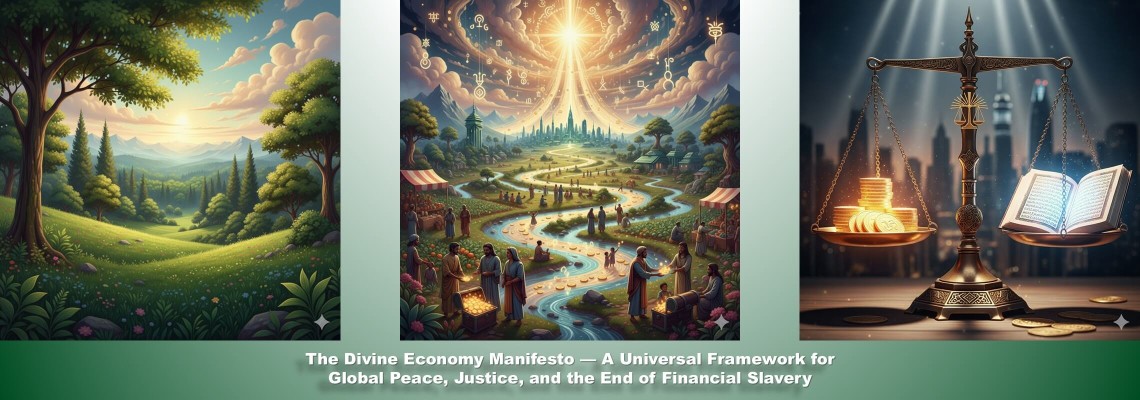
Introduction — The Divine Pattern of Provision
A Global Islamic Economic Manifesto
The story of wealth, sustenance, and human survival begins not in the markets of the Earth, but in the divine gardens of Paradise. The first provision granted to humanity was not gold or silver, but trust — the sacred Amanah that Allah entrusted to Adam (‘alayhis-salām) and his progeny: the balance between need and greed, use and abuse, sharing and hoarding.
(وَفِي السَّمَاءِ رِزْقُكُمْ وَمَا تُوعَدُونَ)
“And in the heaven is your provision and whatever you are promised.”
— Qur’an 51:22
Before the first coin was ever minted, the earth itself was the treasury of mankind. Every tree, drop of water, mineral, and grain of sand was an unspoken divine grant. Humanity was never meant to compete for wealth; it was designed to cooperate in sustenance. The divine pattern was not inequality, but balance.
— Mawlana Shaykh Nazim al-Haqqani (qaddasAllahu sirrahu)
The First Lesson of Paradise
When Adam (‘alayhis-salām) was placed in Jannah, he was surrounded by abundance — rivers flowing, fruits hanging, and peace reigning. Yet, he was given a single restraint: not to touch a particular tree. This was the first divine economy — a balance between unlimited access and moral responsibility. The test was not hunger; it was self-restraint.
(وَكُلَا مِنْهَا رَغَدًا حَيْثُ شِئْتُمَا وَلَا تَقْرَبَا هَٰذِهِ الشَّجَرَةَ)
“Eat freely of the Garden wherever you will, but do not approach this tree...”
— Qur’an 2:35
This divine pattern — freedom balanced by moral law — would later evolve into the laws of trade, charity, and zakāh. Every prophet who came after Adam reminded mankind of this same equation: wealth is a trust, not a right.
When Adam and Eve Descended from Paradise
When Sayyidunā Ādam (عَلَيْهِ ٱلسَّلَامُ) and Sayyidah Ḥawwā (عَلَيْهَا ٱلسَّلَام) descended to Earth, they carried the memory of Divine nearness — the rule of balance (mīzān), trust (amānah), and innate contentment (riḍā). In Paradise there was no ownership or currency; provision was direct from the Creator.
(...وَلَقَدْ كَرَّمْنَا بَنِي آدَمَ وَحَمَلْنَاهُمْ فِي الْبَرِّ وَالْبَحْرِ)
And indeed We have honored the children of Adam…
— Surah Al-Isra’ 17:70
On Earth the perfect abundance was replaced by effort and exchange. This is where the first human valuation took shape — not yet in metals or coins, but in labor, trust, and intent. Allah declares that He made some above others as a test:
(...وَهُوَ الَّذِي جَعَلَكُمْ خَلَائِفَ الْأَرْضِِ)
And He it is Who has made you successors upon the earth and raised some of you above others in degrees, that He may try you in what He has given you.
— Surah Al-An’am 6:165
Shaykh Nazim on the First Loss
“When people began to love gold more than the faces of the poor, they lost the Divine Light in their eyes. The heart that counts coins forgets to count its blessings.”
The First Exchange: Barter and Divine Balance
2. The First Exchange: Barter and Divine Balance
In the generations after Adam, communities functioned on barter — food for tools, cloth for shelter. This economy preserved a natural balance: value was visible and physical, not abstract. Exchanges depended on transparency, honor, and trust. Scholars and Awliyā’ later called this the Age of Amānah (Trust).
| Paradise (Jannah) | Earth After the Fall |
|---|---|
| Sharing & abundance | Ownership & hoarding |
| Trust & balance | Fear & competition |
| Divine sustenance (rizq) | Self-made currency (value systems) |
3. The Divine Currency: The True Meaning of Value
Allah’s measurements are not of metal or paper. True currency in the Divine view is niyyah (intention), ikhlāṣ (sincerity), and ṣadaqah (charity). The Qur’an warns that on the Day of Judgment no amount of wealth will save a heart that is impure:
يَوْمَ لَا تَنفَعُ مَالٌ وَلَا بَنُونَ إِلَّا مَنْ أَتَى اللَّهَ بِقَلْبٍ سَلِيمٍ
“The Day when neither wealth nor children will benefit anyone, except he who comes to Allah with a pure heart.” — Surah Ash-Shu‘arā’ 26:88–89
The practical implication: purify wealth by giving, by releasing hoarded treasures into circulation for the needy. That circulation is the lifeblood of fair societies — a principle emphasized by the Prophets and the Awliyā’.
Key Principles (Early Age)
- Labor = primary source of value
- Trust and transparency in exchange
- Distribution of surplus by moral duty
Social Result
Communities remained resilient; hoarding was socially discouraged; those who produced were honored; wealth flowed like water and healed social wounds.
4. Awliyā’ and the Spiritual Diagnosis
The saints (Awliyā’ Allah) repeatedly explained that the corruption of economy is first a corruption of the heart. An oft-quoted diagnosis:
Hazrat Shaykh Nazim would often say that the spiritual loss was immediate: the more a society measures success by accumulation, the faster its communal light extinguishes.
The Descent and the Division
When Adam descended to Earth, wealth was not yet measured. Land was open, water was shared, and sustenance flowed naturally. The descent brought physical separation but not yet economic inequality. The first form of exchange was gratitude and service — not coins and notes.
— Anonymous Sufi Saying
But as time passed, humanity’s heart became distant from divine remembrance. The concept of possession began to form. “This is my land,” “this is my fruit,” “this is my tool.” The tongue of unity slowly became the language of division. From gratitude emerged ownership, from ownership came control, and from control — greed.
From Divine Balance to Economic Exploitation
Every prophet warned about imbalance. When nations began to hoard wealth, they decayed spiritually and politically. Pharaoh claimed ownership of rivers; Qarun stored gold until the ground swallowed him. The Qur’an, the Torah, the Bible — all echo the same divine law: Wealth must circulate.
(كَيْ لَا يَكُونَ دُولَةً بَيْنَ الْأَغْنِيَاءِ مِنْكُمْ)
“So that wealth may not merely circulate among the rich among you.”
— Qur’an 59:7
The divine system was based on circulation, not accumulation. Modern banking inverted this principle, transforming wealth from a river into a dam. Nations, corporations, and individuals began to suffocate in debts created by man, while ignoring the abundant mercy created by Allah.
A Message for the Modern World
This introduction is not a history — it is a mirror. In the age of artificial intelligence, digital currencies, and unseen wars of economy, man is again being tested with the same tree of desire that stood in Paradise. Only now, the tree has new fruits: stock markets, cryptocurrencies, and consumerism.
Yet the divine principle remains the same: Humanity was not created to earn endlessly, but to live consciously.
— Mawlana Shaykh Nazim al-Haqqani
As we proceed through this grand exploration — from the origins of wealth in Paradise to the spiritual and social healing of nations — this blog stands as a manifesto for a world beyond money: a world of balance, compassion, and divine justice.
Part 2 — The Origin of Wealth: From Paradise to Earth
Wealth did not begin as coins or jewels; it began as divine abundance. Before mankind’s descent to Earth, the treasury of existence was already overflowing — not in material but in mercy, beauty, and trust. What humans later called “wealth” was originally a reflection of divine generosity.
(اللَّهُ الَّذِي خَلَقَ السَّمَاوَاتِ وَالْأَرْضَ وَأَنْزَلَ مِنَ السَّمَاءِ مَاءً فَأَخْرَجَ بِهِ مِنَ الثَّمَرَاتِ رِزْقًا لَكُمْ)
“Allah is He Who created the heavens and the earth and sent down water from the sky,
then brought forth with it fruits as provision for you.”
— Qur’an 14:32
The First Currency Was Gratitude
In the Garden, Adam (‘alayhis-salām) never worked, traded, or hoarded. He only received — and thanked. His gratitude was the first currency of existence. The more he thanked, the more Allah expanded his nearness. This was the purest form of economy — an economy of the soul, where thankfulness generated abundance.
Gratitude was not only a prayer; it was the first law of sustenance.
When Adam disobeyed, he did not lose only a garden — he lost a world without trade, a life without debt, and a sustenance without struggle. The descent to Earth was the beginning of the human economy: where every grain would now require effort, and every blessing would require remembrance.
The Birth of Labor
On Earth, the law of sustenance took a new form. Allah declared that man shall earn “by the sweat of his brow,” meaning effort would now become part of the equation of provision.
(فَإِذَا قُضِيَتِ الصَّلَاةُ فَانْتَشِرُوا فِي الْأَرْضِ وَابْتَغُوا مِنْ فَضْلِ اللَّهِ)
“When the prayer is finished, disperse through the land and seek the bounty of Allah.”
— Qur’an 62:10
Here begins the sacred meaning of work. Labor, when done with remembrance, becomes worship; but when done with greed, becomes slavery. The Sufis say: “Work with your hands, but never let your heart leave His remembrance.” Thus, the line between trade and prayer was once almost invisible.
— Hazrat Data Ganj Bakhsh (رحمة الله عليه)
The First Markets
As tribes multiplied, man discovered the logic of exchange — barter. Wheat for wool, milk for pottery, leather for tools. These early exchanges carried not greed but trust. A handshake was enough; no signatures, no ledgers, only honor and truthfulness.
This era — the Era of Barter — preserved moral dignity. People believed that “to cheat in trade is to cheat your own soul.” The Prophet Muhammad ﷺ later confirmed this ethic in the words:
“The truthful and trustworthy merchant will be with the Prophets, the truthful, and the martyrs.” — (Tirmidhi)
The Spiritual Secret of Circulation
From Adam to Ibrahim, from Musa to Isa (‘alayhim as-salām), all divine teachings emphasized that sustenance grows only when it moves. The Qur’an calls this divine motion “Infaq” — giving, spending, circulating. The economy of Heaven is not about saving, but serving.
The divine market has no inflation — only expansion through generosity.
When people stopped circulating wealth, stagnation began. Poverty appeared, not because the earth became less fruitful, but because hearts became less generous. Spiritual poverty was the first real economic crisis.
Prophetic Economies — The Model of Justice
When prophets established societies, they built moral economies. Prophet Yusuf (‘alayhis-salām) created Egypt’s first grain reserve not to profit, but to protect the poor. Prophet Shu‘ayb (‘alayhis-salām) warned against dishonest scales. Prophet Muhammad ﷺ abolished interest, monopolies, and exploitation.
Thus, divine economics was never a theory — it was a way of life. Its pillars were trust, equity, compassion, and accountability before Allah.
(وَيْلٌ لِلْمُطَفِّفِينَ الَّذِينَ إِذَا اكْتَالُوا عَلَى النَّاسِ يَسْتَوْفُونَ)
“Woe to those who give less [than due], who when they take from people demand in full.”
— Qur’an 83:1–2
The Hidden Test Within Wealth
Every coin is a witness — either for us or against us. Wealth tests the righteous not by hunger but by choice. To spend in the path of Allah is the purification of wealth, but to hoard it is the pollution of the soul.
— Hazrat Ali (كرم الله وجهه)
Thus, the spiritual masters taught that earning halal and spending with intention transforms ordinary wealth into barakah. But earning through deceit or oppression corrupts it, turning the same gold into a burden on the Day of Judgment.
The Sufi View: Rizq Is Written, Not Earned
The Awliya Allah revealed that sustenance is decreed, not determined by one’s effort. A person may strive endlessly, but he will never receive more than what is destined — nor lose what is truly his. This divine assurance releases the heart from greed.
— Hadith (Ibn Majah)
Hence, the Sufis say: “Don’t chase rizq — chase the One Who provides it.” The true trader is the one who bargains his desires in exchange for divine pleasure.
— Mawlana Jalaluddin Rumi
The origin of wealth is not in gold, silver, or labor — it is in the heart’s relationship with the Divine. The same hand that earns can either build a palace or a prison, depending on what intention rules it.
Part 3 — The Corruption of Wealth and the Rise of Inequality
After the purity of divine circulation faded, mankind began to treat wealth as ownership rather than stewardship. This shift marked the first corruption in human civilization — the separation of wealth from worship. The treasures that were once meant to serve became thrones of domination.
(وَتُحِبُّونَ الْمَالَ حُبًّا جَمًّا)
“And you love wealth with immense love.”
— Qur’an 89:20
From Trust to Possession
In the earliest ages, wealth was seen as Amānah — a trust from Allah. But as generations passed, the ego began whispering ownership: “This is mine.” Thus began the disease of inequality. For when a man says, “mine,” he indirectly says, “not yours.” The distance between two hearts starts with that word.
The Invention of Hoarding
When wealth began to be accumulated rather than circulated, the rhythm of creation was disrupted. Hoarding killed motion; motionless wealth became dead wealth. Every divine system — from blood to rivers — flows. When flow stops, decay begins.
(وَالَّذِينَ يَكْنِزُونَ الذَّهَبَ وَالْفِضَّةَ وَلَا يُنفِقُونَهَا فِي سَبِيلِ اللَّهِ فَبَشِّرْهُم بِعَذَابٍ أَلِيمٍ)
“Those who hoard gold and silver and do not spend it in the way of Allah —
give them glad tidings of a painful punishment.”
— Qur’an 9:34
The Qur’an thus warns that wealth without circulation becomes a form of oppression. The rich man becomes the new Pharaoh, and the poor his slaves. Inequality is not only an economic error — it is a spiritual sickness.
The Birth of Debt and Interest
As hoarding increased, circulation stopped — and borrowing was born. The lender became master, the borrower became servant. The first form of economic slavery appeared not with chains but with contracts.
(يَا أَيُّهَا الَّذِينَ آمَنُوا لَا تَأْكُلُوا الرِّبَا أَضْعَافًا مُّضَاعَفَةً)
“O believers! Do not consume usury, doubled and multiplied.”
— Qur’an 3:130
Interest transformed compassion into exploitation. What was once a loan of mercy became an instrument of dominance. From Babylonian temples to modern banks, the curse of Ribā remained the same — the few grow richer by the suffering of the many.
All Abrahamic prophets stood against usury. The Torah condemns it, the Psalms curse it, the Bible forbids it, and the Qur’an declares it a war against Allah and His Messenger ﷺ.
(فَإِن لَّمْ تَفْعَلُوا فَأْذَنُوا بِحَرْبٍ مِّنَ اللَّهِ وَرَسُولِهِ)
“And if you do not desist, then be informed of a war from Allah and His Messenger.”
— Qur’an 2:279
From Pharaoh to Modern Empire
The ancient Pharaohs enslaved bodies; modern systems enslave minds. The new empire is not built by armies but by credit ratings, media, and markets. Through debt, taxation, and manipulation of desire, the human being becomes a consumer — not a soul.
The Awliya Allah foresaw this. Shaykh Nazim al-Haqqani said:
— Shaykh Nazim Al-Haqqani (ق)
The Psychological Collapse of Equality
As wealth concentrated in few hands, the human heart began to compare. The disease of envy entered — not against oppressors but neighbors. Competition replaced compassion; worth was now measured in possessions, not virtues.
Inequality does not only breed hunger — it breeds humiliation. The poor feel invisible; the rich feel invincible. Both lose humanity.
The Modern Mirage of “Progress”
Technology promised equality, but delivered illusion. The digital age multiplied information but divided compassion. The same machines that could unite hearts now isolate them behind screens.
The new corruption of wealth is not gold or silver — it is attention. Corporations no longer sell products; they sell distraction. The more distracted a person is, the less conscious he becomes, and the less he questions injustice.
The Divine Law of Balance
Allah’s universe operates in balance: day and night, male and female, giving and taking. When wealth becomes concentrated, this harmony breaks — and the earth responds with imbalance: economic crashes, mental diseases, social violence, and climate disasters.
Yet the mercy of Allah remains infinite. When man repents, gives, and returns to justice, the divine balance restores itself — both in the soul and the world.
Economic Revelations Across Religions (Qur’an, Bible, Torah, Psalms)
Every sacred book—whether revealed to Moses, David, Jesus, or Muhammad ﷺ—echoes a single divine law: “Wealth belongs to God alone.” Humanity has been entrusted to use, share, and multiply it for goodness, not for tyranny or pride. Each revelation brought a mirror to correct the greed of its era and realign humankind with the Divine Economy—an eternal system of justice, mercy, and balance.
“All scriptures speak one truth—that no soul has ownership except through service to others.” — Shaykh Nazim al-Haqqani
The Qur’an — Divine Balance and Accountability
(كُلُوا وَاشْرَبُوا وَلَا تُسْرِفُوا ۚ إِنَّهُ لَا يُحِبُّ الْمُسْرِفِينَ)
Eat and drink, but waste not by excess; indeed, He loves not the wasters.
— Qur’an 7:31
Islam’s economic philosophy stands upon three pillars: justice, moderation, and circulation. Wealth must flow like blood in the body—if it stops, corruption begins. The Prophet ﷺ said: “The upper hand is better than the lower hand.” (Bukhari)
The Qur’an repeatedly condemns hoarding (kanz) and interest (riba)—two cancers that drain compassion from society. It instructs the faithful to purify their wealth through zakat, which ensures that economic activity remains connected to spiritual responsibility.
| Qur’anic Principle | Economic Guidance | Spiritual Purpose |
|---|---|---|
| Zakat (Obligatory Charity) | Redistribution of wealth among needy | Purification of ego and social healing |
| Prohibition of Riba | Elimination of debt slavery and exploitation | Economic mercy and communal trust |
| Trust (Amanah) | Business conducted with honesty and balance | Alignment of trade with divine ethics |
(وَفِي أَمْوَالِهِمْ حَقٌّ لِّلسَّائِلِ وَالْمَحْرُومِ)
nd in their wealth there is a rightful share for the beggar and the deprived.
— Qur’an 51:19
“Charity extinguishes divine anger, and connects the heart of the giver with the mercy of Heaven.” — Hadith
The Bible — Compassion as Currency
The teachings of Jesus (peace be upon him) transform economics into ethics of the heart. The true kingdom is not in accumulation but in contentment and service. The early followers of Christ practiced communal sharing—“All who believed were together and had all things in common.” (Acts 2:44)
“It is easier for a camel to go through the eye of a needle than for a rich man to enter the Kingdom of God.” — Jesus (Mark 10:25)
The Biblical economy envisions forgiveness of debts every seven years (Deuteronomy 15:1) and Jubilee every fifty years—a system in which lands and properties return to their rightful families, ending generations of oppression. This divine rotation is a clear parallel to the Islamic concept of barakah through circulation.
The Torah — Justice in Transaction and Inheritance
The Mosaic law builds an economic system around moral responsibility. Every transaction must uphold the dignity of both parties. The Torah forbids charging interest to fellow Israelites (Exodus 22:25) and commands gleaning rights—leaving crops for the poor and travelers (Leviticus 19:9-10).
“The land shall not be sold permanently, for the land is Mine; you are but strangers and sojourners with Me.” — Leviticus 25:23
This ancient statement echoes the Qur’anic truth: “To Allah belongs whatever is in the heavens and the earth.” (Qur’an 2:284). Both scriptures confirm that ownership is temporary and custodial.
The Psalms — The Spiritual Dimension of Sustenance
The Psalms transform economics into poetry, teaching gratitude as the root of abundance. Prophet David (peace be upon him), a king yet an ascetic, reminds us that real power lies in submission. His songs celebrate simplicity, humility, and the inner joy of serving others.
“The righteous will never be forsaken, nor their children beg for bread.” — Psalm 37:25
Universal Call — Unity of Divine Economics
The holy books, when read together, reveal a single moral economy: Justice, Mercy, Circulation, and Detachment. From Moses to Muhammad ﷺ, from the Psalms to the Qur’an, the command remains constant— “Share, forgive, and return to balance.”
“In every scripture, God taught that what you hold too tightly will one day hold you.” — Sufi Saying
Thus, divine economics is not a theory—it is a mirror to our soul. Each scripture offers humanity the same truth in different languages: that greed divides, but gratitude unites. The coming global model must be rooted in this interfaith harmony, drawing from the original covenant of justice that all prophets carried.
The Sufi Vision of Detachment and Universal Balance
The saints (Awliyāʼ Allāh) present a healing diagnosis for the sickness of our age: the heart has been colonised by attachment to things, and the economy has been severed from the soul. Sufism proposes a practical, spiritual, and social remedy — a doctrine of detachment (zuhd), trusteeship (amānah), and the cosmic balance (mīzān).
1. What Sufism Means by Detachment (Zuhd)
Zuhd does not mean negligence of duties nor withdrawal from society. Rather it is a transformation of intention: one continues in work, family, and trade but the heart remains free. Where the world becomes an end, sorrow follows; where the world remains a means, mercy follows.
2. Trusteeship (Amānah): Reclaiming Ownership as Responsibility
Sufis insist that everything is ultimately the property of the Creator; humans are merely trustees. This redefinition changes policy: land, resources, and wealth should be managed for the common good rather than as instruments of personal immortality.
3. The Cosmic Balance (Mīzān) and Economic Equilibrium
The Sufi metaphysic of mīzān sees justice as an ontological imperative: the universe itself rests upon measured balance. Economic policies that disrupt this balance — extreme inequality, abusive credit, ecological pillage — invite correction through social and natural crises.
4. Economic Practices Inspired by the Saints
From Bayt al-Māl to Waqf, the Islamic tradition includes practical tools that mirror Sufi ethics. The saints encouraged:
- Regular charitable distribution (ṣadaqah / zakah) to cleanse accumulation.
- Endowments (waqf) to fund schools, hospitals and public goods permanently.
- Mutual-credit and trust-based exchange networks to reduce dependence on predatory finance.
- Simple lifestyles for leaders to model sufficiency and remove incentives for predation.
5. The Inner Economy: Niyyah and Barakah
Sufis teach that all external economics arises from an inner economy of intention. The concept of barakah (blessing) is the signature of correctly oriented intention: modest provision, rightly spent, grows beyond arithmetic expectation.
6. Sufi Responses to Modern Economic Structures
Confronted with credit economies, algorithmic markets, and data extraction, Sufi wisdom offers practical interventions:
- Institutionalize waqf-like public trusts for essential services (health, education, housing).
- Create mutual aid networks that function on reputation and spiritual accountability rather than collateral.
- Promote ethical finance models (profit-share, cooperative banking) that align with trusteeship values.
- Embed contemplative practice in professional and civic life to reduce anxiety-driven consumption.
7. Leadership, Example and Structural Reform
The Sufi path stresses leadership by example. If rulers live modestly and legislate to ensure provision for all, a cultural transformation becomes possible. Structural reforms inspired by Sufi ethics include:
- Public provision guarantees (housing, primary health, basic education).
- Progressive disincentives for hoarding: graduated social contributions on large inactive wealth.
- Support for community cooperatives and commons-based management.
- Embedding spiritual education about trusteeship into national curricula.
These measures are not ideological luxuries — they are pragmatic guardrails to realign incentives with the cosmic mīzān.
The Sufi vision is radical only in appearance: it calls for nothing supernatural, only for a reorientation of intention, leadership, and law. If communities practice trusteeship and leaders model sufficiency, the economy becomes an instrument of compassion — and the world returns toward balance.
The Shaykh Nazim Forecast — The Final Battle of Economy vs. Faith
Throughout the 20th and 21st centuries, Mawlana Shaykh Nazim Al-Haqqani (قُدِّسَ سِرُّهُ العَزِيز) warned the world that the greatest war of our time would not merely be fought with weapons, but with the hidden sword of economic enslavement. He called it “the last and most subtle fitnah of Dajjāl” — the deception of money that replaces the remembrance of Allah with dependence upon systems, cards, and digits that can vanish in a second.
1. The Hidden Fitnah of the Economic Dajjāl
Shaykh Nazim described Dajjāl not as a one-eyed monster in simple physical form, but as a system of deception — a mechanism that blinds the spiritual eye. He said that when the world becomes fully dependent upon artificial currencies and detached from food, earth, and faith, then Dajjāl’s system is complete.
In one of his powerful speeches, he warned that a time would come when the money would have no value; only gold, silver, and direct exchange of food and faith would save the believer. He said the spiritual people will return to nature, to land, to pure water, and to prayer — these will be the true currency of survival.
2. The Collapse of False Systems
Shaykh Nazim foresaw the digital age — the rise of electronic money, global banking algorithms, and data-driven slavery. He said that when the human being’s worth becomes a number, the mercy of the world will vanish. This system, he said, will eventually collapse under its own injustice, and people will cry for a system that brings mercy before profit.
3. Faith as the True Capital
Shaykh Nazim reminded followers that in every era, true wealth has always been Īmān (faith). When the heart is rich with remembrance, every hunger becomes light, every poverty becomes endurance, and every limitation turns into grace. He said that the final battle between economy and faith will be the battle of heart versus machine.
4. Return to Simplicity: The Survival Path
He advised people worldwide to return to farming, natural living, clean food, and direct exchange. “Every believer,” he said, “should plant something before the great collapse.” He encouraged self-sufficiency and community harmony as the real investment.
5. The Coming Great Purification
Shaykh Nazim foretold that before the emergence of true peace, there would be a purification — a global reset caused by human arrogance, economic greed, and moral blindness. He said this period would expose all systems built upon lies and force people to rediscover sincerity and cooperation.
His call was never about fear but about readiness — to return to faith before the storm forces return. He urged people to learn contentment and to protect their time, family, and worship as sacred currencies.
6. Signs of the End-Time Economy
- Wealth controlled by invisible digits and algorithms.
- Loss of barakah (blessing) — more income, less peace.
- Mass anxiety and depression replacing contentment.
- Exploitation of human desires through advertisements and loans.
- Global debt systems creating spiritual and moral slavery.
He emphasized that these signs are not to frighten but to awaken — to build the Noah’s Ark of spiritual economy where generosity, simplicity, and sincerity will float above the flood of material chaos.
the poor man’s prayer will outshine the banker’s might.” — (Naqshbandi Poetic Wisdom)
Thus, Shaykh Nazim’s forecast stands as both prophecy and program: detach from illusion, return to simplicity, rebuild the heart’s economy, and live in remembrance. Only then will humanity survive the storm that money has created.
The Super Economic Model — Family-State Paradigm
When the empires of greed collapse and digital thrones vanish, what shall rise next? The answer, revealed through the light of Prophetic wisdom and echoed by the saints, is the Family-State Paradigm — an economic structure that imitates the compassion of a family within the organization of a just state. It is the earthly shadow of the divine order where mercy replaces interest, trust replaces taxation, and service replaces exploitation.
1. The Blueprint of the Prophetic Household
In the house of the Prophet ﷺ, every person ate according to need, not status. This divine balance — need-based distribution — became the model for the first Islamic economy under the rightly guided caliphs. There was no concept of hoarding, because rizq (sustenance) was viewed as a trust from Allah, not a private property.
2. The State as a Family of Souls
The Family-State paradigm re-imagines governance not as power over citizens but as care over dependents. The ruler becomes the father, the ministers the elder siblings, and the people the children — each with duty and dignity. Taxes are replaced by voluntary contributions motivated by ihsān (excellence) and shukr (gratitude).
3. Circulation Instead of Accumulation
Modern economics thrives on hoarding and inequality. The Family-State system revives the Qur’anic principle of circulation of wealth, ensuring no soul starves while another drowns in luxury.
Zakat, Sadaqah, and Waqf together create a continuous flow — like the blood in a healthy body. In this model, every excess becomes nourishment for another’s need.
4. Work as Worship — The Spiritual Labor Economy
In the Family-State, every act of honest labor is counted as worship (ʿibādah). Employers become guardians of human souls, not buyers of time. Profit is seen as a divine reward for service, not a manipulation of markets.
5. No-Cost Governance and Communal Wealth
In this model, governance becomes a service of love. State officers are not salaried lords but caretakers sustained by communal resources. Education, healthcare, water, and land become shared trusts — Amānah — not commodities.
6. Technological Justice — Tools Serving the Soul
Unlike capitalist technology that exploits emotion, the Family-State integrates ethical technology — designed to ease human suffering, not to expand consumer addiction. Digital transparency ensures no corruption, while artificial intelligence becomes a servant of conscience.
7. From Survival to Fulfillment — The Paradise-Like Vision
The Family-State does not aim at mere survival but at spiritual fulfillment. Its ultimate goal is to manifest on earth the attributes of Raḥmah (Mercy), ʿAdl (Justice), and Barakah (Blessing). It teaches that true civilization begins when every person wakes up without fear of hunger or humiliation.
Thus the Family-State Paradigm becomes not a utopia of theory but a prophecy of destiny — a living model waiting to rise from the ruins of greed. It begins from the home, expands to the street, and blooms into a civilization where love is the currency and justice the law.
Implementation Framework for Global Peaceful Economics (UN Section)
Humanity now stands on a historic threshold — the point where the economic machine must either transform into a system of divine balance or collapse under its own injustice. The United Nations, world governments, and global institutions have the unprecedented opportunity to redefine economics as a moral science rather than a market formula. This section outlines the actionable, spiritual, and institutional framework to establish a Global Peaceful Economic System rooted in divine mercy and social equality.
1. The Divine Principle of Shared Ownership
Every human being is born with an equal right to the earth’s resources. The future economic structure should be built on collective custodianship instead of private ownership. Nations remain sovereign, but all natural resources — water, air, energy, and agriculture — are recognized as trusts of humanity under divine law.
2. Establishing the Global Council of Ethical Economics (GCEE)
The United Nations can form a Global Council of Ethical Economics — a multidisciplinary body composed of economists, spiritual scholars, philosophers, and social leaders from all faiths. Its mission: to audit global financial systems not by GDP or debt ratios, but by their ethical and human impact indices.
| Domain | Old Paradigm | New GCEE Paradigm |
|---|---|---|
| Economic Evaluation | GDP & Deficit | Human Happiness & Justice Index |
| Monetary System | Interest, Debt, Credit | Service, Barakah, and Human Effort |
| Trade Philosophy | Profit Maximization | Mutual Benefit and Compassion |
| Resource Ownership | Privatized Exploitation | Collective Stewardship |
3. Global Wealth Redistribution Program
The new system must reintroduce the moral spirit of zakat at a global scale — not as charity, but as obligatory justice. Every multinational corporation exceeding a certain annual threshold should contribute to an International Human Equality Fund governed transparently by the GCEE.
4. Digital Governance and Transparency
Technology must be repurposed as a servant of honesty. Through blockchain and global biometric registration, every financial transaction can be transparent, traceable, and accountable. This removes corruption, black markets, and illicit wealth — the three poisons of modern civilization.
5. Abolishing Interest-Based Lending
The UN’s charter should be amended to recognize interest-based lending as an act of economic violence. Global financial institutions must transform into partnership-based cooperative models where risk and profit are shared, aligning with Qur’anic and Biblical commandments.
6. The Global Employment and Skill Security Program
Governments will ensure every citizen’s livelihood through state-supported skill networks. Instead of unemployment benefits, citizens are given direct access to training, business tools, and community projects — fulfilling the divine principle that everyone works with dignity.
7. Global Peace Treaties through Economic Equality
Wars today are fought for economic control — not survival. When nations adopt equality in trade and resource access, war loses its motive. The UN should facilitate treaties of peace where natural resources are shared, not weaponized.
8. GNH Monitoring and United Nations Transformation
The UN should transition from GDP-based policy evaluation to a Gross National Happiness (GNH) framework. This includes mental health, ethical economy, family stability, and environmental compassion. Each nation submits an annual Happiness Report instead of an Economic Growth Report.
This transformation is not merely bureaucratic — it is prophetic. It fulfills the ancient promise that humanity will return to its fitrah (natural order) and that nations will become like tribes in a single family of souls.
From GDP to GNH — Happiness as the New Wealth
The modern world worships a false god named GDP — Gross Domestic Product. It measures the movement of money, not the meaning of life. Under its rule, war, disease, and pollution all add to “growth.” The time has come to replace this illusion with a living measure of human and spiritual prosperity — Gross National Happiness (GNH).
1. The Spiritual Logic of Happiness Economics
Happiness is not pleasure. It is the peaceful equilibrium of the soul. A system that ignores inner balance cannot produce outer peace. Therefore, every economic metric must begin by asking: “Does this decision increase compassion, trust, and spiritual well-being?”
2. The Four Pillars of Gross National Happiness
Adapted and expanded from the Bhutanese model, but integrated with Qur’anic ethics, GNH rests on four universal pillars:
- Ethical Governance: Leaders accountable not only to law but to conscience.
- Balanced Development: Economy aligned with environment and soul.
- Cultural and Spiritual Preservation: Protecting languages, traditions, and inner sciences.
- Environmental Harmony: Nature treated as a partner, not property.
3. Replacing Profit with Purpose
The concept of “profit” must evolve into purpose yield — the measurable value of a decision’s contribution to human happiness. A company’s worth is no longer its stock price, but its Social Joy Index (SJI) — how many lives it uplifts without exploitation.
| Old Economic Indicator | New GNH Equivalent |
|---|---|
| Corporate Profit | Social Joy Index (SJI) |
| GDP Growth Rate | Human Flourishing Index (HFI) |
| Consumer Spending | Mindful Consumption Ratio (MCR) |
| Unemployment Rate | Purpose Engagement Level (PEL) |
4. The Happiness Constitution for Nations
Every nation must integrate happiness and ethical well-being into its constitution. Ministries of Finance will be renamed Ministries of Well-Being. National budgets will include “Happiness Expenditure” lines to fund community, arts, nature restoration, and spiritual education.
5. Measurement through Inner and Outer Indicators
GNH combines both quantitative and qualitative dimensions. It measures not just health, education, and income, but also:
- Spiritual contentment and prayer frequency
- Family unity and community trust
- Time spent in nature and silence
- Honesty and fairness in daily trade
6. Integrating GNH into the UN Sustainable Goals
The United Nations must revise its Sustainable Development Goals (SDGs) to include GNH-based performance indicators. Every country’s progress will be reviewed not only by poverty reduction but by spiritual satisfaction, ethical governance, and ecological compassion.
7. The Moral Dividend: A New Currency of Blessing
Under a GNH-based system, nations will earn a Moral Dividend for every ethical and compassionate policy. This dividend replaces interest-based global credits and encourages cooperation between states for peace and shared prosperity.
As this system matures, humanity will rediscover the original Qur’anic vision of economy: a world where trade serves the heart, not the ego, and where wealth becomes the instrument of love rather than dominance.
The Return of the Moral Market and the Age of Compassionate Trade
When wealth ceases to define worth, the marketintentions. Humanity will rediscover that commerce was once an act of service, not competition — a means to nourish the world, not to dominate it.
1. The Market as a Mirror of the Soul
Every market reflects the morality of its participants. In the early days of human civilization — from the bazaars of Madinah to the markets of Damascus, Baghdad, and Delhi — merchants were teachers of ethics. Trust (Amanah) was the true currency. The Prophet Muhammad ﷺ said:
The modern corporate world reversed this sacred order — turning trust into transaction and competition into greed. The coming transformation will restore the Moral Market, where every purchase is an act of compassion and every exchange an offering to humanity.
2. The End of Exploitation-Based Supply Chains
The new market system must dismantle hidden slavery — the exploitation of laborers, farmers, and artisans. A compassionate economy ensures every worker is honored, every wage is fair, and every hand in the chain receives blessing.
3. Spiritual Trade Ethics: The Law of Divine Exchange
Islam, like all divine revelations, established the Law of Divine Exchange: give what you love, to receive what you need. This is the core of economic spirituality. The Qur’an declares:
Under this principle, charity becomes capital and generosity becomes investment. The moral market rewards those who circulate goodness, not hoard wealth. This divine economics abolishes scarcity through gratitude.
4. The Rebirth of Local Economies and Ethical Guilds
The next civilization will revive guild-based trade — networks of artisans, farmers, healers, and scholars working under ethical charters. Digital technology will connect them globally, but their ethics will remain local and human-centered. This will end monopoly structures and ensure circular prosperity.
5. The Sufi Merchants — Caravans of Light
In history, the spread of Islam, truth, and balance came not by armies but by merchants — the caravans of light carrying silk, spices, and sincerity. Their scales were fair, their tongues truthful, and their faces radiant with trust. They built economies of faith across oceans and continents.
The Naqshbandi Path reminds us that every act of buying and selling can be zikr — remembrance of Allah — when done without deceit or pride. Shaykh Nazim Al-Haqqani ق said:
6. The Age of Compassionate Trade: A New Global Charter
The United Nations and interfaith leaders must now initiate the Global Charter of Compassionate Trade — a universal agreement banning exploitative production, unethical marketing, and financial usury in all forms. Instead, trade will be guided by transparency, equity, ecological care, and mutual prosperity.
| Old Model | New Compassionate Model |
|---|---|
| Profit from weakness | Empowerment through partnership |
| Competition for market | Cooperation for humanity |
| Hoarding of resources | Shared stewardship of creation |
| Brand dominance | Cultural humility |
This is the dawn of a new economic order — one that blends divine wisdom, modern governance, and spiritual ethics. When nations and individuals begin trading compassion instead of commodities, the world will finally rediscover its lost equilibrium.
Life Expectancy, Health, and the Return to Divine Balance
In the early chapters of human history the human frame carried a different rhythm — a life tuned to divine order. Scriptures mention extraordinarily long lives (for example, the age of Nūḥ ﷺ) and prophets who lived centuries as part of a divinely sustained design. This section examines how social, spiritual and economic corruption shortened human lifespans, and how the manifesto’s return to balance can restore health, vitality, and longer life.
1. How Life Expectancy Changed — Spiritual & Material Causes
Several interlinked causes reduced life expectancy over millennia:
- Spiritual disconnection: loss of regular remembrance, gratitude and moral discipline.
- Environmental degradation: polluted air, toxic soils, and disrupted ecological cycles.
- Poor nutrition: processed foods and loss of local, regenerative agriculture.
- Psychosocial stress: chronic anxiety produced by inequality and debt slavery.
- Medical industrialization: dependence on profit-driven treatment rather than prevention.
2. Comparative Snapshot: Ages, Health & Spirituality
| Period | Typical Lifespan | Health Profile | Spiritual Context |
|---|---|---|---|
| Adamic / Early Prophetic | Centuries (scriptural accounts) | Robust, regenerative | Direct divine connection, abundant barakah |
| Classical / Pre-Industrial | 100–300 years (gradual decline) | Strong immunity, varied local diets | Religious life integral to daily routines |
| Industrial / Modern | 60–80 years (varies by region) | Rise of chronic disease | Fragmented spiritual practices |
| Manifesto Future (Projected) | 150–250+ years (with balance) | Low chronic morbidity; high resilience | Reintegration of remembrance, community and ecology |
3. The Manifesto Remedies — Policy & Practice
To restore life expectancy and health the manifesto proposes an integrated program of spiritual, social and medical reforms:
- Regenerative local agriculture (community gardens, seed banks, medicinal plants).
- Daily public rhythm — civic time carved for prayer, remembrance (dhikr), rest and light meaningful labor.
- Public health as prevention — nutrition, sleep hygiene, mental-health practices, nature exposure over pill-first medicine.
- Waqf-funded healthcare — permanent endowments for clinics prioritizing prevention and spiritual counseling.
- Work-life reconfiguration — shorter paid weeks, dignity of labor, and skill guarantees so people aren’t forced into exploitative work.
- Ban on predatory products — strict limits on artificial chemicals, addictive designs, and exploitative marketing.
4. Spiritual Practices That Extend Life
The Awliyā’ and prophetic teachings give concrete practices linked to longevity:
- Consistent remembrance (dhikr) and gratitude (shukr) to reduce stress and open barakah.
- Moderation in eating and fasting cycles to stimulate cellular repair.
- Physical labor in nature (gardening, walking) to strengthen immunity and mental clarity.
- Community service — builds social bonds that lower mortality risk.
- Meaningful worship and purpose — psychological resilience improves biological outcomes.
“A heart that remembers its Lord is a body that heals itself.” — (Shaykh Nazim / Sufi teaching)
5. Medical & Scientific Actions
Science must serve the soul. Practical scientific steps include:
- Research into regenerative diets based on traditional foods and medicinal plants.
- Funding longevity studies emphasizing psychosocial and spiritual variables.
- Community-based health centers integrating conventional medicine with counseling, nutrition and spiritual care.
- Urban planning that maximizes green space, clean air, and natural rhythms of light and water.
6. Measures of Success — Health & Happiness Indicators
Replace narrow metrics with integrated indicators:
- Average healthy-life expectancy (HALE) combined with spiritual well-being scores.
- Community resilience index: social bonds, food security, local health capacity.
- Barakah index: qualitative surveys measuring perceived blessing and gratitude.
- Environmental health index: air, water and soil purity.
7. A Final Reflection — The Return to Divine Rhythm
The manifesto argues that health and longevity are collective goods. When systems prioritize dignity, rest, remembrance and ecological balance, bodies regenerate and lifespans extend. This is not mere wishful thinking — it is a return to the cosmic design that blessed early humanity.
End of Part 10 — Life Expectancy, Health, and the Return to Divine Balance. Next: The Future Human Civilization — Science Serving the Soul.
The Future Human Civilization — Science Serving the Soul
Humanity stands at the threshold of a profound transition — from a civilization that worships consumption to one that sanctifies consciousness. The coming era, if aligned with divine wisdom, will not abolish science; it will redeem it. The manifesto envisions a world where knowledge once enslaved to profit is purified to serve life, justice, and remembrance.
Science, when stripped of soul, becomes a mechanical god. It feeds pride, not purpose; expansion, not enlightenment. The future we must build is one where the microscope and the prayer rug face the same direction — both toward Truth (الحق).
1. The Crisis of Modern Knowledge
Modern knowledge, stripped of soul, turned from revelation to speculation. The intellect, divorced from spirit, produced instruments of comfort that birthed confusion. The manifesto names this as ‘the fall of the sacred in science.’
- Science without mercy: innovation that extracts but does not heal.
- Technology without conscience: machines that multiply loneliness.
- Economics without ethics: research enslaved to shareholders.
- Education without awakening: facts memorized, but wisdom forgotten.
1. The Purpose of Science in the Divine Economy
In the early revelations, knowledge (‘Ilm) was a sacred trust — a light bestowed to guide humanity toward justice, mercy, and gratitude. The Prophets were the first scientists, decoding the language of the universe through the remembrance of Allah. But modern civilization divorced knowledge from remembrance, and hence, turned science into commerce.
The Qur’an repeatedly invites reflection upon creation:
وَفِي الْأَرْضِ آيَاتٌ لِّلْمُوقِنِينَ، وَفِي أَنفُسِكُمْ أَفَلَا تُبْصِرُونَ
“And on the earth are signs for those who have sure faith, and in your own selves — will you not see?” (Surah Adh-Dhariyat, 51:20–21)
The new civilization must restore this divine pattern — science must serve the purpose of existence, not the marketplace. Every innovation should pass a moral audit: Does it heal or harm the planet? Does it connect hearts or divide nations? Does it enrich the few or uplift the many?
2. The Re-sanctification of Science (Conscious Technology)
Artificial Intelligence, biotechnology, and quantum science are the new alphabets of human destiny. But unless guided by wisdom, they will enslave humanity under algorithms of greed. The true transformation lies in the concept of Conscious Technology — tools designed with compassion, awareness, and divine accountability. Machines must learn from the saints, not merely from data.
Science must again kneel before the Source of its light. Revelation and reason are not rivals; they are two wings of the same bird. When aligned, they elevate civilization from industrial chaos to spiritual ecology.
- Cosmology with dhikr: understanding creation as divine sign, not random event.
- Medicine with mercy: every cure seen as trust from Allah, not as commodity.
- Technology with humility: designed to restore time, not to consume it.
- Education with remembrance: teaching that connects the heart to meaning.
3. Technological Redemption — Designing for Soul
The manifesto calls for technological repentance: systems and devices that heal rather than harm. Every invention must now pass the test of compassion.
| Field | Current State | Redeemed Future |
|---|---|---|
| Artificial Intelligence | Predictive control, surveillance capitalism | Compassionate intelligence: empathy modeling, justice systems, knowledge for healing |
| Energy & Environment | Fossil exploitation, planetary exhaustion | Solar-divine grids, bio-harmonic designs, energy sufficiency |
| Communication | Addiction loops, vanity metrics | Networks of truth, remembrance and learning |
| Architecture | Concrete deserts, isolation towers | Eco-masjids, communal courtyards, nature integrated design |
The Integration of the Heart and Mind
The greatest discovery of the next century will not be interplanetary travel but the interdimensional travel of consciousness. Neuroscience will confirm what Sufis have always taught — that the heart is the true center of perception. Modern man has mapped the brain but ignored the heart, and thus, all his progress has failed to make him peaceful.
“The heart of man is a throne — either the Divine sits upon it, or the ego.” — Hazrat Ali (RA)
The future universities will teach meditation before mathematics, charity before chemistry, and gratitude before genetics. Education will no longer produce workers, but caretakers of creation.
Toward the civilization of Light: From Sufi cosmology, light (Nur) is the essence of all matter. When science rediscovers this truth — that all atoms are divine vibrations — then matter and spirit will unite again. The energy crisis, pollution, disease, and war will dissolve once humanity realigns technology with the rhythm of mercy.
“When technology exceeds the moral development of man, it becomes his executioner.” — Adapted from Albert Einstein
4. The Economy of Knowledge
The manifesto envisions a sacred economy of science — a waqf-based model where discovery serves the collective, not corporations. Scientists become trustees of divine signs, not owners of patents.
- Public research endowments sustaining non-commercial innovation.
- Open-source healing technologies accessible to all communities.
- Ethical certification of laboratories ensuring ecological and spiritual neutrality.
- Universal scientific literacy taught alongside spiritual ethics.
5. Spiritual Technologies — Tools of Awakening
The next frontier is not space, but consciousness. Technologies of the heart will rise: dhikr-aided meditation tools, sacred acoustics, bio-resonant healing devices — all tuned to divine remembrance rather than digital noise.
- Qur’anic frequency studies mapping healing sound patterns.
- Digital masjids — virtual sanctuaries for remembrance, accessible to the homebound.
- Bio-feedback dhikr counters teaching presence of heart.
- Planetary adhān systems synchronizing prayer and planetary cycles.
The Ethical Framework of Divine Science
Every scientific act will be judged by the principle of “Rahmah” (Mercy). Laboratories will adopt spiritual oaths like doctors once did with the Hippocratic Oath. The new oath of scientists will begin:
“By the Light that created me, I shall not invent that which harms the innocent, nor conceal that which could heal. I shall remember that truth is not mine to own, but mine to reveal.”
Science serving the soul means knowledge guided by humility. It means a global system where patents serve humanity, not corporations; where medicine heals before it profits; and where invention is an act of gratitude, not domination.
The last frontier is not Mars — it is the human conscience. The Qur’an, Bible, Torah, and Psalms all converge on the prophecy of a world where knowledge bows to compassion. This is the civilization promised in all divine scriptures — the age where science becomes the language of worship. When that day arrives, laboratories will be like mosques, observatories will become temples of gratitude, and scientists will be saints in lab coats — guardians of the divine trust known as knowledge.
6. The Soul as the New Frontier
The human soul is the final undiscovered continent. When science turns inward with sincerity, exploring consciousness through prayer, ethics and purification, it will rediscover the infinite worlds hidden within man — the true universes the prophets hinted at.
“He who knows his soul, knows his Lord.” — (Hadith)
7. A Final Reflection — The Science of Light
The future civilization will not separate physics from metaphysics, or laboratory from prayer. It will be a civilization illuminated — where data becomes dhikr, and equations bow before revelation. This is the rebirth of knowledge: science serving the soul.
End of Part 11 — The Future Human Civilization: Science Serving the Soul. Next: The Ethics of Time, Labor, and True Prosperity.
The Global Peace Framework and the Role of the United Nations
The age of global anxiety and manufactured wars is nearing its end. A new peace architecture is emerging — not enforced by weapons, but by wisdom. The manifesto envisions the United Nations as a renewed moral assembly: a house of justice guided by divine ethics rather than geopolitical interest.
1. Why the Present Order is Collapsing
Modern diplomacy failed because it was founded on competition, not compassion. Economic empires disguised as aid programs hollowed the spirit of unity. The collapse of this material order creates space for a moral renaissance.
- Debt traps have enslaved nations instead of liberating them.
- Media empires have shaped conflict more than truth.
- Arms economies have turned war into business.
- Climate neglect has exposed the moral bankruptcy of governance.
2. The Divine Peace Framework — Stepwise Restoration
The global peace framework will rise gradually, with divine economy and ethics reinstalled through stages of renewal:
| Phase | Timeline | Transformation Focus | Expected Outcome |
|---|---|---|---|
| 1. Moral Realignment | Years 1–5 | Formation of Global Council of Conscience (faith, ethics, ecology scholars) | Shift in global narratives from power to peace |
| 2. Economic Purification | Years 5–10 | Phased end of usury, debt slavery, and arms-based GDP | Balanced, value-based trade; debt forgiveness initiatives |
| 3. Institutional Renewal | Years 10–15 | UN restructured under a Spiritual Charter of Nations | Justice-centered global policies and conflict prevention |
| 4. Universal Integration | Years 15–25 | Education, media, and economy realigned with divine ethics | A global consciousness of peace and shared spiritual purpose |
3. The United Nations — From Political to Spiritual Authority
The manifesto redefines the UN’s purpose. Instead of managing crises, it must prevent them by moral authority. The UN of the future will derive legitimacy not from military might, but from spiritual consensus — the collective voice of nations purified from greed.
- Rewritten Charter: replacing political privilege with ethical responsibility.
- Permanent Council of Spiritual Leaders: guiding conflict resolution through wisdom and remembrance.
- Ethical Arbitration Tribunal: replacing veto power with virtue-based consensus.
- Transparent Peace Index: measuring nations by compassion, justice, and service to humanity.
“True sovereignty belongs not to nations but to justice itself.” — (Manifesto decree)
4. The Gradual Return of Divine Order
Every country will reabsorb divine economy at its own pace. The transition begins with those most burdened by inequality — Africa, South Asia, and the Arab world — spreading through trade reforms, ecological waqfs, and moral education systems. Within one generation, a planetary equilibrium will emerge: a world governed not by fear, but by faith.
End of Part 12 — The Global Peace Framework and the Role of the United Nations. Next: The Ethics of Time, Labor, and True Prosperity.
GLOSSARY AND ACADEMIC REFERENCES
To complete this Manifesto of Divine Economics, it is vital to clarify the core spiritual and economic terms used throughout. These are not merely academic phrases but bridges between ancient revelation and modern consciousness. Each carries both metaphysical and practical weight.
Glossary of Key Terms
| Term | Explanation |
|---|---|
| Divine Provision (رزقِ الٰہی) | The metaphysical system by which every living soul receives sustenance, decreed in the Preserved Tablet (لوح محفوظ). It transcends material wealth and includes spiritual, emotional, and intellectual blessings. |
| Economic Detachment (زہدِ معیشت) | A Sufi term signifying mastery over wealth rather than being mastered by it — using resources without attachment, following the Sunnah of moderation. |
| Moral Market | An economic structure rooted in compassion, honesty, and divine accountability, where trade becomes worship and labor becomes dhikr (remembrance). |
| Family-State Paradigm | The proposed future model where governance mimics the ethical and emotional care of a family, eliminating exploitative hierarchies while promoting collective prosperity. |
| GNH (Gross National Happiness) | A modern concept inspired by Bhutan’s model, reframed here as the measurement of spiritual, emotional, and communal well-being above GDP. |
| Divine Economy | The cosmic pattern of balance between giving and receiving — where charity opens the gates of abundance, and hoarding invites scarcity and imbalance. |
| Ihsan (احسان) | Excellence in action — to serve, trade, or rule as though one sees Allah. The foundation of moral and economic justice in Islam. |
| Barakah (برکت) | Divine blessing that multiplies limited resources beyond calculation. The opposite of modern inflation — an unseen increase through sincerity and lawful means. |
| Awliya Allah (اولیاء الله) | The saints and friends of God whose inner purity and outward service uphold spiritual balance on Earth. They are the unseen guardians of justice and mercy. |
Academic & Scriptural References
- Qur’an: Surah Al-Baqarah (2:177, 2:261), Surah Al-Hashr (59:7), Surah Al-Rum (30:39), Surah Adh-Dhariyat (51:19).
- Hadith: Sahih Muslim, Sahih al-Bukhari — “Charity does not decrease wealth.”
- Bible: Proverbs 19:17, Matthew 6:24, Luke 12:15, Acts 20:35.
- Torah: Leviticus 25 (Jubilee Laws of Debt Forgiveness), Deuteronomy 15:7-11.
- Psalms: Psalm 112 — “Good will come to those who are generous and lend freely.”
- Hazrat Mian Muhammad Bakhsh (رحمة الله علیہ): “مال دنیا دا نئیں، ایمان دا دشمن اے — جیڑا لالچ کیتا، اوہ غم وچ ڈُبیا۔”
- Hazrat Lal Shahbaz Qalandar (رحمة الله علیہ): “جو عشق دا سودا کرن، اوہ حساب کتاب توں آزاد ہوندے نیں۔”
- Baba Fariduddin Masood Ganj Shakar (رحمة الله علیہ): “جیہڑا بندہ صبر دا سودا کیتا، اوہ رب دے راز وچ شریک ہویا۔”
- Imam al-Ghazali — Ihya Ulum al-Din: The destruction of wealth is not in loss, but in attachment to it.
- Shaykh Nazim al-Haqqani (ق): “The world will end when money becomes god, and people forget that bread comes from Heaven.”
- UNDP Reports & Bhutan Gross National Happiness Index: Re-evaluations of prosperity metrics beyond GDP, 2015–2024.
- World Inequality Report (2023): Documenting concentration of global wealth among 1% of humanity.
Acknowledgment of the Divine Chain of Knowledge
This work stands on the shoulders of all Prophets, Messengers, Saints, and scholars who carried the lamp of Divine Justice across ages. The author acknowledges with humility the inspiration received from the Naqshbandi Golden Chain, particularly through the spiritual transmissions (فيض) of Hazrat Shaykh Nazim al-Haqqani and his blessed deputies who upheld the moral economy of love, service, and remembrance.
“Verily, knowledge is a trust — and wealth is a test. Blessed is he who uses both for the upliftment of all creation.”
Frequently Asked Questions — Divine Economy Manifesto
Below are concise answers to the most common questions readers ask about the manifesto, its proposals and spiritual guidance.