









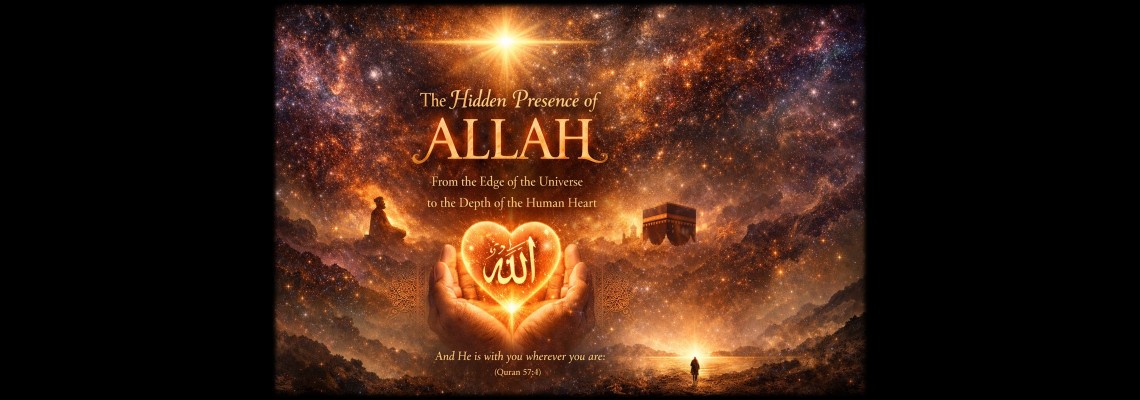
The Cry of Existence
When Knowledge Reaches the Sky but the Soul Remains Hungry
1. The Silent Scream Behind Modern Knowledge
Humanity has never known more than it knows today. We have mapped the galaxies, split the atom, decoded DNA, and sent machines beyond the solar system.
Yet never before has humanity felt so lost.
Anxiety is widespread. Depression is normalized. Meaning is outsourced to entertainment. And silence terrifies us.
This is not because humans lack intelligence — but because intelligence was severed from its Source.
Knowledge without Allah becomes heavy. Information without meaning becomes noise. Progress without purpose becomes exhaustion.
The Qur’an describes this condition with surgical precision:
“And whoever turns away from My remembrance — indeed, for him is a constricted life.”
— Qur’an 20:124
This constriction is not financial. It is existential.
Modern man has everything — except inner rest. Because rest does not come from control. It comes from recognition.
2. Why Human Intelligence Reached the Sky but the Soul Fell
Allah honored humanity with intellect. But intellect was never meant to rule alone.
In Islamic metaphysics, intellect (‘Aql) is a servant — not a king.
When intellect submits to revelation, it becomes light. When intellect rebels, it becomes arrogance.
This is why the Qur’an repeatedly criticizes not ignorance — but knowing without humility.
“They have hearts with which they do not understand, eyes with which they do not see, and ears with which they do not hear.”
— Qur’an 7:179
Notice: Allah does not accuse them of lacking brains. He accuses them of disconnected hearts.
The soul fell not because science advanced — but because love was removed from knowledge.
3. Fitrah: The Memory Allah Placed Before Creation
Before you had language, before culture shaped you, before belief or disbelief — Allah placed something within you.
It is called fitrah.
Fitrah is not learned. It is remembered.
It is the reason a child looks at the sky in wonder. The reason beauty moves us. The reason injustice feels wrong even without religion.
“So direct your face toward the religion, inclining to truth — the fitrah of Allah upon which He has created mankind.”
— Qur’an 30:30
Sufis say: The soul remembers Allah even when the tongue denies Him.
That is why denial never brings peace — only distraction.
4. Qur’anic Reality vs an Accidental Universe
Modern narratives insist: Everything happened by chance. Order emerged from chaos. Meaning is human-made.
The Qur’an asks a single devastating question:
“Were they created by nothing? Or were they themselves the creators?”
— Qur’an 52:35
This verse does not argue. It exposes absurdity.
Sufis explain: Chance cannot produce longing. Randomness cannot produce love. Blind forces cannot produce consciousness that seeks meaning.
Existence itself is a message. Creation itself is speech.
And Allah is the Speaker — though He remains unseen.
5. The First Veil: Thinking Allah Is Far
The greatest deception is distance.
People imagine Allah as remote — somewhere beyond galaxies, separate from daily life.
But the Qur’an shatters this illusion:
“And We are closer to him than his jugular vein.”
— Qur’an 50:16
This nearness is not physical. It is existential.
Allah is nearer than thought, nearer than breath, nearer than fear — yet hidden to the distracted heart.
Sufis say: Allah is not hidden because He is distant — He is hidden because He is too close.
6. The Ache That Refuses to Die
Why does the human heart ache even when life appears complete?
Because the heart was designed for infinity — not consumption.
Nothing finite can satisfy an infinite hunger.
That hunger has a name: Ishq-e-Haqiqi — love for the Real.
Until this love is found, the soul wanders — from idea to idea, from pleasure to pleasure, from identity to identity.
But wandering is not freedom. It is homesickness.
7. A Whisper Before We Continue
If while reading this, your chest tightened, your breath slowed, or your eyes softened —
That is not persuasion.
That is remembrance.
And this is only the beginning.
The secret is not outside. The veil is inside.
The Hidden Intention of Creation
Love Was the Reason — Not Need
8. Allah Did Not Create Out of Need
One of the greatest misunderstandings about creation is the assumption that Allah created because He needed something.
Need belongs to the created. Dependence belongs to the weak. Desire belongs to the incomplete.
Allah is free from all of this.
The Qur’an states with absolute clarity:
“O mankind, you are the ones in need of Allah, while Allah is the Free of need, the Praiseworthy.”
— Qur’an 35:15
If Allah needed nothing, then creation cannot be explained by necessity.
Sufis therefore say: Creation was not an act of need — it was an act of love.
9. “I Was a Hidden Treasure” — The Most Dangerous Secret
Among the most quoted and most misunderstood sacred narrations is the Hadith Qudsi:
“I was a Hidden Treasure, and I loved to be known, so I created creation.”
This statement does not mean Allah lacked recognition.
It means: Love desires expression.
Beauty yearns to be witnessed.
Perfection overflows.
Sufi masters explain: Allah’s love to be known does not benefit Him — it benefits the one who knows Him.
Creation is not a favor to Allah. Creation is mercy for creation.
10. Why Allah Hid Himself After Creating Everything
If Allah wanted to be known, why did He not simply reveal Himself openly?
Why hide?
The answer is subtle — and dangerous to shallow minds.
Because love without choice is not love.
If Allah were visibly present, faith would become compulsion. Worship would become reflex. Submission would lose meaning.
Therefore Allah veiled Himself — not out of distance, but out of mercy.
“No vision can encompass Him, but He encompasses all vision.”
— Qur’an 6:103
Allah is not hidden because He is absent. He is hidden because He is too immense to be grasped.
11. The Veils Are Not Outside — They Are Within
Sufis insist: Allah did not hide Himself from creation — He hid creation from itself.
The true veil is not matter. It is ego.
It is the illusion of independence. The illusion of authorship. The illusion of control.
Imam Junayd said:
“The veil between you and Allah is you.”
As long as the self claims ownership, Allah remains unseen.
When the self dissolves, Allah is not found — He is revealed.
12. Creation as a Mirror, Not a Substitute
The universe was never meant to replace Allah.
It was meant to point to Him.
Stars are not gods. Laws are not creators. Energy is not eternal.
They are mirrors — reflecting attributes, not essence.
Beauty reflects Jamal. Power reflects Jalal. Order reflects Hikmah. Mercy reflects Rahmah.
But the mirror is not the face.
This is where many fall. They fall in love with the reflection and forget the One being reflected.
13. Why Allah Placed Himself at the Highest Station
Allah describes Himself as:
“The Most High.”
— Qur’an 87:1
This “height” is not spatial.
It is ontological.
Allah is beyond comparison, beyond imagination, beyond containment.
Sufis say: If Allah were inside creation, He would be limited.
If Allah were outside creation, He would be distant.
So Allah is neither inside nor outside — yet closer than closeness itself.
14. The Paradox: Beyond the Universe, Yet Inside the Heart
Here lies the great paradox that breaks the mind and opens the heart.
Allah is described by Sufis as:
- At the furthest boundary of existence
- And at the deepest point of the believer’s heart
The Prophet ﷺ transmitted this sacred meaning:
“Neither My heavens nor My earth can contain Me, but the heart of My believing servant contains Me.”
This does not mean Allah is physically inside the heart.
It means: The heart becomes capable of recognizing what the universe cannot hold.
15. Why Love Is the Only Way to Know Allah
Allah cannot be reached by force.
Arguments may remove doubt, but they do not produce intimacy.
Logic may explain signs, but it cannot taste presence.
Only love dissolves distance.
This is why the Qur’an repeatedly ties guidance to love:
“He loves them, and they love Him.”
— Qur’an 5:54
Notice: Allah mentions His love first.
Human love is a response. Divine love is the origin.
16. When Love Awakens, Knowledge Changes Form
Before love, knowledge is information.
After love, knowledge becomes illumination.
The same universe looks different.
Pain becomes meaningful. Time becomes precious. Death becomes a meeting.
This is the beginning of Ma‘rifat — not knowing about Allah, but knowing Allah.
17. A Pause Before Going Deeper
What has been revealed so far is only the outer layer of the secret.
Ahead lies:
- The Awliya as living proof
- The heart as the final sanctuary
- Why even atheists tremble at beauty and death
If your heart feels heavier — it is not burden.
It is awakening.
The journey has begun. The veils are thinning.
The Place Where Allah Is Found
The Heart, the Awliyāʾ, and the Secret of Ma‘rifat
18. Awliyāʾ Allah: Walking Evidence of the Unseen
Many ask for proof of Allah.
Sufis respond quietly: Look at His friends.
The Awliyāʾ Allah are not miracles first — they are transformations.
They were ordinary human beings: they ate, slept, worked, suffered. But something within them changed direction.
Their hearts turned completely toward Allah, and Allah turned creation toward them.
“Indeed, the friends of Allah — there will be no fear upon them, nor shall they grieve.”
— Qur’an 10:62
This verse is not poetry. It is description.
Fear belongs to those attached to loss. Grief belongs to those attached to impermanence.
The Awliyāʾ attach only to the Eternal.
19. Why Awliyāʾ Are the Strongest Argument Against Materialism
Materialism claims: You are your body. You are your brain. You are chemistry.
But the Awliyāʾ disprove this by their very presence.
They live with minimal material attachment, yet possess immense inner richness.
They speak little, yet hearts shake.
They own nothing, yet give everything.
Science can measure neurons, but it cannot explain serenity.
It can map the brain, but it cannot manufacture peace.
The Awliyāʾ are living anomalies in a purely material worldview.
20. The Heart: Not a Metaphor, but a Reality
Modern language reduced the heart to emotion.
Islam restored the heart to its original station.
In Qur’anic language, the heart (Qalb) is the center of perception.
“It is not the eyes that are blind, but the hearts within the chests.”
— Qur’an 22:46
The heart sees what eyes cannot.
It recognizes truth before the mind explains it.
This is why guidance often feels like certainty before it becomes argument.
21. The Deepest Chamber of the Heart
Sufis describe layers of the heart:
- Qalb — the turning heart
- Rūḥ — the spirit
- Sirr — the secret
- Sirr al-Sirr — the secret of the secret
Each layer is deeper than thought.
Each layer is quieter than silence.
At the deepest point, language dissolves.
This is where Ma‘rifat occurs.
22. Ibn ‘Arabi: Allah Is Known by Self-Annihilation
Shaykh al-Akbar Ibn ‘Arabi taught a truth that terrifies the ego:
You cannot know Allah while insisting on knowing yourself as independent.
The self must dissolve — not physically, but existentially.
“When the servant disappears, the Truth appears.”
— Ibn ‘Arabi
This disappearance (Fana) is not destruction.
It is liberation from illusion.
What remains is not emptiness — but Presence.
23. Imam Junayd: Sobriety After Love
Some imagine Sufism as emotional intoxication.
Junayd of Baghdad corrected this:
True Sufism ends in clarity, not chaos.
“The water takes the color of the cup.”
— Imam Junayd
When the heart is purified, Divine attributes reflect accurately.
Mercy replaces cruelty. Humility replaces arrogance. Wisdom replaces reaction.
This is Baqā’ — remaining with Allah after losing the ego.
24. Rumi: Love Is Not a Path — It Is the Destination
Rumi shattered intellectual pride with poetry.
He did not argue. He burned.
“Why are you so busy with this or that, good or bad; pay attention to how things blend.”
— Jalaluddin Rumi
For Rumi, the universe is a lover’s dance.
Every motion yearns. Every separation cries. Every return celebrates.
Love is not something added to existence — it is existence recognizing itself.
25. Why the Awliyāʾ Hide Themselves
True saints do not advertise.
They hide — because visibility feeds the ego.
They prefer obscurity, because Allah sees them anyway.
This is why many Awliyāʾ live and die unknown, yet their presence changes history silently.
They are the spiritual pillars holding the world together.
26. The Heart as the Final Sanctuary
Mosques can be destroyed. Books can be burned. Institutions can collapse.
But the heart that knows Allah remains a sanctuary.
This is why tyrants fear saints more than armies.
Because armies control bodies. Saints awaken souls.
27. Signs That the Heart Is Awakening
Awakening does not announce itself loudly.
It begins subtly:
- Silence feels meaningful
- Worldly noise feels heavy
- Beauty brings tears
- Injustice hurts deeper
- Death feels closer — but not terrifying
These are not weaknesses.
They are signs that the heart is remembering its origin.
28. A Door Before the Final Revelation
If you have followed this far, you are no longer a reader.
You are a seeker.
Only one veil remains:
Why even those who deny Allah still feel Him — especially scientists, atheists, and skeptics.
That secret will be unveiled next.
The mirror is ready. The reflection is unavoidable.
The Inescapable Presence
Why Denial Still Trembles Before Beauty, Death, and Infinity
29. Why Atheism Is Not the Absence of Allah — but the Fear of Meaning
Many imagine that atheism is the rejection of Allah.
In reality, it is often the rejection of accountability.
To accept Allah is to accept purpose. To accept purpose is to accept responsibility.
Modern denial is rarely intellectual — it is emotional.
It is easier to believe the universe is accidental than to accept that existence has intention.
Because intention demands response.
30. Why Scientists Tremble at Beauty
Even the most materialistic scientist will pause before:
- The mathematical precision of the universe
- The fine-tuning of physical constants
- The elegance of natural laws
They call it “awe.”
But awe is a spiritual emotion.
It is the soul recognizing something greater than control.
“Those who have knowledge fear Allah the most.”
— Qur’an 35:28
True knowledge does not produce arrogance. It produces humility.
When arrogance appears, knowledge has already been severed from wisdom.
31. Science as a Mirror — Not the Face
Science is powerful.
But it answers only one type of question: How does it work?
It cannot answer:
- Why does existence exist?
- Why does beauty move us?
- Why does suffering demand meaning?
Sufis explain:
Science is a mirror.
Allah is the Face reflected.
Those who fall in love with the mirror mistake reflection for reality.
32. Why Death Shatters All Denial
No philosophy survives death untouched.
At funerals, even atheists become silent.
Why?
Because death exposes the lie of permanence.
It tears away distraction.
It forces the ultimate question:
If I end — then what was all this for?
Islam does not fear this question.
Islam answers it.
33. The Qur’anic Exposure of Denial
The Qur’an does not insult deniers.
It diagnoses them.
“And they denied them, while their souls were convinced of them — out of injustice and arrogance.”
— Qur’an 27:14
Denial is often not disbelief.
It is suppression.
The soul knows — but the ego refuses.
34. Why Even Disbelievers Feel Allah in Silence
Silence removes distractions.
In silence, the soul speaks.
This is why many who deny Allah fear silence.
They fill their lives with noise — screens, opinions, stimulation — to avoid hearing the inner call.
But the call does not disappear.
It waits.
35. Haqeeqat: Reality Cannot Be Escaped
Haqeeqat does not require belief.
Gravity works whether one believes or not.
Likewise, Divine Reality remains whether acknowledged or denied.
The difference is not in reality — it is in relationship.
One resists. Another surrenders.
36. Ma‘rifat: When Knowing Becomes Meeting
Ma‘rifat is not intellectual victory.
It is surrender.
It is the moment the seeker realizes:
“I was never searching for proof — I was searching for home.”
At this stage, arguments fall away.
Only presence remains.
37. The Final Secret of the Awliyāʾ
The Awliyāʾ do not argue Allah’s existence.
They embody it.
Their lives whisper:
“Come and see.”
Not: “Come and debate.”
This is why their company changes hearts more than libraries change minds.
38. The Return: Not With Fear, But With Love
Allah does not want terrified servants.
He wants lovers.
This is why the Qur’an balances awe with intimacy:
“He loves them, and they love Him.”
— Qur’an 5:54
Fear may initiate the journey.
But only love completes it.
39. If Tears Came, They Were Not Weakness
If your eyes softened while reading, if your breath slowed, if your heart felt heavy —
That was not sadness.
That was recognition.
The soul recognizing its Source always feels overwhelming.
40. The Last Whisper
You were not created to be lost.
You were not created to wander endlessly.
You were created to know — and be known.
Allah was never far.
Only the veils were close.
Remove the veils. Return with love. You were always expected.
“And whoever comes to Me walking, I come to him running.”
— Hadith Qudsi
Universal Questions About Allah, Reality & the Human Soul
- Why did Allah create the universe if He needs nothing?
Allah created not out of need, but out of mercy and love. Creation is a manifestation of His Names — The Merciful, The Creator, The Loving. He created so that beings may know Him, not to benefit Him. - Is Allah present everywhere or beyond space?
Allah is not confined by space. He is beyond all dimensions, yet His knowledge, power, and awareness encompass everything. Presence is not physical for Allah. - What is Haqeeqat in Islam?
Haqeeqat is the inner reality behind appearances — the truth that everything exists by Allah, through Allah, and for Allah. - What is the difference between Haqeeqat and Ma‘rifat?
Haqeeqat is the reality itself; Ma‘rifat is the lived recognition of that reality within the heart. - Can science prove or disprove Allah?
Science studies creation, not the Creator. It explains mechanisms, not meaning. Allah is beyond empirical limitation. - Why do atheists still feel emptiness and awe?
Because the soul recognizes its origin even when the mind denies it. Awe is fitrah remembering Allah. - Is Allah inside the human heart?
Allah is not contained, but the heart is the place of awareness, recognition, and divine light. - What does Qur’an mean by “Allah is nearer than jugular vein”?
It means Allah’s knowledge, awareness, and control are closer than one’s own life force. - Why is Allah hidden yet obvious?
He is hidden from arrogance but obvious to humility. The veil is not on Allah — it is on the heart. - What is the purpose of human existence in Islam?
To know Allah, love Him, worship Him, and reflect His mercy on earth. - Why does beauty make humans emotional?
Beauty reminds the soul of its divine origin. All beauty is a reflection of Allah’s perfection. - Is love of Allah emotional or rational?
It begins with reason but matures into love that surpasses logic. - Why do Sufis avoid arguments?
Because truth is tasted, not debated. Arguments feed ego; love dissolves it. - What is the role of silence in spirituality?
Silence allows the heart to hear what noise conceals — divine presence. - Why does death shake belief systems?
Because death strips illusions and exposes ultimate reality. - Can a disbeliever reach Allah?
Yes. Guidance is Allah’s mercy. A sincere heart is never locked. - What is the meaning of divine love?
It is Allah drawing the servant toward Himself through mercy and longing. - Do saints (awliya) see Allah?
They see with the heart — awareness, not physical sight. - Why does arrogance block faith?
Because faith requires surrender, and arrogance refuses to bow. - Is spirituality possible without religion?
Spiritual feelings may exist, but without guidance they lack direction and safety. - Why does modern life feel meaningless?
Because purpose was replaced with productivity and consumption. - What is qalb in Islamic spirituality?
Qalb is the spiritual heart — the center of perception and connection with Allah. - How does zikr awaken the soul?
By polishing the heart until it reflects divine light. - Why does Allah test humans?
Tests purify, awaken, and return the soul to sincerity. - Is fear or love the foundation of faith?
Fear begins the path; love completes it. - What is ilm-ul-yaqeen?
Certainty through knowledge. - What is ayn-ul-yaqeen?
Certainty through witnessing. - What is haq-ul-yaqeen?
Certainty through direct experience. - Why do Awliya say Allah is found, not proven?
Because proof convinces the mind, but finding transforms the soul. - Is Allah limited by language?
No. Language describes experience, not essence. - Why do humans seek infinity?
Because the soul comes from the Infinite. - What is the secret of existence?
Love — flowing from Allah and returning to Him. - Can logic alone lead to God?
Logic can guide the path, but the heart must walk it. - Why does the heart understand what mind cannot?
Because the heart perceives meaning, not just information. - What happens when one truly knows Allah?
Fear fades, peace descends, ego dissolves. - Why does denial feel exhausting?
Because resisting truth consumes energy. - Is Allah closer in hardship?
Allah is always near, but hardship removes distractions. - Why do tears come during spiritual realization?
Because the soul recognizes its Beloved. - What does surrender truly mean?
Trusting Allah completely — even when understanding ends. - Is Allah disappointed with humanity?
No. His mercy always outweighs human failure. - Can broken hearts find Allah faster?
Yes. Cracks allow divine light to enter. - Why do saints speak in poetry?
Because prose ends where love begins. - What is the final destination of the soul?
Return to Allah with peace. - Is love the final truth?
Yes. Love is the language of existence. - Does Allah wait for humans to return?
Allah is always near — waiting is for us, not Him.