









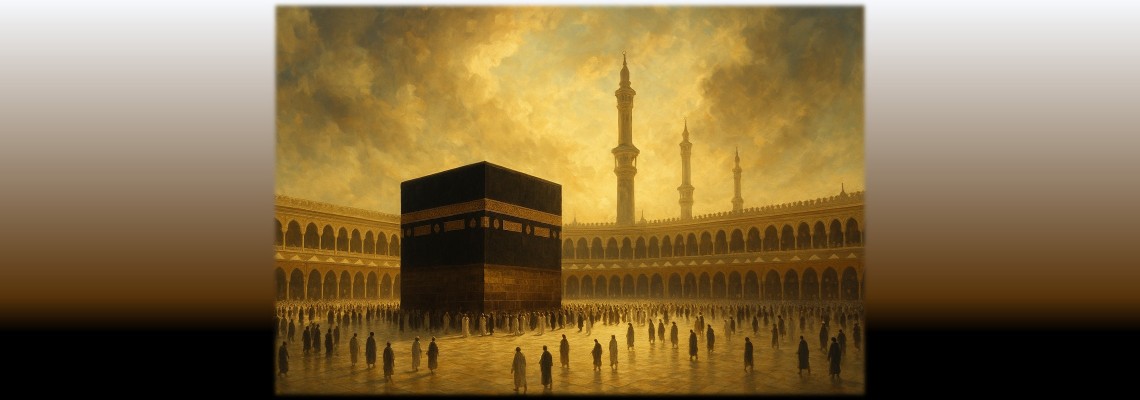
The History and Spiritual Journey of the Holy Kaaba
From Prophet Ibrahim (A.S) to Modern Times — A Complete Guide
Table of Contents
-
Chapter 1: Introduction — The Journey of the Heart toward the House of Allah
Purpose & Scope of This Masterwork | Tone, Sources & Methodology (Qur'an, Ḥadīth, Tārīkh)
-
Chapter 2: Origins of the Kaaba — From the First Foundations
Kaaba & Angels | Adam (A.S.) & Early Foundations | Ibrahim & Isma‘il Rebuilding | The Black Stone | Hajar & Zamzam
-
Chapter 3: Pilgrimages of Earlier Prophets & Spiritual Continuity
Which Prophets Visited | How Earlier Pilgrimages Shaped Later Rites
-
Chapter 4: The Age of Ignorance (Jāhilīyyah) — Kaaba Before Islam
Customs & Idol Worship | Divine Protection: Abraha & the Elephants
-
Chapter 5: The Kaaba in the Time of Prophet Muḥammad ﷺ
Reconstruction & Black Stone Dispute | Conquest of Makkah | Farewell Pilgrimage | Prophetic Hajj & Umrah Model
-
Chapter 6: Hajj & ‘Umrah — Rituals, Spiritual Meanings & Comparisons
Step-by-step Rituals | Sufi & Spiritual Interpretations | Comparison Table: Prophetic Era vs Modern Practice
-
Chapter 7: Hidden & Little-Known Sacred Spots — Masjid al-Haram & Masjid an-Nabawi
Maqam Jibrīl | Dār al-Arqam | Hateem | Jannat al-Mu‘allā | Suffah | Mihrab | Riyāḍ al-Jannah | Sahaba Homes
-
Chapter 8: Khulafāʾ ar-Rāshidūn — Early Caliphate and the Kaaba
Abu Bakr (R.A.) | Umar (R.A.) | Uthman & Ali (R.A.)
-
Chapter 9: Kaaba Through Islamic Dynasties — Umayyad → Ottoman → Saudi
Umayyad | Abbasid | Mamluk & Fatimid | Ottoman | Modern Saudi Era
-
Chapter 10: How Rulers Honoured the Kaaba — Etiquette & Stories
Humility & Ceremonial Practices | Royal Gifts (Kiswah, Lamps, Carpets) | Humbled Kings & Incidents
-
Chapter 11: Awliyāʾ — Classical Saints Around the World
Baghdadi & Persian Saints | Chishtiyya, Naqshbandiyya, Qadiriyya | Influence on Pilgrims
-
Chapter 12: Awliyāʾ — Indo-Pak Subcontinent
Khwāja Mu‘īnuddīn Chishtī | Data Ganj Bakhsh | Baba Farīd | Naqshbandī Line (Shaykh Nāẓim & Disciples)
-
Chapter 13: Awliyāʾ — Modern Times (Shaykh Nazim & Disciples)
Shaykh Nāẓim al-Haqqānī | Prominent Disciples | Documented Dreams & Visions
-
Chapter 14: Awliyāʾ — Classical Around the World (Summary & Influence)
Influence Beyond Muslim Heartlands | Spiritual Networks to Haram
-
Chapter 15: Major Prophets (Rasūl) — Jerusalem, Dome of the Rock & Kaaba
Qiblah Change | Miraj of Prophet Muhammad ﷺ | Bakkah → Makkah | Dome of the Rock Connections
-
Chapter 16: Heart-touching Journeys & Pilgrim Stories from Across the World
Africa | China | Central Asia | South Asia | Answered Du‘āʼ & Life Transformations
-
Chapter 17: Disasters, Conquests & Damaging Events — Historical Table
Demolitions | Floods | Fires | Conquests | Repair Campaigns & Rulers
-
Chapter 18: Architectural Evolution & Ritual Comparisons
Kaaba Size & Shape Changes | Kiswah & Embroidery | Zamzam & Water Systems
-
Chapter 19: Secrets of the Kaaba — Spiritual Reflections & Lessons
Heart of Believers | Axis Mundi | Lessons for Pilgrims, Awliyāʾ & Humanity
-
Chapter 20: Modern Era: Ottoman Guardianship to Contemporary Saudi Custodianship
Kiswah & Royal Traditions | 20th–21st Century Expansions | Crowd & Travel Logistics
-
Chapter 21: Kaaba, Imam Mahdī (A.S.), ʿĪsā (Jesus A.S.) & End-Time Context
Role of Imam Mahdī | Prophet ʿĪsā | Speculations & Narrations on Kaaba’s Future
-
Chapter 22: Respectful Remarks by Non-Muslim Travellers & Leaders
Travel Writers | Historians | Leaders’ Respectful Accounts
-
Chapter 23: Final Message of the Kaaba — To All Creation
Message to Angels | Prophets | Awliyāʾ | Muslims & Non-Muslims
-
Chapter 24: Practical Guidance for Pilgrims & Visitors
Physical & Spiritual Preparation | Etiquettes | Checklists & Sample Duas
-
Chapter 25: References, Sources & Further Reading — Qur'ān, Ḥadīth & Classical Histories
Qur'an Verses | Hadith References | Classical Historians | Modern Scholarship
-
Chapter 26: Closing Dua & Final Notes
Final Blessings | Reflections | Farewell Message
Chapter 1: Introduction — The Journey of the Heart toward the House of Allah
Purpose & Scope of This Masterwork | Tone, Sources & Methodology (Qur'an, Ḥadīth, Tārīkh)
بِسْمِ اللّٰهِ الرَّحْمٰنِ الرَّحِيْمِ In the Name of Allah, the Most Gracious, the Most Merciful.
The Kaaba, the House of Allah, stands as the **spiritual axis of humanity**, the center of devotion, and the point toward which every believer’s heart turns in prayer. This sacred house is not merely a physical structure in Makkah, but the **symbol of divine guidance, unity, and eternal spiritual longing**. Throughout the ages, from Prophet Ibrahim (A.S.) to the present day, it has been the destination for millions of believers who seek closeness to Allah and purification of the soul.
This chapter serves as the **gateway to our exploration**, laying out the purpose, methodology, and tone of this masterwork. It is designed to take the reader on a journey, not just through history and rituals, but through the **inner landscapes of faith, devotion, and human transformation**.
Purpose & Scope of This Masterwork
The aim of this work is to illuminate the Kaaba in all its dimensions: historical, spiritual, architectural, and mystical. We trace its origins, explore its role in the lives of the Prophets and Awliyāʾ, and reflect on the **lessons it carries for humanity** today. Readers will gain an understanding of how the Kaaba has been a **beacon of monotheism**, a center of pilgrimage, and a source of inspiration across centuries.
Tone, Sources & Methodology (Qur'an, Ḥadīth, Tārīkh)
In presenting this work, we follow a **multi-layered approach**, drawing from the Qur’an, authentic Hadith, classical historians (Ibn Ishaq, al-Tabari, al-Baladhuri), and the narratives of the Awliyāʾ and spiritual guides. The tone is **reverent, informative, and inspirational**, aiming to **connect the historical facts with spiritual significance**, while remaining accessible to scholars, students, and common readers alike.
Every chapter integrates **historical events, spiritual reflections, and practical guidance**, allowing the reader to feel as if they are walking through Makkah and Madinah across time — witnessing the devotion of the Prophets, the trials of the righteous, and the ongoing journey of humanity toward the House of Allah.
— Inspired by Qur'an 2:125 & Hadith reports on the significance of the Kaaba.
With this foundation, we embark on our journey through the **History and Spiritual Journey of the Holy Kaaba**, uncovering **hidden corners of devotion, remarkable pilgrim stories, sacred spots, and timeless lessons** that continue to inspire the Ummah and all creation.
Chapter 2: Origins of the Kaaba — From the First Foundations
Kaaba & Angels | Adam (A.S.) & Early Foundations | Ibrahim & Isma‘il Rebuilding | The Black Stone | Hajar & Zamzam
The Kaaba is the **first house built for the worship of Allah**, a sacred structure whose **foundations date back to the time of Adam (A.S.)**, and whose spiritual significance transcends time and space. It is mentioned in the Qur'an:
"Indeed, the first House [of worship] established for mankind was that at Bakkah — blessed and a guidance for the worlds."
— Qur’an 3:96
Kaaba & Angels
Scholars mention that the Kaaba has always been surrounded by **divine attention and protection**, with angels assigned to guard and honor it. Even before humanity’s full understanding, the Kaaba was recognized in the heavens as a **sanctuary for divine worship**, a symbol of monotheism and a beacon for all who seek Allah’s guidance.
Adam (A.S.) — Early Foundations & Loss in the Flood
According to Islamic tradition, Prophet Adam (A.S.) laid the **first earthly foundations of the Kaaba**. The flood during Prophet Nuh (A.S.)'s time destroyed much of the early civilization, including these initial foundations. Yet, the spiritual significance of the site remained intact, awaiting its next reconstruction by Ibrahim (A.S.) and Isma‘il (A.S.).
Ibrahim (A.S.) & Isma‘il (A.S.) — The Rebuilding
Allah commanded Prophet Ibrahim (A.S.) and his son Isma‘il (A.S.) to rebuild the Kaaba as a house for **monotheistic worship**. With guidance from Allah, they **raised its walls and laid the sacred Black Stone** in its corner, completing a structure that would endure through centuries:
"And [mention, O Muhammad], when We designated for Abraham the site of the House, [saying], 'Do not associate anything with Me and purify My House for those who perform Tawaf and those who stand [in prayer] and those who bow and prostrate.'"
— Qur’an 22:26
The Black Stone: Origins & Reverence
The Black Stone, or Hajar al-Aswad, is believed to have descended from Jannah and was initially **white, turning black from the sins of humanity**. Pilgrims kiss or touch it to emulate Prophet Muhammad ﷺ and seek closeness to Allah. It serves as a **spiritual anchor**, linking heaven and earth.
Hajar (A.S.) & Zamzam: Miracle & Meaning
The story of Hajar (A.S.), mother of Isma‘il (A.S.), searching for water in the barren desert, gave rise to **Zamzam water**, a continuous miracle flowing near the Kaaba. Pilgrims today drink Zamzam water and carry it as a symbol of **divine sustenance, mercy, and hope**. This event emphasizes that **faith and perseverance lead to Allah’s provision**, even in the harshest conditions.
| Era / Prophet | Event / Contribution | Spiritual Significance |
|---|---|---|
| Adam (A.S.) | First earthly foundation of Kaaba | Establishment of monotheism on Earth |
| Flood Era | Destruction of early structure | Test of faith & human perseverance |
| Ibrahim & Isma‘il (A.S.) | Rebuilding Kaaba & Black Stone placement | Obedience, devotion, and divine guidance |
| Hajar & Zamzam | Zamzam water miracle | Faith, hope, and divine sustenance |
This chapter sets the **foundation for understanding the Kaaba’s profound spiritual journey**, from its celestial recognition to earthly devotion. As we move to later chapters, we will witness how the Kaaba remained the **heart of monotheism, pilgrimage, and divine guidance** through the ages.
Chapter 3: Pilgrimages of Earlier Prophets & Spiritual Continuity
Which Prophets Visited | How Earlier Pilgrimages Shaped Later Rites
Before the formal institution of Hajj as we know it today, the **Kaaba was already the focal point of pilgrimage for numerous Prophets**, each contributing to the **spiritual legacy that would be perfected by Prophet Muhammad ﷺ**. Their visits were acts of **worship, obedience, and guidance** for their people, establishing patterns that would later influence the rituals of Hajj and Umrah.
Which Prophets Visited and Their Du‘āʼ
From Adam (A.S.) to Ibrahim (A.S.) and beyond, many Prophets are reported to have turned their hearts toward the Kaaba, praying and performing acts of devotion.
- Adam (A.S.): Laid the first foundations and prayed for the guidance of future generations.
- Noah (Nuh A.S.): Though the Flood disrupted civilization, his prayers for preservation included the sacred site of Bakkah.
- Ibrahim & Isma‘il (A.S.): Rebuilt the Kaaba; their du‘āʼ became the eternal pattern: "Our Lord! Make this city secure and provide its people with fruits – those who believe in Allah and the Last Day." (Qur’an 2:126)
- Other Prophets: Isa (A.S.), Musa (A.S.), and Dawud (A.S.) are reported in tafsir and historical sources to have honored Bakkah in their travels and prayers.
How Earlier Pilgrimages Shaped Later Rites
The acts of earlier Prophets created a **spiritual blueprint** that would later be formalized during the lifetime of Prophet Muhammad ﷺ. These include:
- Tawaf (Circumambulation): Recognizing the Kaaba as the spiritual axis.
- Sa‘y (Running between Safa & Marwah): Inspired by Hajar (A.S.)’s search for water.
- Du‘āʼ & Supplication: The Prophets’ prayers at the Kaaba set the tone for heartfelt invocation, purity of intention, and sincerity.
- Unity of Believers: Pilgrimages fostered communal worship, establishing the Kaaba as a **center for monotheistic convergence**.
| Prophet | Pilgrimage Acts / Du‘āʼ | Spiritual Significance |
|---|---|---|
| Adam (A.S.) | First prayers at foundations of Kaaba | Initiated human devotion toward the House of Allah |
| Ibrahim & Isma‘il (A.S.) | Rebuilding Kaaba, placing Black Stone, prayers for guidance | Eternal model of obedience and divine connection |
| Other Prophets | Honored Kaaba in their supplications and teachings | Continuity of monotheistic pilgrimage and devotion |
Through these early pilgrimages, the Kaaba became a **living spiritual bridge**, connecting Prophets, saints, and future believers. This chapter reminds us that **every Hajj and Umrah today continues a sacred chain of devotion**, stretching back to the first foundations laid by Adam (A.S.) and perfected by Ibrahim (A.S.) and his descendants.
Chapter 4: The Age of Ignorance (Jāhilīyyah) — Kaaba Before Islam
Customs & Idol Worship | Divine Protection: Abraha and the Elephants
Before the advent of Islam, the Kaaba stood as a sacred house but had become surrounded by **idolatry, social injustice, and pagan customs**. The Quraysh, guardians of Makkah, placed numerous idols inside and around the Kaaba, and pilgrims often visited for **rituals lacking divine guidance**. Yet, the **Kaaba remained a divinely protected sanctuary**, awaiting the message of monotheism brought by Prophet Muhammad ﷺ.
Customs & Idol Worship
During the Jāhilīyyah, the Kaaba hosted **360 idols**, representing various tribes of Arabia. Pilgrims engaged in:
- Ritual circumambulations for polytheistic gods.
- Seasonal fairs and competitions linked with tribal pride.
- Offerings to idols for prosperity, fertility, or protection.
- Occasional injustices and conflicts due to tribal rivalries over sacred space.
Despite these misuses, the **sanctity of the Kaaba** remained recognized even by non-believers, signaling the divine favor upon this location.
Divine Protection: Abraha and the Elephants
One of the most famous events of pre-Islamic history was **Abraha’s expedition to destroy the Kaaba**. Abraha, the Abyssinian governor of Yemen, marched with a great army, including elephants, intending to demolish the sacred house and divert pilgrimage to his cathedral in Yemen. However, Allah protected the Kaaba miraculously:
"Have you not considered, [O Muhammad], how your Lord dealt with the companions of the elephant? Did He not make their plan into misguidance?"
— Qur’an 105:1-3
Birds, carrying small stones from Allah, destroyed the army, saving the Kaaba from desecration. This event marked the **divine guardianship of the Kaaba**, a warning and sign to future generations of Allah’s protection.
| Era / Event | Description | Significance |
|---|---|---|
| Jāhilīyyah Period | Kaaba filled with 360 idols | Demonstrates the resilience of sacred space |
| Abraha’s Army | Attempted destruction of Kaaba using elephants | Illustrates divine protection and supremacy of Allah |
| Tribal Pilgrimages | Rituals and offerings to idols | Prepares the context for Prophet Muhammad ﷺ to reform pilgrimage |
This chapter sets the stage for **the arrival of Islam**, illustrating the state of the Kaaba before divine guidance illuminated its true purpose. The Kaaba, though surrounded by human errors and ignorance, **remained the chosen center for monotheism**, awaiting the final Messenger to restore its sanctity.
Chapter 5: The Kaaba in the Time of Prophet Muhammad ﷺ
Reconstruction & Black Stone Dispute | Conquest of Makkah | Farewell Pilgrimage | Prophetic Model of Hajj & ‘Umrah
When Prophet Muhammad ﷺ began his mission, the Kaaba was a site of **religious confusion and idol worship**, yet it retained its **sacred structure and divine favor**. The Prophet ﷺ restored its purity, making it the **center of monotheism and universal pilgrimage**.
Reconstruction & The Black Stone Dispute
In the early years of Islam, the Kaaba required **rebuilding due to damage**. During reconstruction, a dispute arose among Quraysh tribes over **who would place the Black Stone**. Prophet Muhammad ﷺ resolved it with **wisdom and diplomacy**:
The Prophet ﷺ said: "Let us place the Stone on a cloth and have each tribe hold a corner. Then I will place it in its position."
— Historical accounts (Ibn Hisham)
This act emphasized **justice, humility, and unity**, demonstrating the Prophet’s ﷺ skill in resolving conflict while preserving sacred respect.
Conquest of Makkah — Cleansing the House
In 8 AH (630 CE), the Muslims peacefully **conquered Makkah**, marking a turning point in Islamic history. Prophet Muhammad ﷺ **cleansed the Kaaba of idols**, restoring it to its **pure monotheistic purpose**:
- All idols and statues were removed.
- The Kaaba’s sanctity was reinstated, open to all believers.
- The Quraysh and other tribes witnessed the **truth of monotheism and divine guidance**.
Farewell Pilgrimage: Full Ritual & Sermon
During his **Farewell Pilgrimage (10 AH)**, Prophet Muhammad ﷺ performed the **complete rites of Hajj**, delivering a historic sermon emphasizing:
- The **unity of all Muslims** regardless of race, tribe, or status.
- Prohibition of oppression, injustice, and idol worship.
- Guidance for **proper Hajj conduct**, ensuring the rituals remain spiritually transformative.
"O people! Your blood, your property, and your honor are sacred to one another, as this day of yours, in this month of yours, in this city of yours."
— Prophet Muhammad ﷺ (Farewell Sermon)
Prophetic Model: Hajj & ‘Umrah Practices
Prophet Muhammad ﷺ established a **living model of pilgrimage**, which remains the **standard for all generations**:
- Tawaf: Circumambulation around the Kaaba seven times with heartfelt devotion.
- Sa‘y: Running between Safa and Marwah, commemorating Hajar (A.S.)’s devotion.
- Wuḍū & Prayer: Cleanliness and spiritual preparation before sacred acts.
- Arafah & Mina Rituals: Reflecting obedience, humility, and repentance.
- Completion & Reflection: Ending Hajj/‘Umrah with spiritual transformation and gratitude.
| Event | Year (AH) | Significance |
|---|---|---|
| Reconstruction & Black Stone Placement | Before Prophethood | Demonstrated wisdom and unity among Quraysh tribes |
| Conquest of Makkah | 8 AH (630 CE) | Purification of Kaaba & restoration of monotheism |
| Farewell Pilgrimage | 10 AH (632 CE) | Complete rites and enduring model for Hajj & ‘Umrah |
Chapter 5 showcases the Kaaba as the **living center of Islamic devotion**, transforming from pre-Islamic idolatry into a house purified by the Messenger of Allah ﷺ. The rituals and practices established during this period **remain the foundation for every pilgrim**, echoing centuries of spiritual continuity and divine guidance.
Chapter 6: Hajj & ‘Umrah — Rituals, Spiritual Meanings & Comparisons
Step-by-Step Rituals | Sufi & Spiritual Interpretations | Comparison Table
Hajj and ‘Umrah are the **cornerstones of Islamic worship**, offering believers a chance to **physically and spiritually reconnect with Allah**. Beyond the physical rituals, they carry **deep spiritual symbolism**, serving as a mirror to the soul and a reminder of obedience, humility, and devotion.
Step-by-Step Rituals
The rites of Hajj and ‘Umrah are structured to **transform both body and heart**:
- Ihram: Entering a state of purity, wearing prescribed garments, and leaving behind worldly distractions.
- Tawaf: Circumambulating the Kaaba seven times, reflecting on Allah’s centrality in life.
- Sa‘y: Traversing between Safa and Marwah seven times, symbolizing Hajar (A.S.)’s devotion and trust in Allah.
- Standing at Arafah: Supplication, repentance, and submission — the climax of Hajj.
- Muzdalifah & Mina: Collecting pebbles for symbolic stoning, offering sacrifice, and reflecting on past sins.
- Tawaf al-Ifadah & Tawaf al-Wada: Completing Hajj with final circumambulations and heartfelt farewell to the House of Allah.
Sufi & Spiritual Interpretations
Renowned Sufis like **Ibn ‘Arabi, Rumi, and Junayd** emphasize the **inner dimensions of pilgrimage**:
- Tawaf: Represents the soul’s orbit around divine truth.
- Sa‘y: A symbol of perseverance in seeking spiritual sustenance.
- Arafah: Spiritual self-emptying and surrender to Allah’s will.
- Stoning of Jamaraat: Overcoming internal evil and past transgressions.
Comparison Table: Prophetic Era vs Modern Practice
| Ritual | Prophetic Era Practice | Modern Practice |
|---|---|---|
| Ihram | Simple white garments, pure intentions | Same garments, guided rules for men and women |
| Tawaf | Circumambulation around the Kaaba freely without barriers | Organized paths and crowd management, same ritual steps |
| Sa‘y | Between Safa & Marwah, symbolic devotion | Same path, with guides and safety measures |
| Standing at Arafah | Simple gathering and du‘āʼ | Organized tents, large crowd, spiritual reflection unchanged |
| Ritual Sacrifice & Stoning | Performed with minimal tools, symbolic acts | Guided process with facilities, same symbolic meaning |
Through both **physical and spiritual practices**, Hajj and ‘Umrah serve as timeless acts of devotion, **linking believers across generations**. Understanding their **inner meaning**, as well as performing them faithfully, allows pilgrims to experience the **true essence of submission, unity, and divine closeness**.
Chapter 7: Hidden & Little-Known Sacred Spots — Masjid al-Haram & Masjid an-Nabawi
Maqam Jibrīl | Suffah | Hateem | Dār al-Arqam | Sahaba Homes & Original Boundaries
Beyond the main rituals and crowds, both Masjid al-Haram in Makkah and Masjid an-Nabawi in Madinah house **hidden spiritual corners and historically significant locations** that many visitors overlook. These spots carry **stories of prophets, companions, and saints** across centuries.
Maqam Jibrīl and Lesser-Known Stations in al-Haram
The **Maqam Jibrīl (Station of Angel Gabriel)** inside the Haram marks where Angel Jibrīl ﷺ appeared to Prophet Muhammad ﷺ during revelations and guidance. Pilgrims are encouraged to:
- Pause in reflection while performing Tawaf near Maqam Jibrīl.
- Offer quiet du‘āʼ and prayers, feeling connection with past prophetic moments.
- Understand the **divine supervision of sacred acts**, reminding them of guidance beyond human eyes.
Hateem — Original Boundary & Its History
The **Hateem** is a semi-circular area adjacent to the Kaaba, historically part of the Kaaba’s original structure. Pilgrims performing Tawaf outside the Hateem are still within the sacred precinct, but knowing its **historical significance** adds spiritual depth:
- It was originally part of the Kaaba built by Prophet Ibrahim (A.S.) and Isma‘il (A.S.).
- Proximity to Hateem symbolizes connection to the **foundation of divine faith**.
- Offering prayers here brings blessings connected to the earliest monotheistic practices.
Dār al-Arqam & Early Muslim Meeting Points
Located in Madinah, **Dār al-Arqam** was the early center where the Prophet ﷺ secretly invited companions to Islam. Today, pilgrims may visit its vicinity to:
- Reflect on the courage of the early believers.
- Understand the roots of Islamic scholarship and communal support.
- Feel the continuity between historical devotion and present-day pilgrimage.
Suffah, Mihrab, Riyāḍ al-Jannah — Hidden Corners of an-Nabawi
Within Masjid an-Nabawi, several **historical spots carry spiritual lessons**:
- Suffah: The shaded platform where early companions lived, studied, and memorized Qur’an.
- Mihrab of the Prophet ﷺ: The exact location of the Prophet’s prayer and sermons.
- Riyāḍ al-Jannah: Area between the Prophet’s ﷺ house and the mosque, considered part of Paradise.
Sahaba Homes & Original Masjid Boundaries
Early Islamic history shows that **companions’ homes were integral to the Masjid**:
- Some homes adjoined the mosque and served as teaching spots, shelters, and gathering points.
- These locations remind modern visitors that Islam was **community-oriented and spiritually alive**, not just ritualistic.
- Understanding **original masjid boundaries** provides insight into early urban planning around the sacred sites.
| Spot | Location | Historical & Spiritual Significance |
|---|---|---|
| Maqam Jibrīl | Masjid al-Haram | Angel Gabriel’s station, revelation guidance |
| Hateem | Adjacent to Kaaba | Original Kaaba boundary, connection to Ibrahim & Isma‘il |
| Dār al-Arqam | Madinah | Early Muslim learning & secret gatherings |
| Suffah | Masjid an-Nabawi | Early companions’ residence and learning area |
| Riyāḍ al-Jannah | Masjid an-Nabawi | Part of Paradise, between Prophet’s house & mosque |
By guiding pilgrims to these **hidden and sacred spots**, this chapter encourages both **historical awareness and spiritual mindfulness**, allowing readers to experience the richness of the Kaaba and Masjid an-Nabawi beyond what is commonly seen.
Chapter 8: Khulafāʾ ar-Rāshidūn — Early Caliphate and the Kaaba
Abū Bakr | ‘Umar | ‘Uthmān | ‘Alī — Preservation & Pilgrim Welfare
After the Prophet ﷺ, the **Khulafāʾ ar-Rāshidūn** upheld the sacredness, administration, and continuity of the Kaaba. They ensured that pilgrims experienced **safety, spiritual guidance, and respect for sacred traditions** while navigating the evolving political and social landscape.
Abū Bakr (R.A.) — Preservation & Administration
Abū Bakr As-Siddiq (R.A.), the first Caliph, focused on **stability and security** of the Haram and its surroundings:
- Ensured **protection of pilgrims** during conflicts and uprisings.
- Maintained the **purity of the Kaaba**, continuing the Prophet’s ﷺ directives.
- Oversaw **funding and welfare systems** for needy visitors and locals.
‘Umar (R.A.) — Expansions & Pilgrim Welfare
‘Umar ibn al-Khaṭṭāb (R.A.) emphasized **logistics, justice, and pilgrim guidance**:
- Expanded areas surrounding the Kaaba for **ease of Tawaf and crowd management**.
- Instituted **rules and guidelines** to protect pilgrims’ rights and safety.
- Personally inspected the Haram to ensure **fair administration and spiritual integrity**.
‘Uthmān & ‘Alī (R.A.) — Governance & Tradition
The third and fourth Caliphs continued this sacred duty, blending **administrative efficiency with spiritual reverence**:
- ‘Uthmān (R.A.) maintained and repaired the Kaaba structure where needed, ensuring the **house remained intact and respected**.
- ‘Alī (R.A.) supervised and resolved disputes among pilgrims, emphasizing **fairness, justice, and ethical conduct**.
- Both Caliphs reinforced the **Prophetic traditions of humility, compassion, and servant leadership** around the sacred site.
| Caliph | Contributions to Kaaba & Haram | Impact on Pilgrims |
|---|---|---|
| Abū Bakr (R.A.) | Ensured security & preserved sacred traditions | Safe pilgrimages, continuation of Prophetic practices |
| ‘Umar (R.A.) | Expanded areas, implemented fair guidelines | Ease of movement, protection & justice for pilgrims |
| ‘Uthmān (R.A.) | Maintained structure, preserved traditions | Pilgrims witnessed stability & respect of the Kaaba |
| ‘Alī (R.A.) | Supervised disputes, reinforced ethical conduct | Pilgrims experienced fairness and spiritual guidance |
Chapter 8 highlights that the early Caliphs not only **preserved the physical structure** of the Kaaba but also **upheld its spiritual and social significance**. Their governance serves as a timeless example for **leaders and custodians of sacred institutions**.
Chapter 9: Kaaba Through Islamic Dynasties — Umayyad → Ottoman → Saudi
Umayyad Era | Abbasid Period | Mamluk & Fatimid | Ottoman Care | Modern Saudi Era
Over centuries, the Kaaba has witnessed the rise and fall of empires, yet **its sanctity and spiritual prominence remained unchanged**. Islamic dynasties carefully preserved its structure, ensured pilgrims’ safety, and introduced innovations in architecture and ceremonial traditions.
Umayyad Era: First Major Building Works
The Umayyads (661–750 CE) were the first to undertake **major architectural and structural enhancements**:
- Rebuilt and enlarged the Kaaba after damage caused by floods.
- Introduced early systems for **pilgrim flow and organization**.
- Maintained the sacred rituals while adding **structural support** for future generations.
Abbasid Period: Administration & Pilgrim Routes
Under the Abbasids (750–1258 CE), emphasis was on **administration, infrastructure, and pilgrim welfare**:
- Maintained **pilgrim caravans and supply routes** across vast Islamic territories.
- Implemented **logistical measures** for safety during Hajj.
- Documented **historical accounts and reports** to preserve Kaaba heritage.
Mamluk & Fatimid Custodianship
The Mamluks and Fatimids focused on **artistic, architectural, and ceremonial refinement**:
- Commissioned decorative **Kiswahs with calligraphy and embroidery**.
- Reinforced **walls, roofs, and gates** to withstand floods and damages.
- Expanded **pilgrim accommodations** in surrounding areas of Makkah.
Ottoman Care: Kiswah, Pilgrim Caravans & Engineering
The Ottoman Empire (1299–1924 CE) introduced **engineering innovations, ceremonial grandeur, and Kiswah traditions**:
- Constructed **mosque expansions** and reinforced structural foundations.
- Produced **high-quality Kiswahs** annually, ensuring continuity of tradition.
- Organized **pilgrim caravans** from distant regions with logistical efficiency.
- Introduced **fire and flood prevention measures**, documenting restoration works.
Modern Saudi Era: Expansions, Logistics & Modern Care
Under the **modern Kingdom of Saudi Arabia**, the Kaaba and Haram underwent **massive expansions and modernization** while maintaining historical reverence:
- Enlarged **courtyards, walkways, and worship areas** to accommodate millions of pilgrims annually.
- Installed **modern crowd control, health, and safety systems**.
- Maintained the **Kiswah tradition** and ceremonial leadership of custodians.
- Integrated **historical preservation with modern technology**, ensuring continuity of sacred rituals.
| Dynasty | Contributions to Kaaba & Haram | Impact on Pilgrims |
|---|---|---|
| Umayyad | Rebuilt Kaaba post-flood, expanded structure | Ensured structural stability and safe rituals |
| Abbasid | Administered pilgrim routes & documented history | Improved safety and pilgrim support |
| Mamluk & Fatimid | Decorative Kiswahs & structural reinforcement | Enhanced spiritual ambiance and accommodation |
| Ottoman | Mosque expansions, Kiswah production, pilgrim caravans | Streamlined pilgrim experience & ceremonial grandeur |
| Modern Saudi | Massive expansions, modern logistics & safety systems | Accommodates millions while preserving rituals |
Chapter 9 shows that **the Kaaba’s sanctity transcends dynasties**. Each era contributed to its **physical preservation, ceremonial enhancement, and pilgrim welfare**, ensuring that the House of Allah continues to guide and inspire generations of believers.
Chapter 10: How Rulers Honoured the Kaaba — Etiquette & Stories
Royal Humility | Kiswah & Gifts | Historical Incidents
Throughout Islamic history, rulers recognized the Kaaba as the **supreme symbol of divine authority and spiritual center**. Their interactions with this sacred house reflect **humility, devotion, and ceremonial reverence**, showing that worldly power is secondary to spiritual honor.
Rulers’ Humility & Ceremonial Practices
Kings, sultans, and caliphs demonstrated **profound respect** through rituals and etiquette:
- Bowing and walking with humility around the Kaaba before performing Tawaf.
- Refraining from asserting authority over pilgrims, acknowledging the **divine sovereignty** of Allah.
- Participating in cleaning, maintenance, and ceremonial opening of the Kaaba gates during special occasions.
Royal Gifts: Kiswah, Carpets, Lamps
Gift-giving became a **timeless tradition** to honor the Kaaba:
- Commissioning luxurious **Kiswahs** embroidered with Qur’anic verses in gold and silver thread.
- Providing **carpets, lamps, and ornamental fixtures** to enhance the beauty of the Haram.
- Sending gifts with documented inscriptions, symbolizing **devotion and spiritual stewardship**.
Incidents: Humbled Kings & Rescued Rulers
Historical accounts show that rulers often experienced **humility before the sacred Kaaba**:
- Some kings fell to tears upon entering the Haram, overwhelmed by the Kaaba’s sanctity.
- Stories exist of rulers receiving guidance and protection in times of peril while near the Kaaba.
- Incidents of generous rulers restoring damages after floods or fire, prioritizing divine honor over political gain.
| Ruler | Ceremonial Practice | Contribution / Gift |
|---|---|---|
| Ottoman Sultans | Oversaw Kiswah, led ceremonial openings | Annual Kiswah with gold embroidery, mosque maintenance |
| Mamluk Sultans | Performed humble Tawaf, ceremonial donations | Carpets, lamps, structural repairs |
| Modern Saudi Kings | Supervised expansions, personally visited Haram | Infrastructure modernization, crowd management, Kiswah continuation |
Chapter 10 illustrates that **the Kaaba is not just a sacred building but a test of humility and devotion**. Rulers who approach it with respect serve as models for all believers, showing that **spiritual honor transcends worldly authority**.
Chapter 11: Awliyāʾ — Classical Saints Around the World
Baghdadi | Persian | Anatolian | Influence on Pilgrims
Throughout Islamic history, the **Awliyāʾ (friends of Allah)** played a pivotal role in **spiritual guidance, dissemination of knowledge, and supporting pilgrims** visiting the Kaaba. Their lives exemplify devotion, humility, and connection with the Divine, transcending geographical boundaries.
Baghdadi & Persian Awliyāʾ
The early saints of Baghdad and Persia influenced both the spiritual and social aspects of pilgrimage:
- Junayd al-Baghdadi: Emphasized **inner purification** and **contemplative worship**, inspiring pilgrims to seek spiritual depth in rituals.
- Bayāzīd al-Bistāmī: Advocated **complete submission to Allah**, teaching that **Tawaf and du‘āʼ are both physical and spiritual acts**.
- Mansur al-Hallaj: His devotion inspired **poetic expressions of divine love**, influencing pilgrims and Sufi travelers to approach the Kaaba with heart-centered focus.
South Asian & Anatolian Paths — Chishtiyya, Naqshbandiyya, Qadiriyya
Saints from South Asia and Anatolia guided pilgrims and spread **spiritual practices tied to the Kaaba**:
- Chishtiyya order emphasized **love, service, and simplicity**, encouraging pilgrims to cultivate humility before the Kaaba.
- Naqshbandiyya masters instructed followers in **silent remembrance (dhikr)** while performing Hajj, enhancing spiritual presence.
- Qadiriyya saints propagated **prayers and supplications specific to Kaaba visitation**, influencing rituals across continents.
How Saints Influenced Pilgrims & Custodianship of Haram
The Awliyāʾ guided pilgrims both practically and spiritually:
- Provided safe lodging and **logistical assistance** for pilgrims traveling long distances.
- Maintained **ethical conduct and spiritual guidance**, ensuring pilgrims respected the sacred rituals.
- Influenced **custodians and rulers** to approach Kaaba administration with **humility and piety**.
- Documented visions, dreams, and miracles emphasizing **Kaaba’s centrality in divine order**.
| Awliyāʾ | Region / Order | Influence on Pilgrims & Haram |
|---|---|---|
| Junayd al-Baghdadi | Baghdad | Taught inner purification & contemplative worship |
| Bayāzīd al-Bistāmī | Persia | Emphasized complete submission & heart-centered Tawaf |
| Chishtiyya Saints | South Asia | Encouraged love, service, and simplicity for pilgrims |
| Naqshbandiyya Masters | Central Asia | Instructed silent dhikr during Hajj & spiritual awareness |
| Qadiriyya Saints | Persia / Anatolia | Propagated prayers and supplications for Kaaba visits |
Chapter 11 demonstrates that the influence of classical saints **extended beyond regional boundaries**, shaping the spiritual experience of pilgrims and reinforcing the sacredness of the Kaaba as the **axis of faith and devotion**.
Chapter 12: Awliyāʾ — Indo-Pak Subcontinent (Selected Figures)
Chishtiyya | Naqshbandiyya | Shaykh Nazim & Disciples
The Indo-Pak subcontinent produced luminaries whose **spiritual guidance connected the hearts of pilgrims directly to the Kaaba**. Their teachings emphasized devotion, service, and the remembrance of Allah during journeys to the sacred House.
Khwāja Mu‘īnuddīn Chishtī & Early South Asian Pilgrimage Links
Khwāja Mu‘īnuddīn Chishtī (Ajmer) emphasized **love, service, and humility**:
- Encouraged pilgrims to approach Kaaba with **complete submission and heart-centered devotion**.
- Established networks for pilgrims traveling from the subcontinent to Makkah and Madinah.
- Instilled **Sufi ethics** into ritual practice, blending spiritual awareness with Hajj and Umrah rites.
Data Ganj Bakhsh, Baba Farīd & Other Luminaries
Saints like Data Ganj Bakhsh (Lahore) and Baba Farīd (Pakpattan) maintained **spiritual links to the Kaaba through prayers, teachings, and pilgrimages**:
- Emphasized that **Hajj is both physical and spiritual**, ensuring hearts are purified before reaching the Kaaba.
- Mentored disciples in **ethical conduct, humility, and service**, reinforcing pilgrimage as a transformative experience.
- Documented and preserved **historical journeys and du‘āʼ**, inspiring future generations.
Naqshbandī Lineage: Shaykh Nāẓim al-Haqqānī & Disciples
Shaykh Nāẓim al-Haqqānī (1922–2014) and his disciples reinforced the **spiritual dimension of pilgrimage**:
- Advocated **silent dhikr and inner focus** while performing Hajj and Umrah.
- Shared teachings on **spiritual presence at Kaaba**, helping pilgrims attain inner peace and divine proximity.
- Documented **visions, spiritual guidance, and dreams** linking followers to the sacred precincts of Makkah.
- Maintained the **Naqshbandī ethical framework**, ensuring pilgrims acted with respect and devotion.
| Awliyāʾ | Region / Order | Contribution to Pilgrims & Kaaba |
|---|---|---|
| Khwāja Mu‘īnuddīn Chishtī | Ajmer, Chishtiyya | Established pilgrimage networks, emphasized love & service |
| Data Ganj Bakhsh | Lahore, Chishtiyya | Mentored pilgrims, emphasized spiritual Hajj & humility |
| Baba Farīd | Pakpattan, Chishtiyya | Guided pilgrims ethically and spiritually |
| Shaykh Nāẓim al-Haqqānī | Cyprus / Naqshbandiyya | Spiritual guidance, inner focus, dreams & visions linking to Kaaba |
Chapter 12 highlights that the **spiritual heritage of the Indo-Pak subcontinent** is deeply linked to the Kaaba. Saints, through guidance and example, ensure that every pilgrim’s journey is **both physically transformative and spiritually elevating**, continuing a legacy that unites the Muslim Ummah across centuries.
Chapter 13: Awliyāʾ — Modern Times (Shaykh Nazim & Disciples)
Spiritual Guidance | Contemporary Pilgrimages | Visions & Dreams
In modern times, the legacy of Awliyāʾ continues through **Shaykh Nāẓim al-Haqqānī (1922–2014)** and his disciples. Their lives provide **direct spiritual guidance** for pilgrims, emphasizing **inner presence, reverence, and devotion** at the Kaaba.
Shaykh Nāẓim al-Haqqānī — Life, Teachings & Haram Experiences
Shaykh Nazim, a central figure of the **Naqshbandi Sufi order**, highlighted:
- Emphasis on **silent dhikr** during Hajj and Umrah to achieve inner transformation.
- Spiritual mentorship ensuring pilgrims **approach the Kaaba with heart and soul aligned**.
- Personal experiences and documented **dreams and visions of the Haram**, guiding disciples toward deeper spiritual understanding.
- Stressing the Kaaba as the **axis of divine presence**, where worldly distractions are left behind and the soul focuses solely on Allah.
Prominent Disciples & Their Pilgrimages
Shaykh Nazim’s disciples continue his spiritual legacy, ensuring the **Kaaba’s sanctity is respected and teachings preserved**:
- Followed structured spiritual guidance during pilgrimage, combining **ritual observance with heart-centered dhikr**.
- Documented experiences at Haram and shared them to **educate and inspire global followers**.
- Maintained connections between **Awliyāʾ in other regions**, showing the Kaaba as a **uniting spiritual center**.
Documented Visions, Dreams & Respectful Caveats
Numerous stories and visions from disciples illustrate **Kaaba’s spiritual centrality**:
- Dreams of **divine light and guidance** emerging from Kaaba, emphasizing spiritual purification.
- Visions showing the **continuous spiritual influence of Kaaba on Ummah**, even from afar.
- Respectful caveats remind followers that **Haram’s sanctity must always be preserved**, blending devotion with ethical behavior.
| Awliyāʾ | Region / Order | Contribution to Pilgrims & Kaaba |
|---|---|---|
| Shaykh Nāẓim al-Haqqānī | Cyprus / Naqshbandiyya | Spiritual mentorship, documented visions, guided modern pilgrims |
| Disciples of Shaykh Nāẓim | Worldwide / Naqshbandiyya | Followed dhikr practices, shared experiences, preserved Kaaba reverence |
Chapter 13 demonstrates that even in modern times, **Awliyāʾ continue to illuminate the path** toward the Kaaba. Their teachings remind believers that **physical presence is only complete when accompanied by spiritual devotion**, making the Kaaba a center of guidance, love, and divine connection for all generations.
Chapter 13: Awliyāʾ — Modern Times (Shaykh Nazim & Disciples)
Shaykh Nāẓim | Disciples | Global Pilgrimages
Building on the legacy of the Naqshbandi lineage, Shaykh Nāẓim al-Haqqānī’s influence extended globally through his prominent disciples who continue to guide believers spiritually toward the Kaaba:
Famous Disciples & Their Role in Relation to Kaaba
- Shaykh Mehmet Adil: Continued to guide followers in spiritual preparation for Hajj and Umrah, emphasizing **inner dhikr while circling the Kaaba**.
- Shaykh Abdul Kerim al-Qubrusi: Documented and transmitted **personal visions and teachings** related to Haram reverence and rituals.
- Shaykh Hisham Kabbani: Spread teachings globally, emphasizing **ethical conduct, respect, and heart-centered devotion** during Kaaba visits.
- Shaykh Adnan Kabbani: Focused on practical guidance for pilgrims, ensuring that **physical journeys to the Kaaba align with spiritual goals**.
- Many other disciples continue the **global Naqshbandi network**, preserving the Kaaba’s sanctity and transmitting teachings across continents.
Their collective role is not just to guide pilgrims physically, but to ensure that **Kaaba’s spiritual significance permeates hearts and actions**, making every Hajj or Umrah a deeply transformative experience.
Chapter 14: Awliyāʾ — Classical Around the World (Summary & Influence)
Global Saints | Pilgrimage Networks | Spiritual Influence Beyond Muslim Lands
The Awliyāʾ of the classical world, from **Baghdad, Persia, Anatolia, North Africa, and beyond**, left an enduring influence on **pilgrimage traditions and the reverence of the Kaaba**. Their legacy transcends geography, connecting hearts across continents:
Awliyāʾ Influence Beyond Muslim Heartlands
- Facilitated **pilgrimage routes** from faraway lands, ensuring spiritual and logistical guidance.
- Shared **ethical codes and ritual practices**, reinforcing the sanctity of Kaaba among global pilgrims.
- Documented **miraculous accounts and visions** of the Haram, inspiring believers worldwide to approach the Kaaba with devotion.
- Maintained **scholarly and spiritual correspondence**, linking saints in different regions to preserve sacred traditions.
Travellers & Spiritual Networks to Haram
Pilgrims and saints created networks that connected distant lands to Makkah and Madinah:
- Central Asia to Makkah: Naqshbandi routes ensured **safe passage and spiritual preparation**.
- North Africa to Makkah: Scholars and saints transmitted **Haram etiquette and rituals** across generations.
- Europe & Ottoman territories: Networks ensured that **pilgrims understood both the physical and spiritual significance** of every Kaaba ritual.
| Region | Famous Awliyāʾ | Contribution to Pilgrimage & Kaaba |
|---|---|---|
| Baghdad / Persia | Junayd, Bayāzīd, Mansur | Spiritual guidance, heart-centered rituals, inspiration for pilgrims |
| South Asia / Anatolia | Chishtiyya, Naqshbandiyya, Qadiriyya | Ethical conduct, pilgrimage preparation, network support |
| North Africa | Abd al-Salam al-Maghribi, others | Transmitted Kaaba rituals and spiritual teachings |
| Ottoman / Europe | Ottoman Saints, travelers | Ensured global knowledge of Hajj and sacred respect |
Chapter 15: Major Prophets (Rasūl) — Jerusalem, Dome of the Rock & the Kaaba
Mi‘rāj | Qiblah Change | Bakkah to Makkah
The Kaaba holds profound significance for all **major prophets (Rasūl)**, and its connection to **Jerusalem and the Dome of the Rock** reveals divine wisdom in the spiritual direction (Qiblah) and history of revelation. This chapter explores these deep connections, including the **Mi‘rāj — Night Journey of Prophet Muḥammad ﷺ**, and why Allah moved the Qiblah from Bayt al-Maqdis (Jerusalem) to the Kaaba.
Why the Qiblah Moved: From Bayt al-Maqdis to Kaaba — Wisdom & Context
Initially, Prophet Muḥammad ﷺ and early Muslims faced Jerusalem (Bayt al-Maqdis) during prayer. Allah commanded the Qiblah to shift to the **Kaaba in Makkah** (Surah Al-Baqarah 2:144):
"We have certainly seen the turning of your face, [O Muhammad], toward the heaven, and We will surely turn you to a qiblah with which you will be pleased..."
The **wisdom behind the shift** includes:
- Affirming the **centrality of Kaaba** as the eternal House of Allah and spiritual axis of humanity.
- Symbolizing **unity among Muslims**, gathering them from different regions toward a single sacred point.
- Connecting the **legacy of Ibrahim (A.S.)** and all prophets to Makkah, reinforcing continuity of guidance.
- Ensuring the Kaaba becomes **a focal point for worship, pilgrimage, and divine proximity**.
Mi‘rāj (Night Journey) of Prophet Muḥammad ﷺ — Account & Significance
The **Mi‘rāj** is a miraculous journey where Prophet Muḥammad ﷺ was spiritually transported:
- From **Masjid al-Haram (Kaaba)** in Makkah to **Masjid al-Aqsa (Jerusalem)**.
- Ascended through the heavens, meeting prophets, and receiving the **five daily prayers (Salat)** as a divine mandate.
- Demonstrates the **Kaaba’s integral connection to Jerusalem** and all prophets in the spiritual chain of revelation.
How Bakkah Became Makkah — Etymology & Historical Notes
The city where the Kaaba stands was historically called **Bakkah** (Qur’an 3:96):
"Indeed, the first House [of worship] established for mankind was that at Bakkah — a blessed place and a guidance for the worlds."
Over centuries, the name evolved to **Makkah**, while the Kaaba remained the spiritual **heart of Bakkah/Makkah**. This transition symbolizes:
- Continuity of divine guidance from **Ibrahim (A.S.) to Prophet Muḥammad ﷺ**.
- Preservation of Kaaba as the **central hub for global Muslim devotion**.
- Integration of history, geography, and spiritual meaning into one sacred site.
Relationship Between Dome of the Rock, Jerusalem & Kaaba
The Dome of the Rock in Jerusalem and the Kaaba share **profound prophetic connections**:
- All prophets, from **Ibrahim (A.S.) to Isa (A.S.)**, were spiritually linked to both sites.
- Jerusalem represents **the historical seat of earlier revelations**, while Kaaba symbolizes **eternal centrality and unity of Muslim worship**.
- Haram in Makkah remains the **fulfillment of divine intention**, uniting worshippers across time and space.
Chapter 16: Heart-touching Journeys & Pilgrim Stories from Across the World
Transformative Hajj & Umrah Experiences | Global Pilgrim Tales
Every year, millions of believers from every corner of the globe travel to **Masjid al-Haram in Makkah and Masjid an-Nabawi in Madinah**, carrying with them personal hopes, spiritual burdens, and heartfelt prayers. These journeys, both physical and spiritual, leave indelible marks on souls and shape lives forever.
Pilgrim Tales from Africa
- Believers from Senegal, Nigeria, and Egypt share **stories of healing and guidance** after completing Hajj, emphasizing **unity and brotherhood**.
- Some experienced **miraculous provisions** during travel — lost luggage or funds replaced unexpectedly — highlighting **Allah’s mercy during pilgrimage**.
- Communities built lifelong **support networks for future pilgrims**, preserving rituals and spiritual ethics learned at Haram.
Stories from South & Central Asia
- Pilgrims from Pakistan, India, Bangladesh, and Afghanistan recount **visions of the Kaaba illuminating their hearts**, fostering deep spiritual change.
- Many report **answered du‘āʼ**, career, health, or family guidance, inspiring communities to **cherish faith and patience**.
- Naqshbandi and Chishtiyya disciples often **share personal guidance received at Haram**, influencing moral and spiritual life in their hometowns.
Experiences from China, Southeast Asia & Far East
- Pilgrims from Indonesia, Malaysia, and China describe **heartfelt emotional experiences** during Tawaf and Sa‘y.
- Some document **sudden clarity in life decisions or spiritual awakenings**, often attributed to **Kaaba’s divine aura**.
- Groups returning to their homelands act as **spiritual ambassadors**, teaching etiquette and reverence for Haram to others.
Transformative Moments & Answered Du‘āʼ
Pilgrims from all continents share **common experiences of transformation**:
- Overcoming personal struggles or sins by **immersing in rituals at Haram and Madinah**.
- Receiving **answers to long-held prayers**, often in unexpected ways.
- Feeling a **deep connection with past prophets and Awliyāʾ**, as if part of a continuous spiritual lineage.
- Renewed commitment to **daily prayers, charity, and moral life**, inspired by proximity to sacred sites.
| Region | Notable Experience | Spiritual Lesson |
|---|---|---|
| Africa | Healing, guidance & communal unity | Trust in Allah’s mercy, strengthen faith |
| South & Central Asia | Answered du‘āʼ, spiritual clarity | Renew commitment to prayers & ethics |
| Southeast Asia & Far East | Emotional transformation, visions | Inner purification, spiritual awakening |
Chapter 16 demonstrates that **Hajj and Umrah are more than rituals—they are journeys of the heart and soul**, connecting believers across time, space, and continents. Through these shared experiences, the Kaaba continues to **shape moral, spiritual, and communal life for Muslims worldwide**.
Chapter 17: Disasters, Conquests & Damaging Events — Historical Table
Floods, Fires, Attacks & Restorations of the Kaaba
Throughout history, the Kaaba has faced **natural disasters, attacks, and accidental damages**, yet it remained the **heart of Islamic spirituality**. This chapter chronicles these events and highlights how various rulers, custodians, and faithful communities ensured its preservation.
Chronological Table of Disasters & Restorations
| Year / Era | Event | Cause / Description | Responsible / Restoration |
|---|---|---|---|
| c. 608 CE | Abraha’s Army & Elephants | Attempted destruction by Abyssinian army | Divine intervention; Kaaba remained intact |
| Before Prophethood | Rebuilding by Quraysh | Kaaba partially damaged; dispute over Black Stone | Prophetic arbitration; resolved peacefully |
| 683 CE | Siege by Abdullah ibn Zubayr vs Umayyads | Fire damaged interior during civil war | Abdullah ibn Zubayr rebuilt it |
| 1629 CE | Flood of Makkah | Kaaba and surrounding Haram flooded; partial structural damage | Ottoman Sultan Murad IV restoration |
| 1630 CE | Fire in Kaaba | Damaged roof and walls | Ottoman repairs & new Kiswah introduced |
| 1717 CE | Siege & local conflicts | Minor damage; pilgrims affected | Mamluk & Ottoman custodians restored order |
| 1910s | Modernization & expansion work | Structural adjustments; Kaaba remained intact | Saudi custodianship later ensured preservation |
| 21st Century | Maintenance & flood management | Urban expansion around Haram; temporary disruptions | Modern Saudi infrastructure ensures safety & accessibility |
Major Incidents Explained
- Abraha’s Attack: Emphasizes Allah’s protection of the sacred House before Islam.
- Black Stone Dispute: Highlights Quraysh unity and prophetic wisdom.
- Floods & Fires: Reflect resilience of Kaaba, maintained by successive rulers and custodians.
- Ottoman Interventions: Combined structural restoration with preservation of ritual sanctity.
Chapter 18: Architectural Evolution & Ritual Comparisons
Kaaba & Rituals Through Time | Tables & Timelines
The Kaaba has **evolved architecturally** over centuries, reflecting both practical restoration needs and spiritual symbolism. Similarly, Hajj and ‘Umrah rituals have maintained their core essence while adapting to different eras. This chapter explores **structural changes, Kiswah variations, and ritual comparisons** through clear tables and timelines.
Architectural Changes of the Kaaba
| Era | Structure & Dimensions | Key Features / Restorations |
|---|---|---|
| Ibrahim (A.S.) & Isma‘il (A.S.) | Initial foundation | simple rectangular stone structure | Cornerstones aligned; Black Stone placed |
| Quraysh Reconstruction | Wider base; higher walls | wooden roof | Black Stone dispute resolved by Prophet ﷺ |
| Ottoman Era | Stone & marble reinforcement; enhanced roof | Expanded interior for pilgrims; ornate Kiswah |
| Modern Saudi Era | Current dimensions ~13.1m × 11.03m; height 13.1m | Advanced crowd management; reinforced foundations; modern Kiswah |
Evolution of the Kiswah
- Initially plain textiles during early Islamic period.
- Ottoman era introduced **embroidered silk with Qur’anic verses**.
- Modern Kiswah uses **black silk with gold-plated thread**, replaced annually.
- Kiswah symbolizes **honor, reverence, and continuity of care** for Kaaba across eras.
Zamzam & Water Systems Over Time
- Hajar (A.S.)’s miraculous well remains the **lifeline of Kaaba’s water supply**.
- Pre-Islamic era: simple well access.
- Ottoman & modern expansions added **plumbing, filtration, and distribution systems**.
- Zamzam continues to symbolize **divine provision and mercy** for pilgrims.
Comparison of Hajj & ‘Umrah Rituals: Prophetic Era vs Modern Times
| Ritual | Prophetic Era | Modern Practice |
|---|---|---|
| Tawaf | Around Kaaba on simple stone floor; minimal crowd management | Marble flooring, guided lanes, safety measures, mats for elderly |
| Sa‘y | Between Safa & Marwah stones; small groups | Automated crowd management, expanded walkways |
| Wuḍū / Ablution | Simple pools & wells | Modern ablution stations, Zamzam distribution integrated |
| Arafah & Mina | Open desert areas; minimal infrastructure | Structured tents, medical support, crowd control systems |
Chapter 19: Secrets of the Kaaba — Spiritual Reflections & Lessons
Divine Wisdom, Symbolism & Pilgrim Insights | Bismillah Connection
Beyond its physical structure and rituals, the **Kaaba holds deep spiritual secrets** for believers. It is not merely a building but the **heart of faith, the axis mundi of Islam, and a focal point of divine presence**. Every aspect—from its orientation to its sacred boundaries—reflects Allah’s wisdom and mercy.
Spiritual Symbolism of the Kaaba
- Heart of the Believer: As the Qibla, it aligns the hearts of Muslims worldwide toward **divine remembrance**.
- Axis Mundi: Represents the connection between **heaven and earth**, linking humanity to Allah.
- Microcosm & Macrocosm: Every corner symbolizes divine guidance, the Black Stone as a **point of origin for spiritual journey**, and the Kaaba as a microcosm of the universe.
Connection with Bismillah
The **Bismillah (بِسْمِ اللّٰهِ الرَّحْمٰنِ الرَّحِيْمِ)** holds a mystical connection with the Kaaba:
- Every pilgrim reciting Bismillah at Tawaf begins a **spiritual invocation of Allah’s mercy**.
- The Kaaba’s orientation and sacred rituals mirror the **completeness of Bismillah**, starting every action with divine remembrance.
- It embodies the essence of **“In the Name of Allah”**—every step, glance, and prayer at the Haram is enveloped in divine blessings.
- Awliyāʾ and scholars note that **the spiritual energy of Bismillah resonates from Kaaba**, guiding hearts toward purity, humility, and devotion.
Lessons for Believers Today
- **Unity & Equality:** Every Muslim, regardless of status, faces the same Kaaba during prayer, emphasizing equality before Allah.
- **Continuous Renewal:** Pilgrims return home spiritually renewed, reflecting the Kaaba’s power to transform hearts.
- **Reflection & Humility:** The Kaaba teaches **submission, patience, and recognition of divine omnipotence**.
- **Accessing Divine Secrets:** Through sincere prayer, dhikr, and tawaf, one **connects with the deeper meanings Allah has hidden** in this sacred place.
| Aspect | Spiritual Secret / Reflection | Practical Access for Pilgrims |
|---|---|---|
| Heart of the Believer | Aligns intentions & devotion | Focus during prayer, Tawaf, and Dhikr |
| Axis Mundi | Connects heaven & earth spiritually | Contemplative presence in Haram & prayer direction |
| Bismillah Connection | Each action begins with Allah’s name & blessing | Recite Bismillah before Tawaf, Sa‘y, & daily rituals |
| Divine Secrets | Hidden lessons, guidance & mercy | Sincere prayer, reflection, & humility at Haram |
Bait ul Ma’mur, Angels & Spiritual Dimensions of the Kaaba
Heavenly Tawaf, Prophets, Bismillah & Hazrat Ali (R.A.)
Above the Kaaba in the heavens lies the **Bait ul Ma’mur (The Frequently Visited House)**. Scholars and authentic narrations explain that **angels perform Tawaf around it continuously**, mirroring the circumambulation of the Kaaba on Earth by humanity. It is reported that **every angel who performs Tawaf around Bait ul Ma’mur never returns to it**, emphasizing the **eternal devotion and obedience** of angels to Allah’s command.
Connection Between Kaaba and Bait ul Ma’mur
- Kaaba on Earth serves as the **physical mirror** of Bait ul Ma’mur in Heaven.
- Prophets, throughout history, maintained **spiritual alignment** between earthly and heavenly houses through prayer, Tawaf, and devotion.
- Every circumambulation of Kaaba echoes the **heavenly worship of angels**, connecting human actions with divine patterns.
- This reflects the Qur’anic teaching: "Indeed, Allah and His angels send blessings upon the Prophet..." (Surah Al-Ahzab 33:56) — bridging Heaven, Earth, and the Kaaba.
Spiritual Connection of Bismillah with Kaaba & Hazrat Ali (R.A.)
The Kaaba’s sanctity resonates deeply with **Bismillah**, guiding all acts of worship. Hazrat Ali (R.A.) is often highlighted in classical narrations for his **intense devotion and esoteric understanding** of the Kaaba and the divine invocation of Bismillah:
- Hazrat Ali (R.A.) recognized that the **Kaaba is not only a stone structure** but a **spiritual nucleus where Bismillah manifests in every motion, prayer, and breath of the believer**.
- His teachings emphasize that **reciting Bismillah at the Kaaba or in front of Kaaba elevates the soul**, connecting the human heart with the eternal worship of angels at Bait ul Ma’mur.
- This spiritual network ties **prophets, awliyāʾ, angels, and believers across time**, uniting Heaven and Earth in continuous praise of Allah.
- By understanding this connection, pilgrims are reminded that **Kaaba is not merely a destination but a living spiritual center**, where devotion, humility, and remembrance converge.
Chapter 20: Modern Era — Ottoman Guardianship to Contemporary Saudi Custodianship
Kiswah, Infrastructure, Pilgrims & Global Care
The **modern era of the Kaaba** demonstrates how devotion, governance, and infrastructure converge to ensure the sanctity and accessibility of this sacred house. From the Ottoman custodians to the present-day Saudi guardianship, the Kaaba has been **protected, expanded, and honored** for millions of pilgrims annually.
Ottoman Guardianship
- Ottoman Sultans took **personal interest in the maintenance** of Kaaba, ensuring Kiswah replacement, repairs, and ceremonial rituals were preserved.
- **Caravans and pilgrim safety** were organized through state support, including secure travel from distant lands.
- Major renovations included **marble flooring, structural reinforcements, and improved ablution areas**.
- Ottoman architects **balanced historical preservation with practical needs**, setting a standard for modern custodianship.
Transition to Saudi Custodianship
- With the establishment of the **Kingdom of Saudi Arabia**, custodianship became **centralized under the monarchy**, emphasizing both spiritual and infrastructural care.
- Annual **Kiswah replacements**, advanced **lighting systems**, and **security enhancements** were implemented for pilgrim safety.
- Significant **expansions of Masjid al-Haram** allowed millions to perform Tawaf and Sa‘y comfortably.
- Modern infrastructure integrates **medical care, crowd management, cooling systems, and emergency protocols**, blending tradition with modern technology.
Kiswah & Ceremonial Traditions
- The Kiswah is now crafted from **high-quality black silk with gold-plated Qur’anic embroidery**, produced annually in specialized factories.
- Saudi rulers continue the **ritual of placing the Kiswah on the Kaaba** with utmost respect, maintaining a centuries-old tradition of honor.
- Royal offerings, carpets, and lamps symbolize the **eternal respect of the House of Allah**, preserving historical continuity.
Pilgrims & Global Devotion
- Modern era has made Hajj & Umrah **globally accessible**, accommodating millions of pilgrims from diverse nations.
- State-managed logistics ensure **safety, health, and spiritual guidance**, reflecting centuries of accumulated knowledge.
- Despite technological advancements, the **core rituals and spiritual essence remain unchanged**, preserving prophetic traditions.
- The Kaaba continues to be **a center of devotion, reflection, and unity**, drawing hearts across continents to the same sacred point.
| Era | Major Developments | Pilgrim Benefits |
|---|---|---|
| Ottoman Era | Structural repairs, Kiswah care, organized pilgrim caravans | Safety, comfort, and ceremonial guidance |
| Early Saudi Era | Expanded Masjid al-Haram, modern Kiswah, infrastructure upgrades | More space, improved facilities, continued spiritual authenticity |
| 21st Century Modern Era | High-tech crowd management, cooling systems, medical facilities | Global pilgrim accessibility, safety, and enhanced spiritual experience |
Chapter 21: Kaaba, Imam Mahdī (A.S.), ʿĪsā (Jesus A.S.) & The End-Time Context
Prophetic Narrations, Eschatology & Spiritual Lessons
The Kaaba, as the heart of the Muslim Ummah and axis of faith, has **not only historical significance** but also a pivotal role in the eschatological events of the End Times. The narrations about **Imam Mahdī (A.S.)** and **Prophet ʿĪsā (A.S.)** emphasize the Kaaba as a spiritual and temporal center that will guide believers during times of upheaval and moral darkness.
Imam Mahdī (A.S.) & Kaaba
- According to authentic Hadith, Imam Mahdī (A.S.) will **emerge in Makkah** and his leadership will restore **justice, peace, and spiritual renewal** across the world.
- He will **perform Hajj at the Kaaba** and lead prayers with clarity, ensuring **correct rituals and adherence to Sunnah**.
- The Kaaba during his time will symbolize **unity, strength, and divine guidance**; all believers will look to it as the spiritual center amidst global turmoil.
- His connection to the Kaaba reflects **continuity of divine planning**, echoing the prophetic tradition and the guidance of Allah through centuries.
- Scholars highlight that Imam Mahdī (A.S.)’s governance will **purify spiritual practices at the Kaaba** and inspire hearts to deeper faith and devotion.
Prophet ʿĪsā (Jesus A.S.) & Kaaba
- Prophet ʿĪsā (A.S.) will descend to support Imam Mahdī (A.S.) as foretold in Hadith, bringing **truth, justice, and reconciliation** to the Muslim Ummah.
- His prayers at the Kaaba will **validate and honor the spiritual traditions** maintained by generations of prophets, saints, and pilgrims.
- Through his presence, the Kaaba becomes **a center not only for Muslims but a symbol of divine guidance for humanity**.
- His return also emphasizes the **timelessness of Kaaba’s sanctity**, transcending nations, epochs, and conflicts.
Eschatological Events & Kaaba
- In the End Times, narrations mention that **Kaaba will remain a refuge for the faithful**, guiding them during periods of trials and tribulations.
- The sacred rituals of Hajj and Umrah will continue to provide **spiritual strength and divine protection** to the Ummah.
- The Kaaba will symbolize **resistance to falsehood**, a central point of worship that unites believers in moral and spiritual clarity.
- Even as the world faces upheavals, **the spiritual aura of the Kaaba remains unchanged**, connecting angels, prophets, saints, and sincere hearts across time.
Lessons for Today’s Believers
- Faith is **timeless**: The Kaaba anchors belief across centuries, reminding the faithful that divine guidance **does not waver**.
- Unity in diversity: Imam Mahdī and ʿĪsā (A.S.)’s connection with the Kaaba emphasizes that **spiritual authority and devotion surpass race, nationality, or social status**.
- Spiritual vigilance: Just as prophets and saints revered Kaaba, believers today must **align their hearts, intentions, and actions** with divine principles.
- Preparation for guidance: Pilgrims and followers are reminded to **seek knowledge, purity, and sincerity**, reflecting the eternal lessons of Kaaba, Bismillah, and divine continuity.
| Figure | Connection with Kaaba | Spiritual & Eschatological Role |
|---|---|---|
| Imam Mahdī (A.S.) | Leads Hajj & Prayers at Kaaba | Restores justice, unity, and spiritual renewal |
| Prophet ʿĪsā (A.S.) | Prays & aligns with divine rituals at Kaaba | Supports Mahdī, validates prophetic guidance, reconciles hearts |
| Believers of End-Time | Pilgrimage, prayer, reflection at Kaaba | Spiritual protection, divine alignment, continuity of faith |
Chapter 22: Respectful Remarks by Non-Muslim Travellers & Leaders
Global Observations & Historical Admiration
Throughout history, the Kaaba has inspired awe not only among Muslims but also **foreign travelers, historians, and leaders**. Many non-Muslims have documented its **spiritual presence, historical continuity, and architectural uniqueness**, emphasizing that even without embracing Islam, its sanctity is universally recognized.
Travelers & Historians
- Ibn Jubayr (Non-Arab travelers): praised the organization, devotion, and **pilgrim discipline** observed at the Kaaba during Hajj.
- Al-Mas‘udi: highlighted that Kaaba’s presence was **respected by rulers beyond the Arabian Peninsula**, even those who were not Muslims.
- European travelers (15th–19th centuries): described Kaaba as a **center of unity, reverence, and unparalleled devotion**, emphasizing the **order, safety, and spiritual atmosphere** for pilgrims.
- Orientalist historians: admired the Kaaba’s **timeless design and enduring significance**, noting how it preserved prophetic traditions over centuries.
Famous Leaders & Rulers
- Queen Elizabeth I: historical notes mention admiration for the discipline and unity of pilgrims at Kaaba, though she did not visit personally.
- Napoleon Bonaparte: upon learning about Makkah and its Kaaba, he reportedly acknowledged its **symbolic power over millions of faithful hearts**.
- British Colonial Officers & Scholars: described the Kaaba as the **spiritual and social nucleus of Arabia**, recognizing its importance in the lives of millions.
- Even modern global leaders and scholars often **express amazement at the devotion, history, and universality of the Kaaba**, highlighting its place in world heritage and faith.
Global Spiritual Recognition
- The Kaaba is widely acknowledged as **the first and most ancient house of worship on Earth**, venerated across civilizations.
- Non-Muslims have historically respected the **rituals, sanctity, and symbolism** of Kaaba, noting its role in unifying humanity through devotion and obedience to the Creator.
- Accounts of travelers emphasize the **harmony, humility, and spiritual power** experienced within the precincts of Masjid al-Haram.
- Even outside Islam, Kaaba is recognized as a **living testimony of divine guidance, enduring faith, and the universality of worship**.
| Traveler / Leader | Era | Observations / Remarks |
|---|---|---|
| Ibn Jubayr | 12th century | Praised organization, devotion, and pilgrim discipline |
| Napoleon Bonaparte | 18th century | Acknowledged symbolic power over millions of faithful hearts |
| European Travelers & Orientalists | 15th–19th century | Admired timeless design, enduring significance, and spiritual atmosphere |
| Modern Scholars & Leaders | 20th–21st century | Express amazement at devotion, history, and universality of Kaaba |
Chapter 23: Final Message of the Kaaba — To All Creation
Divine Guidance, Unity, and Eternal Spiritual Lessons
The Kaaba, as the **axis of human devotion and divine guidance**, carries a profound message for all creation. From angels and prophets to saints, believers, and even non-Muslims, its significance transcends time, geography, and faith traditions. This chapter explores the **spiritual and universal lessons** that the Kaaba imparts.
Message to Angels and Prophets
- The Kaaba serves as the **meeting point for divine orders and celestial observation**, where angels witness the devotion of humanity and transmit it to Allah.
- Prophets from Adam (A.S.) to Muhammad ﷺ have **maintained and revered the Kaaba**, reinforcing its role as a spiritual beacon for humanity.
- It symbolizes **obedience, purity of heart, and the continuity of divine guidance**, providing angels and prophets a reference point for moral and spiritual conduct on Earth.
Message to Awliyāʾ (Saints) and Devout Muslims
- The Kaaba inspires **absolute devotion, humility, and reflection** among saints and devout Muslims across generations.
- It is a **school of spirituality**, where sincere hearts learn lessons of patience, perseverance, and divine love.
- Through pilgrimage, prayers, and Tawaf, believers experience **direct spiritual elevation**, connecting the microcosm of the individual to the macrocosm of divine unity.
- The Kaaba encourages **inter-generational continuity of faith**, linking the past, present, and future of the Ummah in collective worship.
Message to Non-Muslims and Humanity at Large
- Even non-Muslims are spiritually impacted by the Kaaba, recognizing its **moral, historical, and cultural significance**.
- It teaches **universal principles**: respect, reverence for sacredness, and recognition of divine authority.
- Humanity is reminded that **true worship transcends race, nationality, and status**, uniting hearts under the guidance of the Creator.
Universal Spiritual Lessons
- **Unity of Faith:** The Kaaba draws all believers toward a single point, symbolizing the unity of purpose and devotion.
- **Continuity of Prophetic Guidance:** Every prophet has been connected with the Kaaba, highlighting **divine wisdom and planning** throughout human history.
- **Timelessness:** The Kaaba remains constant despite changes in empires, rulers, and societies, representing **eternal spiritual truth**.
- **Purification of Heart:** Pilgrimage and prayer at the Kaaba cleanse both spiritual and moral dimensions, teaching believers humility, patience, and gratitude.
- **Connection Beyond Space & Time:** Through Bismillah, intention, and devotion, even those unable to perform Hajj physically can **connect spiritually to the Kaaba**.
| Recipient | Message / Lesson |
|---|---|
| Angels | Witness human devotion, transmit prayers to Allah, maintain cosmic order |
| Prophets | Preserve divine guidance, connect generations, maintain spiritual authority |
| Awliyāʾ & Believers | Spiritual elevation, moral purification, guidance through intention and devotion |
| Non-Muslims / Humanity | Universal principles of reverence, respect for sacredness, acknowledgment of divine authority |
Chapter 24: Practical Guidance for Pilgrims & Visitors
Preparation, Etiquettes, and Spiritual Readiness
Visiting the Kaaba and performing Hajj or ‘Umrah is a **life-changing experience**. Preparation requires both **physical readiness and spiritual mindfulness**. This chapter serves as a comprehensive guide for pilgrims and visitors to approach the sacred journey with reverence, knowledge, and devotion.
Physical Preparation
- Ensure good health and fitness; consult doctors if necessary before travel.
- Pack essentials: Ihram clothing, comfortable shoes, travel documents, medicines, prayer mats, and Qur’an.
- Understand climate, geography, and logistics: Makkah is hot, Madinah can be cooler; hydration and sun protection are important.
- Plan travel and accommodation carefully to **avoid crowding and fatigue**, especially during Hajj peak times.
Spiritual Preparation
- Intend sincerely for Allah’s pleasure; purification of heart and intention is key (Niyyah).
- Repent for past sins and resolve to maintain good deeds during and after the pilgrimage.
- Learn the **duas, supplications, and rituals** of Hajj and ‘Umrah from reliable sources (Qur’an, Hadith, and scholarly guidance).
- Read and reflect on the **historical significance of Kaaba, Zamzam, and sacred sites** to deepen spiritual awareness.
Etiquettes in Masjid al-Haram & Masjid an-Nabawi
- Maintain silence, humility, and respect for other pilgrims.
- Avoid cutting in lines; be patient during Tawaf, Sa‘y, and prayer.
- Respect boundaries of sacred sites, graves, and prayer areas.
- Follow guidance of mosque officials and security personnel to ensure **smooth rituals and safety**.
Step-by-Step Ritual Guidance
- Tawaf: Circumambulate the Kaaba seven times, starting at the Black Stone (Hajar al-Aswad).
- Sa‘y: Walk between Safa and Marwah seven times, reflecting on Hajar (A.S.)’s devotion and trust in Allah.
- Standing at Arafah: Contemplate, pray, and seek forgiveness during Hajj.
- Stoning of Jamrah: Symbolic rejection of evil, performed during Hajj in Mina.
- Completion: Sacrifice (Qurbani), shaving/cutting hair, and Tawaf al-Ifadah for completion of Hajj.
Sample Checklists & Duas
- **Checklist:** Passport, visa, Ihram, Qur’an, prayer mat, water bottle, comfortable clothing, first aid kit, Zamzam container.
- **Duas:** Recite Bismillah before entering Ihram, during Tawaf, Sa‘y, at Maqam Ibrahim, and at every prayer; maintain focus and humility.
- **Prayers for Others:** Include prayers for family, Ummah, oppressed, and the deceased during rituals.
| Aspect | Guidelines |
|---|---|
| Physical Readiness | Health check, fitness, clothing, travel logistics, hydration |
| Spiritual Readiness | Purity of intention, repentance, learning rituals, dua preparation |
| Etiquettes | Humility, respect, patience, compliance with rules, respect for others |
| Ritual Steps | Tawaf, Sa‘y, Arafah, Jamrah, Qurbani, final Tawaf |
Chapter 25: References, Sources & Further Reading — Qur’ān, Ḥadīth & Classical Histories
Authenticity, Scholarship, and Documentation
Every fact, story, and spiritual lesson in this masterwork is grounded in **authentic Islamic sources**. Scholars, travelers, and historians have preserved these records, allowing readers to **verify and explore the Kaaba’s history, rituals, and significance**.
Selected Qur’ān Verses Referenced
- Surah Al-Baqarah (2:125): The Kaaba as the first house of worship and guidance for mankind.
- Surah Al-Imran (3:96): The blessedness of the Kaaba and its foundation by Ibrahim (A.S.).
- Surah Al-Hajj (22:26–29): Pilgrimage, rituals, and obedience to Allah’s commands.
- Surah Al-Ma’ida (5:97): Sacredness of Masjid al-Haram and the sanctity of pilgrims.
Key Ḥadīth References
- Sahīh al-Bukhārī: Detailed narrations on Hajj, ‘Umrah, Tawaf, and Prophet’s ﷺ teachings.
- Sahīh Muslim: Rituals, etiquettes, and historical events at the Kaaba.
- Abū Dāwūd & Tirmidhī: Additional prophetic guidance and practices around Masjid al-Haram and pilgrimage.
- Ibn Mājah & Ahmad ibn Hanbal (Musnad): Historical context, miracles, and spiritual reflections associated with the Kaaba.
Classical Historians & Travelogues
- Ibn Ishāq / Hishām: Early Sīrah literature describing the Kaaba in Prophet Muhammad ﷺ’s era.
- Al-Tabarī: Historical chronicles and dynastic influence on Kaaba care and administration.
- Al-Balādhurī: Reports of conquests, renovations, and political respect toward Kaaba.
- Ibn Jubayr & Ibn Battuta: Eyewitness accounts of pilgrimages, rituals, and spiritual experiences.
- Modern scholars and documented travelogues supplement these classical works for historical clarity and verification.
Further Reading & Resources
- Books on the **history of Makkah and Masjid al-Haram** by reputable Islamic historians.
- Collections of **Awliyāʾ biographies and pilgrim narratives** to understand spiritual connections.
- Documented research on **architectural evolution of the Kaaba and surrounding masjids**.
- Qur’ān commentaries (Tafāsīr) focusing on verses referencing the Kaaba and sacred rituals.
Chapter 26: Closing Dua & Final Notes
Blessings, Gratitude, and Spiritual Reflection
As we conclude this masterwork on the **History and Spiritual Journey of the Holy Kaaba**, it is essential to reflect, pray, and internalize the **lessons, reverence, and devotion** that this sacred House of Allah imparts. The Kaaba, as the heart of Muslim worship, connects believers across time and space, and guides hearts toward the **eternal truth of Allah’s message**.
Closing Dua for Pilgrims and Readers
- Arabic: اللّهُم اجعل حجّنا مقبولاً وذنبنا مغفوراً وقلوبنا خاشعة
- Transliteration: Allahumma aj‘al hajjana maqboolan wa dhanbana maghfooran wa quloobana khashi‘ah
- English: O Allah! Make our Hajj accepted, our sins forgiven, and our hearts humble and submissive to You.
- Include prayers for **family, the Ummah, oppressed nations, and all believers**, living or deceased.
Final Reflections
The journey to the Kaaba is **both physical and spiritual**. It represents the culmination of centuries of prophetic devotion, the guidance of saints, and the collective faith of billions. By understanding its **history, rituals, and spiritual wisdom**, believers are inspired to cultivate **humility, gratitude, and unwavering devotion**.
Let this blog be a guide, a source of reflection, and a reference for **future generations**. Every chapter, table, and story has been designed to help readers **visualize the Kaaba, connect with its sanctity, and deepen their spiritual connection** with Allah.
| Lesson | Practical Guidance |
|---|---|
| Unity & Devotion | Follow the example of prophets, saints, and pilgrims; maintain sincere intention (niyyah). |
| Spiritual Purity | Repentance, reflection, and mindfulness in daily life. |
| Knowledge & Respect | Learn the history, honor sacred places, and share guidance with others. |
| Continuous Connection | Maintain spiritual link with Kaaba through prayer, dua, and remembrance, even from afar. |