







Islamic Guidance Through Life Stages: From Adam to Old Age
The Journey Begins:
From Prophet Adam (A.S.)
Allah ﷻ
created Adam (A.S.) as the first human and honored him with knowledge and
dignity. When Adam and Hawwa (A.S.) were sent to Earth after the deception of
Iblis, humanity's journey of truth and falsehood began. Since then, people have
been divided between the followers of divine truth and followers of satanic
deception.
Truthful Followers
and Spiritual Ranks
In Islamic spiritual traditions—particularly in Sufism and
certain Shia mystical cosmologies—the terms Nujabā (نُجَبَاء),
Nuqabā (نُقَبَاء),
Abdal (بدلاء),
and Akhyār (أَخْيَار) refer
to special classes of awliyāʾ Allah (friends of God) or
spiritually elect individuals who serve as hidden saints or divine agents on
Earth. These categories are generally not mentioned explicitly in the Qur'an or
Hadith with these classifications but have been drawn from spiritual insights,
hadith interpretations, and centuries of mystical experience, especially
within Sunni Sufi and Shia Gnostic frameworks.
1. Abdal (بدلاء) – "The Substitutes"
Meaning: “Those who are substituted.” When one dies,
another replaces him—hence the name abdal.
Role:
- These
are pious saints whose presence keeps the world in spiritual balance.
- They
are believed to be constantly replaced when one dies.
- The
world remains safe from catastrophe due to their spiritual light (barakah).
- Their
prayers are accepted and they work silently to reform hearts.
Number: Traditionally said to be 40, but
numbers can vary (some reports say 7, 12, or 300).
Location: Believed to be scattered around the Islamic
world, but many Sufi sources place them in Sham (Syria), Iraq,
Hijaz, and sometimes Maghreb or Indian
Subcontinent.
Reference:
"Do not curse the people of Syria, for among them are
the abdal..." – (Musnad Ahmad)
2. Nujabā (نجباء) – "The Noble Ones"
Meaning: Derived from “noble” or “pure.”
Role:
- Spiritually
elevated beings known for their humility, knowledge, and divine service.
- Often
associated with the attribute of rahmah (mercy) and wisdom.
- They
act as intermediaries of divine mercy.
Number: Often said to be 300 in
traditional Sufi cosmology.
Location: Usually believed to be in Egypt and North
Africa, but may be elsewhere.
3. Nuqabā (نقباء) – "The Leaders or
Overseers"
Meaning: Derived from “naqīb”, meaning a chief or
representative.
Role:
- These
are spiritual administrators or leaders under whom others serve.
- They
act as guides and shepherds of spiritual communities (tariqas).
- According
to some, they have knowledge of hidden affairs and protect the faithful.
Number: Usually said to be 40, like the
abdal.
Location: Mentioned in mystical traditions to be
found in Iraq, Levant, and often involved with major spiritual
centers like Baghdad, Damascus, Cairo.
4. Akhyār (أخيار) – "The Good and Righteous
Ones"
Meaning: From khayr (goodness),
meaning those distinguished by virtue and righteousness.
Role:
- A
general class of spiritually purified individuals.
- Their
prayers bring rain, mercy, and removal of calamity.
- Often
a larger group from which the other ranks are drawn.
Number: Believed to be 500 or more
in some sources.
Location: Scattered globally, but mostly in lands
where Islam flourished.
Where Are They Now?
- These
individuals are hidden saints. Their identities are not
public.
- Often,
even they themselves may not be aware of their own rank.
- Located
in regions where spiritual activity is strong: Levant (Sham),
Iraq, Hijaz, Egypt, Sudan, Morocco, and Indian Subcontinent (Pakistan,
India, Bangladesh).
- Some
traditions suggest that a special gathering of these
saints takes place around the Kaaba, or that they are
connected to the Mahdi's emergence.
In Shia Mysticism:
In Shia Islam, especially within Irfan (mystical
theology), these classes are sometimes seen as helpers (awsiya, abdāl, aqtab)
of Imam Mahdi (A.S).
- They
believe that 313 companions of Imam Mahdi will be from
among these categories.
- They
work in spiritual preparation for the Zuhur (appearance) of
the Imam.
- Their
knowledge is from Ilm al-Ladunni (Divine knowledge).
|
Title |
Meaning |
Role/Function |
Traditional Number |
Location (Believed) |
|
Abdal |
Substitutes |
Spiritual protectors, replace each other |
40 |
Syria, Iraq, Sham |
|
Nujabā |
Noble ones |
Gentle, noble-hearted guides of mercy |
300 |
Egypt, Maghreb |
|
Nuqabā |
Overseers |
Spiritual leaders overseeing groups |
40 |
Iraq, Syria, spiritual hubs |
|
Akhyār |
Righteous ones |
General class of good souls |
500+ |
Global (esp. Muslim lands) |
In Islamic spiritual and mystical traditions—especially
within Sufism and esoteric Hadith interpretations—there are
several categories of special spiritual people besides Nujabā
(نجباء),
Nuqabā (نقباء),
Abdāl (بدلاء),
and Akhyār (أخيار).
These groups are often seen as hidden awliyā’ (friends of Allah) who
fulfill divine roles in maintaining the spiritual and cosmic balance of the
world.
Here's a categorized list of such people mentioned across
Islamic texts, mystical traditions, and scholarly writings:
1. Qutb (القطب) – The
Pole / Axis
Meaning:
- Literally
means "the Pole", around which everything revolves.
- Also
called "Ghawth al-A'zam" (The Supreme Helper).
Role:
- The
highest-ranking spiritual figure on Earth at any time.
- Acts
as the spiritual heart of the world; all other saints
receive light through him.
- In
some views, the Qutb is hidden and known only to other saints.
Often equated with:
- Sayyiduna
Abdul Qadir al-Jilani is referred to as Ghawth al-A'zam by
many.
2. Ghawth (الغوث) – The
Succorer or Helper
Meaning:
- A
title meaning "the one who gives aid" or
spiritual rescue.
Role:
- Often
synonymous with the Qutb.
- Responds
to global calamities and supplications.
- Seen
as the ultimate intercessor among saints.
3. Awtād (الأوتاد) – The
Pegs
Meaning:
- "Pegs"
or "stakes" that keep the Earth stable, as per spiritual
interpretation of Qur’an 78:7:
“And the mountains as pegs…”
Role:
- Usually 4
individuals, stationed in the 4 corners of the Earth.
- They
spiritually anchor the world.
- Work
under the Qutb and help maintain worldly balance.
4. Imāmān (الإمامان) – The
Two Imams
- In
some Sufi and Shia traditions, two major guides support the Qutb.
- Some
connect them with Hasan and Husayn (R.A) in a spiritual
metaphysical sense.
- In
mystical cosmology, they represent knowledge and inner light.
5. Rijāl
al-Ghayb (رِجَالُ
الغَيْب) – Men of the Unseen
Meaning:
- "Men
of the Unseen" – mysterious spiritual beings or saints not visible to
ordinary people.
Role:
- Perform
divine tasks across the Earth or heavens.
- Appear
in times of need or to those near spiritual awakening.
- Mentioned
in stories of saints meeting them during Hajj, battles,
or personal crises.
6. Ṣāliḥīn (الصالحين) – The
Righteous
Meaning:
- Righteous
people whose hearts are close to Allah.
Role:
- A
broader group that includes many ranks of spiritual beings.
- Their
prayers and presence bring mercy.
- Mentioned
repeatedly in the Qur’an and Hadith.
7. Majdhūbīn
(المجذوبين) – Those
Spiritually Enraptured
Meaning:
- From
"jadhb" – divine attraction. These are intoxicated
lovers of Allah.
Role:
- Often
display strange outward behavior due to being spiritually overwhelmed.
- Deeply
connected to Allah; sometimes appear mad or unaware of surroundings.
- Highly
respected in Sufi circles, though often misunderstood.
8. 313
Companions of Imam Mahdi (A.S)
- In
both Sunni and Shia eschatology, 313
righteous people will form the elite army of Imam Mahdi
(A.S).
- They
are handpicked, spiritually elevated, and may belong to the categories
above (Abdal, Nuqaba, etc.).
- Their
role: bring justice, establish divine rule, and fight
oppression.
9. Ashab
al-Kahf (Companions of the Cave)
- Not
current figures, but they serve as a model of hidden
pious individuals.
- Allah hid
them for centuries, and they were unaware of the passage of time.
- Used
in mystical teachings as a metaphor for divine protection
and retreat from corruption.
10. Mukhlisīn
/ Mukhlafīn (المخلصين
/ المخلَفين) – The Sincere Ones
- These
are those who devote themselves purely to Allah, without ego
or fame.
- They
may not be known to the public but are beloved to Allah.
These ranks symbolize that Allah’s mercy never
leaves the world unattended. Even in times of hardship, there are hidden
lights, whether we see them or not.
“There are those who are unknown on Earth but well-known
in the heavens.”
|
Title |
Meaning |
Role |
Typical Number |
|
Qutb/Ghawth |
Pole / Helper |
Highest spiritual authority, intercessor |
1 |
|
Awtad |
Pegs of the Earth |
Anchor the Earth spiritually |
4 |
|
Nuqaba |
Leaders/Overseers |
Spiritual governors and guides |
12 or 40 |
|
Nujaba |
Noble Ones |
Gentle saints, mercy bearers |
300 |
|
Abdal |
Substitutes |
Maintain Earth’s balance, replace each other |
40 |
|
Akhyar |
The Righteous Ones |
Good, pious souls; general spiritual elite |
500+ |
|
Rijal al-Ghayb |
Men of the Unseen |
Hidden saints who aid in divine tasks |
Unknown |
|
Majdhubeen |
Spiritually Enraptured |
Lost in divine love, sometimes appear mad |
Few |
|
Salihin |
The Righteous |
Good, upright believers |
Many |
|
313 Mahdi’s Army |
Chosen for End Times |
Elite helpers of Imam Mahdi (A.S) |
313 |
Classical References
From Hadith:
- Abdal
Hadith (Musnad Ahmad, Ibn Asakir):
"There will always be forty people in my Ummah whose
hearts are like the heart of Ibrahim (A.S). Whenever one of them dies, Allah
replaces him with another."
– (Musnad Ahmad: Hasan according to some scholars)
- Syrian
Abdal Hadith:
"Do not curse the people of Sham, for among them are
the Abdal. Whenever one of them dies, Allah replaces him with another."
– (Ahmad, Tabarani – chain has some weakness)
From Sufi Texts:
- Ibn
Arabi – "Futuhat al-Makkiyya":
- Describes
the Qutb as the axis of the world and details the number
and duties of Abdal, Awtad, Nuqaba, and Nujaba.
- Talks
about spiritual cities like Fas (Fez), Damascus, Baghdad being
homes to saints.
- Imam
Suyuti – Sharh al-Sudur:
- Lists
the spiritual hierarchy with names and numbers.
- He
even references 313 Awliya, connecting them to the army of
Mahdi.
- Kashf
al-Mahjub – Data Ganj Bakhsh:
- Mentions
different maqāmāt (spiritual stations) and that some
saints are hidden from the people but known to Allah.
In Islamic spirituality, these righteous individuals
are not just legends but deeply rooted in the unseen world, where Allah’s
mercy and order are upheld through them. Whether they are Qutb or Rijal
al-Ghayb, they remain a mystical sign of Allah’s mercy and are
often linked to the final emergence of Imam Mahdi (A.S).
1. How Do These Hidden Saints Work?
These people—Abdal, Nuqaba, Nujaba, Akhyar, Awtad, Qutb,
Ghawth, Rijal al-Ghayb—are not like worldly rulers. They operate silently,
spiritually, and invisibly, by Allah's command.
Their Work Includes:
|
Function |
Description |
|
Spiritual Protection |
They protect regions and people from calamities, wars,
diseases, etc., often without people knowing. |
|
Barakah Distributors |
Their presence brings blessings, rain, peace, and
ease to people. |
|
Intercession (Shafa’ah) |
They intercede for sinners, communities, or even entire
cities without being asked. |
|
Supplication Experts |
Their duas are always accepted, especially in
times of crisis. |
|
Earth Stabilization |
Awtad and Abdal spiritually "anchor" the Earth,
as mentioned in Sufi commentary of Qur’an 78:7. |
|
Hidden Help |
Sometimes they appear during someone’s desperation—lost
travelers, disaster zones, sick people—and vanish mysteriously. |
|
Supporters of Mahdi (A.S) |
Some are preparing the world silently for
Imam Mahdi's appearance and will join his army. |
"They walk among us, but we do not recognize them.
They are Allah’s secret agents of mercy."
2. How to Find Them (or Be Close to Them)?
You can’t find them by logic or maps. They are
found by Allah's will, not by effort.
But here’s what tradition, Sufi teachers, and the pious have
taught about becoming close to such awliya or even meeting them by
Allah’s permission:
A. Purify Yourself
- Tazkiyah
(Self-Purification): Cleanse your heart of pride, anger, jealousy,
love of dunya.
- Sincerity
(Ikhlas): Do everything only for Allah's pleasure.
B. Increase in Acts Beloved to Allah
- Tahajjud
Prayer – Especially in the last third of the night.
- Istighfar –
Constantly seek forgiveness; they love pure hearts.
- Durood
Sharif – Send abundant blessings on the Prophet ﷺ.
- Silent
Dhikr – Particularly La ilaha illallah, Allah, Ya
Hayyu Ya Qayyum, etc.
C. Keep the Company of the Righteous
- Go
to gatherings of dhikr, visit shrines of
known saints (awliya Allah) with respect and humility.
- Respectful
love for living Sufi shaykhs might bring you close to a real
hidden wali.
"If you cannot find a wali, become one—and the wali
will find you."
D. Watch for Signs of Their Presence
Sometimes, Allah gives subtle signs when
you are near such a soul:
- Your
heart feels soft and connected to Allah suddenly.
- You
feel like crying or feel peace in someone’s presence.
- A
stranger gives you life-changing advice or help and disappears.
- You
see the same unknown man in multiple places (Hajj, masjid, dhikr), but no
one knows him.
- Dreams:
Some saints appear in true dreams (Ru’ya Saadiqah) as
guidance.
Famous Example
Stories
- Many
have reported meeting a strange man in a moment of danger
who helped them and then vanished.
- Shaykh
Abdul Qadir Jilani said in his Futuh al-Ghaib:
"Sometimes, one of the Rijal al-Ghayb may be wearing
torn clothes and begging, and the world ignores him. Yet he holds a rank higher
than kings."
Can They Be
Identified Easily?
No. Hidden saints:
- Do
not advertise themselves.
- May
look like beggars, madmen, or travelers.
- Are
sometimes unaware of their own rank until Allah reveals
it.
“Some people are unknown on Earth, but famous in the
heavens.” – Hadith meaning
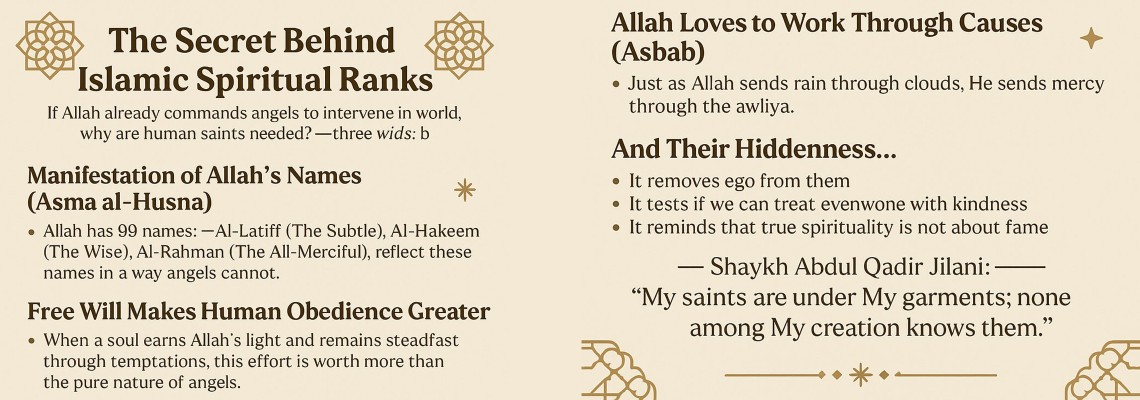
Why Do These Human Ranks Exist If Angels Are
Already Doing All Work?
The secret lies in
three divine wisdoms:
1. Manifestation of Allah’s Names (Asma al-Husna)
"I was a hidden treasure and I loved to be known, so
I created creation."
— Hadith Qudsi
- Allah
has 99 Names, such as Al-Latif (The Subtle), Al-Hakeem
(The Wise), Al-Rahman (The Most Merciful), Al-Jabbar (The Compeller), etc.
- These
names are manifested through His creation —
including human beings, not just angels.
- Angels
are pure and infallible, but they have no free will.
- Humans
can choose to submit to Allah — and those who do with
love, surrender, and purification become mirrors of
Divine Names.
❝ Angels are like the body of
the command. Saints (Awliya) are like the soul of the command. ❞
— Sufi teaching
2. Free Will Makes Human Obedience Greater Than
Angels
- Angels
cannot sin, but human beings can—and when they still choose to
obey Allah, that has more value.
- Hidden
saints are proof of humanity’s highest spiritual potential.
Quran (38:71-73):
“When I have fashioned him (Adam) and breathed into him
of My Spirit, fall down in prostration to him.”
- Even angels
were commanded to bow to Adam عليه السلام
— this shows the potential of the human soul.
- These
saints carry the spirit of obedience, love, and knowledge, and
so Allah honors them with cosmic roles.
3. Allah Loves to Work Through Causes (Asbab)
- Allah
is not bound by means, but He chooses to
operate through means (asbab) in the world:
- He
gives rizq through parents, jobs.
- He
sends rain through clouds.
- He
heals through doctors.
- And
He spreads light and mercy through awliya and
spiritual ranks.
“These awliya are like channels of Allah’s mercy on
Earth. When the Ummah forgets the truth, they quietly uphold it.”
What Is the Secret Behind Their Hiddenness?
- Humility
& Ego Protection:
- If
their identity became public, people would worship them,
or they might fall into pride.
- So
Allah hides them—even from themselves at times.
- Test
for Others:
- The
real test is: Can you respect people and treat them well even if
you don’t know their rank?
- Perhaps
the poor man you ignored was a wali of Allah.
- Connection
to Divine Will:
- Their
silence shows that true spirituality is not fame or miracles,
but deep inner connection to Allah.
- They
don’t seek reward or recognition—only Allah.
Angels vs. Saints: A Brief Comparison
|
Feature |
Angels |
Awliya / Saints |
|
Created from |
Noor (light) |
Earth (clay) + Divine Spirit |
|
Free Will |
No |
Yes |
|
Sin |
Never |
Can sin, but repent and rise |
|
Work for Allah |
Constantly |
By choice and love |
|
Source of Rank |
By Creation |
By Purification and Love |
The Greatest Secret:
Allah uses His closest lovers among human
beings as mirrors of His mercy, love, wisdom, and guidance.
These people are a living proof that even
in a world full of darkness, the light of Allah never disappears.
“My servants, My saints are under My cloaks. No one knows
them except Me.”
– Hadith Qudsi (reported in some Sufi texts)
Here is a categorized list of spiritual and moral
ranks mentioned in the Qur’an and Hadith. These groups are distinct
from the hidden spiritual ranks like Abdal, Nuqaba, Nujaba, etc.,
but are equally honored by Allah. They are often identified by their qualities,
missions, and stations in the path of Allah:
Ranks of Righteous People in Qur’an & Hadith
|
Title |
Meaning / Role |
Qur’anic Reference |
|
Sādiqīn (صَادِقِينَ) |
The Truthful — those whose hearts, speech, and actions
match truth |
Surah At-Tawbah (9:119): "Be with the
truthful (ṣādiqīn)." |
|
Shuhadā (شُهَدَاء) |
The Martyrs — those who gave their life in Allah’s cause |
Surah Al-Baqarah (2:154), Surah Āl-ʿImrān (3:169) — “Alive
with their Lord, provided for…” |
|
Zākirīn (ذَاكِرِينَ) |
Those who constantly remember Allah, male and female |
Surah Al-Ahzab (33:35) — “…the men and women who
remember Allah much…” |
|
Ṣāliḥīn (صَالِحِينَ) |
The Righteous — those who live upright lives in obedience
to Allah |
Surah An-Nisā (4:69): “…with those upon whom Allah
has bestowed favor… the righteous (ṣāliḥīn).” |
|
Sabirīn (صَابِرِينَ) |
The Patient — those who persevere through trials in faith |
Surah Al-Baqarah (2:153): “Indeed, Allah is with
the patient.” |
|
Muttaqīn (مُتَّقِينَ) |
The God-conscious — those who guard themselves from sin |
Surah Al-Baqarah (2:2): “Guidance for the
muttaqīn.” |
|
Muhsinīn (مُحْسِنِينَ) |
The Excellent — those who worship Allah as though they see
Him |
Surah Al-Baqarah (2:112), Hadith Jibril: “Worship
Allah as if you see Him…” |
|
Tawwābīn (تَوَّابِينَ) |
The Oft-Repentant — those who constantly return to Allah
after sin |
Surah Al-Baqarah (2:222): “Indeed, Allah loves
those who repent…” |
|
Munfiqīn (مُنْفِقِينَ) |
The Generous Givers — those who spend in Allah’s cause |
Surah Āl-ʿImrān (3:134): “Who spend [in the cause
of Allah] during ease and hardship…” |
|
Mutahharīn (مُتَطَهِّرِينَ) |
The Purified — those who keep themselves spiritually and
physically clean |
Surah Al-Baqarah (2:222): “Allah loves those who
purify themselves.” |
|
Khashi‘īn (خَاشِعِينَ) |
The Humble — those whose hearts tremble with awe in prayer |
Surah Al-Mu’minūn (23:2): “Certainly will the
believers have succeeded, those who are humble…” |
|
ʿĀbidīn (عَابِدِينَ) |
The Worshippers — those who regularly perform ibadah |
Surah At-Tawbah (9:112): “…the worshippers…” |
|
Qānitīn (قَانِتِينَ) |
The Devoutly Obedient — consistent and submissive in
worship |
Surah Al-Ahzab (33:35): “…and the devoutly
obedient men and women…” |
Aayah of High Honor
“Whoever obeys Allah and the Messenger… will be with
those upon whom Allah has bestowed His favor: the Prophets, the Truthful (ṣiddīqīn),
the Martyrs (shuhadā), and the Righteous (ṣāliḥīn). And excellent are those as
companions.”
— Surah An-Nisa (4:69)
Satanic Ranks & Opposing Forces in Islam
|
Satanic Title |
Meaning / Role |
Reference / Notes |
|
Awliya al-Shayṭān (أَوْلِيَاءُ الشَّيْطَان) |
Friends and loyalists of Satan |
Surah Al-Mujādilah (58:19): “Shayṭān has gained
control over them, so he made them forget the remembrance of Allah. They are
the party of Shayṭān.” |
|
Hizb al-Shayṭān (حِزْبُ الشَّيْطَان) |
Party of Satan (Satan’s camp) |
Surah Al-Mujādilah (58:19) — “Indeed, the party of
Satan will be the losers.” |
|
Tāghūt (طاغوت) |
Tyrants, false gods, rebellious leaders |
Surah Al-Baqarah (2:256): “Whoever rejects Tāghūt
and believes in Allah…” |
|
Munāfiqūn (مُنَافِقُون) |
Hypocrites — those who pretend to be Muslim but work
against Islam |
Surah An-Nisā (4:145): “Indeed, the hypocrites
will be in the lowest depths of Hellfire…” |
|
Zalīmīn (ظَالِمِينَ) |
Wrongdoers — those who reject truth, abuse others |
Surah Al-Baqarah (2:254): “And Allah does not
guide the wrongdoing people.” |
|
Fāsiqīn (فَاسِقِينَ) |
Rebellious, disobedient sinners — openly corrupt |
Surah Al-Baqarah (2:26): “But He leaves astray
only the defiantly disobedient.” |
|
Kāfirīn (كَافِرِينَ) |
Disbelievers — those who reject Allah knowingly |
Mentioned over 500 times; Surah Al-Kāfirūn, Surah
Al-Baqarah |
|
Murtaddīn (مُرْتَدِّين) |
Apostates — those who leave Islam after embracing it |
Surah Muhammad (47:25-27): “Those who turn back
after guidance…” |
|
Ṣabbāḥīn (صَبَّاحِينَ) |
Blasphemers — those who insult Allah or the Prophet
intentionally |
Hadith and classical sources use this term |
|
Iblīsiyyīn (إِبْلِيسِيِّين) |
Devilish in nature — those who follow Iblīs ideologically
and spiritually |
Iblīs = Chief Shayṭān (Surah Al-Kahf 18:50) |
|
Khanzab |
Specific shayṭān of waswasah (whispers)
in prayer |
Hadith in Sahih Muslim |
Hadith Reference: Satan’s Helpers
Abu Musa al-Ashʿari reported:
“When the sun rises, Satan places his throne upon the sea
and sends his troops in every direction. The closest to him in rank is the one
who causes the most corruption.”
— [Sahih Muslim]
Secret of Their
Influence:
- Shayṭān whispers
(waswas) — his allies act.
- Evil
beings can form spiritual networks just like the Awliya
Allah.
- They
are found in media, politics, religious manipulation, and
social corruption.
- They
attack from inside hearts and external systems —
both emotional and institutional.
Ranks & Traits Opposed to Truth and
Righteousness (in Qur'an & Hadith)
|
Arabic Term |
Meaning |
Opposes (Spiritual Trait) |
Qur’anic / Hadith Reference |
|
Kāzibīn (كاذبِين) |
Liars |
Ṣādiqīn (Truthful) |
Surah Az-Zumar 39:3, Surah Al-Hujurat 49:11 |
|
Ghāfilīn (غَافِلِين) |
Heedless, unaware |
Zākirīn (Those who remember Allah) |
Surah Al-A‘rāf 7:179, Surah Yūsuf 12:105 |
|
Ẓālimīn (ظَالِمِين) |
Wrongdoers, oppressors |
ʿĀdilīn (Just people) |
Surah Al-An‘ām 6:82, Al-Baqarah 2:254 |
|
Fāsiqīn (فَاسِقِين) |
Rebellious, sinful, corrupt |
Ṣāliḥīn (Righteous people) |
Surah As-Sajdah 32:18-20 |
|
Mujrimīn (مُجْرِمِين) |
Criminals, persistent sinners |
Muttaqīn (God-fearing) |
Surah Al-Muddaththir 74:41-47 |
|
Mufsidīn (مُفْسِدِين) |
Corrupters, mischief-makers |
Muṣliḥīn (Reformers) |
Surah Al-Baqarah 2:11-12 |
|
Mukadhdhibīn (مُكَذِّبِين) |
Deniers of truth |
Mu’minīn (Believers) |
Surah Al-Mursalat 77:15, 19, etc. |
|
Zāllīn (ضَالِّين) |
Those gone astray |
Mahdiyyīn (Rightly guided) |
Surah Al-Fātiḥah 1:7 |
|
Kāfirīn (كَافِرِين) |
Disbelievers |
Muwaḥḥidīn (Monotheists) |
Frequently used in Qur’an |
|
Murtaddīn (مُرْتَدِّين) |
Apostates |
Sābiqīn (Steadfast in faith) |
Surah Muhammad 47:25-27 |
|
Mustakbirīn (مُسْتَكْبِرِين) |
Arrogant ones |
Khāshiʿīn (Humble and devout) |
Surah An-Naḥl 16:23 |
|
Mukhālifīn (مُخَالِفِين) |
Opposers of the Prophet ﷺ or his path |
Muṭīʿīn (Obedient ones) |
Surah Al-Tawbah 9:81-83 |
|
Munāfiqīn (مُنَافِقِين) |
Hypocrites |
Mukhlisīn (Sincere) |
Surah Al-Munāfiqūn 63:1-3 |
Key Observations:
- Spiritual
purity in Islam is not just about belief, but consistent
truthfulness, humility, and justice.
- Opposites of
these virtues are often linked with:
- Divine
punishment
- Loss
of guidance
- Being
cast into lower depths of Hell (Darakat as-Suflā)
By Birth – Human is Born With:
|
Characteristic |
Arabic Term |
Meaning |
Source |
|
Pure nature |
Fitrah (فطرة) |
Innate disposition toward truth and good |
Hadith: Sahih Muslim 2658 |
|
Truthfulness |
Ṣidq (صدق) |
Tendency to speak truth |
Implied in fitrah |
|
Recognition of One God |
Tawḥīd (توحيد) |
Natural belief in one Creator |
Qur'an 7:172, Hadith in Musnad Ahmad |
|
Tendency to do good |
Birr / Khayr (بر / خير) |
Inclination toward kindness |
Qur'an 90:10 (guidance to two paths) |
|
Shame/modesty |
Ḥayā’ (حياء) |
Sense of shame and morality |
Hadith: "Every religion has a character, Islam’s is
modesty" – Bukhari |
|
Trustfulness |
Amānah (أمانة) |
Innate sense of honesty |
Qur'an 33:72 – trust given to man |
What Corrupts Fitrah?
The Prophet ﷺ said:
“Every child is born upon fitrah, but his parents make him a
Jew, a Christian, or a Magian…”
— Sahih Muslim 2658
So the soul is initially inclined toward light,
truth, and submission to Allah. But external influences (environment,
upbringing, society, ego, and Shayṭān) distort this fitrah.
Examples of Born-with vs. Developed Traits:
|
Born With (Fitrah-based) |
Developed Later (Corrupted traits) |
|
Belief in One God |
Atheism or polytheism |
|
Love of justice |
Oppression, tyranny (ẓulm) |
|
Shame/modesty |
Indecency, shamelessness (fahshā’) |
|
Truthfulness (ṣidq) |
Habitual lying (kidhb) |
|
Empathy and mercy |
Cruelty, selfishness |
Summary:
- Human
is born spiritually inclined toward good.
- Evil
traits like lying, hypocrisy, arrogance, heedlessness, kufr are acquired,
not innate.
- The
soul recognizes Allah from before birth — as seen in Qur’an 7:172:
“Am I not your Lord?” They said, “Yes, we bear witness.”
In Islam, moral character development is
lifelong, with different spiritual challenges and opportunities at
each stage. Below is a structured guide on how to refrain from evil
traits and nurture good character through the stages
of life, separately for children, youth, adults (men and women), and
elders, based on Islamic teachings:
1. Childhood (0–12 years)
Focus: Imprinting Values and Nurturing Fitrah
|
Group |
Common Traits to Prevent |
How to Refrain / Guide |
|
All children |
Lying, selfishness, envy, tantrums |
• Tell stories of prophets and sahabah |
|
Boys |
Aggression, arrogance |
• Train with Prophet’s gentleness (Hadith: “He was kind
even with children”) |
|
Girls |
Over-shyness, fear, jealousy |
• Build confidence with Islamic female role models (e.g.
Fatima, Maryam) |
“The best gift
from a parent to a child is good manners.” – (Tirmidhi)
2. Youth / Adolescence (13–25 years)
Focus: Resisting Temptations, Building Identity
|
Group |
Common Challenges |
How to Refrain / Strengthen Character |
|
Boys |
Lust, peer pressure, laziness |
• Regular salah and fasting |
|
Girls |
Vanity, jealousy, insecurity |
• Hijab with dignity |
|
All Youth |
Disrespect, rebellion, anger |
• Study seerah and lives of awliya |
“Youth spent in
worship will be under the shade of Allah on the Day of Judgment.” –
(Bukhari)
3. Manhood / Womanhood (26–60 years)
Focus: Balancing Worldly Life with Deen, Staying Sincere
|
Group |
Spiritual Dangers |
How to Refrain / Act Wisely |
|
Men |
Pride in status, greed, neglect |
• Consistent charity (sadaqah) |
|
Women |
Gossip, vanity, laziness |
• Study tafsir and Hadith with scholars |
|
All Adults |
Materialism, hypocrisy, showing off |
• Renew intention (niyyah) |